
Meta Ad Account Structure for Multi-Objective Campaigns
Organize Meta campaigns by funnel stage, consolidate ad sets, use CBO, and exclude overlapping audiences to cut waste.
Running Meta ads with multiple objectives - like awareness, engagement, and sales - requires a clear structure and a conversion optimization checklist to avoid wasted budget and poor performance. Without proper organization, campaigns can overlap, compete in auctions, and fail to gather enough data for Meta's algorithm to optimize effectively. Here's how to fix it:
Separate campaigns by funnel stage: Use distinct campaigns for awareness (TOFU), engagement (MOFU), and conversions (BOFU) to align with specific goals.
Consolidate ad sets: Avoid over-segmentation by grouping similar audiences, ensuring each ad set gets enough data (50 conversions/week) to exit the learning phase.
Use Campaign Budget Optimization (CBO): Let Meta allocate budgets dynamically across ad sets, but set minimum/maximum spend limits for critical segments. Implementing these performance guardrails ensures budget stability.
Exclude overlapping audiences: Prevent ad fatigue and cost increases by excluding warm audiences from prospecting campaigns and recent buyers from acquisition-focused ads.
Implement clear naming conventions: Standardize names (e.g.,
[Funnel Stage]_[Objective]_[Audience]_[Date]) for faster reporting and analysis.
The BEST Meta Ads Account Structure for 2026 (Step By Step Tutorial)
Why Multi-Objective Campaigns Need Proper Structure
Running campaigns for awareness, traffic, and conversions without a clear structure can cause major headaches. Why? Because Meta's algorithm ends up chasing conflicting goals. For instance, if you mistakenly pick "Traffic" when your actual aim is "Sales", Meta will focus on people likely to click your ad rather than those ready to buy. The result? High click-through rates but a disappointing return on ad spend. This highlights why having a well-organized, goal-specific campaign structure is essential.
One of the biggest culprits of inefficiency is audience overlap. When multiple ad sets target the same group of people, they compete in Meta's auction. This competition drives up costs and splits valuable conversion data. Plus, overlapping audiences mean users might see multiple ads from you at once, which leads to ad fatigue, more "hide ad" actions, and a dip in your account's quality ranking. Imagine splitting a $1,000 weekly budget across ten ad sets instead of two - your data gets spread too thin, making it harder to achieve statistically significant results. This often leaves ad sets stuck in the dreaded "Learning Limited" mode, unable to stabilize.
"When your structure is right, optimization becomes straightforward. When it's wrong, you're essentially funding chaos." – AdStellar
A well-thought-out structure fixes these issues by assigning each campaign a single, clear objective tied to a full-funnel strategy. This approach includes tools like audience exclusions to avoid overlap, consolidated budgets to focus data collection, and controlled testing environments. This is where A/B testing conversion rules becomes vital for scaling winners. These measures make it easier to pinpoint what works - whether it's the variables to test like creative and targeting, or another factor. Often, the difference between a campaign that scales profitably and one that stagnates boils down to these structural choices made early on.
Core Principles for Structuring Multi-Objective Meta Ad Accounts
Laying a strong foundation for your Meta ad accounts starts with a few key principles. These guidelines are essential for creating campaigns that grow, rather than stagnate.
Separate Campaigns by Funnel Stage
Each stage of the funnel has unique needs, and Meta's algorithm optimizes differently depending on whether you use AI or manual audience creation. For example, prospecting cold audiences requires a broader reach and longer learning periods, while retargeting warm audiences works best with smaller, high-intent groups. Implementing AI-powered retargeting can further refine these segments for better ROAS. Mixing these objectives in one campaign weakens overall performance.
"One objective per campaign. If you're running both prospecting ads to cold audiences and retargeting ads to warm audiences, those belong in separate campaigns even if they share the same conversion goal." – AdStellar
By separating campaigns based on funnel stages, you can also apply precise audience exclusions. For instance, excluding website visitors from prospecting campaigns prevents you from paying higher costs to target users who could be reached more efficiently through retargeting. This approach ensures better cost management and sets the stage for smoother budget adjustments later.
Use Campaign Budget Optimization (CBO)
Campaign Budget Optimization (CBO) is a powerful tool that allows Meta to automatically allocate your budget to the best-performing ad sets in real time. Rather than manually tweaking budgets daily, CBO identifies which audiences are most likely to convert, leveraging how AI learns from performance data, making it invaluable for scaling successful campaigns.
That said, it’s important to set minimum and maximum spend limits at the ad set level. This ensures that critical segments, like niche retargeting lists, still receive adequate delivery. For initial testing - whether it’s new audiences or creative elements - Ad Set Budget Optimization (ABO) can provide more control by ensuring even spend across variables. Once testing is complete, CBO can take over to simplify budget management.
Set Up Clear Naming Conventions
A consistent naming system is crucial for quick analysis and efficient reporting. Using a standard format like "[Funnel Stage][Objective][Audience][Creative Type][Date]" makes it easier to filter data and identify trends. Common codes for 2026 include "PROS" (Prospecting), "RET" (Retargeting), "LAL" (Lookalike), and "BRD" (Broad).
"Campaign Level: Why Are We Spending? Your campaign is your strategy container. It captures the strategic intent behind the budget." – Cedric Yarish, AdManage
Clear naming conventions also link your Ads Manager data with creative libraries, reporting tools, and budget automation rules. This level of clarity is especially important when juggling multiple objectives, as it helps you quickly spot patterns and streamline your workflow.
How to Structure Campaigns for Each Objective
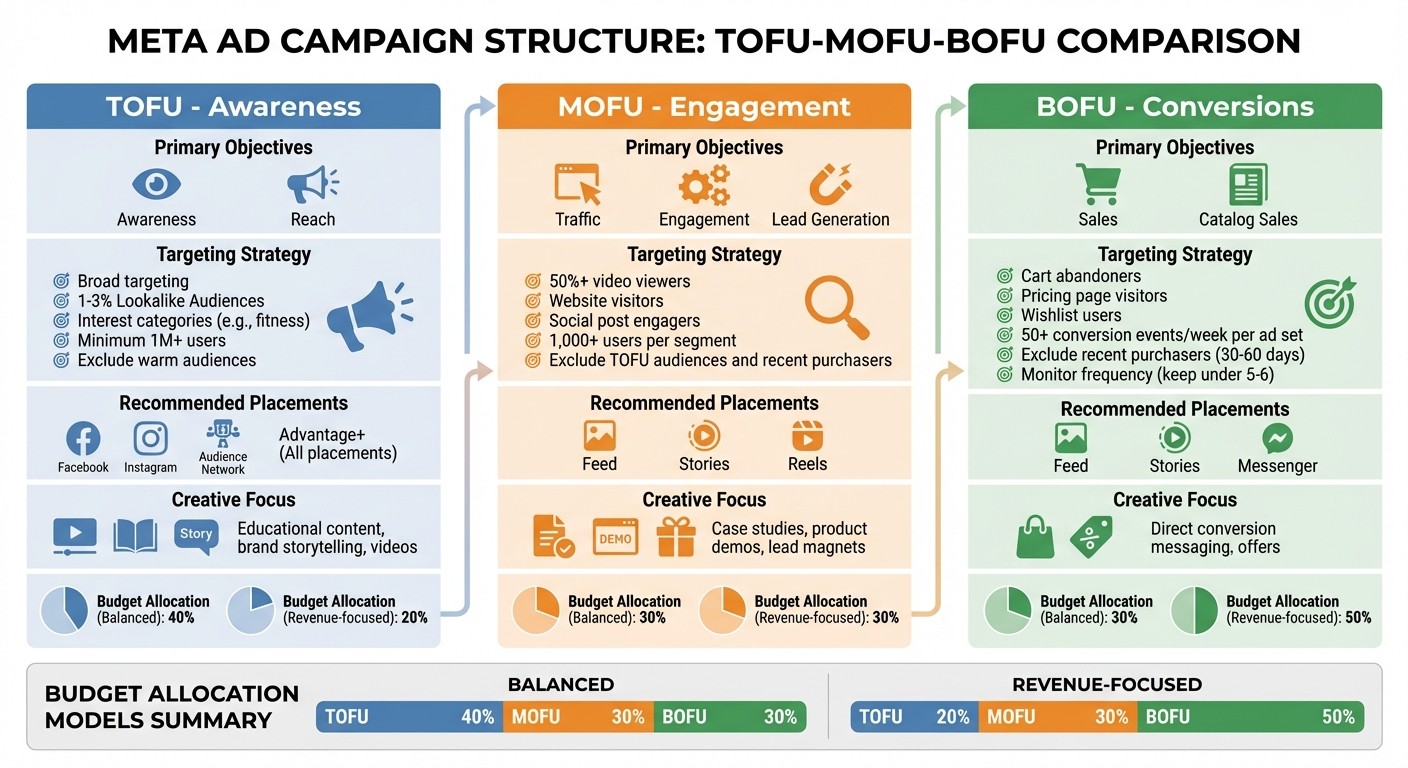
Meta Ad Campaign Structure by Funnel Stage: TOFU, MOFU, and BOFU Comparison
Top-of-Funnel (TOFU) Campaigns
TOFU campaigns are all about introducing your brand to new audiences. The goal here is to build awareness using objectives like Awareness or Reach.
Start by targeting broad audience groups, such as multiple lookalike tiers or general interest categories (e.g., "fitness"). Keep the target size large - at least 1 million users - so the algorithm has plenty of room to optimize. Make sure to exclude warm audiences to keep costs down and focus on new prospects. Use Advantage+ placements to let Meta automatically distribute your ads across platforms for maximum effectiveness.
For creative content, avoid the hard sell. Instead, focus on educating your audience and sharing your brand's story. Videos work particularly well for this stage since they can create familiarity without pressuring viewers to take immediate action.
Once you've built awareness, it's time to move these newly engaged users into the middle of your funnel.
Middle-of-Funnel (MOFU) Campaigns
MOFU campaigns are designed to nurture the interest you've sparked in your TOFU campaigns. These campaigns aim to engage users who are already familiar with your brand. Use objectives like Traffic, Engagement, or Lead Generation, depending on the action you want users to take.
Here, you'll want to segment your audience using behavioral targeting - think users who watched at least 50% of your videos, visited your site recently, or interacted with your social posts. Make sure each audience segment is large enough (around 1,000+ users) to ensure stable ad delivery.
To avoid overlap and competition within your funnel, exclude TOFU audiences and filter out recent purchasers (unless you're running a cross-sell campaign). For placements, focus on formats like Feed, Stories, and Reels, which perform well at this stage. Your creative should highlight case studies, product demonstrations, or lead magnets to guide users toward conversion.
Once you've warmed up your audience, you're ready to move them to the bottom of the funnel for direct conversions.
Bottom-of-Funnel (BOFU) Campaigns
BOFU campaigns are where the magic happens - this is where you convert interested users into paying customers. Use objectives like Sales (formerly Conversions) or Catalog Sales to drive direct revenue.
Target "hot" audiences - those who are closest to making a purchase. This includes cart abandoners, visitors to your pricing page, or users who added items to their wishlist but didn't complete checkout. Segment these audiences carefully to tailor your messaging. For example, you might create different ads for users who abandoned high-value carts versus casual browsers. Just ensure each ad set generates about 50 conversion events per week to exit the learning phase.
Keep an eye on frequency; if your ad frequency exceeds 5–6 for warm audiences, it's time to refresh your creative or temporarily pause the ad set. Also, exclude recent purchasers (within the last 30–60 days) from acquisition-focused campaigns to avoid wasting your budget. Use placements like Feed, Stories, and Messenger to maximize your chances of converting these warm leads.
When it comes to budget allocation by funnel stage, here's a typical breakdown:
Balanced growth model: 40% TOFU, 30% MOFU, and 30% BOFU.
Revenue-focused model: 20% TOFU, 30% MOFU, and 50% BOFU.
This breakdown allows you to align your spending with your campaign priorities.
Funnel Stage | Primary Objectives | Targeting Strategy | Recommended Placements |
|---|---|---|---|
TOFU | Awareness, Reach | Broad targeting, 1–3% Lookalikes, Interests | Advantage+ (All) |
MOFU | Engagement, Leads, Traffic | Video viewers, page engagers | Feed, Stories, Reels |
BOFU | Sales, Catalog Sales | Cart abandoners, pricing page visitors | Feed, Stories, Messenger |
How to Optimize and Scale Multi-Objective Campaigns
Run Separate Test and Scaling Campaigns
A solid account structure is just the beginning. To get the most out of your campaigns, you need to separate testing from scaling. Start by creating a dedicated "Sandbox" campaign for testing out new creatives, audiences, and placements. Allocate around 20–30% of your daily ad spend to this testing phase. Once an ad demonstrates success - by hitting a CPA that's 20% below your target after 100 conversions - move it into a "Winners" campaign specifically designed for scaling.
When scaling a winning ad, always use the original Post ID. This helps retain social proof, which boosts the Estimated Action Rate in Meta's auction system. The result? Better ad delivery and lower costs. To further streamline scaling, use Campaign Budget Optimization (CBO). CBO automatically shifts your budget to the best-performing ad sets, ensuring efficient spending. Make sure your campaigns generate enough conversions to exit the learning phase, as this is key to stabilizing performance. From there, focus on scaling strategies that avoid internal competition between your campaigns.
Scale Campaigns While Avoiding Overlap
With testing and scaling clearly separated, it's essential to scale thoughtfully to prevent your campaigns from competing against each other. Use Meta's Audience Overlap tool in Ads Manager to check if your ad sets are targeting the same users. If you notice more than 25% overlap, consolidate those ad sets. This approach focuses your conversion data, giving Meta's algorithm clearer signals to optimize performance.
Additionally, exclude warm audiences from your cold targeting campaigns using audience data. This ensures your conversion data stays concentrated where it matters most. When increasing budgets, do it gradually - stick to a 20–30% increase every 3–4 days. Sudden budget hikes can trigger a new learning phase, which might disrupt your campaign performance.
Use AdAmigo.ai for Automated Optimization
Managing multiple objectives manually can feel overwhelming. That’s where AI automation platforms like AdAmigo.ai come in. AdAmigo acts as an autonomous AI media buyer, continuously auditing your account, finding high-impact opportunities, and implementing improvements 24/7. You can set your KPIs and let the AI take over, or if you prefer, you can approve changes before they’re applied.
AdAmigo's AI Autopilot handles everything from launching tests and adjusting budgets to scaling winning ads and pausing underperformers. Plus, its AI Creative Generation system studies your top-performing ads and even analyzes competitor content to create fresh concepts that help combat ad fatigue. For agencies, this means a single media buyer can manage 4–8× more clients, as the AI handles repetitive tasks. For in-house teams, it’s like having a full-time media expert whose skills grow over time - without the added expense of hiring more staff.
Common Mistakes and How to Avoid Them
When your account structure is off-track, it can lead to errors that disrupt Meta's optimization process. Fixing these issues is key to running a smooth and effective multi-objective campaign.
Over-Segmentation That Limits Learning
Spreading your budget too thin across numerous ad sets can severely limit performance, making it difficult to scale Meta ad budgets effectively. When each ad set gets only a small slice of the budget, Meta's algorithm struggles to gather enough data to optimize effectively. This often leaves campaigns stuck in "Learning Limited" mode, where the system can’t detect patterns to refine delivery or prioritize ad sets by performance metrics.
"When you fragment your budget across too many campaigns and ad sets, each one receives insufficient conversion data for Meta's algorithm to optimize effectively." - AdStellar AI
Meta’s algorithm generally needs about 50 conversion events per ad set per week to move out of the learning phase. For instance, if you’re running 15 ad sets at $20 per day each, none may hit that threshold. Instead, consolidating your budget into 3 ad sets at $100 per day each can give the algorithm the data it needs to perform better.
Solution: Use AI audience segmentation to combine similar audiences into fewer, better-funded ad sets. For example, instead of separating "Digital Marketing" and "Social Media Marketing" into two ad sets, merge them into one broader category. You can also use a target audience finder to identify high-potential segments that overlap. This approach focuses your conversion data, helping the system learn faster and deliver better results.
On the flip side, Another common mistake is trying to achieve too many goals within a single campaign.
Mixing Different Objectives in One Campaign
Combining objectives like awareness and conversions within the same campaign can confuse Meta's algorithm. It may prioritize cheaper actions, like clicks, over more valuable ones, such as purchases.
"Meta's algorithm is designed to optimize toward a single, clear objective. When you try to mix several - like reach, leads, and purchases - in one campaign, the system doesn't know what to prioritize." - LeadEnforce
For example, selecting a "Traffic" objective when your actual goal is sales leads the algorithm to focus on users who click, not those who convert. This mismatch can generate high click-through rates but poor returns on ad spend. Stick to one objective per campaign and align it with your funnel stage - use Awareness for top-of-funnel, Traffic or Leads for middle-of-funnel, and Sales for bottom-of-funnel goals.
Another frequent oversight involves audience targeting, specifically failing to set exclusions.
Failing to Use Exclusions to Prevent Overlap
When ad sets compete for the same audience, it drives up costs and waters down conversion data. This often happens when you don’t exclude certain groups, like warm or hot audiences, from specific campaigns.
Solution: Exclude warm audiences from cold prospecting campaigns. For instance, if someone has already visited your website or engaged with your content, they shouldn’t be included in your cold acquisition efforts. Similarly, exclude previous customers from campaigns aimed at acquiring new leads. This ensures your budget is spent on the right audience and avoids unnecessarily high acquisition costs.
Using funnel-stage exclusions can also help. For example, remove website visitors from top-of-funnel campaigns and exclude past purchasers from new acquisition campaigns. This keeps your efforts focused and eliminates internal competition within your campaigns.
Conclusion and Key Takeaways
Wrapping up the strategies we've explored, it’s clear that a well-organized campaign structure is not just a technical detail - it’s the backbone of successful Meta ad campaigns. By aligning your ad account setup with funnel stages, you’re giving Meta’s algorithm the data it needs to perform at its best. This means creating campaigns with distinct objectives, leveraging Campaign Budget Optimization (CBO) for scaling, and using clear naming conventions to streamline management and reduce wasted spend.
"Your campaign structure isn't administrative overhead. It's the foundation that determines whether Meta's algorithm can actually learn from your data, optimize your spend, and scale your results." - AdStellar.ai
Another critical piece? Consolidating your budget into fewer, more robust ad sets. This approach helps you hit optimization thresholds faster by leveraging historical data and avoids the inefficiencies of spreading your budget too thin. Steering clear of common mistakes - like over-segmentation, mixing objectives, or overlooking audience exclusions - keeps your campaigns efficient and minimizes unnecessary competition within your account.
For those managing multiple clients or scaling ad spend beyond $50,000 per month, automation becomes a game-changer. Manual management can only take you so far, and tools like AdAmigo.ai step in to handle the heavy lifting. These platforms can manage testing, tweak budgets, and optimize creatives in real-time, allowing you to focus on the bigger picture. AdAmigo.ai works within your established structure, respecting your budget allocations, audience exclusions, and funnel logic, all while identifying new ways to improve performance.
Start strong with a focused campaign setup, stick to single-objective campaigns, and let Meta’s algorithm - and automation tools like AdAmigo.ai - take your results to the next level.
FAQs
How do I decide which objective to use for each funnel stage?
When setting up campaigns, it's crucial to align your objectives with the specific goals of each funnel stage. For early funnel stages - such as awareness - focus on objectives like reach, brand awareness, or traffic. These help increase visibility and get your brand in front of more people.
As you move into the mid-to-late funnel stages, shift your focus to objectives that encourage action. Think lead generation, engagement, or conversions - perfect for driving sign-ups, purchases, or other meaningful interactions.
By tailoring your objectives to the funnel stage, you not only help Meta's algorithm deliver your ads more effectively but also make it easier to measure success. This approach ensures your campaigns are both efficient and purpose-driven.
How many ad sets should I run per campaign to avoid “Learning Limited”?
To keep your Meta ads from falling into the "Learning Limited" status, stick to 3 to 5 ad sets per campaign. This setup allows each ad set to collect enough data to move out of the learning phase, improving performance and preventing wasted budget.
Using too many ad sets can lead to audience overlap and spread your data too thin. On the flip side, having too few ad sets restricts your ability to test effectively. Striking this balance helps your campaigns learn efficiently and perform better overall.
When should I use CBO vs ABO for testing and scaling?
CBO (Campaign Budget Optimization) is perfect for scaling campaigns and achieving broader optimization. It works by dynamically allocating your budget across ad sets based on performance. This approach helps maximize results without requiring constant manual adjustments, making it a great choice when you’re ready to scale up.
On the other hand, ABO (Ad Set Budget Optimization) is your go-to for testing. It allows you to maintain precise control over individual ad set budgets, ensuring there’s no overlap. This setup gives you clear insights into what performs best, setting the stage for a smooth transition to CBO once you’re ready to scale.