
Full-Funnel AI Optimization for Meta Ads
Guide Meta ad performance with AI full-funnel strategies: automate targeting, creative testing, and 24/7 monitoring to scale.
Want better results from your Meta ads? A full-funnel strategy is the key to balancing awareness, consideration, and conversions. Many advertisers Using a Meta ads campaign blueprint helps organize these stages. focus only on bottom-of-funnel (BOFU) campaigns, driving up costs and exhausting their audience. Instead, guiding prospects through all three stages - top-of-funnel (TOFU), middle-of-funnel (MOFU), and BOFU - creates a more sustainable system.
Managing this process manually is time-consuming and error-prone. That’s where AI tools like AdAmigo.ai come in, automating audience targeting, creative testing, and real-time performance monitoring. This lets you manage more campaigns, cut wasted spend, and improve results - like an 83% ROAS boost reported by some users.
Here’s how manual ad management compares to AI-driven automation:
Manual workflows require constant monitoring, manual exclusions, and limited creative testing.
AdAmigo.ai handles everything from audience segmentation to creative generation and 24/7 campaign monitoring.
Quick Comparison:
Feature | Manual Management | AdAmigo.ai |
|---|---|---|
Setup Effort | High (manual configurations) | Low (5-minute API connection) |
Audience Targeting | Basic exclusions, slower adjustments | Real-time micro-segmentation |
Creative Testing | Limited A/B tests | Hundreds of variations tested fast |
Performance Monitoring | Reactive, working hours only | 24/7 proactive with alerts |
Scaling | Bandwidth-limited | AI-driven scaling |
For small teams or scalable campaigns, AI tools like AdAmigo.ai can transform how you manage Meta ads. A hybrid approach - combining AI efficiency with human creativity - delivers the best results.
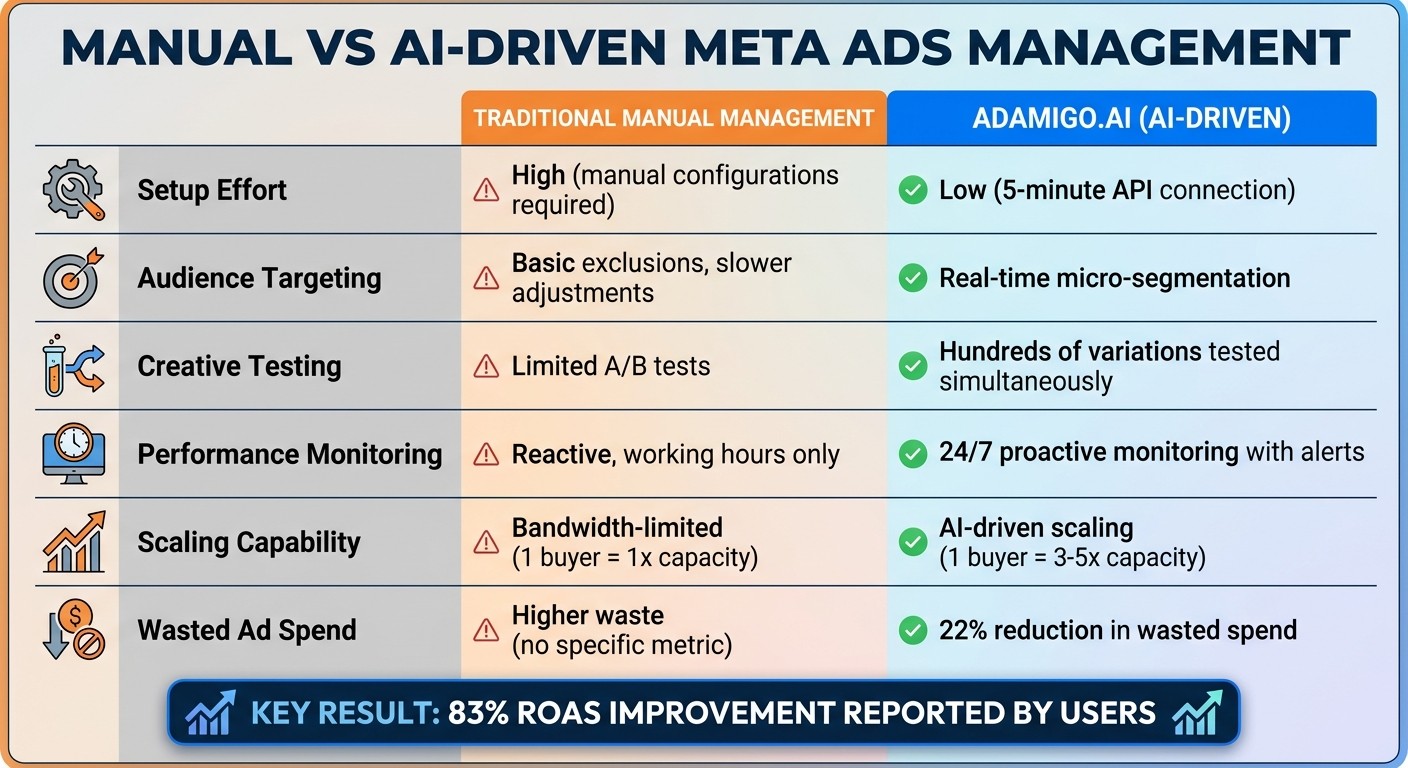
Manual vs AI-Driven Meta Ads Management Comparison
1. Traditional Meta Ad Campaign Management
Audience Targeting and Optimization
Managing ad campaigns manually means breaking the funnel into separate TOFU (cold), MOFU (warm), and BOFU (hot) campaigns. Each stage demands its own audience setup, exclusion lists, and targeting rules. This requires media buyers to configure everything in Ads Manager manually, ensuring that people who move down the funnel are excluded from earlier-stage ads. It’s a tedious process, prone to errors, and can lead to wasted ad spend.
When this approach is scaled across multiple clients or products, it can quickly become unmanageable. A single person can only handle so many accounts before mistakes creep in. Audience optimization under this system depends on daily checks of performance metrics and manual adjustments. There’s no real-time adaptation to performance changes, which limits efficiency and adds complexity to creative testing.
Creative Development and Testing
In traditional setups, creative development often relies on gut instinct rather than data. Advertisers create ads based on assumptions about what might work, which can result in generic messaging that fails to connect with specific audience groups. For instance, using urgency-focused offers for cold audiences unfamiliar with the brand often backfires, burning through budgets unnecessarily.
Given that creative quality drives 47% of sales lift, relying on intuition and limited creative testing slows down optimization. Refreshing ad creatives only happens sporadically, usually when performance takes a noticeable dip due to ad fatigue. Without proper tagging or clear attribution, it’s hard to pinpoint which creative elements (often due to misunderstood attribution rules) - like hooks, offers, or formats - are actually effective. These gaps highlight why a more integrated and data-driven solution is needed to improve funnel performance.
Performance Monitoring and Safety
Monitoring performance manually involves frequent checks to review metrics, catch anomalies, and identify delivery issues before they spiral out of control. This process lacks automation, meaning if a campaign’s costs suddenly spike or delivery halts, the problem is only noticed during the next manual check. For agencies juggling multiple clients, this reactive approach adds stress and increases the chances of costly mistakes going undetected. These challenges make it clear why a faster, more automated system is necessary, as discussed in the following section.
2. AdAmigo.ai
Automation and Execution
AdAmigo.ai takes the hassle out of manual ad management by using an always-active AI agent. All it takes is five minutes to connect your Meta account via API, and the system starts auditing your account, website, and competitor ads. From there, it crafts strategies tailored to your needs. The platform operates with two main features: AI Autopilot, which identifies impactful opportunities and implements improvements (either automatically or with your approval), and the AI Chat Agent, which allows you to manage campaigns through simple questions and commands. For example, you can ask, "Why did ROAS drop yesterday?" or instruct, "Launch a new retargeting campaign."
Unlike traditional rule-based systems that might pause campaigns during short-term dips, AdAmigo.ai uses dynamic thresholds to analyze real-time data and market trends. Every day, it creates a prioritized action plan - whether that’s deploying new creatives, pausing low-performing ad sets, or reallocating budgets. You can choose to approve these actions with a single click or let the system handle everything on its own. This level of automation allows a single media buyer to manage three to five times more clients compared to traditional workflows, freeing up time for strategists to focus on big-picture decisions like audience targeting and creative development.
Audience Targeting and Optimization
AdAmigo.ai excels at creating micro-segments by analyzing campaign performance and competitor data. It identifies behaviors and engagement trends that manual setups often overlook. The AI adapts targeting strategies across the funnel stages: it launches multiple lookalike audiences for awareness, fine-tunes interests and behaviors for consideration, and builds dynamic retargeting lists for conversions. Instead of relying on manual exclusion lists and audience rules, the system makes real-time adjustments to scale successful campaigns and pause underperformers. It works seamlessly with your KPIs, like ROAS or CPA, to ensure your targeting is always optimized. With AI audience segmentation in place, the platform shifts to refining creative strategies.
Creative Development and Testing
The platform’s AI Creative Generation (Ad Factory) analyzes your top-performing ads and competitor content to automatically produce fresh variations. For awareness campaigns, it focuses on crafting engaging hooks. For consideration, it tests variations designed to increase interactions. And for conversions, it refines purchase-driven copy and visuals. The Bulk Ad Launcher lets you upload creatives to Google Drive and deploy hundreds of ads in just minutes. It handles everything - generating ad copy, structuring campaigns, and publishing directly to your Meta account. This approach ensures your campaigns avoid creative fatigue by continuously iterating on ideas instead of waiting for performance to drop.
Performance Monitoring and Safety
AdAmigo Protect keeps a close eye on your account, monitoring it 24/7 for potential issues like delivery problems, unusual spend patterns, or sudden ROAS drops. It flags low-reach spend in awareness campaigns, alerts you to engagement declines during the consideration stage, and prevents wasted budget on underperforming conversion ads. The system works in real time, aligning alerts with your custom guardrails - such as budget caps, ROAS goals, and approval preferences. By using Meta’s official API framework, it ensures compliance while offering immediate notifications and adjustments. This proactive monitoring catches problems early, preventing costly mistakes that manual oversight might miss.
5 NEW AI That Just Changed Facebook Ads Forever
Pros and Cons
Balancing the full Meta ad funnel requires finding the sweet spot between automation and human strategy. As mentioned earlier, traditional manual methods and AI-driven automation each bring their own strengths to the table. Manual management thrives on strategic planning and delivering tailored brand messaging. However, it's limited by human capacity - there’s only so much one person can handle before quality starts slipping. Manual setups also fall short when it comes to scaling creative tests or responding quickly to sudden performance shifts.
On the other hand, AdAmigo.ai shines in handling massive datasets and managing thousands of ad variations in real time. Thanks to its around-the-clock monitoring, it can instantly detect delivery issues, budget anomalies, or drops in ROAS. One user even reported an 83% improvement in ROAS just a week after implementing AdAmigo.ai’s recommendations. Additionally, the platform cuts wasted ad spend by 22% by pausing underperforming ads and reallocating budgets to better-performing ones automatically. That said, AI has its own blind spots - it can struggle with rapidly shifting consumer trends that lack historical data and may miss the emotional or cultural subtleties that human strategists naturally understand. This creates an interesting contrast between AI's execution speed and human strategic depth.
A hybrid approach combines the best of both worlds. Using AI for efficiency and volume while relying on human expertise for creative and strategic direction allows for optimal campaign performance. This model is a game changer - it enables a single media buyer to handle three to five times more clients compared to traditional workflows. Meanwhile, senior strategists can focus on high-level growth opportunities instead of repetitive tasks.
Feature | Traditional Meta Management | AdAmigo.ai |
|---|---|---|
Automation | Manual setup; labor-intensive | One-click bulk launch; automated AI agent |
Targeting Accuracy | Human intuition and insights | Micro-segmentation via performance data |
Speed of Creative Testing | Slow; limited A/B tests | Tests hundreds of variations simultaneously |
Monitoring Capabilities | Limited to working hours | 24/7 real-time monitoring; dynamic thresholds |
Scaling | Restricted by bandwidth |
When getting started with AdAmigo.ai, it’s smart to use manual vs. autopilot recommendations at first. This lets you review AI recommendations and ensure they align with your goals before moving to full Autopilot for routine tasks. To maintain performance, review the AI-generated action plans daily and refresh your creatives every 2–4 weeks, or if ad frequency exceeds 3 impressions within 7 days, to avoid audience fatigue.
Conclusion
Each stage of the marketing funnel, from awareness to conversion, benefits differently from manual and AI-driven methods. The choice between these approaches often depends on factors like team size, budget, and growth goals. For smaller campaigns requiring tight brand control, manual strategies can be a better fit. As Aaron Edwards points out, "Meta has been trying to automate media buying through simplifying the process, keeping audiences broad, giving advertisers less control and levers to restrict our targeting". This highlights the challenges marketers face when trying to maintain manual control in an increasingly automated landscape.
For larger campaigns or those focused on scalability, AI-driven tools like AdAmigo.ai are game-changers. They allow brands to scale budgets without losing ROAS by automating complex optimizations with automated bid rules. Agencies managing multiple client accounts and eCommerce brands looking to grow without adding more team members can benefit significantly. AI enables one media buyer to handle up to five times more clients, offering unmatched efficiency. For eCommerce brands, having an always-on AI media buyer ensures consistent performance improvements. For example, Meta’s Advantage+ sales campaigns have shown a 20% improvement in CPA, and full-funnel AI strategies can enhance overall marketing performance by up to 91%.
The best results often come from a hybrid approach. By combining AI’s speed and scalability with human creativity and strategic thinking, marketers can achieve both efficiency and depth. This balance ensures that campaigns not only perform well but also resonate with their audience on a deeper level.
FAQs
How do I know if I need TOFU and MOFU ads?
Whether you should use TOFU (Top of Funnel) and MOFU (Middle of Funnel) ads depends on your marketing goals and where your audience is in their journey.
TOFU ads are all about introducing your brand to new audiences. They're designed to boost awareness and get your name out there. Think of them as the first handshake with potential customers.
MOFU ads, on the other hand, target people who already know your brand. These ads aim to deepen engagement and move these individuals closer to making a decision.
For a well-rounded approach, incorporating both TOFU and MOFU ads is key. This full-funnel strategy helps guide prospects from the awareness stage all the way to conversion. But if your main focus is retargeting or driving conversions, you might want to prioritize BOFU (Bottom of Funnel) ads instead.
What should I let AI automate vs keep manual?
AI shines when it comes to automating repetitive, data-heavy tasks such as real-time optimization, audience segmentation, budget management, and testing different ad variations. Platforms like AdAmigo.ai handle these tasks efficiently, helping you save time while boosting outcomes.
That said, strategic decisions, personalized messaging, and creative elements should remain in human hands. People bring a deep understanding of cultural nuances, emotional intelligence, and the ability to create visuals or copy that resonate with a brand’s identity and its audience. By combining the strengths of AI with human creativity, you can achieve the best results.
How do I set safe guardrails for AI Autopilot?
When using AI Autopilot, it's essential to put controls in place to manage spending and performance effectively. Here’s how you can do that:
Set Budget Limits: Decide on daily, lifetime, or account-wide caps to ensure you don’t exceed your spending limits. This keeps your campaigns financially controlled.
Establish Bid Caps: Set maximum bid limits to keep acquisition costs manageable and predictable.
Define Performance Targets: Focus on specific metrics, such as Return on Ad Spend (ROAS) or Cost Per Lead (CPL), to align campaigns with your business goals.
Use Automated Rules: Let the AI handle adjustments or pause campaigns automatically - based on the thresholds you’ve defined.
By configuring these safeguards, you can let AI manage your campaigns while staying within your preferred limits.