
AI vs Manual Audience Creation for Meta Ads
Compare AI and manual audience creation for Meta ads—when AI scales best, when manual control wins, and how a hybrid approach improves ROAS.
When deciding between AI audience segmentation vs manual targeting for Meta ads, the best choice depends on your goals, budget, and data. Here's the breakdown:
AI Audience Creation: Ideal for large budgets and data-rich campaigns. AI analyzes vast amounts of data in real-time to optimize targeting and performance. For example, AI-driven campaigns like Meta Advantage+ audience segmentation can lower customer acquisition costs by up to 18% and increase return on ad spend (ROAS) by 23% when spending exceeds $3,000 per day.
Manual Audience Creation: Offers more control and precision for niche markets, regulated industries, or smaller budgets (under $1,000/day). Manual strategies often outperform AI in these scenarios, delivering 31% better results for low-budget campaigns.
Hybrid Approach: Combining both methods can maximize results. Start with manual targeting to test and refine, then use AI for scaling and ongoing optimizations.
Quick Comparison
Feature | AI (Advantage+) | Manual Targeting |
|---|---|---|
Best For | High budgets, broad audiences | Small budgets, niche markets |
Data Processing | Real-time, millions of signals | Static, human-defined |
Performance (>$5k/day) | 4.2× ROAS | 3.4× ROAS |
Setup Time | Minutes | Hours/days |
Control | Limited | Full |
For e-commerce or lead generation, AI excels with speed and scalability. For B2B or compliance-heavy campaigns, manual targeting ensures precision. A balanced mix often delivers the best outcomes. This is especially true when implementing full-funnel AI optimization to capture users at every stage of the journey. Following a Meta ads ROI optimization guide can help you determine the right balance for your specific business goals. Implementing proven optimization tips can further enhance these results.
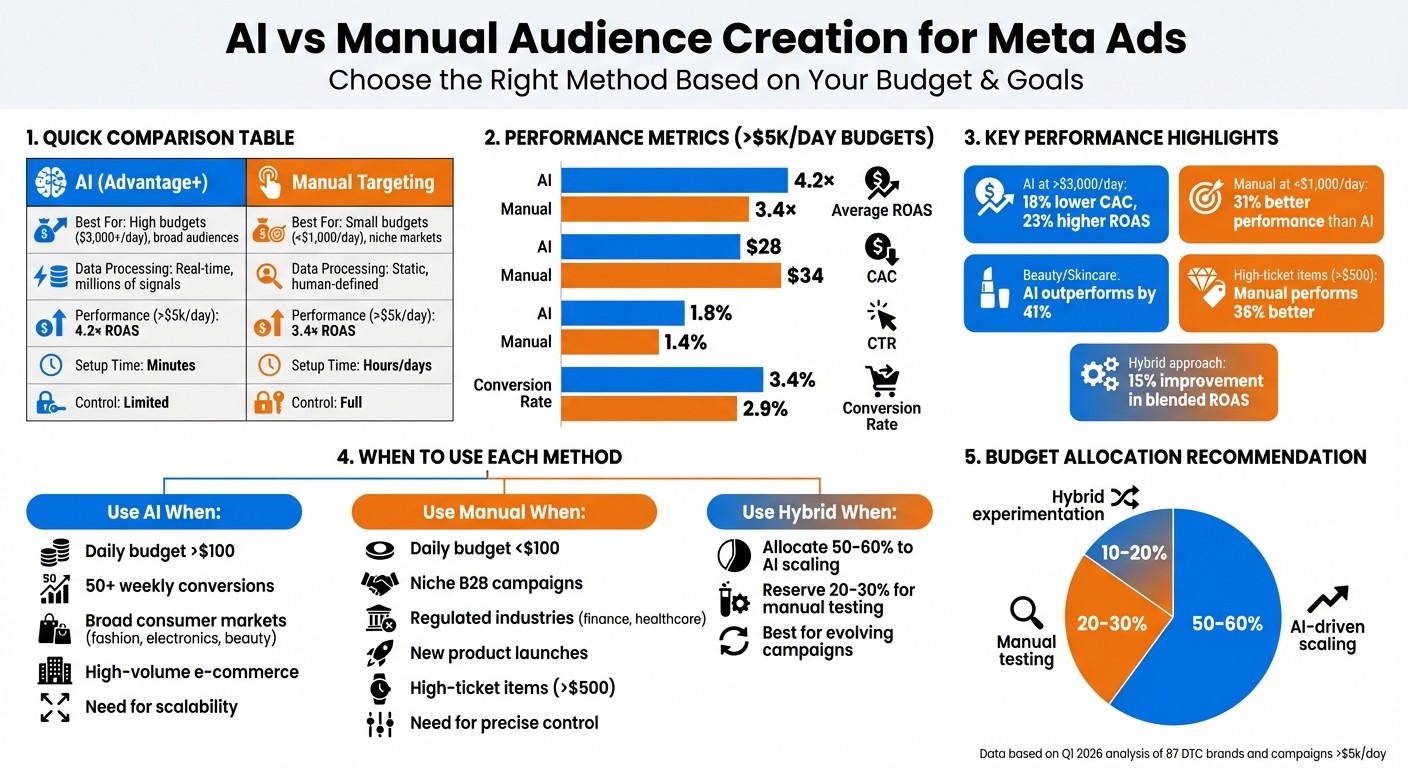
AI vs Manual Audience Creation for Meta Ads: Performance Comparison by Budget and Campaign Type
How to Use Meta's New AI Features for Facebook Ads (Without Ruining Your Results!) 🚀
How Audience Creation Works
Grasping how each method functions helps you figure out which one suits your campaign best. With manual audience creation, you’re in charge of every detail. This includes fine-tuning pixel data, building lookalike audiences, and setting exclusions through precise segmentation. You can craft custom audiences from website visitors or customer lists, layer in interests, behaviors, and demographics, and even create lookalike audiences based on your most loyal customers. You also decide where your ads appear - like limiting them to Instagram Stories or avoiding the Audience Network entirely.
This hands-on method is ideal for budgets ranging from $30 to $100 per day. In fact, manual campaigns have been shown to deliver 42% better ROAS compared to AI-driven campaigns in this range. One big advantage is control over exclusions - you can block multiple custom lists, while AI tools like Advantage+ often restrict you to just one or two exclusions. A smart strategy here is the rolling refresh: start with three ad creatives, pause the weakest performer after 500 impressions, and lower creative testing costs by introducing a new one every 7–14 days.
On the other hand, AI audience segmentation and predictive targeting relies on algorithms to do the heavy lifting. Meta’s Advantage+ Audience uses inputs like age, location, and interests as flexible starting points for machine learning. The system analyzes Pixel data, conversions, and engagement trends to predict who’s most likely to convert, fine-tuning targeting in real time. Tools like AdAmigo.ai take this further by analyzing your top-performing ads and even competitor campaigns to launch optimized audiences quickly - no manual setup required. For instance, Advantage+ Shopping Campaigns can deliver 12% to 17% lower Cost Per Acquisition compared to manual campaigns.
AI systems like AdAmigo’s AI Autopilot continuously learn from campaign performance. They assess creatives, audiences, budgets, and bids as a single system, making improvements automatically or with your approval. This level of AI-driven resource prioritization ensures budgets and creatives are always optimized. You can even guide the system through simple instructions like, “Scale spend 30% at ≥3× ROAS,” and it handles everything from budget adjustments to testing new strategies.
The main difference boils down to AI vs manual campaign management effort versus automation. Manual creation gives you complete control but requires expertise and constant oversight. Meanwhile, AI creation trades some control for speed and scalability, leveraging algorithms to process vast amounts of data that would overwhelm human capabilities. These distinctions play a critical role in how each method impacts campaign efficiency and targeting accuracy. Next, we’ll dive into how they compare in these areas.
Efficiency and Accuracy Compared
Time and Effort Required
Setting up campaigns manually can take hours, even days. You’re starting from scratch - building custom audiences by layering demographics, interests, and behaviors - and then constantly monitoring performance. Every tweak, whether it’s refining exclusions or adjusting lookalike percentages, requires hands-on effort and reconfiguration.
AI-powered tools, on the other hand, streamline this process. Platforms like AdAmigo.ai can analyze your performance history and top-performing ads to create optimized audiences in just minutes. These tools handle everything from targeting setup to creative adjustments, all while monitoring and fine-tuning in real-time. With AI, a single media buyer can manage three to five times more clients compared to traditional manual methods, leaving more room to focus on strategy.
The cost difference is also striking. AI-generated ads cost between $0.90 and $1.97 each, while manually designed ads typically range from $30 to $50 per ad. For agencies managing multiple clients or brands scaling rapidly, these savings in both time and money can add up significantly.
These efficiencies in time and cost naturally lead to a closer look at how data processing and targeting precision compare between AI and manual setups.
Data Processing and Targeting Precision
Manual targeting relies on static inputs, often based on assumptions, which can limit its effectiveness. AI, on the other hand, continuously processes millions of data signals in real-time, dynamically updating targeting as user behaviors shift. Instead of waiting days to identify trends, AI tools make adjustments every few minutes, keeping pace with Meta’s fast-moving auction environment. For instance, Advantage+ Shopping Campaigns have demonstrated 13% lower costs for product catalog sales compared to traditional manual methods.
Aspect | AI-Powered (e.g., Advantage+, AdAmigo.ai) | Manual Creation |
|---|---|---|
Data Processing | Real-time, millions of signals | Static, limited inputs |
Time Investment | Minimal (minutes, real-time) | High (hours/days, ongoing) |
Scale | Multiple/large campaigns | Small/niche campaigns |
Targeting Updates | Dynamic, data-driven | Fixed segments, human-defined |
However, manual methods still hold an edge in certain scenarios. For niche, compliance-heavy, or highly complex B2B campaigns, manual targeting offers precise control over audience traits. In regulated sectors like finance or healthcare, the ability to fine-tune exclusions and prioritize quality over quantity is critical. But when it comes to high-volume e-commerce or lead generation, AI’s ability to process vast datasets and adapt instantly makes it the go-to choice for speed and accuracy.
Performance Results: AI vs Manual
Performance Examples and Data
When it comes to campaign performance, AI continues to set itself apart from manual methods, especially with larger budgets. For campaigns spending over $3,000 per day, AI-driven strategies achieve 18% lower customer acquisition costs (CAC) and 23% higher return on ad spend (ROAS) compared to manual targeting. The gap widens further with daily budgets exceeding $5,000, where AI averages a 4.2× ROAS, while manual methods typically reach 3.4× ROAS.
The difference becomes even more pronounced depending on the industry. Beauty and skincare brands, for instance, see AI outperform manual approaches by 41%, while supplement companies benefit from a 28% boost in performance. These figures highlight how AI's capabilities in analyzing vast datasets and making real-time adjustments translate into better results.
"In our Q1 2026 analysis of 87 DTC brands, Advantage+ campaigns found 34% of conversions came from audience segments that brands had never manually targeted - proving the algorithm's discovery capability." – MHI Media This highlights the power of AI audience segmentation in identifying high-value customers.
Platforms like AdAmigo.ai provide AI solutions that combine audience discovery with ongoing creative optimization, further enhancing campaign outcomes.
That said, AI isn't always the better choice. For budgets under $1,000 per day, manual campaigns outperform AI by 31%, as AI systems often struggle with limited conversion data. Similarly, for high-ticket items priced above $500, manual targeting and AI tools for interest-based ads deliver 36% better performance, as the longer decision-making process requires more precise audience control.
Performance Metrics Side-by-Side
Metric | AI (Advantage+) @ >$5k/day | Manual @ >$5k/day |
|---|---|---|
Average ROAS | 4.2× | 3.4× |
CAC | $28 | $34 |
CTR | 1.8% | 1.4% |
Conversion Rate | 3.4% | 2.9% |
Business Type | Recommended Method | Primary Advantage |
|---|---|---|
Broad E-commerce | AI (Advantage+) | 15–20% CPA improvement in fashion/home goods |
Niche B2B | Manual Targeting | Greater control over job titles and industries |
New Product Launch | Manual Targeting | Builds initial data for AI learning |
High-Volume Scaling | AI (Autopilot) | Executes thousands of micro-adjustments per second |
A balanced approach often works best. Advertisers typically allocate 50–60% of their budget to AI-driven scaling while reserving 20–30% for manual testing of new audiences or creatives. This hybrid strategy - using AI vs manual scaling strategies for prospecting and retargeting - delivers a 15% improvement in blended ROAS compared to relying solely on one method.
Next, we’ll explore the specific scenarios where AI, manual targeting, or a combination of both is most effective, similar to the choice between dynamic placements vs manual placements.
Which Method to Use
Building on insights into efficiency and performance, here’s a breakdown of when each audience creation method works best.
When AI Audience Creation Makes Sense
AI-driven audience creation is most effective when you have plenty of data to work with. For example, Meta’s algorithms need at least 50 weekly conversions to function well. This threshold is critical for exiting the Meta Ads learning phase and stabilizing performance. If your daily ad spend exceeds $100 and you’re running 10–20 strong creative variations, tools like [Advantage+ or AdAmigo.ai can uncover audience segments](https://www.adamigo.ai/blog/meta-advantage-audience-segmentation-explained) that manual methods might miss.
This method shines in broad consumer markets like fashion, electronics, beauty, and home goods. AI thrives in these industries by testing thousands of micro-segments in real time, making it ideal for data-rich, high-volume scenarios. E-commerce brands with substantial traffic and sales volume benefit greatly from AI’s continuous, around-the-clock optimizations.
When Manual Audience Creation Works Better
Manual targeting is essential for niche markets, regulated industries, or campaigns with limited historical data. For example, B2B advertisers often see better results by manually targeting specific job titles, company sizes, or industries. Similarly, industries like finance or healthcare, where compliance is critical, require the precision and oversight that manual methods provide.
When launching a new product, manual audience creation also has the upper hand. It allows for controlled testing to build an initial data set. Once you’ve identified what works, you can transition to AI for scaling. For campaigns with smaller budgets - under $100 per day - manual methods are typically more effective, as there isn’t enough data for AI to optimize properly.
Using Both Methods Together
The choice between AI and manual methods often depends on your campaign’s data volume, industry, and need for control. Many advertisers find success with a hybrid strategy. They start by manually testing Meta Ads variables to identify winning combinations and then transition those strategies to AI for scaling and long-term optimization.
Platforms like AdAmigo.ai make this hybrid approach seamless. They allow you to set targeting preferences, budget constraints, and compliance rules while the AI takes care of execution. This way, you maintain strategic oversight while benefiting from AI’s automated bid, budget, and placement optimizations.
Conclusion
When comparing these two methods, each has its own strengths, depending on the campaign's goals and resources. For campaigns with larger budgets and abundant conversion data, AI-driven audience creation proves highly effective. For instance, Advantage+ campaigns can achieve 18% lower customer acquisition costs and 23% higher ROAS when budgets exceed $3,000 per day. These algorithms excel by testing thousands of micro-segments through behavioral clustering and dynamically adjusting bids in real time.
On the other hand, manual approaches are ideal for advertisers needing greater precision and control. B2B advertisers, regulated industries subject to evolving targeting rules, and campaigns with budgets under regulated industries, and campaigns with budgets under $150 per day50 per day often see better outcomes with hands-on targeting. Manual strategies also work well in niche markets where compliance and strategic oversight are essential. In fact, for campaigns with budgets below $1,000 per day, manual methods can outperform Advantage+ by up to 31%.
A hybrid approach often strikes the right balance. For example, running manual A/B tests to identify high-performing segments and then leveraging tools like AdAmigo.ai to scale those results can be highly effective. Platforms like this handle tasks like automating budget adjustments, refreshing creatives, and optimizing audiences around the clock, while you retain control of the overall strategy.
For small businesses and agencies, AI tools can dramatically ease the workload. AdAmigo's Autopilot mode, for instance, can manage hundreds of ads by refreshing creatives every 3–5 days and optimizing budgets. This allows a single media buyer to handle 4–8× more clients.
Ultimately, the right method depends on your campaign's specifics. High budgets and broad audiences align well with AI, while smaller budgets and niche campaigns often thrive with manual tactics. In many cases, combining both approaches offers the best results as campaigns evolve and more data becomes available.
FAQs
How do I know if I have enough conversion data for AI targeting?
AI targeting works best when it has access to a solid amount of historical conversion data. Most platforms suggest having 50-100 conversions per event as a starting point, though the exact number can differ depending on the platform. Simply put, the more data you provide, the better the AI can perform. On the flip side, if your conversion volume is too low, the AI might struggle to optimize effectively.
To get the most out of AI targeting, keep a close eye on your campaign's performance metrics and stick to the specific recommendations provided by the platform you're using. This ensures the AI has enough information to fine-tune your audience targeting for better results.
What’s the best audience setup for a small daily budget on Meta?
For smaller budgets, blending AI-driven audience segmentation with manual fine-tuning can be a game-changer. AI works by analyzing user behavior and interests in real time, helping to create targeted groups that improve both efficiency and ROAS (Return on Ad Spend). For more niche campaigns, you can step in to refine these segments or set strict parameters manually. This combination lets you harness AI for broader targeting while using manual adjustments to ensure precision - perfect for squeezing the most out of a tight budget.
When should I switch from manual targeting to AI for scaling?
When you're scaling campaigns, juggling multiple accounts, or aiming for faster, data-driven results, switching to AI targeting can make a big difference. AI thrives on analyzing massive datasets, automating updates, and boosting your return on ad spend (ROAS). It saves time and cuts down on manual work. This approach is especially helpful when manual targeting becomes a bottleneck for growth or when you need to make quick adjustments to tackle ad fatigue and improve performance.