
Top Variables to Test in Meta Ads
Which Meta Ads elements move the needle? Test headlines, visuals, CTAs, audiences, and placements for 7+ days and allocate 10–20% budget to reliable results.
A/B testing is the backbone of successful Meta ad campaigns. To find what drives results, focus on testing high-impact variables like headlines, visuals, CTAs, audience segments, and placements. Run tests for at least 7 days, ensuring each variant gets enough budget to generate 50 optimization events. Automation tools like AdAmigo.ai can simplify this process, saving time and improving efficiency by managing creative generation, targeting, and budget optimization.
Key takeaways:
Headlines: Test styles like testimonials, questions, and stats to see what resonates.
Visuals: Experiment with images, videos, and demographic-specific content.
CTAs: Try personalized vs. generic phrases to boost clicks.
Audience Segments: Compare engaged, existing, and new audiences for cost-effectiveness.
Placements: Test platforms like Facebook Feed, Instagram Stories, or Reels.
For budget and bidding strategies, allocate 10–20% of your ad spend to testing, a key strategy for scaling small Meta ad budgets. Compare manual (Bid Cap) and automated (Highest Volume) approaches to find the best balance between cost control and scalability. AI tools like AdAmigo.ai streamline testing by automating repetitive tasks, enabling faster scaling of winning campaigns.
How To A/B Test Your Meta Ads Creatives (+ Free Cheat Sheet)

Key Variables to Test in Meta Ads
When it comes to Meta Ads, focusing your testing efforts on the highest-impact elements - like headlines, visuals, and ad formats - can make all the difference. Small changes, like tweaking button colors, usually lead to minimal gains. Instead, channel your time and budget into testing the variables that truly influence performance. These elements work together to optimize your Meta ads ROI and lay the groundwork for later experiments with budget and bidding strategies.
Headlines
Your headline is your first - and sometimes only - chance to grab attention. A strong headline can increase conversion rates by as much as 300%. Testing different headline styles is key to finding what resonates with your audience. Try variations such as:
Testimonials: “Sarah lost 15 lbs in 30 days.”
Questions: “Tired of expensive gym memberships?”
Statistics: “Join 50,000+ happy customers.”
Pain Point Solutions: “Finally, a skincare routine that actually works.”
Audience Callouts: “Attention small business owners.”
Each approach triggers different psychological responses. By experimenting with multiple headline types, you can pinpoint the messaging that connects best with your audience.
Images and Videos
Visuals aren’t just important - they’re essential, accounting for 75-90% of your ad’s performance. Experimenting with different creative elements can help your audience see themselves in your ad. For example, test visuals that vary by:
Demographics: Gender, age, or relatability versus aspiration.
Formats: Before-and-after transformations, benefit-focused imagery, or calendar-style visuals.
Video ads, in particular, can deliver engagement costs that are 30% lower than static images. Try testing video lengths, opening hooks, and formats to discover what grabs attention and keeps users engaged.
Call-to-Action Buttons
The wording of your call-to-action (CTA) button might seem like a small detail, but it can have a big impact. Personalized CTAs perform 202% better than generic ones. Test variations like:
“Shop Now” vs. “Learn More.”
“Get My Discount” vs. “See Pricing.”
The key is to experiment with specificity and urgency. For instance, compare a direct approach like “Shop Now” with softer phrasing such as “Explore Options” to see what drives more clicks.
Audience Segments
Understanding your audience is crucial. Build a full-funnel Meta ads setup by breaking your testing into three main groups to identify the most responsive and cost-effective segments:
Engaged Audiences: Recent website visitors or people who’ve interacted with your social media, ideal for retargeting.
Existing Audiences: Current customers, perfect for cross-selling or upselling.
New Audiences: Broad targeting or lookalike audiences, useful for prospecting.
Within these groups, you can further test targeting strategies like interest-based segments, behavioral targeting, or custom audiences to uncover who responds best to your ads - and at what cost.
Placements
Where your ad appears can be just as important as the content itself. Test placements like the Facebook Feed, Instagram Stories, or Reels to find out where your creative performs best. Some audiences might engage more on Instagram Stories, while others convert better through the Facebook Feed. By running placement-specific tests, you can allocate your budget to the platforms that deliver the highest returns. And if a placement consistently underperforms, don’t hesitate to cut it, even if it’s traditionally considered effective.
Budget and Bidding Strategy Tests
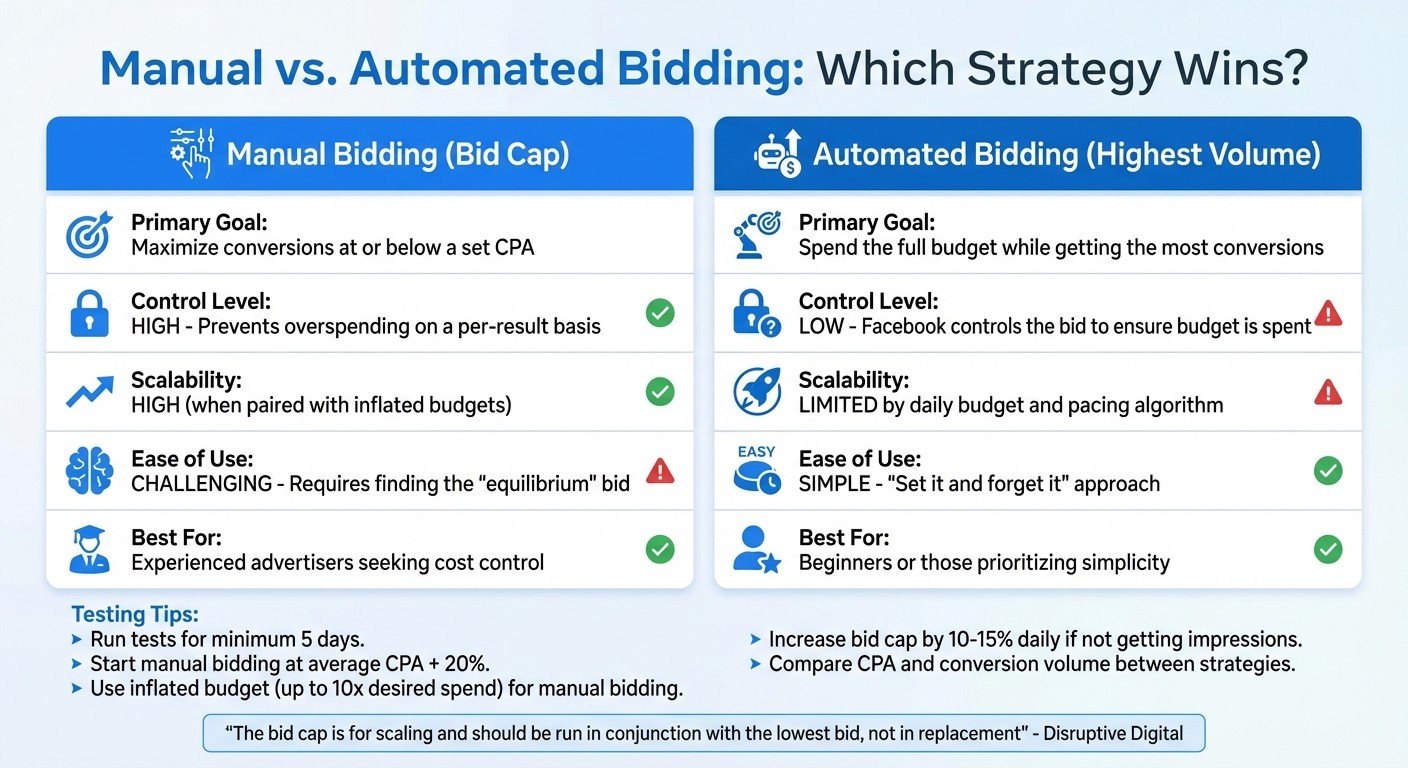
Manual vs Automated Bidding Strategies for Meta Ads
Once you've nailed down your creative tests, it's time to shift focus to budget and bidding strategies. These adjustments help you maximize your ad spend while keeping costs in check with effective Meta ad guardrails.
To get reliable results, run your tests for a minimum of 7 days. This timeframe captures weekly fluctuations and ensures you gather enough data - aim for at least 50 conversions per week to move past the Learning Phase. If your conversion cycle is longer, consider extending the test to 10–14 days. Meta emphasizes this duration because shorter tests often yield inconsistent results.
Daily Budget Adjustments
Experimenting with daily budgets can help you find the right spending level to scale Meta ad budgets effectively. A good rule of thumb is to allocate 10% to 20% of your total ad budget to testing. Many marketers follow the 70/20/10 rule: 70% of the budget goes toward proven strategies, 20% to emerging tactics, and the remaining 10% to experimental campaigns. This approach strikes a balance between stability and trying new ideas.
If you're working with a higher budget, you'll need a wider variety of ad creatives to avoid ad fatigue. Research suggests that only 2% of creatives typically perform well enough to scale, so keep a steady flow of fresh ads ready. For campaigns with high acquisition costs or extended sales cycles, avoid spreading your budget too thin across multiple ad sets. Doing so can limit the algorithm's ability to gather enough data for optimization.
The next step is to test your bidding strategies to find the right mix of control and automation.
Manual vs. Automated Bidding
After refining your budget, compare two main bidding methods: manual vs. automated budget testing using Bid Caps or Highest Volume strategies. Each has its own strengths and trade-offs. Automated bidding is straightforward - Meta uses your entire budget to get the most conversions possible. On the other hand, manual bidding offers more control by letting you set a maximum cost per result. The downside? Manual bidding takes more effort to fine-tune.
To test manual bidding, start by taking the average cost per acquisition (CPA) from an automated campaign and add 20% as your initial bid cap. Use an "inflated budget" - up to 10 times your desired spend - so the bid cap, not the budget, limits delivery. This approach helps you determine if your bid is competitive enough to scale. If you're not getting impressions, increase the bid cap by 10% to 15% daily until delivery improves. Test both strategies for at least five days to give the algorithm enough time to adjust and compare the CPA and conversion volume.
"The bid cap is for scaling and should be run in conjunction with the lowest bid, not in replacement" – Disruptive Digital.
Here’s a quick comparison of manual and automated bidding:
Feature | Manual Bidding (Bid Cap) | Automated Bidding (Highest Volume) |
|---|---|---|
Primary Goal | Maximize conversions at or below a set CPA | Spend the full budget while getting the most conversions |
Control | High; prevents overspending on a per-result basis | Low; Facebook controls the bid to ensure budget is spent |
Scalability | High, when paired with inflated budgets | Limited by the daily budget and pacing algorithm |
Ease of Use | Challenging; requires finding the "equilibrium" bid | Simple; "set it and forget it" approach |
How AI Tools Improve Meta Ads Testing
Testing every variable in Meta ads manually takes a lot of time and effort. AI automation platforms simplify this process by automating repetitive tasks, freeing up your time for bigger-picture strategies. With AI, managing an account can take just 15–30 minutes instead of hours. This efficiency allows a single media buyer to handle over 10 accounts, compared to the 1–3 accounts they’d manage using traditional methods. This streamlined approach also opens the door for more advanced and integrated ad testing.
AI doesn’t just save time; it processes data instantly and performs complex multivariate testing that would be impossible for a human team to manage. For instance, Meta’s Advantage+ suite optimizes ad placements across Facebook, Instagram, Audience Network, and Messenger automatically. It also adjusts creative elements dynamically, eliminating the need for manual configurations. Similarly, Campaign Budget Optimization (CBO) ensures your budget is reallocated in real time to the best-performing ad sets, so you’re always investing in what works.
Unlike static, rule-based AI tools, adaptive AI systems continuously refine their strategies based on live performance data. These tools coordinate adjustments in creative elements, audience targeting, bidding, and budget allocation as a seamless system. This means they can scale successful campaigns quickly while avoiding common pitfalls like frequent learning phase resets.
One standout example of such technology is AdAmigo.ai, which has revolutionized ad testing and optimization.
AdAmigo.ai: Automated Testing and Optimization
AdAmigo.ai takes care of the entire ad cycle, from generating creative assets to launching campaigns with a single click. Its AI Ads Agent analyzes your brand identity and tracks your top-performing ads continuously. From there, it generates fully designed creatives and integrates them directly into your Meta account. It tests various ad elements - headlines, images, calls-to-action (CTAs), and audience segments - automatically. The setup process is quick, taking about five minutes. All you need to do is connect your Meta ad account, set your key performance indicators (KPIs) (e.g., "Increase spend by 30% while maintaining a ROAS of at least 3×"), and provide a brief for the AI.
Once campaigns are running, the platform offers precise recommendations, such as “scale to Engaged Shoppers cohort” or “pause this underperforming placement.” The AI Chat Agent also makes campaign management easier by delivering actionable insights and enabling bulk campaign analysis and launches directly through chat. For agencies, this means a single media buyer can handle 4–8 times more clients, while senior strategists can focus on higher-level planning.
AdAmigo.ai works within the rules you set for budgets, pacing, geographies, and placements. You can choose between fully autonomous operation or semi-autonomous mode, where you approve changes before they go live. Its Bulk Ad Launch feature allows you to create dozens - or even hundreds - of Meta ads at once, complete with optimized copy, visuals, and targeting, all pulled directly from your Google Drive. By continually testing and refreshing ad variations, AdAmigo.ai minimizes ad fatigue and scales winning campaigns faster than any human team. Some users have even reported ROAS increases of up to 83%.
Conclusion
Testing different Meta ad variables isn't just a good idea - it's a must for anyone serious about improving ad performance. Instead of relying on guesswork, systematic testing using an AI testing framework provides clear, data-backed insights that can transform your campaigns. And we’ve seen the proof in action.
Take the 2025 partnership between Meta Business Partner Adquadrant and Solvable, for example. By shifting their focus from sheer conversion volume to targeting high-intent users through Value Optimization, CEO Wade Schlosser and his team achieved impressive results: a 19% boost in ROAS (from 0.99 to 1.18), a 17% jump in revenue per conversion, and a 7.3% drop in pay-per-click costs. Schlosser summed it up perfectly:
"Meta's Value Optimization completely transformed our campaigns. By focusing on high-value conversions rather than just volume, we saw a measurable lift in ROAS and were able to scale efficiently." This success relies on knowing how to analyze Meta ad metrics effectively.
This case highlights why transitioning from manual to automated testing is no longer optional - it’s essential. Manual testing can be overwhelming, especially for experienced teams, due to its time-consuming and intricate nature. That’s where AI-powered tools like AdAmigo.ai come in. These tools handle everything from generating creatives to making real-time adjustments, such as testing creatives with AI agents, freeing up your time to focus on strategy.
To get started, allocate 20–40% of your ad budget to continuous testing. Stick to testing one variable at a time to pinpoint what’s driving performance changes, and let your tests run long enough to collect meaningful data. Once you identify winning strategies, scale them carefully by avoiding common scaling problems and increasing your budget in 10–20% increments every 48–72 hours to keep Meta’s learning phase intact.
The best-performing Meta campaigns don’t happen by accident - they’re built on relentless testing and smart scaling. By making testing a core part of your approach, you’ll not only avoid stagnation but also set your campaigns up for consistent, month-over-month growth. Dive into testing today, and watch your ROAS take off.
FAQs
How long should you run A/B tests for Meta ads to get reliable results?
When running Meta ad A/B tests, aim for a duration of at least 7 days but keep it under 30 days. This window strikes a balance - giving your test enough time to collect reliable data while steering clear of diminishing returns. However, the ideal timeframe can depend on variables like your budget, audience size, and specific campaign objectives.
How can AI tools like AdAmigo.ai make Meta ad testing faster and more effective?
AI tools like AdAmigo.ai take the hassle out of Meta ad testing by automating the entire process. Instead of spending hours manually creating and managing ad variations, this tool can whip up dozens - or even hundreds - of combinations for headlines, images, and CTAs in just seconds. Plus, it doesn’t stop there. AdAmigo.ai keeps an eye on performance, shifts budgets to the best-performing ads, and fine-tunes targeting - all in real time.
By spotting trends, predicting which creatives will hit the mark, and offering audience tweaks, AdAmigo.ai allows marketers to focus on big-picture strategy rather than tedious tasks. This data-driven approach delivers insights faster, scales effortlessly across multiple audiences, and helps boost ROAS without the headaches of manual testing.
What are the advantages of manual vs. automated bidding in Meta ads?
Manual bidding gives advertisers the reins, allowing them to set specific bid caps and maintain tight control over their ad spend. This approach ensures you stay within your desired cost-per-acquisition, making it easier to protect your budget while zeroing in on high-value audiences. It’s particularly helpful for newer accounts without much historical data, as it enables precise targeting of placements or audience segments. Plus, manual bidding is a solid choice for avoiding low-quality traffic and quickly adapting to market shifts.
On the flip side, automated bidding leverages Meta’s AI to adjust bids in real time based on your performance goals - whether it’s maximizing clicks, conversions, or ROAS. This hands-off approach saves time, minimizes the need for constant tweaking, and works well for scaling campaigns with larger budgets or ample data. If efficiency and volume are your priorities, automated bidding can deliver without requiring constant attention.
For those looking to strike a balance, tools like AdAmigo.ai offer a hybrid solution. They combine AI-driven bid optimizations with the flexibility to set manual caps and rules, giving you the best of both worlds: automation paired with precise control for improved results.