
Machine Learning for Meta Ads Metrics
ML-driven optimization for Meta Ads: improves estimated action rates, ad quality, ROAS, cross-device targeting, and campaign scaling.
Machine learning is transforming how Meta Ads campaigns are managed. Instead of relying on surface-level metrics, it identifies the most impactful data points like Estimated Action Rates, Ad Quality Scores, and Return on Ad Spend (ROAS) to optimize performance and scale budgets. By processing massive amounts of data in real-time, ML uncovers patterns that manual methods often miss, helping advertisers achieve better results with less effort.
Here’s the key takeaway: Meta’s ML systems improve ad performance through advanced techniques like neural networks, predictive analytics, and cross-device behavior modeling. These systems optimize bids, budgets, and audience targeting across platforms like Facebook and Instagram. For example, advertisers using Advantage+ Shopping campaigns have seen a 17% drop in Cost Per Acquisition (CPA) and a 32% boost in ROAS.
To go further, tools like AdAmigo.ai simplify campaign management by automating creative testing, budget adjustments, and audience targeting. With features like an AI Chat Agent and bulk ad management, these tools save time and improve efficiency, allowing teams to focus on growth.
Key points:
ML analyzes deep metrics (e.g., Estimated Action Rates) to optimize ad delivery.
Techniques like Meta Lattice and cross-device modeling improve ad targeting and scaling.
Tools like AdAmigo.ai automate campaign adjustments for better performance.
Want better ad results? Start by linking the Meta Pixel with the Conversions API and respecting the 50-conversion learning phase. From there, let machine learning handle the heavy lifting.
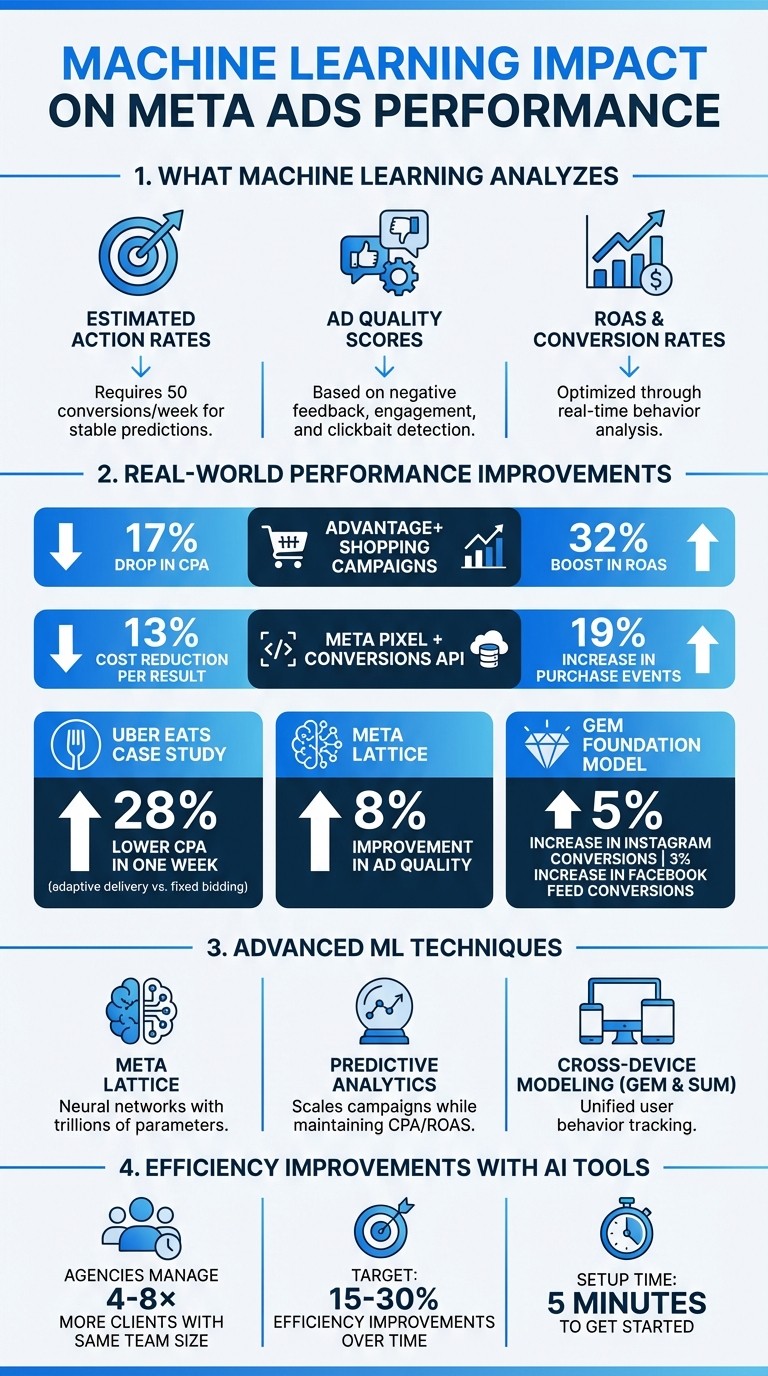
Machine Learning Impact on Meta Ads Performance: Key Metrics and Results
Core Metrics Analyzed by Machine Learning in Meta Ads
Estimated Action Rates
Meta's machine learning evaluates the likelihood of a user taking action after seeing an ad. This is captured in the Estimated Action Rate, which plays a critical role in determining auction outcomes: Total Value = Bid × Estimated Action Rate + Ad Quality Score. The system factors in signals you won’t find on your dashboard, like how long someone pauses on your ad or if users with similar browsing habits converted after seeing related content.
The algorithm improves its predictions as it gathers more data, but it typically needs about 50 conversions per week to produce stable and accurate predictions.
Ad Quality and Relevance Scores
Machine learning doesn’t just assess conversion potential - it also measures how well your ad performs in terms of quality and relevance.
Your ad quality score is based on three main factors. First, Meta tracks negative feedback, such as ad hides or reports. Second, it evaluates engagement metrics like likes, shares, and saves. Finally, it uses clickbait detection to identify exaggerated or misleading headlines. These factors determine whether your ad can compete for impressions at a reasonable cost.
If your ad scores in the bottom 20%, it will be flagged as "Below Average" in Meta's Diagnostics. This is a clear signal to tweak your creative assets or optimize your landing page performance. Ignoring this warning can lead to higher costs and fewer conversions.
Return on Ad Spend (ROAS) and Conversion Rates
Machine learning also plays a big role in optimizing your ad spend and improving conversion performance.
By studying post-click behaviors - like how long users stay on your site and patterns among similar audiences and segmenting users by intent - machine learning fine-tunes ad delivery and audience targeting. Using both the Meta Pixel and Conversions API has been shown to cut costs by 13% per result and increase attributed purchase events by 19%.
A great example of this is Uber Eats in 2024. They used Meta's adaptive delivery models to adjust bids in real time, achieving a 28% lower cost per acquisition (CPA) in just one week compared to fixed bidding strategies. This success came from the system’s ability to respond instantly to conversion signals, eliminating the need for manual adjustments.
These metrics lay the groundwork for exploring more advanced machine learning strategies in scaling campaigns.
Machine Learning Techniques for Multi-Metric Optimization
Neural Networks for Pattern Recognition
Meta has transitioned from using multiple isolated models to a unified architecture called Meta Lattice. This system relies on deep neural networks with trillions of parameters to evaluate ad performance across various datasets and objectives simultaneously.
One of its standout features is joint optimization. By analyzing metrics like clicks, video views, and conversions across platforms such as Feed, Stories, and Reels, the system identifies patterns that individual models might overlook. As Meta's research team puts it:
"Meta Lattice is capable of improving the performance of our ads system holistically... through joint optimization of a large number of goals".
The architecture also employs sparse activation techniques to detect unique engagement patterns between users and advertisers. This is particularly effective for new products with limited data. Using Pareto-front feature selection, Meta Lattice balances thousands of objectives, ensuring that enhancing one metric - like ad quality - doesn't negatively impact another, such as conversion rates. This strategy has led to an 8% improvement in ad quality.
Predictive Analytics for Campaign Scaling
Predictive analytics build on deep pattern recognition to help scale ad campaigns effectively. These models determine which campaigns are ready to scale and suggest how to do so without compromising efficiency. Unlike manual approaches, AI-driven systems can maintain metrics like CPA (Cost Per Acquisition) and ROAS (Return on Ad Spend) while increasing budgets. Manual scaling often struggles with rising costs as spending grows.
These predictive systems continuously process hundreds of variables and respond instantly to performance changes, operating around the clock. For campaigns that are already established, the models can scale efficiently. They require just 50 events over a 7-day period to exit the learning phase and stabilize their predictions.
Cross-Device Behavior Modeling
Cross-device behavior modeling takes targeting to the next level by integrating user activity across different platforms. Meta's Generative Ads Recommendation Model (GEM) uses multi-domain learning to combine insights from its ecosystem. For example, engagement data from Instagram video ads can enhance predictions for Facebook Feed, even when optimizing for different goals.
The Scaling User Modeling (SUM) framework creates compact "user embeddings" that capture cross-platform behavior. These embeddings are shared across hundreds of models, offering a unified view of each user. In Q2 2025, the GEM foundation model contributed to a 5% increase in ad conversions on Instagram and a 3% rise on Facebook Feed.
A server-to-server connection further enhances event match quality and attribution, especially in environments with stricter privacy constraints.
Together, these techniques form a robust machine learning framework that consistently improves Meta's ad performance across its platforms.
How Machine Learning Works in Meta Ads (2025)
Understanding these mechanics is the first step toward mastering Meta ads automation for your campaigns.
AI Tools for Meta Ads Performance Optimization
Third-party AI tools take Meta's built-in machine learning (ML) features a step further, offering advertisers more precise campaign management. By using neural networks and predictive analytics, these tools transform platform data into actionable strategies - no in-house data science team required.
AdAmigo.ai: Your Autonomous AI Media Buyer
AdAmigo.ai acts as an autonomous media buyer, seamlessly managing creatives, targeting, budgets, and bids. Unlike rigid, rule-based systems, it learns and adapts in real time, refining its strategies based on campaign performance.
This tool analyzes brand identity, competitor ads, and top-performing creatives to generate optimized ad variations. With just one click, these variations can be launched directly into your Meta account. Its AI Actions feature identifies and prioritizes daily adjustments for creatives, audiences, budgets, and bids, simplifying complex data into clear, actionable steps.
AdAmigo offers flexibility: run it in autopilot mode or approve each change manually. Either way, it adheres to your budget limits, pacing rules, geo restrictions, and placement preferences. For agencies, this means one media buyer can handle four to eight times more clients, leaving senior strategists free to focus on growth. For brands, it can replace or supplement expensive hires with an AI system that grows smarter over time.
AdAmigo.ai Chat Agent: Instant Insights and Actions
The AI Chat Agent functions like a personal assistant for your ad data. Need to know why your cost-per-acquisition (CPA) increased? It provides data-driven answers by analyzing patterns across your campaigns with AI tools for Meta ad account analysis. This eliminates the need to dig through Ads Manager reports manually.
But it’s not just about diagnostics. The Chat Agent also handles bulk campaign management directly through its interface. For instance, you can instruct it to increase your ad spend by 30% while maintaining a 3× return on ad spend (ROAS). The AI then adjusts budgets, refreshes creatives, and refines audience targeting - all within the chat.
Bulk Ad Launch and Round-the-Clock Optimization
The Bulk Ad Launch feature streamlines the process of launching multiple Meta ads at once. It pulls creatives from Google Drive and uses machine learning to optimize copy and targeting based on past performance. This speeds up creative testing by deploying multiple ads simultaneously.
Once the ads are live, AdAmigo takes over. It continuously adjusts bids, rotates fresh creatives to combat ad fatigue, and reallocates budgets every few minutes. Winning ads are scaled faster than manual teams could ever manage. Setup is quick and straightforward: connect your Meta ad account, define your KPIs, and review daily AI-generated recommendations. You can approve, edit, or let the system handle everything automatically while your campaign performance improves over time.
Conclusion: Improving Meta Ads Results with Machine Learning
Key Takeaways
Machine learning (ML) takes ad performance analysis to a whole new level. It evaluates metrics like Estimated Action Rates, Ad Quality Scores, ROAS (Return on Ad Spend), and Conversion Rates all at once, uncovering trends and opportunities that manual methods often miss. This approach enables smarter scaling across devices and channels.
Platforms such as AdAmigo.ai simplify this process by automating creative adjustments, audience targeting, budget allocations, and bid optimizations in real time. Unlike static systems with fixed rules, these tools adapt their strategies based on actual outcomes, improving with every interaction. Agencies have reported managing 4-8× more clients with the same team size, while internal teams reduce the need for additional hires by relying on AI for continuous improvement.
Instead of spending hours on manual tweaks, marketers can use automated daily action lists. This not only saves time but also ensures steady performance gains, allowing teams to shift their focus to bigger-picture strategies.
Next Steps for Implementation
Putting these ideas into action is straightforward and quick - just five minutes to get started. First, connect your Meta ad account and define clear KPIs. For instance, you might aim to "Increase ad spend by 30% while maintaining at least a 3× ROAS." Then, configure the AI tool with your goals and start reviewing its daily recommendations. These could include campaign adjustments, audience refinements, budget reallocations, or new creative ideas. You can approve, tweak, or even enable auto-publishing for these suggestions.
If you're new to this, begin with semi-autonomous mode. This lets you review and understand each recommendation before implementing it. Once you're more comfortable, switch to full autopilot and let the system handle the execution. Meanwhile, you can focus on strategic growth initiatives. The AI Chat Agent is also there to answer performance-related questions or help you launch campaigns directly through conversation. Over time, monitor key metrics like ROAS and quality scores, aiming for 15-30% efficiency improvements as the system learns and adapts to your account.
FAQs
Which Meta Ads metrics matter most for machine learning?
Meta Ads metrics that matter most for machine learning are those directly tied to performance. These include CPA (Cost Per Action), ROAS (Return on Ad Spend), CTR (Click-Through Rate), CPC (Cost Per Click), and conversion-focused metrics like CVR (Conversion Rate) and CPL (Cost Per Lead). AI tools leverage real-time analysis of these metrics to fine-tune bids, sharpen targeting, and enhance ad creatives, ensuring campaigns run more efficiently and profitably.
Why do I need 50 conversions to exit the learning phase?
Meta's machine learning algorithms require at least 50 conversions to collect sufficient data for precise optimization. This threshold allows the system to better predict ad performance and consistently deliver reliable results.
How do Meta Pixel and Conversions API improve ROAS?
Meta Pixel and Conversions API work together to boost your return on ad spend (ROAS) by ensuring precise, real-time tracking of user actions on your website. Meta Pixel tracks on-site interactions like page views and purchases, while the Conversions API enables server-to-server data sharing, avoiding browser-related restrictions. This combination enhances targeting and bidding accuracy, empowering AI tools to fine-tune campaigns for better conversion rates and more efficient use of your ad budget.