
Meta Ads Schema: Best Practices
How to structure Meta ad campaigns: naming, event tracking, consolidation, and testing to hit 50 conversions per ad set and improve performance.
When running Meta ad campaigns, having a structured data schema is essential. It ensures your campaigns provide the algorithm with the right signals to optimize performance, exit the learning phase, and scale efficiently. Poorly designed schemas lead to wasted budgets, fragmented data, and underperforming campaigns.
Here’s what you need to know:
Meta's algorithm needs at least 50 conversion events per ad set weekly to optimize effectively.
A schema includes three layers: Campaigns (business goals), Ad Sets (audience and placement options), and Ads (creative assets).
Consistent event tracking (e.g., using Meta Pixel and Conversions API) is critical for real-time conversion tracking and clean data.
Avoid over-segmenting campaigns - consolidation helps Meta work with stronger, more actionable signals.
Use tools like AdAmigo.ai to automate schema management, streamline campaign setup, and save time.
Meta Ads Tutorial for Beginners (2026): Campaign Setup, Structure & Objectives
Core Components of a Meta Ads Schema
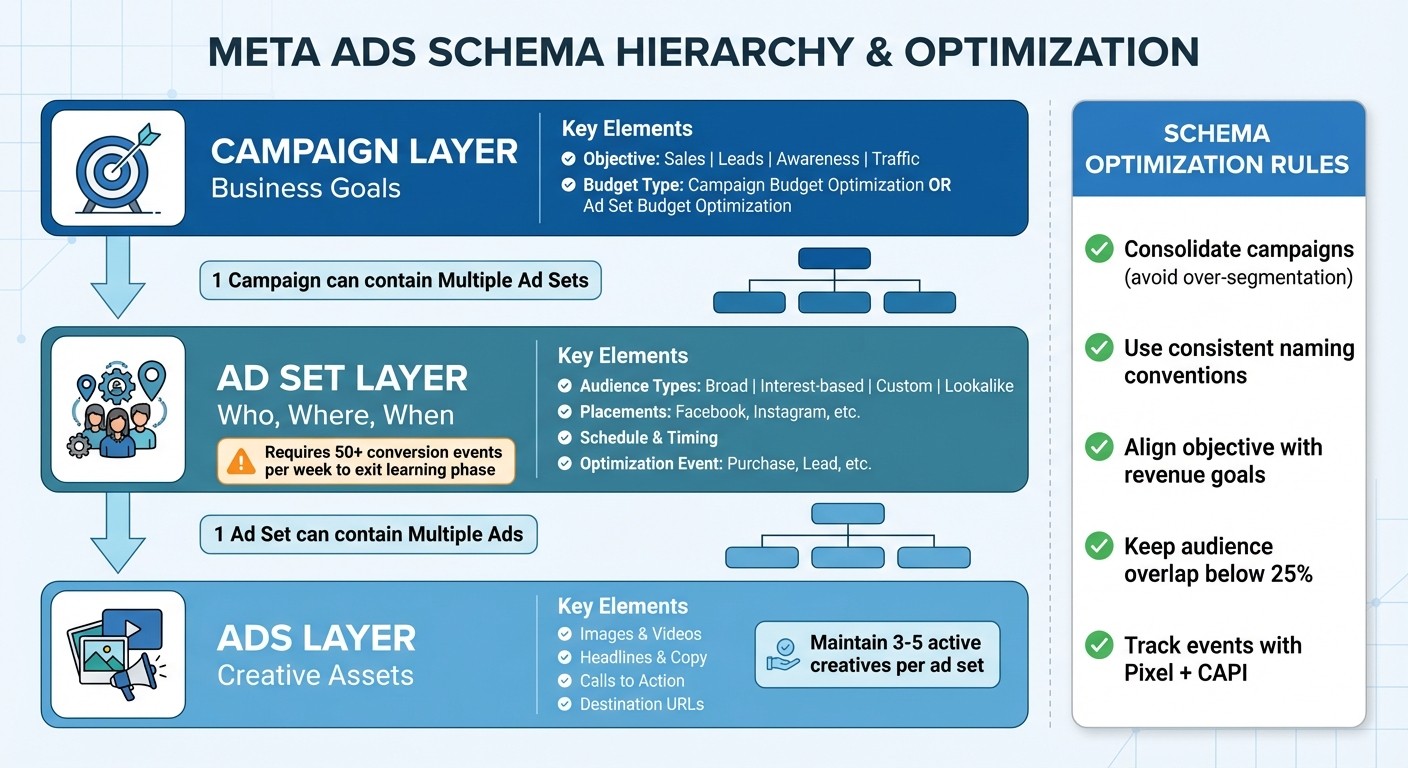
Meta Ads Campaign Structure: 3-Layer Schema with Key Requirements
A Meta ads schema is built on three interconnected layers, each playing a key role in optimizing how your message reaches the right audience. At the top is the Campaign layer, where you define your primary business goal - whether it's Sales, Leads, Awareness, or Traffic. This choice directly informs Meta's algorithm on what to prioritize across all subsequent layers.
Next comes the Ad Set layer, which focuses on the "who, where, and when." This is where you define your target audience - Broad, Interest-based, Custom, or Lookalike - choose between Advantage+ and manual placements across platforms like Facebook and Instagram, set a schedule, and choose your optimization event, such as Purchase or Lead. The learning phase of Meta's algorithm kicks off at this level.
Finally, at the bottom, you have Ads, which include the creative elements like images, videos, headlines, copy, and calls to action. Within each ad set, multiple ads compete for delivery, with Meta prioritizing those that generate the strongest signals for the selected optimization event. Now, let’s dive into the data entities that drive each of these layers.
Key Data Entities
Each layer in the schema requires specific inputs. For campaigns, you need to set an objective and decide on a budget type - either Campaign Budget Optimization or Ad Set Budget Optimization. Ad sets demand audience definitions, placement preferences, schedules, and a chosen optimization event. Ads themselves rely on creative assets, destination URLs, and calls to action.
Audiences, a critical part of the ad set layer, are defined by their data source. For example:
Custom Audiences: Built using first-party data like website visitors or email lists.
Lookalike Audiences: Target users who share characteristics with your best customers.
Broad or Interest-based Audiences: Cast a wider net to reach potential new users.
To maximize performance, aim to maintain 3–5 active creatives per ad set and leverage audience data. Running too many ads can dilute your budget, making it harder for any single ad to gather enough impressions to produce actionable insights. Also, align your campaign objective as closely as possible with revenue goals. For instance, e-commerce businesses should select Sales as the objective to target high-intent users rather than just driving traffic.
Entity Relationships and Hierarchies
A single campaign can house multiple ad sets and ads, with the overarching campaign objective driving optimization across all levels. For example, if you set your campaign objective to Sales, every ad set and ad within that campaign will focus on generating purchases - not just clicks or impressions.
Simplification is key when structuring Meta campaigns. Over-segmenting your campaigns and ad sets can dilute conversion signals, leaving your ads stuck in the learning phase. A more consolidated structure allows Meta's algorithm to gather stronger data signals, exit the learning phase faster, and identify valuable users more effectively.
The impact of this approach is well-documented. In Q4 2022, Pura Vida Bracelets adopted Meta's Advantage+ shopping campaigns, which use automated audience structures. This shift resulted in a 22% increase in ROAS and a 17% reduction in cost per purchase. By consolidating data and letting the algorithm work with stronger signals, brands can achieve better results with less waste.
Best Practices for Structuring Meta Ads Data
Creating a clear and organized schema begins with structured naming conventions. Instead of using vague labels, opt for names like Sales_Prospecting_US or Leads_Retargeting_CA. This method makes it much easier to filter and analyze performance across multiple campaigns without needing to dive into each one individually.
Another critical area is event tracking, which often becomes a weak link in schema design. Meta's algorithm relies heavily on accurate and consistent conversion data to optimize its delivery. To ensure this, your Pixel and Conversions API must send clean signals. For example, hash email (em) and phone number (ph) data using SHA256, convert them to lowercase, and trim any whitespace. Core event fields like event_name, event_time, event_id, and action_source should strictly follow Meta's formatting requirements. Additionally, technical fields such as client_ip_address and client_user_agent need to use standard IPv4/IPv6 and browser string formats. To avoid double-counting conversions when both the Pixel and API are triggered, use unique event_id values for each conversion event.
When it comes to Advantage+ campaigns, consolidation becomes key. Meta's algorithm requires at least 50 conversion events per ad set per week to move out of the learning phase and optimize delivery effectively. If you encounter a "Learning Limited" status, it’s a clear indication that your campaign structure is too fragmented and needs to be streamlined. Broad targeting (e.g., using only age and location) often performs better than interest-based targeting strategies. By 2026, Meta’s algorithm has advanced enough to identify high-intent customers even within broad audience definitions. Instead of dividing campaigns into narrowly defined audience segments, allow Advantage+ to work with a unified dataset and stronger, more consistent signals.
Following these practices not only simplifies data management but also enhances Meta's ability to optimize campaigns for better results. A well-structured schema lays the groundwork for leveraging automation tools like AdAmigo.ai, which can help scale Meta ad performance efficiently.
Tools for Automating and Optimizing Meta Ads Schemas
When it comes to streamlining Meta ads schemas, automated tools and structured checklists play a key role in maintaining efficiency and data accuracy.
AdAmigo.ai for Automated Schema Management
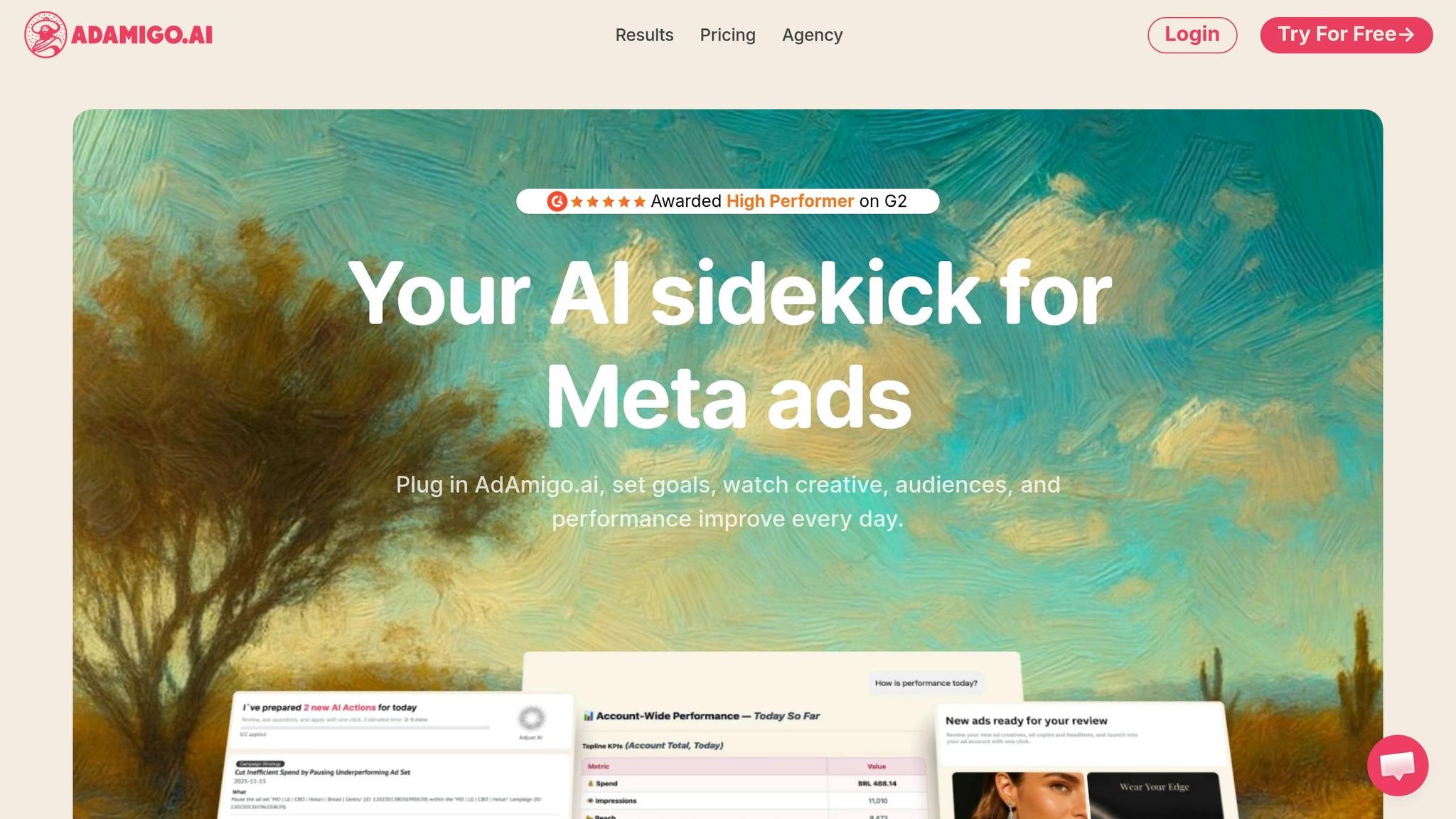
AdAmigo.ai (https://adamigo.ai) is a powerful AI-driven platform designed to simplify and optimize Meta ads schema management. Its AI Ads Agent takes the guesswork out of campaign setup by analyzing your brand identity, competitor strategies, and high-performing ads. It then automatically generates creative sets with consistent naming patterns, such as ScaleROAS3x_ColdTraffic_VideoShampooUGC_Hook1_v2, and launches them directly into your ad account. This eliminates manual errors and ensures every campaign is structured for scalability from the start.
The platform's AI Actions feature provides a daily, prioritized to-do list of impactful adjustments across creatives, audiences, budgets, and bids. It identifies potential issues, such as fragmented schemas or inconsistent event parameters, before they can hurt campaign performance. Additionally, the AI Chat Agent can answer questions like "Why is this event schema underperforming?" while offering actionable insights to refine hierarchies and ensure compatibility with Meta Advantage+.
For agencies juggling multiple clients, the Bulk Ad Launch feature is a game-changer. It enables users to launch Meta ads directly from Google Drive, applying the right copy, creative, and targeting while maintaining schema consistency across campaigns. Unlike static rules engines, AdAmigo.ai continuously learns from real-world results, dynamically adjusting creatives, targeting, bids, and budgets to align with your set rules and goals. This allows one media buyer to manage 4–8 times more clients, shifting focus from execution to strategy.
By combining automation with precision, AdAmigo.ai ensures campaigns adhere to schema standards, paving the way for consistent and scalable advertising processes.
Implementation Checklists
Pixel + CAPI Event Schema Checklist:
Install the Pixel base code on all pages and verify functionality using Meta Events Manager.
Define key standard events like
ViewContent,AddToCart, andPurchase, ensuring required parameters (valuein numeric format,currencyin USD, andcontent_ids) are included.Implement CAPI vs. Pixel for server-side tracking to mitigate iOS-related restrictions.
Use Meta's Test Events tool to verify event deduplication.
Hash user identifiers (e.g.,
em,ph) using SHA256 after converting to lowercase and removing extra spaces.Avoid hashing technical fields like
client_ip_address,client_user_agent,fbc, orfbp. These should follow standard IPv4/IPv6 and browser string formats.
Naming Convention Checklist:
Follow structured naming formats for ads:
[CampaignName]_[AdSetPersona]_[CreativeFormat]_[HeadlineKey]_[Version].Use campaign naming templates like
[Brand]_[Objective]_[Theme]_[Date].Replace spaces with underscores to avoid breaking UTM parameters.
Ensure naming conventions allow for quick filtering within Ads Manager.
Organize related entities hierarchically to support ad family groupings, aiding algorithmic optimization and minimizing over-fragmentation.
These tools and structured checklists help ensure that your Meta ad campaigns are not only well-organized but also primed for performance and scalability.
Common Pitfalls and Optimization Tips
When refining your Meta ads data structure, it's essential to address common mistakes that can derail performance. These pitfalls generally fall into three categories: inconsistent parameters, over-fragmentation, and audience overlap. Here’s how to tackle them effectively.
Avoiding Inconsistent Parameters
Inconsistent naming conventions and event parameters can disrupt attribution and reporting. For instance, sending value as a string ("29.99") instead of a numeric format (29.99) or alternating between USD and usd for currency confuses Meta's algorithm, making it harder to optimize campaigns.
To prevent this, stick to a unified naming convention - use underscores consistently and standardize event parameter formats with a reference table. For customer identifiers like em (email) or ph (phone), hash them using SHA256 after converting to lowercase and removing any extra spaces. However, avoid hashing technical fields such as client_ip_address, fbc, or fbp.
Consistency in parameters is just one piece of the puzzle; your campaign structure also plays a critical role in maintaining strong signals.
Resolving Over-Fragmentation
Dividing your budget across too many campaigns or ad sets can hinder Meta's algorithm. The platform needs around 50 conversion events per ad set each week to exit the learning phase and optimize effectively. If audience overlap exceeds 25%, your ad sets end up competing against each other in auctions, increasing costs while reducing conversions.
To fix this, consolidate campaigns to ensure each ad set can achieve 50 weekly conversions. Combine ad sets flagged as "Learning Limited" to reduce audience overlap and strengthen signal quality. This approach pairs well with clean event tracking, ensuring that your conversion signals remain robust.
Testing Broad vs. Lookalike Schemas
As of 2026, broad targeting - focusing on age, gender, and location - often outperforms detailed interest or lookalike schemas. Meta's algorithm has become advanced enough to identify ideal customers within large audience pools. However, lookalike audiences still excel for high-intent prospecting when backed by strong seed data.
To determine the right strategy, test broad and lookalike targeting with equal budgets using Ad Set Budget Optimization. This helps in comparing manual vs AI budget testing to see which drives better efficiency. If a lookalike ad set remains stuck in "Learning Limited", fold it into a broad targeting structure. Once you’ve identified what works, transition to Campaign Budget Optimization for scaling Meta ad budgets without losing efficiency. Broad targeting is particularly effective for scaling proven campaigns or when working with budgets under $1,000 per week. On the other hand, lookalike schemas are ideal when you have high-quality seed data and enough budget to hit 50 conversion events per week.
Conclusion and Key Takeaways
Using consistent naming conventions, uniform event parameters, and consolidated data makes it easier for Meta's algorithm to optimize your campaigns. Instead of spreading your budget thin across multiple ad sets, focus on consolidating your best-performing ads. This helps campaigns collect enough data to move through the learning phase more efficiently.
When scaling Meta ads, keep your campaigns organized by separating "Test" campaigns - designed for bulk ad testing - from "Scale" campaigns that focus on proven winners. This structure allows you to test new ads quickly without disrupting the performance of your high-performing sets. Additionally, using original Post IDs can help retain social proof and improve Estimated Action Rates in Meta's auction system.
These strategies are essential as the advertising landscape becomes increasingly competitive and automated. With AI-driven creative production raising the stakes, the quality of your creative assets plays a bigger role than ever in determining performance. At the same time, manually managing parameters, consolidating data, and optimizing campaign structures can take hours every week and still leave room for missed opportunities.
For those looking to reduce manual workload, tools like AdAmigo.ai offer a streamlined solution. With just a 5-minute setup, it simplifies schema management compared to the time-consuming process of direct API polling. The platform's AI Actions provide a daily, auto-prioritized task list for impactful adjustments across creatives, audiences, budgets, and bids - all while adhering to your budget and pacing rules. This automation frees up time for media buyers to focus on broader growth strategies.
Whether you choose manual management or automation, the goal remains the same: deliver clean, consolidated data to Meta's algorithm and give it the space to learn. Brands that strike this balance will leave the learning phase faster, achieve lower conversion costs, and scale more predictably.
FAQs
How do I pick the right conversion event to optimize for?
To get the best results, focus on conversion events that directly reflect your business objectives and highlight the most meaningful user actions. Double-check that your Meta Pixel and Events are properly configured. Tools like AdAmigo.ai can simplify the process by helping you prioritize and monitor these events effectively. This setup ensures more precise optimization and improved campaign performance.
What should I do if an ad set is stuck in Learning Limited?
If your ad set is stuck in Learning Limited, it's time to tweak some key elements. Start by refining your headlines, visuals, and audience targeting. Once you've made adjustments, let the changes run for at least 7 days with a sufficient budget to gather meaningful data.
When increasing your budget, do it gradually - aim for a 20–30% increase every few days. This helps maintain stability and avoids disrupting the algorithm. Also, ensure you're generating enough conversion events and steer clear of sudden budget spikes. These steps can help the algorithm successfully complete the learning phase.
How can I prevent Pixel and CAPI from double-counting purchases?
To prevent double-counting purchases when using Pixel and CAPI, implement deduplication strategies such as using consistent event IDs, SHA256-hashed identifiers, and a unified data schema. These methods help ensure accurate attribution by eliminating duplicate events, following Meta's recommended practices.