
How AI Learns From Meta Ad Performance Data
Meta's AI uses real-time signals, EMQ, and dynamic creative testing to reallocate budgets and improve ad conversions.
AI on Meta's advertising platform uses real-time data to optimize ad performance faster and more efficiently than manual methods. Key takeaways:
Real-Time Adjustments: AI analyzes metrics like CTR, CPC, and ROAS to reallocate budgets, pause low-performing ads, and scale high-performing ones instantly.
Dynamic Testing: AI evaluates multiple ad variations simultaneously, replacing underperforming elements without traditional A/B testing delays.
Data-Driven Predictions: By identifying trends and using predictive bidding, AI targets users most likely to convert, improving cost efficiency.
Avoiding Common Mistakes: Over-segmentation, frequent edits, and short analysis windows disrupt the Meta Ads learning phase. Stable campaign structures and consistent data signals are critical.
Enhanced Tools: Features like Event Match Quality (EMQ) scores and Advantage+ campaigns help advertisers lower costs and boost results.
For advertisers managing multiple accounts, automation tools like AdAmigo.ai simplify tasks, allowing more focus on strategy while improving campaign outcomes.
How Meta's AI Analyzes Ad Performance Data

Real-Time Signal Collection and Data Aggregation
Meta's AI relies on Events Manager to pull together data from multiple sources, including Meta Pixel, CAPI, app events, and offline conversions. As users engage with ads - whether by clicking, liking, or sharing - this system collects signals from platforms like Facebook, Instagram, and the Meta Audience Network. Through Meta Business Suite, all paid and organic activity is combined into a single dashboard, giving the AI a clear picture of how factors like creative content, audience targeting, and ad placement work in tandem to deliver results. This setup allows for real-time conversion tracking to adjust ad creative based on live performance data.
Pattern Recognition and Performance Prediction
Once the data is collected, Meta's machine learning algorithms step in to identify trends and predict performance outcomes. These systems typically need 30–50 monthly conversions to confidently recognize patterns and fine-tune bids effectively. Falling below this conversion threshold makes accurate optimizations challenging. The AI also keeps an eye on critical metrics like creative fatigue, which often occurs when ad frequency surpasses 3.5× and click-through rates drop by over 20%. Another factor it monitors is audience overlap, which can push CPMs up by 15–30% when ads compete for the same audience.
In 2026, advertisers who followed Meta's "opportunity score" recommendations saw a median 5% reduction in cost per result. Additionally, AI-powered incremental attribution models led to a 24% boost in incremental conversions compared to traditional models. These data-driven insights enable advertisers to make quick, informed adjustments to their campaigns, ensuring better performance and cost efficiency.
How AI Optimizes Creative Performance in Real Time
Dynamic Budget Reallocation and Delivery Optimization
Meta's AI keeps a close eye on key metrics like CTR (Click-Through Rate), CPC (Cost Per Click), and ROAS (Return on Ad Spend) to adjust campaign budgets on the fly. It shifts funds from ads that aren't performing well to those that are delivering results, ensuring every dollar is used effectively.
Take Meta Advantage+ sales campaigns, for example. These campaigns illustrate how this optimization works, achieving a 20% reduction in cost per acquisition compared to traditional campaign setups. The system identifies which ads drive conversions at the lowest cost and prioritizes those for more impressions. Similarly, Advantage+ leads campaigns lower the cost per qualified lead by 10% by automatically focusing delivery on the creatives that engage prospects the most.
Timing is another area where AI shines. It learns when specific audiences are most likely to take action and adjusts ad delivery accordingly. To avoid overexposing audiences, the system tracks frequency metrics and cuts back delivery when an ad's frequency becomes too high, protecting performance. Advertisers who follow Meta's "opportunity score" recommendations - designed to highlight these optimization chances - typically see a median 5% reduction in cost per result.
This real-time budget reallocation pairs seamlessly with ongoing creative testing, forming a well-rounded strategy for improving campaign outcomes.
Iteration and Testing of Ad Creatives
AI doesn't just manage budgets - it also experiments with creative elements to find the best combinations of headlines, images, and calls-to-action. Unlike traditional A/B testing, which focuses on one variable at a time, Dynamic Creative Optimization evaluates how multiple elements work together in real-time. It learns from every impression, quickly identifying and phasing out underperforming creatives.
Meta's acquisition of Manus AI for over $2 billion brought advanced tools like creative fatigue analysis directly into Ads Manager. This technology detects when an ad stops resonating with its audience before it wastes too much budget. By analyzing patterns of audience saturation, the AI automatically reduces delivery for fatigued ads and suggests when it's time to introduce fresh variations. This approach moves beyond systems that simply offer advice - it represents a shift toward autonomous media buying, where AI takes full control of campaign adjustments.
Key Signals Meta's AI Uses to Improve Ad Performance
Engagement and Conversion Metrics
Meta's AI doesn't just monitor metrics like CTR, CPA, and ROAS - it actively uses them to fine-tune campaigns in real time. By distinguishing between seasonal trends and actual underperformance, the system prevents unnecessary campaign pauses, ensuring potential opportunities aren't missed.
The AI digs deep into micro-variations - like captions, visuals, and call-to-action buttons - to identify what drives better results. These conversion metrics guide the AI in reallocating budgets to the most effective creative and audience combinations. A standout feature is predictive bidding, which evaluates real-time signals like browsing habits and past purchases to estimate conversion potential. This happens even before an auction begins, allowing the system to focus on users most likely to convert.
Another critical tool is the Event Match Quality (EMQ) score. By providing detailed customer data - such as email addresses, IP information, and locations - you enable the AI to better understand user behavior and optimize ad targeting. The more complete the data, the more precise the system becomes at predicting and prioritizing high-value conversions. While engagement metrics shape creative adjustments, timing and context also play a pivotal role in boosting performance.
Temporal and Contextual Signals
To complement engagement metrics, Meta's AI leverages temporal and contextual signals to fine-tune ad delivery. For instance, it identifies peak engagement periods by analyzing real-time trends, ensuring ads are shown when audiences are most likely to act. The system also balances these immediate insights with historical campaign data, creating benchmarks by industry and country that help predict future trends. This approach allows the AI to quickly shift budgets to high-performing segments while keeping long-term ROI in focus.
Another factor is device type, which influences how ads are optimized for viewing. Whether users are on mobile or desktop, the AI adapts content delivery to provide the best experience. It also monitors ad frequency to avoid creative fatigue. In light of iOS privacy changes, the AI now relies on behavioral analysis and aggregate data patterns instead of personal identifiers. This ensures ad effectiveness while respecting user privacy and maintaining compliance with data regulations.
The Exact Meta Campaign Optimization I'm Using Right Now
This Meta ad campaign setup follows the same principles found in our Meta ads automation guide, focusing on efficiency and performance. This approach relies on analyzing Meta ad metrics to ensure every dollar spent contributes to growth.
How Advertisers Can Improve AI Learning for Better Campaign Results
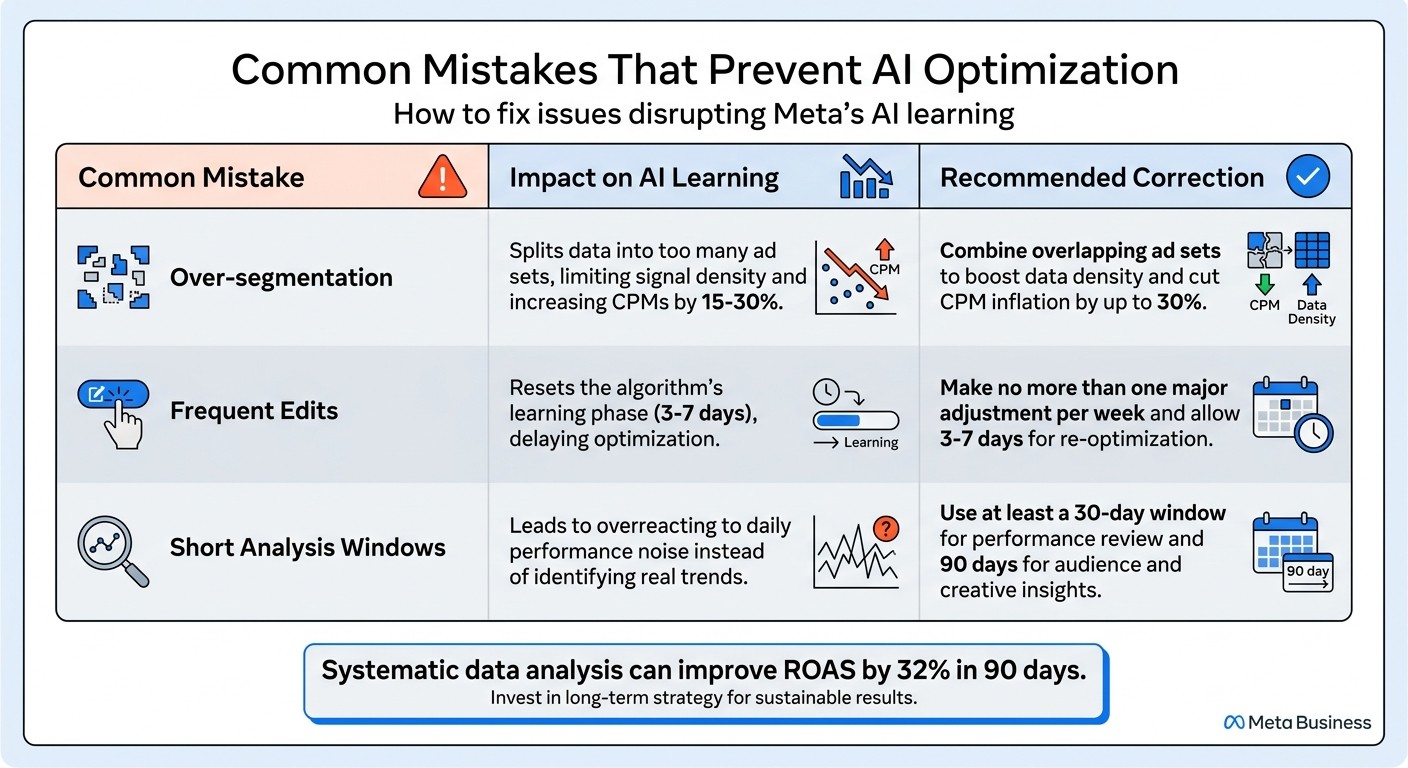
Common Meta AI Optimization Mistakes and Solutions for Better Campaign Performance
Common Mistakes That Prevent AI Optimization
Getting the most out of Meta's AI relies on feeding it consistent, high-quality data. Unfortunately, advertisers often make mistakes that disrupt this process, holding back the AI's ability to optimize effectively. Here are three common pitfalls:
Over-segmentation happens when advertisers divide their audiences into too many small ad sets. This limits the amount of data available for each set, making it harder for the AI to identify patterns and optimize performance. Plus, it creates internal competition, where your campaigns bid against each other, driving up CPMs by 15% to 30%.
Frequent campaign edits are another issue. Every time you make a major change, the AI resets its learning phase, which typically takes 3 to 7 days to complete. Constant tweaks prevent the system from stabilizing, leaving it unable to learn effectively.
Short analysis windows lead to snap decisions based on limited data. Evaluating performance over just 1 or 2 days often results in overreacting to random fluctuations, rather than identifying meaningful trends.
Common Mistake | Impact on AI Learning | Recommended Correction |
|---|---|---|
Over-segmentation | Splits data into too many ad sets, limiting signal density and increasing CPMs | Combine overlapping ad sets to boost data density and cut CPM inflation by up to 30% |
Frequent Edits | Resets the algorithm’s learning phase, delaying optimization | Make no more than one major adjustment per week and allow 3–7 days for re-optimization |
Short Analysis Windows | Leads to overreacting to daily performance noise | Use at least a 30-day window for performance review and 90 days for audience and creative insights |
Avoiding these mistakes ensures the AI has the data it needs to make smarter decisions, paving the way for better campaign outcomes.
Best Practices for Consistent Data Signals
Meta’s research shows that systematic data analysis can improve ROAS by 32% in just 90 days. The secret? Consistency. By providing stable, reliable data, you allow the AI to learn and adapt more effectively.
Keep campaign structures stable by avoiding unnecessary tinkering. Consolidating audiences and reducing segmentation helps the algorithm reach optimization thresholds faster. It’s also important to set clear KPIs and share relevant business context, like promotions or inventory levels, so the AI knows what success looks like for your campaigns.
Rotate creatives based on clear performance metrics. Instead of reacting to gut feelings, monitor key signals like CTR drops (over 15%) or frequency exceeding 3.0x, which usually happen between days 5 and 7. Replace underperforming creatives based on these benchmarks, giving the AI consistent patterns to learn from and improving its ability to optimize future campaigns.
How AdAmigo.ai Uses Meta's AI for Autonomous Optimization
AdAmigo.ai takes Meta's real-time optimization tools to the next level, giving advertisers more control over their campaigns. By working alongside Meta's systems, AdAmigo.ai automates the strategic decisions that advertisers often handle manually. Using the same performance signals that Meta relies on for in-platform adjustments, AdAmigo.ai streamlines campaign management through fully autonomous strategies. As a Meta Business Technology Partner, it continuously audits accounts, identifies opportunities, and makes improvements around the clock.
How AdAmigo Automates Campaign Optimization
At the heart of AdAmigo.ai is its AI Autopilot, a decision-making engine that analyzes Meta's performance data and takes action. It monitors campaigns constantly, testing new approaches, reallocating budgets, scaling successful ads, and pausing underperformers. The platform also includes Ad Factory, which studies top-performing ads and competitor creatives to generate new, brand-aligned assets. This approach pushes optimization beyond the usual trial-and-error methods.
AdAmigo.ai also provides a Protect feature, which safeguards accounts by detecting issues like broken links, disabled ads, or unusual spending patterns. It intervenes automatically to prevent wasted ad spend. This combination of optimization and protection means the system improves performance while managing risks at the same time.
Feature | AdAmigo.ai Capability |
|---|---|
Optimization Level | Full Autopilot or Approval-based Review Mode |
Creative Generation | Weekly, brand-aligned image and video ads |
Scaling | Bulk-launch hundreds of ads via text or voice |
Monitoring | 24/7 anomaly detection and account protection |
Learning | Adjusts strategy based on real-time outcomes and competitor data |
These features give advertisers complete control while allowing them to fine-tune the platform to match their goals.
Customizable Automation for Advertisers
AdAmigo.ai doesn't just automate - it lets advertisers customize how the AI operates. You can choose full autopilot mode, where the system handles everything, or opt for an approval-based mode, where you review each recommendation before it's implemented. Advertisers set their KPIs, budget limits, and targeting preferences, and the AI ensures its actions align with those parameters.
The platform's AI Chat Agent makes campaign management even easier. Instead of navigating through Ads Manager, you can ask questions like "Why did ROAS drop yesterday?" or give instructions like "Launch a new retargeting campaign" using text or voice commands. This feature simplifies the process, saving time and effort.
"The fact that you can launch campaigns through text or voice commands feels like magic! It handles everything from creating lookalike audiences using multiple lookalike tiers to adjusting budgets with just a few prompts".
Another user, Rochelle D., shared her experience:
"Our budgets are controlled, our spend is being smartly allocated and our ROAS is up massively".
AdAmigo.ai has earned recognition as a High Performer on G2, with users praising its precise recommendations and clear explanations for each optimization.
Conclusion
AI is reshaping how Meta ad campaigns are managed by leveraging real-time data to fine-tune performance on the fly. By analyzing engagement signals, conversion metrics, and contextual data, it identifies patterns to determine the most effective creatives, target audiences, and budget allocations. Meta's Advantage+ campaigns already illustrate this potential, with sales campaigns delivering a 20% boost in performance and lead campaigns achieving a 10% reduction in cost per qualified lead. These advancements not only enhance results but also change the way advertisers approach campaign management.
For those aiming to tap into these capabilities, AdAmigo.ai simplifies the process. It automates tasks like auditing accounts, testing creative variations with AI, reallocating budgets, and generating high-performing creatives. The system handles everything from spotting potential issues to scaling successful ads, all while offering advertisers full control through customizable KPIs and guardrails.
This automation allows advertisers to shift their focus from repetitive tasks to strategic planning. Agencies can expand their client portfolios, and in-house teams can execute advanced campaigns without the need for large paid media departments. By providing clear performance goals and maintaining creative diversity, advertisers enable AI to refine and improve campaigns over time.
Whether opting for full automation or an approval-based workflow, advertisers benefit from a system that continuously learns and enhances campaign performance.
FAQs
How many conversions does Meta’s AI need to optimize reliably?
Meta’s AI generally needs 30 to 50 conversions per month to fine-tune campaigns effectively. This amount of data allows the AI to analyze patterns, make informed adjustments, and enhance campaign performance as it gathers insights over time.
What campaign changes reset the learning phase?
Significant adjustments, such as boosting budgets, altering targeting parameters, or refreshing ad creatives, can cause the learning phase to reset. This often results in performance swings and prolongs the period of unpredictability.
How can I improve Event Match Quality (EMQ) to help Meta’s AI?
To improve Event Match Quality (EMQ) and assist Meta’s AI in effectively matching website visitors, it’s crucial to focus on precise event tracking. Start by properly installing your pixel or SDK on all relevant pages of your site. This ensures that user interactions are accurately captured.
Next, send detailed, high-quality data about user actions. Use standardized event parameters and tools like Meta’s Event Setup Tool to configure events effortlessly. This tool helps you capture key interactions, like button clicks or form submissions, and allows you to include custom parameters - such as product IDs or categories. These extra details can significantly improve targeting and optimization efforts.