
Meta Ads Benchmarks by Funnel Stage (2026): Prospecting vs Re-engagement vs Retargeting vs Retention
Stage-specific Meta ads benchmarks and budget splits to reduce retargeting reliance and maximize ROAS.
Meta ads work differently at each funnel stage, and applying the same expectations across all campaigns can waste your budget. Here's what you need to know:
Prospecting targets cold audiences, focusing on awareness with lower conversion rates (0.5%-1.5%) and higher costs per lead (~$51.40).
Re-engagement nurtures warm audiences, improving click-through rates (1.5%-3%) and reducing acquisition costs ($10-$20).
Retargeting converts high-intent users with the highest conversion rates (5%-12%) and ROAS of 4x-10x.
Retention focuses on repeat customers, maximizing lifetime value with ROAS often exceeding 10x.
Budget Allocation for 2026:
40-50% Prospecting: Drive new leads.
20-30% Re-engagement/Retargeting: Convert warm and hot audiences.
20-30% Retention: Boost loyalty and repeat purchases.
Tailor benchmarks by objective and placement for each stage and avoid over-relying on retargeting by implementing full-funnel AI optimization. Tools like AdAmigo.ai can automate ad optimization, ensuring better results across all stages.
Meta Ads: Top, Middle, and Bottom Funnel Strategies
Prospecting Benchmarks: What to Expect from Cold Audiences
Prospecting focuses on reaching new audiences scrolling through their feeds. Because these individuals are unfamiliar with your brand, conversion and click-through rates tend to be lower. The primary goal here is to build awareness and fill the funnel for future conversions. Below, we’ll explore key performance metrics and strategies to boost results with cold traffic.
Expected Metrics for Prospecting Campaigns
When it comes to conversion rates, you can expect a range of 0.37% to 1.54%. Most campaigns average between 0.7% and 1.5%, while top performers exceed 2.0%. If your conversion rate falls below 0.3%, it may indicate your campaign is underperforming.
Click-through rates (CTR) for prospecting hover around 1.28%, which is slightly higher than retargeting campaigns at 1.14%. This is because fresh creative often sparks curiosity in new audiences. Cost per mille (CPM) averages around $7.50, which is lower than retargeting’s $8.43, as prospecting typically targets a broader audience. However, the cost per lead is higher - about $51.40 compared to $33.15 for bottom-funnel efforts.
For campaigns focused on awareness, you’ll generally see a CTR of 0.94%, with CPMs ranging from $10 to $15. Traffic campaigns tend to perform better, with a 1.71% CTR, a cost per click (CPC) of roughly $0.70, and CPMs between $15 and $25. These benchmarks provide a reference point for evaluating your campaign and identifying areas for improvement using AI tools for Meta ad account analysis.
How to Improve Cold Traffic Performance
The first three seconds are critical - this is where you either grab attention or lose it. For Reels and Stories, aim for a hook rate between 58% and 68%. Ads that mimic user-generated content, featuring real faces and a casual, low-production style, outperform polished studio ads by about 15 percentage points. Additionally, 9:16 video formats, tailored for Reels and Stories, account for 63% of high-performing prospecting creatives.
Abderrahmane Bouabdli, Founder of CreaScale AI, puts it succinctly:
Meta Ads CPA is no longer a function of targeting... It's a function of creative diversity and angle psychology.
Instead of testing small tweaks to a single ad, experiment with 8 to 10 distinct psychological angles and test Meta ad CTAs - like status, safety, or urgency - at the same time. Problem-aware messaging, particularly in industries like beauty and skincare, is currently driving strong results for cold traffic.
Optimizing your ad placement can also significantly impact costs. For instance, Instagram Reels have a CPC of around $1.28, which is 26% lower than the $1.72 CPC seen on the Facebook Feed. When writing ad copy, focus on low-barrier hooks like free shipping, discounts, or pricing details. High-trust elements, such as testimonials, are more effective for retargeting campaigns and are less suited for cold audiences.
Recognizing these benchmarks and nuances is essential, as cold traffic metrics differ greatly from those at later funnel stages. Tools like AdAmigo.ai can help fine-tune your approach, ensuring each layer of your funnel is optimized for its specific goals.
Re-engagement Benchmarks: Performance from Warm Audiences
Re-engagement campaigns focus on users who’ve already interacted with your brand, making them a bridge between prospecting and conversions. By targeting these warm audiences - those who’ve shown prior interest - you can improve key performance metrics significantly. With first-visit conversions hovering around 2–4%, nurturing these users further becomes essential.
Expected Metrics for Re-engagement Campaigns
Since warm audiences are already familiar with your brand, their performance tends to outshine cold traffic. Here’s what you can typically expect:
Click-through rate (CTR): Between 1.5% and 3%.
Cost per click (CPC): Ranges from $0.40 to $0.90.
Return on ad spend (ROAS): Generally falls between 3:1 and 6:1.
Cost per acquisition (CPA): Averages $10 to $20.
Cost per mille (CPM): Typically between $6 and $12.
Warm audiences are also more likely to engage, clicking about three times more often than cold prospects.
Using Personalized Content to Re-engage Users
To convert these warm audiences, focus on addressing the reasons they haven’t purchased yet. Instead of simply reintroducing your brand, tailor your ads to overcome common objections like trust, price, or timing. As the AdStellar Editorial Team puts it:
A great retargeting ad doesn't just re-show a product; it answers the unasked question the user had before they left your site.
Building trust is key at this stage. Incorporate social proof such as testimonials, reviews, and user-generated content (UGC). UGC, in particular, can increase conversion rates by up to 29% compared to brand-produced ads. High-performing campaigns devote less than 30% of their re-engagement budget to basic product reminders, instead prioritizing trust-building content like customer stories and brand narratives.
Dynamic product ads with urgency overlays can also make your messaging more relevant. Set retention windows thoughtfully - 14–21 days for website visitors and up to 30 days for social media engagers - to align with the natural decay of purchase intent. Exclude recent buyers (within 7–30 days) to ensure your budget focuses on those still deciding.
Keep a close eye on ad frequency. If users see your ads more than 3–4 times per week, you risk ad fatigue and audience saturation leading to higher costs. To keep things fresh, rotate creatives every 10–14 days, especially for smaller audience segments while avoiding common ad testing mistakes. For high-intent groups like cart abandoners, use AI-powered retargeting and distinct messaging to maximize your funnel’s efficiency.
Next, we’ll explore how retargeting can convert high-intent traffic.
Retargeting Benchmarks: Converting High-Intent Traffic
Retargeting focuses on users who have already shown interest in your site or products - those closer to making a purchase. These high-intent audiences often generate 3-5x higher conversion rates compared to cold prospecting campaigns. However, while dashboard metrics may look impressive, the actual incremental lift is typically just 20-40% of the reported ROAS (e.g., an 8x ROAS might translate to only 2-3x in true revenue). Since retargeting can overinflate results, it’s recommended to limit its budget to 10% of your total Meta ad spend. Let’s break down the metrics and strategies that define successful retargeting campaigns.
Expected Metrics for Retargeting Campaigns
Here’s what you can typically expect from retargeting campaigns:
Click-through rate (CTR): Between 1.8% and 3.5%
Cost per click (CPC): $0.30 to $0.70
Return on ad spend (ROAS): Ranges from 4.0x to 10.0x for high-intent audiences
Conversion rate: Usually falls between 5% and 12%, or even higher
These numbers highlight the strong potential of retargeting to convert users who are already primed to buy. However, like prospecting and re-engagement, retargeting requires its own set of metrics to ensure you’re allocating your budget effectively.
Retargeting Tactics That Drive Conversions
The best retargeting strategies go beyond simply reminding users what they viewed. Instead, they focus on addressing barriers to purchase. As 27Five puts it:
Retargeting isn't about reminding people what they looked at. It's about giving them a reason to come back and buy. The product reminder is the least persuasive ad in your retargeting stack.
To make retargeting work, segment your audience based on their level of intent and tailor your messaging accordingly:
Cart abandoners: Retarget these users within 7 days, as their purchase intent fades quickly.
Product viewers: A 14-day window works well for this group.
General site visitors: Target these visitors within 14-21 days.
Social engagers: Use a longer window of up to 30 days, focusing on product discovery content.
Boost results by incorporating elements like social proof (star ratings, testimonials), risk-reversal offers (free shipping, money-back guarantees), and urgency (low-stock alerts). Dynamic Product Ads (DPAs) are an excellent automated tool for product reminders, but pairing them with manually crafted campaigns featuring customer stories or educational content can build trust and drive more conversions.
Frequency management is crucial to avoid ad fatigue and rising costs. Stick to 3-4 impressions per user per week, though high-intent campaigns can handle 5-7 impressions. Be sure to exclude recent purchasers (within 7-30 days) from acquisition-focused retargeting to avoid wasting ad spend.
Interestingly, Instagram and Facebook Stories outperform Feed placements for retargeting, delivering 18% higher conversion rates.
For example, in April 2026, a Santa Barbara Polo Club iPhone 16 campaign using the PDA Framework achieved impressive results: a $1.65 cost per purchase, 12 purchases in just 24 hours on a $19.77 spend, and a top creative CTR of 6.34%, far exceeding the $28 CPA average. These insights align with a full-funnel approach to maximize both budget efficiency and creative impact.
Retention Benchmarks: Maximizing Customer Lifetime Value
As businesses shift focus from acquiring new customers to fostering loyalty, retention benchmarks become essential for maximizing customer lifetime value (LTV).
Retention campaigns zero in on your most valuable resource: existing customers. These campaigns aim to encourage repeat purchases and boost LTV by targeting audiences that already trust your brand. Because of this trust, retention campaigns often achieve impressive ROAS (Return on Ad Spend), typically between 4.0x and 10.0x or higher. For subscription-based brands, this number can soar even higher - by the twelfth month of a customer’s lifecycle, ROAS may reach 8x or more. With structured strategies and key metrics, retention campaigns ensure customers continue coming back.
Expected Metrics for Retention Campaigns
Retention campaigns often outperform cold and warm traffic in key areas. Here’s what you can generally expect:
Click-through rate (CTR): Between 2.0% and 4.0%
Return on ad spend (ROAS): Typically 4.0x to 10.0x or higher
Next, let’s explore how to turn these metrics into stronger, long-term customer relationships. Implementing proven optimization tips can help bridge the gap between current performance and these high-level benchmarks.
Retention Tactics That Increase Repeat Purchases
The best retention strategies go far beyond generic product reminders. Personalized ads featuring testimonials, educational content, or exclusive offers build deeper loyalty than basic "Shop Now" messages. Timing also plays a huge role - especially for consumable products. For example, set your exclusion windows to just before the average reorder period so your ads appear when customers are ready to restock.
Here are some targeted retention tactics to drive repeat purchases:
Segment audiences by purchase recency: Exclude recent buyers (7–30 days) from acquisition campaigns and instead serve them loyalty-focused content.
Reorder reminders for consumables: Trigger ads with "Time to restock" messages or subscription offers just before customers need to replenish.
Win-back campaigns for lapsed customers: For those who haven’t purchased in 90–180 days, use offers, new product announcements, or storytelling about your brand’s mission to re-engage them.
Progressive discounts can also recover lost sales. For example, offering 10% off on day one, 15% on day three, and 20% on day seven can recover up to 23% of abandoned carts. Catalog-based ads also perform well - Advantage+ Shopping campaigns using a full product catalog deliver a 4.7x ROAS, compared to 3.1x for standard prospecting.
Another powerful tool is value-based optimization. By uploading customer lists with LTV data, platforms like Meta can target audiences similar to your top-spending customers. This approach uses first-party data to create reliable retention audiences, which is increasingly important with evolving privacy regulations. Unlike prospecting campaigns, retention campaigns focus on smaller, high-intent groups, making ad delivery more efficient right from the start.
Side-by-Side Funnel Stage Performance Comparison
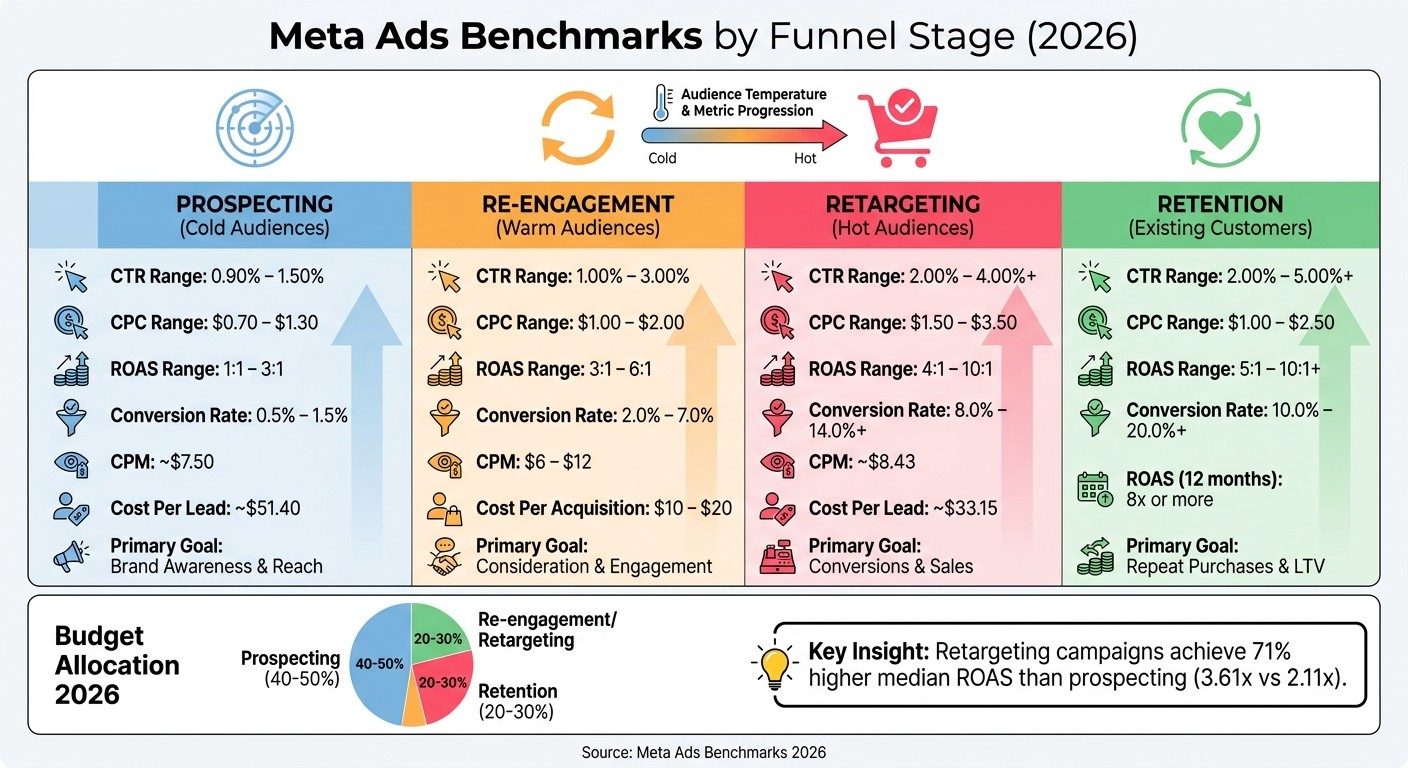
Meta Ads Performance Benchmarks by Funnel Stage: Prospecting vs Re-engagement vs Retargeting vs Retention
The four stages of the marketing funnel - prospecting, re-engagement, retargeting, and retention - reveal a clear progression in performance metrics, improving as you move closer to retention. Each stage serves a unique purpose and requires specific evaluation criteria.
"If you judge every campaign by conversion metrics, you'll underfund awareness and eventually starve your retargeting pools." - Benly.ai
Grasping the differences in benchmarks is essential for setting realistic goals at each stage. For example, cold prospecting is about drawing in potential customers, not achieving a sky-high ROAS right away. On the other hand, retention campaigns capitalize on existing trust, delivering the highest returns with minimal effort. Recognizing how performance evolves across these stages is key to building a full-funnel Meta ads strategy that maximizes overall results. The table below offers a clear snapshot of how audience readiness affects key metrics.
Benchmark Comparison Table
This table highlights how engagement levels across the funnel stages influence critical metrics like click-through rates (CTR), cost-per-click (CPC), CPC benchmarks by country, and return on ad spend (ROAS):
Funnel Stage | CTR Range | CPC Range | ROAS Range | Conversion (%) | Primary Goal |
|---|---|---|---|---|---|
Prospecting (Cold) | 0.90% – 1.50% | $0.70 – $1.30 | 1:1 – 3:1 | 0.5% – 1.5% | Brand Awareness & Reach |
Re-engagement (Warm) | 1.00% – 3.00% | $1.00 – $2.00 | 3:1 – 6:1 | 2.0% – 7.0% | Consideration & Engagement |
Retargeting (Hot) | 2.00% – 4.00%+ | $1.50 – $3.50 | 4:1 – 10:1 | 8.0% – 14.0%+ | Conversions & Sales |
Retention (Existing) | 2.00% – 5.00%+ | $1.00 – $2.50 | 5:1 – 10:1+ | 10.0% – 20.0%+ | Repeat Purchases & LTV |
This side-by-side comparison not only emphasizes the need for tailored benchmarks but also serves as a guide for smarter budget allocation and AI-driven strategies. For instance, retargeting campaigns typically achieve a median ROAS that's 71% higher than prospecting efforts (3.61x versus 2.11x). This efficiency explains why many advertisers dedicate 40-50% of their budget to retargeting, compared to 20-30% for prospecting. Retention campaigns, however, often outperform even retargeting in ROAS, making your existing customer base the most profitable audience to target. These insights underline the importance of allocating resources effectively and leveraging AI tools for behavioral targeting to fine-tune your approach at every funnel stage.
How to Split Your Budget Across Funnel Stages
Getting your budget allocation right across the funnel is a tough but essential call in 2026. Spend too much on prospecting, and you'll waste money on audiences that aren’t ready to convert. Focus too heavily on retargeting, and you risk neglecting the top of the funnel, leaving it underfunded. The goal is to strike a balance that fuels each stage of the funnel, creating a steady flow that boosts overall performance.
Customer acquisition costs have skyrocketed by 60%, and 75% of performance marketers report diminishing returns from campaigns that focus exclusively on the bottom of the funnel. A well-distributed budget, however, can improve marketing effectiveness by as much as 91%.
Recommended Budget Allocation by Stage
Each funnel stage has unique demands, so a carefully planned budget split is critical. For 2026, the suggested breakdown is as follows:
40–50% for prospecting: This ensures a steady stream of fresh leads to prevent audience fatigue.
20–30% for re-engagement/retargeting: These campaigns are highly efficient, delivering an average return of 4.2x ROAS.
20–30% for retention: Retention campaigns leverage existing customer trust, offering lower costs to maximize lifetime value without the hefty price of acquiring new customers.
Meta’s algorithm requires about 50 conversions per week per ad set to exit the "Learning Limited" phase and optimize delivery effectively. To meet this threshold, it’s crucial not to spread your budget too thin. Aim to consolidate your spend into 2–3 ad sets per stage. For guidance, the 70-20-10 rule works well: allocate 70% of your budget to proven performers, 20% to ad sets in the optimization phase, and 10% to experimentation.
Using AI to Optimize Budget Distribution
Manually managing budgets is often slow and reactive. By the time you notice an ad set underperforming, you may have already wasted a good chunk of your budget. AI tools like AdAmigo.ai can save you from this headache. These tools monitor your account in real time, reallocating funds from underperforming ad sets to those delivering better results.
AI doesn’t treat campaigns as isolated efforts. Instead, it reallocates budgets dynamically based on real-time performance, ensuring your money is always working where it matters most. For example, AI can speed up the learning phase by focusing budgets on new ad sets, helping them hit the 50-conversion threshold faster. Once an ad set starts to perform well, AI identifies early indicators of success and increases its budget proactively, often before manual monitoring would catch these trends. Similarly, when engagement begins to dip - often a warning sign before conversions drop - the AI adjusts budgets to maintain steady performance.
With AI Autopilot from AdAmigo.ai, your Meta ad account gets an ongoing audit to pinpoint opportunities and make adjustments automatically (or with your approval). It can launch tests, scale successful ads, pause underperformers, and redistribute budgets across funnel stages - all while staying aligned with your KPIs and budget limits. This means you can maintain the recommended allocation across prospecting, re-engagement, and retention without constantly recalculating percentages, freeing you to focus on strategy and creative work.
When scaling successful campaigns, AI takes a measured approach: budgets are increased by 20–30% every 3–5 days to avoid disrupting the learning phase. For reallocating funds between funnel stages - such as shifting budget from retargeting to prospecting - AI makes gradual changes, typically around 5% of total spend every three days, to keep the algorithm stable. These small, steady adjustments ensure performance remains consistent while optimizing your budget over time.
AdAmigo.ai: Automated Optimization Across All Funnel Stages
Managing ads across multiple funnel stages can be a daunting and resource-heavy task. That’s where AdAmigo.ai steps in, offering a streamlined solution. Acting as an autonomous AI media buyer, it takes care of optimizing performance across all stages - prospecting, re-engagement, retargeting, and retention - without manual intervention.
How AdAmigo.ai Simplifies Funnel Optimization
At the heart of AdAmigo.ai is AI Autopilot, a feature designed to continuously monitor your ad account. It identifies opportunities at every funnel stage, making adjustments automatically or after your approval. From reallocating budgets to scaling high-performing ads and pausing the ones that underperform, it ensures your campaigns align with your KPIs.
Beyond Autopilot, AdAmigo.ai offers an array of tools to make ad management easier:
AI Chat Agent: Manage campaigns using simple text or voice commands. You can ask questions like, “Why did my retargeting ROAS drop yesterday?” or request actions such as, “Launch a new prospecting campaign targeting lookalike audiences.” The agent analyzes data, provides insights, and executes changes for you.
Ad Factory: Keeps your creatives fresh by analyzing top-performing ads and competitor campaigns, then generating new variations. This prevents creative fatigue across all funnel stages. For large-scale campaigns, the Bulk Ad Launcher can generate ad copy, structure campaigns, and publish hundreds of ads in minutes - all you need to do is upload your creatives and a brief.
AdAmigo Protect: Works 24/7 to safeguard your account. It spots errors like broken links, spend anomalies, or suspicious activity before they can derail your campaigns, saving both time and budget.
Here’s how AdAmigo.ai compares to Meta Ads Manager:
Feature | AdAmigo.ai | Meta Ads Manager |
|---|---|---|
Automation | AI-driven (Autopilot) | Basic (Advantage+ suite) |
Bulk Management | One-click launch for hundreds of ads | Manual spreadsheet uploads |
Optimization | Real-time predictive analytics | Manual data-based adjustments |
Creative | AI-generated, on-brand ads | Requires manual design |
Monitoring | 24/7 anomaly detection | Manual performance checks |
Measurable Results with AdAmigo.ai
AdAmigo.ai delivers tangible improvements quickly. Users often see up to a 30% performance boost in the first month, with some reporting an 83% increase in ROAS. As one G2 reviewer, Rochelle D., shared:
"Our budgets are controlled, our spend is being smartly allocated and our ROAS is up massively. Agencies charging 7 times the cost of AdAmigo have been put to shame!"
The platform also scales effortlessly. Agencies can handle three to five times more client accounts because AdAmigo takes care of the repetitive tasks. For in-house teams, it eliminates the need for multiple media buyers while continuously optimizing campaigns across all funnel stages. This efficiency, combined with its strong track record, has earned AdAmigo.ai “High Performer” status on G2, cementing its reputation for delivering results.
Conclusion: Building a Complete Funnel Strategy for 2026
Uniform campaign standards are a sure way to drain your budget and hurt performance. Each stage of the funnel operates differently, producing unique ROAS metrics that reflect how ready the audience is to convert. Holding prospecting campaigns to the same standards as retargeting can cripple your top-of-funnel efforts, shrink your audience pool, and make scaling nearly impossible. This is why it's critical to apply tailored benchmarks at every stage of the funnel instead of relying on a one-size-fits-all mindset.
Fast-forward to 2026, and advertisers are flipping the script - shifting 80–90% of their budgets toward prospecting and re-engagement, cutting back on over-reliance on retargeting. This strategy keeps the pipeline full of fresh prospects, breaking free from the endless cycle of recycling the same small customer base. By using stage-specific benchmarks, you can pinpoint issues more effectively. For instance, low click-through rates in prospecting may highlight creative problems, while weak retargeting conversions could point to landing page friction.
Meta’s new algorithm adds another layer of complexity, requiring advertisers to prioritize sharper creative strategies. Tools like AdAmigo.ai step in to meet this demand, offering around-the-clock bulk creative testing, budget reallocation, and scaling of top-performing ads. Many users see performance jumps of up to 30% within the first month.
Main Takeaways
Here’s a breakdown of the key strategies for building a successful funnel in 2026:
Set stage-specific benchmarks. Evaluate prospecting with metrics like new customer acquisition cost (nCAC) and hook rates. Measure re-engagement by site revisit rates and assess retargeting through incremental conversion lift - not by blended ROAS.
Use strict audience exclusions. Avoid wasting ad spend by excluding cart abandoners and recent purchasers from your prospecting campaigns.
Cap retargeting budgets. Keep retargeting spend at about 10% of your total budget to ensure most of your resources go toward acquiring new customers.
Adopt a hybrid campaign structure. Run dedicated awareness campaigns to feed the top of your funnel while leveraging Advantage+ Shopping Campaigns for consideration and conversions.
Scale budgets carefully. Increase budgets by 20–30% per week to avoid disrupting Meta’s learning phase. Keep retargeting impressions between 5–7 per week to prevent ad fatigue.
The brands thriving in 2026 aren’t chasing quick wins. Instead, they’re building fully developed funnel strategies that balance acquisition, engagement, and retention - laying the groundwork for long-term growth.
FAQs
How do I know which funnel stage my Meta campaign is in?
To figure out which funnel stage your Meta campaign aligns with, take a close look at its objective, audience targeting, and creative strategy. Here's how it typically breaks down:
Top of Funnel (TOFU): Focused on building awareness, with objectives like reach or brand awareness.
Middle of Funnel (MOFU): Aims to nurture interest and consideration, using objectives such as traffic or engagement.
Bottom of Funnel (BOFU): Designed to drive actions like purchases or sign-ups, often leveraging objectives like catalog sales or conversions.
Metrics can also give you clues. A high click-through rate (CTR) with cold audiences usually signals TOFU efforts. Strong engagement metrics might indicate MOFU, while high conversion rates with warm audiences suggest BOFU campaigns.
What should I measure instead of ROAS for prospecting?
For the prospecting phase, prioritize metrics such as click-through rate (CTR), cost per click (CPC), cost per acquisition (CPA), and engagement rates. These metrics give a better understanding of audience interest and how well your campaign is performing at this stage. Avoid focusing on ROAS here, as it’s more applicable to later stages of the funnel.
How can AdAmigo.ai optimize budgets across funnel stages?
AdAmigo.ai leverages AI-powered automation to manage budgets effectively across various stages of the marketing funnel. By analyzing performance data in real-time, it dynamically adjusts spending and fine-tunes targeting and creative strategies to suit each stage. This approach helps optimize campaigns for both cold and warm audiences, leading to better overall results.