
5 Metrics to Track for Static vs Dynamic Ads
Compare CTR, conversion rate, CPA, impressions/reach, and ROAS to optimize static and dynamic ad performance.
Static and dynamic ads serve different purposes in your full-funnel Meta ads setup. Static ads maintain consistent visuals and messaging, ideal for broad brand awareness. Dynamic ads, on the other hand, use automation to personalize content based on user behavior, excelling at driving conversions. This is a core component of full-funnel AI optimization. To ensure success, focus on these five key metrics:
Click-Through Rate (CTR): Measures how engaging your ad is. Dynamic ads often outperform static ones, increasing CTR by up to 35% due to personalization.
Conversion Rate: Tracks how effectively clicks turn into actions. Dynamic ads deliver 27% more conversions, making them perfect for high-intent audiences.
Cost Per Action (CPA): Reflects the cost of achieving a specific result. Dynamic ads can reduce CPA by 50%, helping to reduce Facebook ad costs, while static ads are better for building trust early on.
Impressions and Reach: Static ads excel at maximizing reach for brand awareness, while dynamic ads focus on targeted impressions for conversions.
Return on Ad Spend (ROAS): Evaluates profitability. Dynamic ads typically achieve higher ROAS in conversion-focused campaigns, while static ads build long-term brand recognition.
Quick Comparison
Metric | Static Ads | Dynamic Ads |
|---|---|---|
CTR | Lower, good for broad messaging | Higher, due to tailored content |
Conversion Rate | Lower, builds trust for future actions | Higher, optimized for high-intent users |
CPA | Higher, focuses on awareness | Lower, efficient for retargeting |
Impressions/Reach | Broad reach, consistent messaging | Targeted reach, personalized impressions |
ROAS | Lower for immediate returns | Higher for direct conversions |
For best results, combine both formats: use static ads to create awareness and dynamic ads to drive conversions. This approach balances brand visibility and performance efficiency. This balance is a key reason why businesses advertise on Meta to scale their growth.
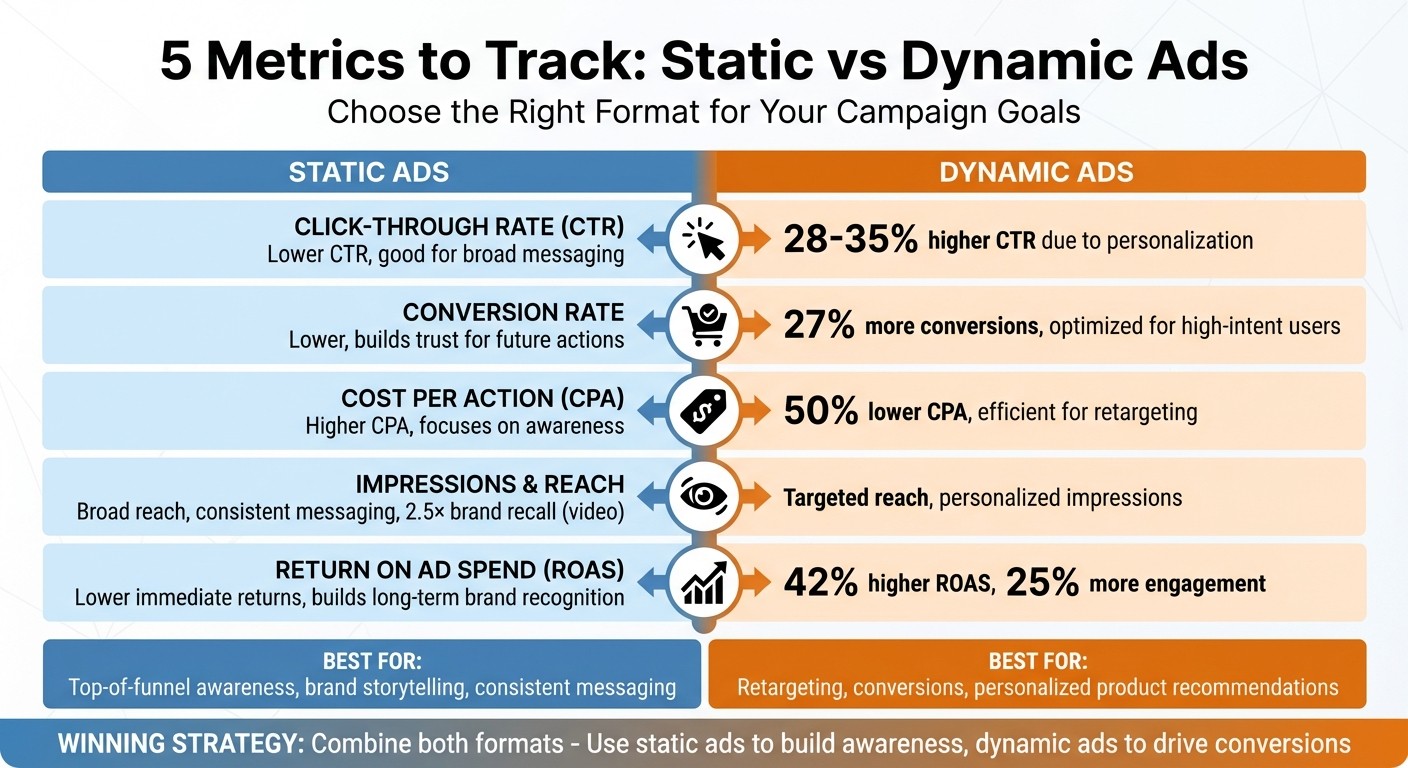
Static vs Dynamic Ads: 5 Key Metrics Comparison
Dynamic vs Static Ads: What's the Difference?
1. Click-Through Rate (CTR)
CTR, calculated as (clicks ÷ impressions) × 100, measures how appealing your ad is to your audience.
Relevance to Ad Performance Goals
CTR is a key indicator of how well your ad connects with its target audience, often requiring Meta ad account analysis to identify performance trends. A higher CTR suggests your message is resonating - people are stopping to engage. For brand awareness campaigns, a strong CTR shows your creative is cutting through the clutter. For conversion-driven campaigns, it’s the first step in guiding users down the funnel, signaling their interest to explore more.
Dynamic ads tend to outperform static ones in this area. Why? They deliver personalized content tailored to user behavior. For example, when users see products they’ve recently browsed, they’re more likely to click. In fact, dynamic ads can increase CTR by 28%–35% by leveraging this personalization.
This brings us to the differences in how static and dynamic ad formats influence CTR.
Applicability to Static vs. Dynamic Ad Formats
The difference in CTR between static and dynamic ads boils down to personalization. Dynamic ads use product catalogs and user data to display content tailored to individual preferences, often managed through AI tools for Facebook and Instagram ads. Static ads, on the other hand, present the same creative to everyone. While this approach works well for broad messaging, it doesn’t align as closely with individual user intent.
By 2026, the most effective campaigns will combine static and dynamic formats. Static ads are ideal for top-of-funnel storytelling, helping to build broad awareness. Dynamic ads, meanwhile, are perfect for retargeting high-intent audiences, driving conversions efficiently.
To accurately track these actions, many advertisers set up Meta custom conversion rules. Next, we’ll dive into how Conversion Rate plays a role in shaping ad performance.
2. Conversion Rate
After CTR indicates interest, conversion rate steps in to confirm intent. The formula - (conversions ÷ clicks) × 100 - shows whether your ad is driving meaningful actions instead of just attracting attention.
Relevance to Ad Performance Goals
Conversion rate separates curiosity from actual results. For bottom-of-funnel campaigns, it directly reveals how well your targeting, offer, and creative align with audience needs using AI behavioral targeting tools using a Meta ads conversion optimization checklist. On the other hand, for top-of-funnel efforts, it highlights which messaging is compelling enough to nudge new audiences toward taking action.
Industry benchmarks give context to what’s achievable. In 2025, restaurants and food businesses averaged an 18.25% conversion rate, while technology companies managed just 2.31%. Health and fitness hit 14.29%, and shopping/retail landed at 3.26%. These figures are essential for setting realistic expectations based on your industry.
Such insights play a critical role in determining campaign profitability, as recent tests demonstrate.
Impact on ROI and Campaign Efficiency
A higher conversion rate means lower acquisition costs and better profitability. For example, dynamic ads have been shown to deliver 27% more conversions in retargeting efforts. A 2026 test compared a dynamic campaign to a static 10% discount ad. The results? The dynamic ad produced 27% more conversions and achieved a 42% higher ROAS.
Static ads, however, are more effective at the top of the funnel, where the goal is to build trust with audiences unfamiliar with your brand. While their conversion rates may be lower, they set the foundation for dynamic ads to succeed later in the customer journey.
Applicability to Static vs. Dynamic Ad Formats
The choice between static and dynamic ads depends on where your audience is in their buying journey. Dynamic ads work best for high-intent users, like those who’ve abandoned carts, browsed specific products, or engaged with your site. These ads deliver personalized content automatically, giving retargeting efforts a noticeable boost. Meanwhile, static ads are ideal for broad storytelling, helping to introduce your brand and build awareness.
The most effective campaigns in 2026 combine both approaches - using static ads to build awareness and dynamic ads to drive conversions.
3. Cost Per Action (CPA)
CPA tells you how much it costs to achieve a specific action - whether that's a purchase, sign-up, or download. The formula is simple: total spend divided by conversions. Unlike vanity metrics, CPA focuses on what truly matters: the cost of achieving actual results.
Relevance to Ad Performance Goals
CPA connects your ad spend directly to business outcomes. It evaluates the efficiency of your entire funnel, from the first ad impression to the final conversion. Here's where dynamic ads shine - they can cut CPA by up to 50% in conversion-focused campaigns. Why? Because they leverage user behavior to personalize content, re-engaging potential customers with tailored product recommendations.
On the other hand, static ads often come with a higher CPA when driving direct sales. However, they excel at building brand awareness. By offering complete creative control and consistent messaging, static ads are ideal for introducing your brand to new audiences. These audiences might need more time to trust your brand before converting, but the investment in awareness pays off by setting the stage for future conversions. Both formats influence ROI and campaign effectiveness in distinct ways, often requiring you to prioritize ad sets by CPA and ROAS to maximize performance.
Impact on ROI and Campaign Efficiency
Your choice of ad format has a direct impact on your results. Dynamic ads, for example, achieve double the click-through rate of static ads and boost engagement by 25%. For e-commerce retargeting, this translates to significantly lower acquisition costs. Meanwhile, static ads focus on long-term brand building, laying the groundwork for future sales.
The most effective campaigns in 2026 take a hybrid approach. Static ads build awareness at the top of the funnel with consistent messaging, while dynamic ads handle retargeting and drive conversions in the middle and bottom stages. This combination uses each format to its strengths, optimizing CPA throughout the customer journey.
Applicability to Static vs. Dynamic Ad Formats
Choosing between static and dynamic ads depends on your campaign goals and where your audience is in the buying journey. Dynamic ads are perfect for e-commerce retargeting and large product catalogs, as they pull from inventory feeds to create personalized product recommendations automatically. This scalability allows brands to generate thousands of ad variations without the need for manual effort.
Static ads, on the other hand, are ideal when you need complete creative control for brand storytelling or want to test new messaging with cold audiences. One effective strategy is to A/B test static creatives and CTAs first, then use the winning elements to scale with dynamic templates. This approach combines the precision of static ads with the efficiency of dynamic automation, ensuring your CPA remains optimized across all stages of the funnel.
4. Impressions and Reach
Impressions represent how many times your ad appears on a screen, while reach reflects the number of unique individuals who see it. For example, a campaign generating 10,000 impressions might reach 10,000 unique viewers - or the same 2,000 people seeing the ad five times each. This balance, known as frequency, is key to understanding whether you’re reaching new audiences or repeatedly targeting the same group. Grasping this concept is crucial when assessing the performance of different ad formats.
Relevance to Ad Performance Goals
Understanding impressions and reach ties directly to your campaign goals. Static ads are great for building broad awareness with consistent messaging, and video formats can boost brand recall by up to 2.5×. On the other hand, dynamic ads use data like browsing behavior and purchase history to deliver personalized content, ensuring the right person sees the right product at the right time. While dynamic ads may generate fewer total impressions, those impressions often carry more weight. Alex, Co-Founder and CMO at Holo, explains:
"If you want brand recognition, static ads remain unbeatable. However, if your goal is conversion, dynamic ads help bring in more clicks to your bottom line".
Impact on ROI and Campaign Efficiency
Impressions and reach are the foundation for other critical metrics like CTR, CPM, and ROAS. You can evaluate these metrics against industry standards using an ad performance benchmark tool. Keeping an eye on frequency benchmarks is vital; experts recommend aiming for 1.5 to 3 views per user per week. If impressions keep climbing but reach stalls, it’s a sign of audience saturation - time to either update your creative assets or expand your targeting.
Dynamic ads can offer better efficiency but require robust data feeds and regular optimization. In contrast, static ads are simpler and more cost-effective for generating a high volume of impressions.
Applicability to Static vs. Dynamic Ad Formats
Modern campaigns often combine both static and dynamic ads. Static ads are ideal for top-of-funnel efforts like storytelling and building brand awareness, while dynamic ads excel at retargeting engaged prospects and driving conversions.
To maximize results, tools like AdAmigo.ai (https://adamigo.ai) can help automate and fine-tune your campaigns. These platforms monitor key metrics and optimize your strategy, ensuring your ads perform at their best.
5. Return on Ad Spend (ROAS)
ROAS is the ultimate measure of campaign profitability, offering a clear picture of how effectively your ad spend translates into revenue.
What is ROAS? It's the revenue earned for every dollar spent on advertising. You calculate it by dividing total revenue by ad spend. For example, if you spend $1,000 and generate $4,000 in revenue, your ROAS is 4:1. This metric highlights whether your campaigns are performing profitably.
How ROAS Aligns with Ad Performance Goals
Dynamic ads, which tailor content based on user behavior, often achieve higher ROAS in conversion-focused campaigns. These ads can generate 25% more engagement compared to static ads. On the other hand, static ads are better suited for building brand awareness and delivering consistent messaging, though they typically result in lower immediate ROAS.
ROAS and Its Role in ROI and Campaign Efficiency
The difference in ROAS between static and dynamic ads underscores their distinct roles across the marketing funnel. Static ads shine at the top of the funnel, where the goal is to introduce your brand and increase recognition. Dynamic ads, however, excel in the mid-to-lower funnel stages by converting potential customers into buyers. Personalization is key here: 80% of consumers report feeling valued when brands deliver tailored experiences, which directly boosts the ROI of dynamic ads.
Balancing Static and Dynamic Ad Formats
Static ads are ideal for creating awareness, while dynamic ads are better for driving conversions. The most effective strategies often combine both. For instance, static ads can attract new prospects, while dynamic ads can retarget and convert them. Tools like AdAmigo.ai (https://adamigo.ai) simplify this process by optimizing both formats with real-time conversion tracking. They allocate budgets to the highest-performing ads and test new creatives to improve through AI-powered creative scaling ROAS benchmarks. This balance ensures you maximize both brand exposure and conversion efficiency. Proper management of the Meta Ads learning phase is also crucial to maintaining this stability.
How to Prioritize Metrics by Campaign Stage
Metrics change depending on where your audience is in the funnel. The key is to analyze Meta ad metrics for the right stage - whether you're introducing your brand, building interest, or driving sales. By focusing on the right metrics at each stage, you can make smarter budget decisions using a Meta ads budget planner and choose ad formats that deliver the best results. Let’s break this down by campaign stage.
At the top of the funnel, it’s all about brand awareness. The metrics that matter most here are reach, impressions, frequency, and CPM. Static ads work best at this stage, delivering consistent messaging to a broad audience. As Alex, Co-Founder and CMO at Holo, explains:
"Static ads belong at the top of your funnel, where you're building awareness and shaping perceptions. They make your brand memorable, even if people don't buy yet".
For the consideration stage, focus shifts to CTR, engagement rate, cost per lead (CPL), and CPC. At this point, both static and dynamic ads can be effective, but dynamic ads start to shine. They generate 25% more engagement, making them a great tool for capturing the attention of users who’ve already shown interest. Personalization becomes critical here.
Finally, at the bottom of the funnel, it’s all about conversions. Metrics like ROAS and CPA take center stage. Dynamic ads are perfect for this stage, as they retarget users with personalized content based on their browsing behavior or past purchases. If your goal is to drive immediate sales or lead conversions, dynamic ads are the way to go.
How to Use Metrics to Improve Performance
Using metric data effectively can transform ad performance. Start by referencing established benchmarks for both static and dynamic ads to guide your decisions. For static ads aimed at building awareness, a click-through rate (CTR) between 0.90% and 1.60% is a reasonable target across most industries. On the other hand, dynamic ads, which focus on driving conversions, typically achieve double the CTR of static ads and reduce cost per acquisition (CPA) by about 50%.
If your CTR dips below these benchmarks or engagement starts to wane, it might be time to refresh your creative. For static ads, periodic updates can combat ad fatigue, while dynamic ads often maintain performance due to their automatic rotation of creative variations. For sales campaigns, pay attention if the CTR drops below 1.38% or if your CPA exceeds $30.00 - this signals an opportunity to test new creative approaches. Similarly, lead generation campaigns performing with a CTR above 2.59% and a cost per lead under $27.66 are ripe for scaling efforts.
Budget adjustments should align with performance. For sales campaigns achieving a return on ad spend (ROAS) of 2.79 or higher, gradually increasing the budget by 10–20% every few days can help scale without disrupting performance. On the flip side, if your CPA is climbing and results are slipping, consider pausing underperforming ad sets or reallocating funds to top-performing ones. Tools like the AdAmigo.ai AI Media Buyer simplify this process by automating adjustments. Their AI continuously monitors metrics such as CTR, CPA, and ROAS, reallocating budgets, pausing low performers, and scaling successful campaigns. This automation not only saves time but also optimizes both static and dynamic campaigns based on the goals of each stage in the marketing funnel.
Metrics should also inform your broader strategy. Treat them as actionable insights. For example, if dynamic ads show a 25% higher engagement rate, it’s a clear sign that personalization is resonating - this is your cue to lean into those strategies. Conversely, if static ad costs are rising, it may be time to refresh the creative or allocate more resources to dynamic retargeting efforts. Let the data guide your decisions, and be ready to adapt quickly to maintain peak performance.
Conclusion
Looking at the key performance metrics, it’s evident that effectively combining static and dynamic ads is crucial for a successful campaign. Metrics like CTR, conversion rate, CPA, impressions and reach, and ROAS each provide unique insights into ad performance. By understanding what these metrics reveal, you can align the right ad format with your campaign objectives. Static ads are ideal for creating brand awareness and delivering consistent messaging at the top of the funnel, while dynamic ads excel at driving engagement and achieving lower CPAs for conversion-focused goals.
The real power lies in using both formats strategically. Static ads help establish your brand and introduce it to new audiences. Once the groundwork is laid, dynamic ads take over to personalize the user experience, converting curious visitors into loyal customers with tailored content. Experts agree: static ads are unmatched for building recognition, while dynamic ads are the go-to for increasing conversions.
Data serves as your guide for continuous improvement. If CTR starts to dip or CPA rises, it’s a sign to solve creative fatigue, test manual vs AI budget allocation, or shift focus to higher-performing ad sets. You can also automate your Meta ads to handle these optimizations in real-time. The metrics you monitor should always reflect the campaign’s position in the funnel, and acting on these insights is what drives long-term success. For a deeper dive into maximizing your returns, check out our guide to Meta Ads ROI optimization.
FAQs
When should I use static vs. dynamic ads?
Static ads are perfect for delivering consistent, brand-focused messages to wide audiences. They’re especially effective for things like product launches, seasonal promotions, or testing visuals and offers. Because they don’t rely on personalization or user-specific data, they’re a solid choice for campaigns where broad appeal is the goal.
On the other hand, dynamic ads shine in campaigns that need a personal touch. These ads adapt their content based on user behavior, making them ideal for retargeting or promoting large product catalogs. Their ability to tailor messaging helps drive higher engagement, better conversions, and ultimately, a stronger ROI.
What’s a good CTR, CPA, and ROAS benchmark for my campaign?
In 2026, a strong Click-Through Rate (CTR) hovers around 2%, giving you a benchmark to measure engagement. When it comes to Cost Per Acquisition (CPA), a solid target is approximately $23.10. For Return on Ad Spend (ROAS), the key is to aim for a value that exceeds your ad spend. This ensures you're running a profitable campaign, though the exact target will vary based on your specific goals.
How do I prevent ad fatigue while keeping reach high?
To keep your audience engaged and avoid ad fatigue, it’s crucial to stay on top of key performance metrics like click-through rate (CTR), conversions, and frequency. A good rule of thumb is to switch up your ad creatives every 21–28 days to maintain interest and prevent your content from feeling stale.
Using dynamic creative optimization (DCO) can make this process even smoother. DCO allows you to test and mix elements like images, headlines, and calls-to-action to deliver ads tailored to specific audience segments. This personalization can help maintain engagement across different groups.
Keep an eye on metrics such as frequency and engagement levels - these can signal when your audience is starting to tune out. When that happens, it’s time to refresh your creatives to keep your campaigns performing effectively.