
Top Metrics for Ad Set Prioritization in Meta Ads
Prioritize Meta ad sets by ROAS, CPA, CTR, CVR and LTV to scale winners, pause fatigued creatives, and maximize long-term profitability.
Running Meta ads effectively means knowing where to allocate your budget. The key? Focus on high-performing ad sets and cut back on those that don’t deliver. Using an AI media buyer can automate this analysis, ensuring your budget always flows toward the most profitable segments. Here’s a quick overview of the most important metrics to track for better ad set prioritization:
ROAS (Return on Ad Spend): Measures profitability. A higher ROAS signals better returns (see these ROAS optimization tips), but consider factors like attribution settings and budget size.
CTR (Click-Through Rate): Indicates how engaging your ad is. Strong CTR with weak conversions? Check your landing page or offer.
Conversion Rate (CVR): Tracks how well clicks turn into actions. Low CVR suggests funnel issues, while high CVR boosts cost efficiency.
CPA (Cost Per Acquisition): Shows how much it costs to acquire a customer. Rising CPA? Adjust targeting or creative.
CPM (Cost Per Mille): Tracks cost per 1,000 impressions. High CPM might be fine for niche audiences but watch for declining engagement.
CPC (Cost Per Click): Affects budget efficiency. Low CPC is good, but only if clicks result in conversions.
Frequency: Measures how often users see your ad. High frequency often leads to ad fatigue - time to refresh creatives.
AOV (Average Order Value): Higher AOV gives more room for scaling and supports better ROAS.
LTV (Lifetime Value): Focuses on long-term profitability. High LTV justifies higher CPAs for valuable customers.
Every Important Meta Ad Metric Explained (2025)
1. ROAS (Return on Ad Spend)
ROAS tells you exactly how much revenue you're earning for every dollar spent on ads. It's essentially a measure of profitability. The formula is simple: divide your total revenue by your total ad spend. For instance, if you spend $1,000 on ads and generate $4,000 in sales, your ROAS is 4:1 (or 4.0).
Performance Relative to Benchmarks
Different industries have different ROAS expectations, just as they do for click-through rates. In e-commerce, a 4:1 ROAS is often the goal, while service-based businesses might settle for a 2:1 ratio. Lead generation requires a bit more manual work - linking revenue back to the value of each lead. You can also track Meta ads in Google Analytics to verify these figures. For example, if you pay $500 for 20 leads, each valued at $50, your ROAS would come out to 2.0.
Impact on Scaling or Pausing Decisions
"ROAS is the heavyweight champion of Facebook Ads metrics... if ROAS looks bad, other campaign aspects lose significance." - Jay Kang, Swydo
While ROAS is a critical metric, it’s important to dig deeper. A creative showing an 8:1 ROAS might look great at first glance, but if Meta is only allocating a tiny budget to it, its impact might be minimal. On the other hand, an ad set with a 5:1 ROAS but a higher budget could be far more impactful. Attribution models impact Meta ad performance and play a big role here. Whether you're using a 1-day or 7-day click window can drastically change your reported ROAS, making it vital to choose the best attribution windows for your goals. Understanding these settings is essential before deciding whether to scale or pause campaigns. It’s not just about ROAS - it’s about the bigger picture, including spend and attribution.
Cost-Efficiency
Sometimes, high conversion rates and low ROAS can signal that your audience is engaged, but the cost of reaching them is eating into your profits. On the flip side, if your click-through rate (CTR) is low but conversions are strong, it might mean your audience isn’t big enough to include more high-intent users. In this case, broadening your audience could help. It’s also important to look at trends over time rather than reacting to daily changes. ROAS often starts lower during the learning phase (weeks 1-2), improves during the growth phase (weeks 3-4), and levels out by week 5. When you combine these insights with ROAS data, you’ll have a clearer idea of which ad sets deserve more budget or need to be paused.
2. CTR (Click-Through Rate)
CTR, or Click-Through Rate, measures the percentage of people who see your ad and decide to click on it. For example, if 1,000 people view your ad and 50 click, your CTR is 5%. This metric is a key indicator of how well your ad's creative and targeting are working together. To understand its effectiveness, it’s important to compare your CTR against industry benchmarks.
Performance Relative to Benchmarks
CTR benchmarks can differ significantly depending on the industry. Knowing how your CTR compares to these benchmarks can help you quickly identify which ads are performing well and which ones need attention. A high CTR compared to your industry average means your ad is connecting with viewers - they find it relevant and engaging enough to click. On the other hand, a low CTR often points to issues like weak ad copy vs. visuals or targeting that misses the mark.
"CTR measures how engaging or relevant your ad is. Low CTRs can signal poor creative or misaligned targeting." - Emanuela Escalante, Senior Paid Social Account Manager, ASK BOSCO®
This understanding is crucial when deciding whether to scale up or make adjustments.
Impact on Scaling or Pausing Decisions
CTR serves as a key metric when deciding whether to scale or pause an ad set. If your CTR is strong but conversions are lagging, the problem likely lies beyond the ad itself - perhaps with your landing page or offer. Before pulling the plug on an ad with weak conversions, check its CTR. If the CTR is solid, focus on improving what happens after the click, like optimizing your landing page.
Frequency also plays a role here. If the same audience sees your ad too often (frequency climbing above 2–5 views per person per week) and CTR begins to drop, it’s a sign of audience fatigue. In this case, it’s time to pause the ad set and refresh your creative or audience.
Audience and Creative Insights
Since CTR is a top-of-funnel metric, it reveals interest but not necessarily profitability. For instance, a high CTR paired with a low Landing Page View rate could point to technical problems, such as a slow-loading page or broken links - not issues with your targeting. For video ads, engagement often drops within the first 3–6 seconds. Use CTR alongside video watch time to refine your opening hook and keep viewers engaged.
Cost-Efficiency
A low CTR can drain your budget. Meta charges you based on impressions, so if fewer people click on your ad, your cost per click (CPC) increases, making your campaign less efficient. Before scaling an ad set, ensure the CTR is strong. Otherwise, you risk wasting money on an ad that isn’t resonating with your audience. A healthy CTR helps you allocate your budget more effectively using full-funnel AI optimization across your Meta ad campaigns. You can also use AI prompts for Meta ads to automate these reporting insights and budget reallocations.
3. Conversion Rate
Conversion Rate (CVR) tells you how well your ad is turning clicks into actions - whether that's a purchase, a signup, or another goal. For example, if 100 people click on your ad and 10 of them take the desired action, your CVR is 10%. This metric is a direct reflection of how effectively your landing page and offer are driving conversions. It’s also a fast way to spot which ad sets are performing well and which need attention, often through bulk ad testing.
Performance Relative to Benchmarks
Benchmarking your CVR against industry averages for Meta ads can help you quickly identify what’s working. On Meta ads, the overall average CVR is 9.21%, but this varies by industry. Fitness campaigns tend to perform better, with an average CVR of 14.29%, while education campaigns hit around 13.58%. B2B and real estate campaigns typically land at 10.63% and 10.68%, respectively. If an ad set exceeds these averages, it might be time to scale your Meta ad budget. On the other hand, if it falls short, some post-click adjustments are likely in order.
"A good conversion rate means your landing page and offer are doing their job. A low rate? Time to fix that funnel." - Emanuela Escalante, Senior Paid Social Account Manager, ASK BOSCO®
Impact on Scaling or Pausing Decisions
CVR plays a big role in analyzing funnel performance. If your ad has a strong Click-Through Rate (CTR) but a poor CVR, it’s a sign that while people are clicking, something on your landing page, offer, or checkout process is causing them to drop off. On the flip side, if your CVR is solid but your Return on Ad Spend (ROAS) is low, you might be dealing with issues like low average order value or tight profit margins. In such cases, tweaking your post-click strategy could help. You can also implement AI-powered retargeting to re-engage those who dropped off. And if your CVR stays below the benchmark even after landing page tests, it’s probably time to pause and rethink your offer.
Cost-Efficiency
A high CVR isn’t just about better performance - it also stretches your budget further. When more people convert, your cost-per-acquisition goes down, making your ad spend more efficient. Keep in mind that Meta’s default attribution window (7-day click, 1-day view) can impact how conversions are recorded, so factor that into your analysis. Even if an ad set with a strong CVR doesn’t seem profitable in terms of ROAS due to limited budget allocation, the high CVR still signals that your campaign is running efficiently.
4. CPA (Cost Per Acquisition)
Cost Per Acquisition (CPA) represents how much it costs to gain a customer, lead, or conversion. For instance, if you spend $500 on ads and secure 10 purchases, your CPA is $50. This metric helps you figure out if your ad spend is actually yielding a return.
Performance Relative to Benchmarks
Comparing your CPA to industry averages can guide your decisions. In the United States, the median cost per lead across industries is $99.09. Legal services typically have a median cost per lead of $65.06, while the painting industry sees a higher median of $94.14. If your CPA falls well below these figures, it’s a good sign that your audience targeting and ad creative are working. On the other hand, a significantly higher CPA suggests there’s room for improvement in your funnel.
"CPA gives you a clear view of how efficient your ad spend is. A high CPA may suggest it's time to tweak your targeting or creative." - Emanuela Escalante, Senior Paid Social Account Manager, ASK BOSCO®
Impact on Scaling or Pausing Decisions
For lead generation and e-commerce campaigns, CPA often outweighs metrics like impressions or likes when making decisions. A crucial consideration is Meta’s recommendation: around 50 conversions per week are needed for campaigns to stabilize. If your budget doesn’t support this, CPA will likely remain high. In such cases, consider increasing the budget or pausing the ad set until you can fund it adequately. If your CPA climbs unexpectedly, check for issues like audience saturation or outdated creative. To combat this, consider scaling with multi-format creatives to keep your ads fresh.
Audience and Creative Insights
When CPA increases, it usually signals an issue with your targeting or ad creative. Competitive industries like finance and insurance, where the average cost per click is $3.77, naturally come with higher acquisition costs. If your CPA suddenly spikes, take a closer look. Are you targeting too broad an audience? Has your ad creative lost its appeal? Testing new variables like audience segments or creative refreshes can often help reduce your Meta ad costs.
5. CPM (Cost Per Mille)
Cost Per Mille (CPM) tells you how much you're spending for every 1,000 impressions your ad receives. For example, if you invest $100 and your ad garners 20,000 impressions, your CPM comes out to $5. Essentially, this metric helps you understand how effectively you're paying for visibility on Meta's platform. Now, let’s look at how CPM plays into different campaign strategies.
Performance Relative to Benchmarks
CPM is a key metric for awareness and branding campaigns, where the main goal is to get your message in front of as many people as possible. On the other hand, for direct sales campaigns, metrics like ROAS (Return on Ad Spend) or CPA (Cost Per Acquisition) take center stage. In conversion-focused campaigns, a sudden increase in CPM could signal rising competition or a drop in your ad's relevance.
Impact on Scaling or Pausing Decisions
Understanding CPM is critical when deciding whether to scale up or pause an ad set. A high CPM isn't necessarily a red flag - especially if you're targeting a niche audience with high value. As Emanuela Escalante, Senior Paid Social Account Manager at ASK BOSCO®, explains:
"Higher CPMs might be OK if targeting is super niche. But you don't want it spiraling unchecked".
If your CPM rises but you don't see better engagement or conversions, it’s time to dig deeper with AI tools for Meta ad account analysis. Are you facing stiff competition for the same audience? Or has your ad creative lost its appeal? Ignoring a rising CPM can quickly drain your budget. This is often a result of common mistakes in ad testing that lead to audience overlap or poor optimization. Keeping an eye on CPM alongside other metrics helps you make smarter decisions about which ad sets to prioritize.
Audience and Creative Insights
CPM fluctuations can also offer valuable clues about your audience or ad creative. A sudden spike in CPM might mean your ad is losing relevance with your target audience or that competition for their attention has increased. To address this, consider refreshing your creative or narrowing your targeting to regain efficiency. For upper-funnel campaigns, where impressions are the main focus, keeping your CPM steady ensures you're reaching as many people as possible without overspending.
6. CPC (Cost Per Click)
CPC, or Cost Per Click, is the price you pay for each click on your ad. For instance, if you spend $100 and get 200 clicks, your CPC comes out to $0.50. This metric is essential for managing budgets and making informed decisions about where to allocate resources.
Performance Relative to Benchmarks
The median CPC for Meta ads is $0.49, while the average across all industries is $0.77. Specific industries vary: travel and hospitality usually see around $0.63, while finance and insurance campaigns can climb to $3.77. If your CPC is significantly higher than your industry’s average, it could mean your targeting is too narrow, your creative isn’t resonating with your audience, or the competition for your audience is particularly fierce.
Impact on Scaling or Pausing Decisions
CPC acts as a key metric to gauge campaign health, much like ROAS and CPA. Monitoring these metrics closely helps in detecting Meta Ads anomalies before they drain your budget. It’s especially useful as an early warning sign. For example, if your CPC increases but your conversion rates remain the same, your CPA will inevitably rise - a clear signal that it’s time to pause or adjust the ad set. On the other hand, a low CPC paired with strong conversion rates indicates an ad set that’s ready to scale. Meta’s quality ranking also plays a role here: ads with higher relevance scores tend to enjoy lower costs in the auction, as Meta rewards ads that resonate with their audience.
Audience and Creative Insights
If your CPC increases while your ad frequency also rises, it’s often a sign of ad fatigue - your audience has seen the ad too many times and stopped engaging. This is the perfect moment to refresh your creative using dynamic creative optimization best practices. User-generated content (UGC) ads, for example, often achieve up to 50% lower CPC compared to traditional branded content. Similarly, video ads can deliver a 30% lower cost-per-engagement than static images. These formats naturally drive more interaction, which Meta rewards with better auction performance and lower costs. These insights underline the importance of keeping your creative fresh and aligned with your campaign’s overall performance.
Cost-Efficiency
A low CPC only benefits you if the traffic it generates leads to conversions. To ensure cost-efficiency, look at CPC alongside metrics like CTR and conversion rate. For example, a $0.30 CPC that brings in unqualified visitors who never convert is far less effective than a $1.50 CPC that consistently delivers paying customers. Always evaluate the entire customer journey - from the click to the final conversion - to measure true efficiency, rather than focusing solely on the cost of landing page traffic.
7. Frequency
Frequency measures how often, on average, a single user sees your ad. For instance, if you spend $500 to reach 1,000 people and generate 3,000 impressions, your frequency would be 3. This metric works alongside ROI and engagement stats to help identify when your audience might be seeing your ad too often. It’s a valuable tool for deciding how to allocate your budget and when to refresh your ad creatives.
Performance Relative to Benchmarks
The sweet spot for frequency is 2–5 views per user per week. As Emanuela Escalante, Senior Paid Social Account Manager at ASK BOSCO®, explains:
"We aim for 2–5 views per person per week depending on the objective. Above that, we're watching for signs of weariness".
For brand awareness campaigns, it’s okay to lean toward the higher end of this range since the goal is to build recognition. On the flip side, direct-response campaigns benefit from sticking to the lower end to keep Facebook ad costs under control. Once frequency goes beyond 5 views per week, ad fatigue sets in, which can hurt both performance and how people perceive your brand. In extreme cases, such as 16 views per week, the negative impact becomes even more pronounced.
Impact on Scaling or Pausing Decisions
When frequency is low but your ROAS (Return on Ad Spend) is strong, it’s a good sign that you can scale up your budget to reach more of your audience without worrying about overexposure. However, if frequency is high and you notice a drop in CTR (Click-Through Rate) along with rising CPA (Cost Per Acquisition), it’s likely your audience is oversaturated. At this point, it’s time to either pause the ad set or refresh your creatives. Meta’s system often picks up on this pattern and recommends using dynamic creative optimization to counteract fatigue.
Audience and Creative Insights
A high frequency paired with declining CTR and increasing CPA is a clear indicator of ad fatigue. This is when you should focus on introducing fresh creative variations rather than just throwing more budget at the campaign. Meta’s "Opportunity Score" frequently identifies this scenario, encouraging advertisers to update their creatives when performance starts to dip. While reach tells you how many unique users saw your ad, frequency provides insight into how intensely those users are being exposed, making frequency control essential for scaling.
Cost-Efficiency
When frequency gets too high, it often leads to diminishing returns. Engagement drops, costs go up, and your campaign becomes less efficient. CTRs fall, CPAs climb, and you end up spending more for fewer results. Here’s a quick breakdown of how different frequency levels affect performance and what actions to take:
Frequency Level | Impact on Performance | Recommended Action |
|---|---|---|
Low (<2 per week) | Message lacks enough exposure to stick; weak brand recall. | Increase budget or refine targeting if ROAS is strong. |
Optimal (2–5 per week) | Balanced exposure; ideal for driving engagement. | Maintain spend and monitor performance. |
High (>5 per week) | Risk of ad fatigue; lower CTR and higher CPA. | Pause ads, refresh creatives, or broaden your audience or compare AI and manual audience creation to find the best scaling strategy. |
8. AOV (Average Order Value)
Average Order Value (AOV) is a straightforward metric: divide your total revenue by the number of orders. It’s a handy way to see if your ad campaigns are bringing in big spenders or bargain shoppers - insight that directly affects how much you can afford to invest in acquiring new customers.
Performance Relative to Benchmarks
Here’s the deal: the higher your AOV, the more you can spend on customer acquisition while staying profitable. For instance, if your AOV is $150 with a 40% profit margin, you can afford to spend up to $60 per customer and still make money. A ROAS (Return on Ad Spend) of 1.5× to 2.0× is considered solid, while hitting 3.0× to 4.0× is exceptional. These benchmarks depend heavily on your AOV - ad sets that bring in $200 orders have far more room to scale than those generating $30 sales.
Impact on Scaling or Pausing Decisions
High AOV ad sets are your best bet for scaling. Why? They give you more breathing room when CPMs (Cost Per Thousand Impressions) and CPAs (Cost Per Acquisition) increase as you raise budgets. Performing an AI CPA analysis can help identify which ad sets maintain efficiency during these shifts. If your AOV is climbing and CPA stays steady, that’s your green light to scale aggressively since your ROAS improves. But if CPA starts creeping up without a corresponding rise in AOV, it’s time to hit pause or make adjustments.
Audience and Creative Insights
AOV isn’t just about dollars - it also tells a story about your audience and creative strategy. For example, a high AOV but low purchase volume might mean you’re targeting a premium, niche audience that doesn’t scale easily. On the flip side, low AOV with high purchase volume suggests mass-market appeal or a focus on discounts. Break down AOV by demographics to refine your targeting. Match AOV data with specific ad creatives to figure out what’s driving larger cart sizes - whether it’s bundles, upsells, or single-item purchases.
Cost-Efficiency
Before scaling any campaign, revisit your break-even ROAS based on your current AOV and adjust your budget accordingly. Use Ad Set Budget Optimization (ABO) to manually scale high-performing, high-AOV ad sets. Alternatively, choosing between CBO vs ABO can let Meta automatically allocate more budget to ad sets that bring in the highest purchase value. Keep an eye on ad frequency, too - if it exceeds 3.0 and AOV is high, refresh your creatives to avoid ad fatigue, which can hurt performance.
Up next, we’ll explore how the long-term value of your customers (LTV) can fine-tune your budgeting strategy even further.
9. LTV (Lifetime Value)
Lifetime Value (LTV) is a key metric that goes beyond short-term performance, offering a clear picture of the total revenue a customer generates throughout their relationship with your business. It helps differentiate quick wins from true long-term profitability.
Performance Relative to Benchmarks
LTV takes the insights from short-term metrics and shifts the focus to long-term revenue potential. A widely accepted goal is to maintain a 3:1 ratio of LTV to Customer Acquisition Cost (CAC). This means for every dollar spent to acquire a customer, you should aim to generate three dollars in lifetime revenue. Falling below this ratio might indicate unsustainable spending, while exceeding it suggests room for scaling effectively. Unlike ROAS, which zeroes in on immediate returns, LTV considers repeat purchases and subscription renewals, giving a more comprehensive view of long-term ROI.
Impact on Scaling or Pausing Decisions
When targeting audiences with high LTV potential, higher CPAs can often be justified because the long-term revenue makes the investment worthwhile. Daphne Tideman from RevenueCat explains this shift in strategy:
"Instead of squeezing CAC further, flip the strategy: focus on increasing LTV. Why? Because the ceiling on LTV is much higher and comes with additional benefits."
Additionally, monitoring your payback period - how long it takes to recover CAC - is crucial. Shorter payback periods allow businesses to reinvest funds faster and scale with greater confidence.
Audience and Creative Insights
LTV data is invaluable for pinpointing audience segments that are worth a higher investment. For instance, brand marketing teams often use LTV to justify spending more to reach high-value demographics, even when others are focused on metrics like CTR or CPC. Meta’s LTV dashboard in Facebook Analytics (found under the "Activity" tab) can help you analyze segments by age, gender, and location. A great example comes from 2025, when lifestyle brand Aerie used Meta Value Rules in 50 underdeveloped markets with high LTV potential. The result? A 4.9-point lift in ad recall and a 22% drop in cost per ad recall lift.
Cost-Efficiency
LTV can also guide cost-efficiency strategies. Start by calculating your break-even CAC based on LTV, then use Meta Ads Manager’s Value Rules to focus on high-value segments. You can also implement custom conversion rules to further refine how you measure and optimize for these high-value actions. For instance, you can apply positive bid adjustments (up to +1,000%) for repeat buyers or loyal demographics, while scaling back (up to -90%) on low-value segments. Baruch Labunski, CEO of Rank Secure, highlights the value of this approach:
"If an audience has been high-value, highly loyal, and high-retention over time, I would be more comfortable increasing my bid, even if the cost of the lead initially seems high."
This strategy shifts the focus from finding the cheapest conversions to acquiring customers who contribute to long-term profitability.
Metric Comparison Table
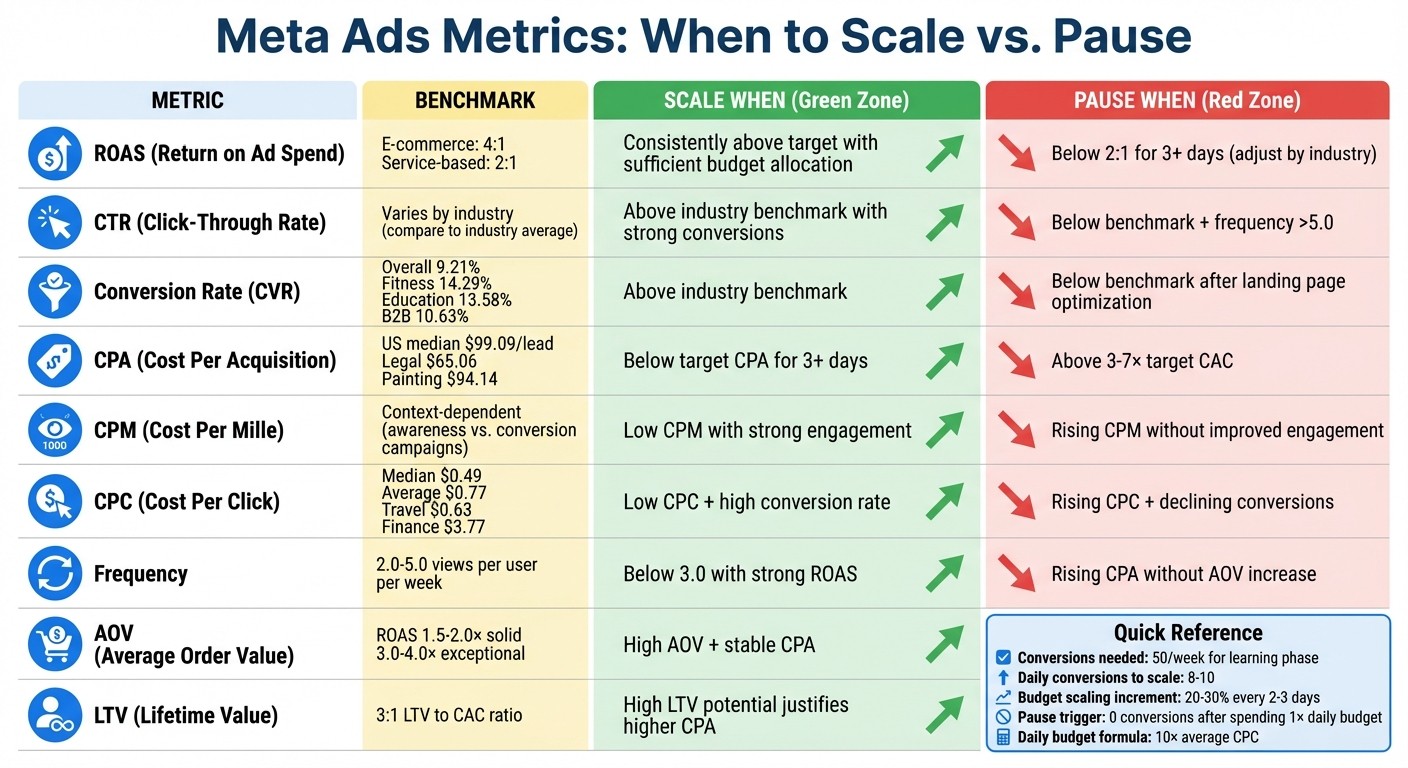
Meta Ads Performance Metrics: Benchmarks and Action Thresholds
The table below provides a quick snapshot of key benchmarks to guide your decisions. Keep in mind that context is crucial - sometimes a higher CPA (Cost Per Acquisition) is acceptable if the overall performance justifies it. As Emanuela Escalante, Senior Paid Social Account Manager at ASK BOSCO®, explains:
"ROAS alone doesn't show you how efficiently traffic is converting"
Before making any final decisions, cross-check these metrics to ensure you're aligning with your goals. You can also leverage AI to analyze historical data for more precise optimization.
Metric | Typical Benchmark | Threshold to Scale | Threshold to Pause |
|---|---|---|---|
CPA | Industry-specific | Below target CPA for 3+ days | Above 3–7× target CAC |
Frequency | 2.0–5.0 | Below 3.0 | Above 5.0 (creative fatigue) |
Conversions | 50/week (Learning) | 8–10 per day | 0 after spending 1× daily budget |
For optimal results, ensure your ad set achieves at least 10 conversions through accurate conversion tracking and maintains stable performance over 3–7 days. Gradually scale budgets by 20%–30% every 2–3 days to protect the learning phase, or set guardrails to automate these adjustments. On the other hand, pause an ad set using automated campaign pausing if it spends 3–7× your target CPA without meeting benchmarks, or if it spends $10 without generating any conversions.
When setting your daily budget, aim for at least 10× your CPC benchmarks. For instance, if your CPC is $5, a daily budget of $50 would be ideal to support optimization efforts.
Using AI to Automate Ad Set Prioritization
Managing ad sets manually can be a serious time drain, especially when you're juggling metrics like CPA, frequency, ROAS, and conversion rates across dozens of campaigns. That's where platforms like AdAmigo.ai step in, offering a streamlined solution. It continuously tracks these key metrics and delivers a daily, auto-prioritized to-do list. Whether it's scaling high-performing ad sets, pausing underperformers, or reallocating budgets to maximize conversions and ROAS, this tool helps you make impactful adjustments effortlessly.
The standout feature, AI Actions, takes things further by analyzing real-time performance data and generating tailored recommendations. You can either approve these suggestions with a single click or let the system handle them autonomously. According to Sherwin S., a G2 reviewer:
"AI recommendations are spot-on (…) It's like having an extra set of super-smart hands helping me hit my KPIs"
And the results speak for themselves - users have reported an 83% improvement in ROAS within just the first week of using the platform.
Unlike manual vs AI budget testing methods found in traditional rule-based tools, AdAmigo.ai functions as a dynamic learning system. It adapts its strategies based on real-world outcomes while respecting your budget caps, geo restrictions, and Advantage+ vs manual placement rules. The AI doesn’t just flag issues like high CPAs; it actively reallocates spend toward ad sets that align with your goals. Plus, it tests new audiences and creatives to replace those that are no longer performing well.
Getting started is simple: connect your Meta ad account, define your KPIs (e.g., "Scale spend 30% at ≥3× ROAS"), and review the daily feed of recommended changes. You can either approve the tweaks manually or let the AI take the reins completely, freeing you up to focus on the bigger picture.
Conclusion
Keeping track of the right metrics transforms ad set prioritization into a AI-driven prioritization strategy. Metrics like ROAS, CPA, CTR, and conversion rates work together to paint a clear picture of performance. By comparing Meta ad metrics as a group, you can quickly spot which ad sets deserve more investment and which ones are draining your budget. The line between a successful campaign and wasted ad spend often comes down to focusing on the numbers that align with your specific goals. Understanding ROAS benchmarks by industry can help you determine if your current performance is truly competitive.
While managing a handful of ad sets manually might be feasible, scaling up makes it nearly impossible without help. Take Signal Theory Inc., for example. They managed to slash their reporting time from four hours to just 30 minutes, as Analyst Shayna Tyler explained:
"Reports that used to take hours now only take about 30 minutes. We're reporting for significantly more clients, even though it is only being handled by a single person. That's been huge for us."
This push for efficiency highlights the growing importance of automation. Beyond saving time, automation boosts accuracy and eliminates the risk of human error. With CPC for lead campaigns projected to rise by about 20% in 2025, getting optimization right is more critical than ever for staying profitable.
Tools like AdAmigo.ai take this a step further by continuously analyzing metrics and delivering daily, customized optimizations. They automatically scale high-performing campaigns and pause those that underperform. Unlike static, rule-based systems, these platforms learn and adapt based on real-world results, ensuring your campaigns stay sharp and effective.
FAQs
How do I manage ad frequency on Meta to prevent audience fatigue?
To keep your Meta ads performing well, it's crucial to manage ad frequency and its effect on results. When users see the same ad more than 3-4 times per week, you’ll likely notice a drop in click-through rate (CTR) and a rise in cost-per-action (CPA) - clear signs of ad fatigue. To stay ahead, use Ads Manager to monitor the Frequency column. If needed, set a frequency cap in the ad set settings, such as limiting impressions to 3 per user per week.
Pay attention to early indicators like decreasing CTR, increasing CPA, or Meta flagging your ads with a “Creative limited” or “Creative fatigue” status. To combat this, refresh your creatives regularly. A good approach is running 4-8 different ads within the same ad set, allowing Meta to automatically favor the top performers. Smaller, more specific audiences may require quicker creative updates compared to broader groups.
Tools like AdAmigo.ai can simplify this process. They can track frequency, alert you when limits are reached, and even suggest or launch new creatives. By staying on top of frequency, setting caps, and rotating ads, you can keep your campaigns performing at their best while avoiding ad fatigue.
What should I do if my cost per acquisition (CPA) is increasing but my return on ad spend (ROAS) is still strong?
If your ROAS is performing well, it’s smart to keep the ad set active while finding ways to bring down the CPA. You can start by refining your audience targeting, experimenting with new creative assets, and fine-tuning your bids or budget distribution. Tools like AdAmigo.ai offer AI-driven automation to handle these optimizations, helping you save time and boost results. By making the right tweaks, you can stay profitable even as costs increase.
How does knowing customer lifetime value (LTV) help with ad budget planning?
Understanding customer lifetime value (LTV) is a game-changer when it comes to making informed decisions about your ad budget. It gives you a clear sense of how much you can afford to spend to bring in a customer while still turning a profit. With this insight, you can direct your budget toward ad sets that not only recover costs but also contribute to your bottom line.
LTV also helps you steer clear of wasting money on audiences that don’t bring much value. Instead, you can focus on scaling campaigns aimed at high-value customers, paving the way for steady, long-term growth.