
AI-Powered Retargeting for Meta Ads
Use Meta Pixel and Conversions API with AI to retarget visitors, personalize creatives, optimize bids, and boost ROAS while reducing ad costs.
AI-powered retargeting on Meta platforms like Facebook and Instagram uses tools such as Meta Pixel and Conversions API to reconnect with users who’ve already shown interest in your brand. By leveraging AI, this approach delivers personalized ads at scale, improves ad performance, and reduces costs.
Key benefits include:
Retargeted users are up to 70% more likely to convert than cold audiences.
AI-driven campaigns can achieve up to 8x lower cost-per-click.
Tools like AdAmigo.ai automate audience targeting, ad creation, and budget management.
How it works:
Data Collection: Meta Pixel and Conversions API track user actions (e.g., cart abandonment, product views).
Audience Segmentation: AI builds custom and lookalike audiences for precise targeting.
Campaign Optimization: AI adjusts budgets, tests creatives, and scales high-performing ads in real-time.
AI simplifies retargeting by automating tasks, improving ROAS while scaling, and saving time, making it a game-changer for businesses of all sizes.
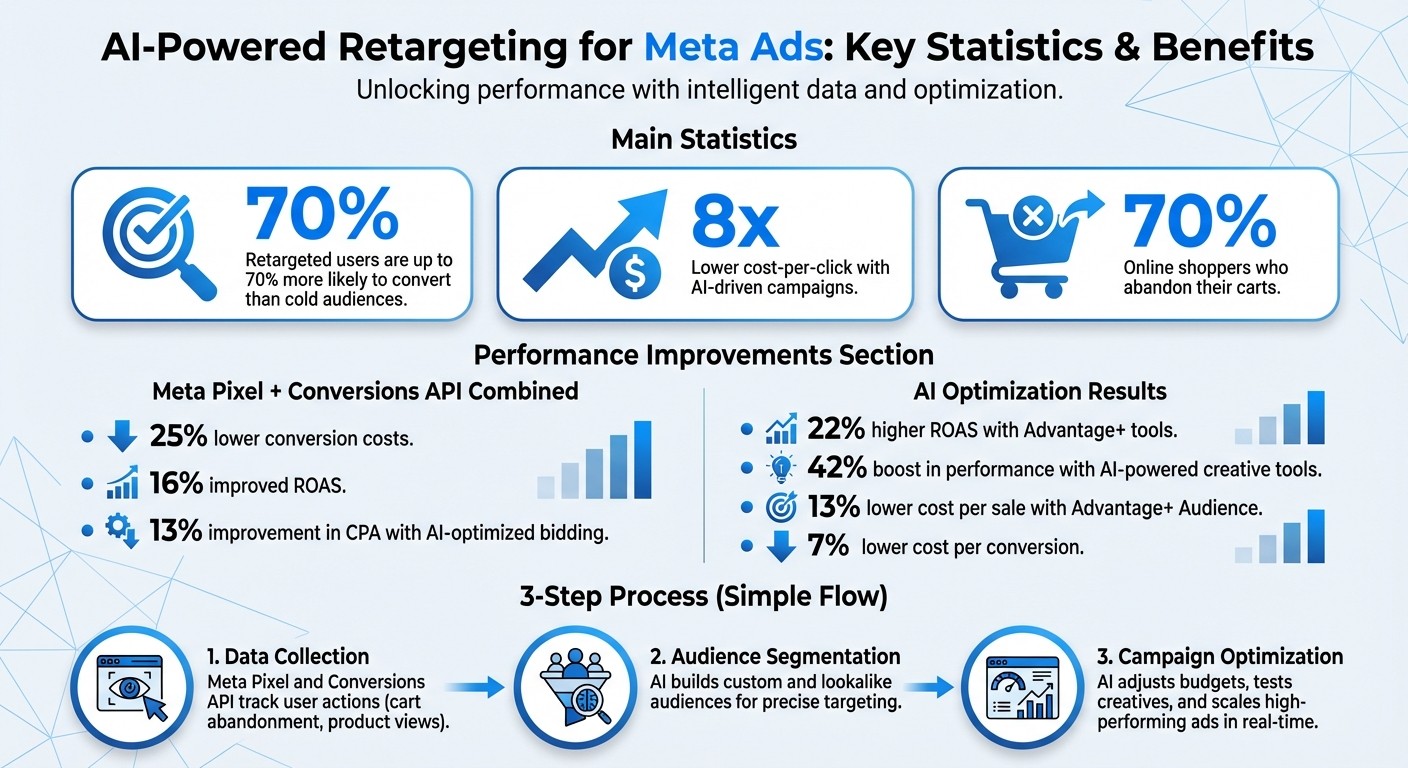
AI-Powered Retargeting Key Statistics and Benefits for Meta Ads
Setting Up AI-Powered Retargeting
Installing the Meta Pixel and Conversions API
For AI to optimize retargeting effectively, it needs precise, real-time user data. Start by installing the Meta Pixel for browser-based tracking and pairing it with the Conversions API (CAPI). This setup ensures data flows seamlessly, even if users block cookies or opt out of iOS tracking due to ATT restrictions.
Why this matters: Combining the Meta Pixel with CAPI can lower conversion costs by 25% and improve ROAS by 16%. This dual approach ensures your AI systems continue receiving critical event data, allowing them to refine audience targeting and deliver ads that resonate.
Here’s how to begin: Go to Meta Events Manager, create a new Pixel, and embed the base code into your website’s header. Next, connect CAPI through your e-commerce platform, such as Shopify or WooCommerce, or opt for a server-side integration. Enable Advanced Matching to securely share hashed visitor details (like email addresses or phone numbers), which helps Meta identify users across devices more effectively.
Once your data collection system is in place, shift your focus to tracking the most impactful user actions.
Event Tracking and Data Collection
AI thrives on high-value signals, such as "Add to Cart", "Initiate Checkout", "Purchase", or "Lead Submissions." These events provide actionable insights, unlike generic page views.
To ensure accurate tracking under Apple’s ATT framework, verify your domain in Meta Ads Manager and prioritize key events. Meta’s Event Setup Tool simplifies this process with a user-friendly, point-and-click interface - no coding required.
For dynamic retargeting, keep your product catalog synced in real time. This allows you to serve personalized ads while excluding users who’ve already converted (e.g., "Recent Purchasers"), ensuring your budget is spent wisely.
Reliable data is the backbone of effective AI performance, so maintaining its accuracy is critical.
Maintaining Data Accuracy
Tracking errors, like incomplete or duplicate data, can disrupt AI performance. Use tools like the Meta Pixel Helper and the Test Events tab to regularly check event accuracy. If you’ve implemented both manual and automatic tracking, audit your setup to avoid double-counting conversions, which can mislead AI models and inflate costs.
To prevent ad fatigue, set frequency caps in Ads Manager to manage audience fatigue. While retargeting ads are 76% more likely to get clicks than cold ads, overexposure can harm your brand’s image. And don’t forget transparency - your privacy policy must clearly state that visitor data may be used for retargeting and advanced matching. This isn’t just ethical; it’s also required by GDPR and Meta’s guidelines.
With a clean and reliable data pipeline feeding into Meta’s platform, AI tools like AdAmigo.ai can take over. These systems can fine-tune audience segments, create high-performing ads, and manage budgets - all in real time, freeing you from manual adjustments.
Building Retargeting Audiences with AI
Creating Custom and Lookalike Audiences
Once your tracking setup is in place, you can start building custom audiences based on specific user behaviors. For example, Meta's Pixel allows you to group visitors into categories like "all website visitors in the last 30 days", "cart abandoners who didn’t purchase within 7 days", or "past purchasers" for upselling campaigns. Targeting these warm audiences can significantly improve conversion rates.
Lookalike audiences take this a step further by using Meta's AI to identify new users who share traits with your most valuable customers. A good starting point is a 1–2% lookalike audience created from high-value converters, such as those who completed purchases or submitted leads - ideally with at least 100 events to work from. Be sure to exclude the source audience to avoid overlap. This strategy helps you scale retargeting efforts while keeping your ads relevant, often leading to better ROAS through Meta's AI-driven pattern analysis.
Meta's machine learning technology tracks user actions in real time across devices, eliminating the need for manual intervention. Platforms like AdAmigo.ai go even further by studying your brand, analyzing competitors, and creating audience segments that can be directly imported into your ad account with just one click.
Once your segmented audiences are set, AI takes over to refine these groups for even more precise targeting.
Using AI to Refine Audience Segments
After setting up broad audience groups, AI can fine-tune these segments based on behavioral details like product preferences, visit frequency, or purchase intent. This allows for hyper-targeted ads that feel more personal and relevant.
For example, AdAmigo.ai continuously analyzes the performance of your ads and competitor data to dynamically adjust audience segments, improving ad relevance and boosting conversions. Similarly, Meta's Andromeda AI processes millions of ads in milliseconds, building detailed user profiles by analyzing behavior, ad creatives, and business factors like pricing and inventory. This real-time optimization can significantly reduce costs - some advertisers have reported 22% lower CPAs by using predictive models to identify likely buyers early in the process.
The quality of your first-party data matters here. By comparing the Meta Pixel and Conversions API, you can ensure cleaner data, which sharpens your audience segmentation. In fact, Meta's AI has demonstrated 6% better retrieval recall and 8% higher ad quality when powered by accurate data signals.
Advantage+ Audience Expansion
Meta’s Advantage+ Audience Expansion builds on effective segmentation by using AI to extend your reach beyond predefined audiences, like custom retargeting groups, to find users with similar high-potential traits. This system optimizes targeting, bidding, and ad delivery in real time, often improving both reach and ROAS. Advertisers using Advantage+ tools have reported 22% higher ROAS compared to manual targeting methods.
Here’s how it works: you define a core retargeting audience, and Advantage+ identifies additional users who exhibit similar behaviors to your converters.
AdAmigo.ai works hand-in-hand with Advantage+ by generating AI-driven audience recommendations and ad creatives that align with your campaign rules - such as geographic targeting, budget constraints, and pacing. AdAmigo refines these segments daily, while Advantage+ expands your reach, creating a seamless system that tests and scales successful campaigns faster than traditional workflows.
"The fact that you can launch campaigns through text or voice commands feels like magic! It handles everything from creating lookalike audiences to adjusting budgets with just a few prompts." - Jakob K., G2 Review
Audience Type | AI Role | Key Benefit |
|---|---|---|
Custom (e.g., cart abandoners) | Analyzes Pixel data for behavior-based segments | Targets high-intent users, boosts conversions |
Lookalike | Builds from customer data, predicts similarities | Expands reach to new high-value prospects |
Advantage+ Expanded | Automates testing and scaling across placements | +22% ROAS, broader performance |
AI Strategies for Campaign Optimization
Automated Creative Generation
AI has revolutionized how creative content is produced for campaigns. By examining your brand identity, competitor trends, and past ad performance, AI can generate tailored, conversion-focused images and videos with just a single prompt. For retargeting campaigns, this means creating personalized ads at scale - like dynamic ads for cart abandoners that highlight the exact products they viewed, paired with time-sensitive discount messaging designed to boost conversions.
Take AdAmigo.ai, for example. It tests hundreds of creative variations across platforms like Facebook Feed, Instagram Stories, and Audience Network. Winning creatives are automatically scaled while underperforming ones are paused, ensuring your ads stay fresh and relevant. This real-time optimization helps combat ad fatigue. In fact, advertisers using AI-powered creative tools have reported a 42% boost in performance by leveraging competitor trend insights in their strategies.
"The AI actions are spot-on, so I can make adjustments fast and see results right away. It's like having an extra set of super-smart hands helping me hit my KPIs." - Sherwin S., G2 Review
Once creatives are optimized, the next step is fine-tuning your budget and bidding strategies to maximize returns.
Budget and Bid Optimization
AI takes the guesswork out of budget management by monitoring campaign metrics in real time and reallocating spend to top-performing ads automatically. Tools like AdAmigo.ai's AI Actions offer a daily prioritized to-do list, suggesting impactful budget and bid adjustments while adhering to your pacing, geographic, and placement rules. Predictive analytics further enhance this process by identifying which retargeting segments - such as cart abandoners versus product viewers - are most likely to convert at the lowest cost, then allocating spend accordingly.
Meta's AI-powered smart bidding adjusts bids in real time based on conversion likelihood, delivering impressive results. Retargeting campaigns often achieve up to 8× lower cost per click compared to cold prospecting. Additionally, advertisers who combine the Conversions API with AI-optimized bidding have seen a 13% improvement in cost per action. Built-in anomaly detection also safeguards your budget by catching issues like spend spikes or broken links before they can drain resources. This constant monitoring is crucial in adapting to fluctuating bid competition and user behavior.
With creative and budget efficiencies in place, AI takes campaign refinement a step further through dynamic A/B testing.
Dynamic A/B Testing with AI
Traditional A/B testing can be painfully slow, taking weeks to yield actionable results. AI accelerates this process by testing hundreds of variations simultaneously. It experiments with different combinations of headlines, images, audiences, and placements, scaling the best performers in real time based on engagement metrics like clicks and conversions.
For retargeting, AI can refine messaging for specific micro-segments. For instance, it can differentiate between cart abandoners who viewed items under $50 and those browsing premium products or tailor ads for users with varying visit frequencies. AdAmigo.ai's Bulk Ad Launch feature makes this even easier by enabling you to create dozens - or even hundreds - of Meta ads with the right copy, visuals, and targeting directly from Google Drive. The AI then continuously monitors and optimizes each variation. Advertisers using tools like Advantage+ - which automate audience targeting, budget allocation, and creative testing - have reported a 22% increase in return on ad spend (ROAS) compared to manual approaches.
AI Strategy | Key Mechanism | Reported Impact |
|---|---|---|
Automated Creative Generation | Tests creative variations and scales winners | 42% boost in performance |
Budget & Bid Optimization | Real-time budget shifts and predictive bidding | Up to 8× lower CPC; 13% better CPA |
Dynamic A/B Testing | Simultaneous testing with real-time scaling | 22% increase in ROAS |
AI also combats ad fatigue by dynamically adjusting frequency caps and rotating creatives based on user engagement. Considering retargeted users are up to 70% more likely to convert, keeping your ads fresh through automated testing ensures you maximize their intent without overwhelming your audience.
Measuring and Scaling AI-Powered Retargeting Campaigns
Key Metrics to Monitor
Tracking the right metrics is essential for spotting your top-performing retargeting campaigns. One of the most important is ROAS (Return on Ad Spend), which tells you how much revenue you're generating for every dollar spent. For retargeting campaigns, aim for a ROAS of 3× or higher, as you're targeting warm leads who already know your brand. Another key metric is CTR (Click-Through Rate), which measures how well your ads resonate. AI-driven personalization can significantly improve CTR by tailoring messages to specific groups, such as cart abandoners versus casual site visitors.
CPA (Cost Per Acquisition) is another critical metric, as it reveals how much it costs to acquire a customer. According to Meta, combining the Conversions API with AI-optimized bidding can lead to a 13% improvement in CPA. Retargeting also tends to be far more cost-efficient, reducing acquisition costs by up to 8× compared to cold prospecting.
Other metrics like cost per sale, conversion rate, and ad frequency are also worth monitoring. Setting frequency caps is particularly important, as they help AI manage ad exposure and prevent audience fatigue. Considering that 70% of online shoppers abandon their carts, tracking these numbers can be pivotal for recovering lost revenue.
Once you've fine-tuned these metrics, AI can take over budget allocation to scale your best-performing campaigns.
Scaling Successful Campaigns with AI
Manually scaling campaigns can be tedious and prone to mistakes. AI takes the guesswork out of the process by analyzing performance data in real time and reallocating budgets to ads with the highest ROAS. Meta's Advantage+ Audience tool, for example, learns which audience segments are most likely to convert, helping advertisers achieve 13% lower cost per sale and 7% lower cost per conversion.
Platforms like AdAmigo.ai make scaling even faster and more efficient. Its AI Actions feature delivers a daily list of suggested optimizations, such as adjusting budgets, expanding audiences, or swapping out underperforming creatives - all while respecting your campaign rules for pacing, geography, and placements. The Bulk Ad Launch tool also allows you to upload and launch hundreds of Meta ads directly from Google Drive in one go. From there, the AI monitors performance and scales the winners automatically.
"Our budgets are controlled, our spend is being smartly allocated and our ROAS is up massively. Agencies charging 7 times the cost of AdAmigo have been put to shame quite frankly!" - Rochelle D., G2 Review
These automated adjustments ensure your campaigns continue to improve and grow over time.
Using AI Insights for Continuous Improvement
The best AI tools don’t just automate tasks - they also provide actionable insights to refine your strategies. For instance, AdAmigo.ai's AI Chat Agent enables you to analyze real-time performance and quickly address questions like why your CTR has dropped or which audience segment isn’t delivering results. The AI works around the clock, monitoring your account 24/7 to catch issues like sudden spikes in ad spend, broken links, or disabled ads before they can hurt your performance.
This constant feedback loop allows you to refine your approach based on real-world data rather than static rules. By setting clear KPI goals (e.g., "Increase spend by 30% while maintaining a ROAS of 3× or higher") and reviewing daily recommendations, you can confidently approve or automate optimizations that drive consistent growth and profitability.
Why You Should Be Using AI Tools in Meta Ads Manager
Implementing these strategies is often most effective when using dedicated AI automation platforms designed for Meta's ecosystem.
Conclusion
By combining precise tracking with smart budget management, AI-powered retargeting transforms campaign performance on Meta. Tasks like adjusting budgets, testing ad creatives, or comparing AI and manual audience creation are no longer a guessing game - AI takes care of it all, around the clock. This means better results, improved ROAS, and more time to focus on big-picture strategy instead of tedious execution.
Platforms like AdAmigo.ai act as intelligent, hands-off media buyers. They dynamically optimize targeting, generate new creatives, and adjust bids and budgets - all while sticking to your campaign guidelines. For agencies, this means managing up to 4–8× more clients. For in-house teams, it frees up hours that would otherwise be spent on manual tweaks and adjustments.
The effectiveness of these tools isn’t just theoretical - real-world examples prove their impact. Simply connect your Meta account, define your KPIs, and let the AI fine-tune your campaigns. You can choose to approve changes manually or fully automate the process, with performance improving over time as the system learns what works best for your audience.
Whether you're targeting cart abandoners or reconnecting with past visitors, AI ensures your ads hit the right audience at the right moment. By continuously analyzing performance data and making adjustments, AI takes retargeting to a new level, offering a scalable solution that evolves with your needs.
FAQs
How can AI enhance retargeting ads on Meta platforms?
Meta's retargeting ads get a boost from AI by using live data to tweak budgets, bids, and audience targeting on the fly. This approach cuts down on ad fatigue, keeps engagement levels high, and helps you get the most out of your ad spend.
With automated optimizations and constant learning from campaign outcomes, AI keeps your ads sharp and relevant. The result? Less time spent managing campaigns and better overall performance.
What are the main advantages of using Meta Pixel and Conversions API for ad campaigns?
Using Meta Pixel and the Conversions API can give your ad campaigns a significant edge. These tools work together to refine targeting by offering detailed insights into user behavior, ensuring your ads connect with the right audience at the right time.
What’s more, they allow for real-time adjustments, so you can tweak your campaigns on the fly based on performance trends. This flexibility helps you stay ahead and make smarter decisions.
Another big win? Better attribution tracking. These tools provide a clearer understanding of what’s driving your conversions. With this knowledge, you can allocate your budget more effectively and fine-tune your ads to maximize performance - leading to a stronger return on ad spend (ROAS).
How does AI improve ad budget management and campaign performance?
AI takes ad budget management and campaign performance to the next level by analyzing live data and making real-time adjustments. It shifts budgets toward top-performing ads, adjusts bids for better results, and refines audience targeting to help you get the most out of your ad spend.
The best part? AI can deliver noticeable improvements in just a matter of days. By automating these time-consuming tasks, it frees you up to focus on the big picture - developing strategies - while ensuring your campaigns operate more efficiently and deliver smarter results.