
Vibe Marketing Autopilot for Meta Ads: AI Agents That Test Creatives and Optimize Your Account Daily
AI agents generate and test Meta ad creatives daily, reallocating budgets within brand guardrails to improve CTR, lower CPA, and speed content production.
Managing Meta ad campaigns is now simpler and faster with AI. Vibe Marketing Autopilot uses AI agents to handle tasks like ad creation, creative testing, and budget adjustments. You describe your brand tone (e.g., "confident and value-forward"), and the system generates ad content, optimizes performance daily, and ensures campaigns stay aligned with your goals.
Key Takeaways:
Automated Ad Creation: AI generates multiple ad variations (copy, visuals, hooks) based on your brand guidelines.
Daily Optimizations: AI analyzes performance data to suggest budget shifts, audience targeting tweaks, and scaling opportunities.
Human Oversight: You review daily recommendations or let the system run on autopilot, staying within set budget and performance limits.
Proven Results: Users report up to a 45% increase in click-through rates, 30% lower acquisition costs, and 80% faster content production.
This system simplifies campaign management, saves time, and helps marketers focus on strategy while AI handles the details.
How I trained AI to be my Meta Ads Media Buyer (it's been crazy)
Core Components of Vibe Marketing Autopilot
Vibe marketing autopilot brings together three AI-driven systems that manage everything from ad creation to real-time budget adjustments. These components work seamlessly to turn your strategic brief into optimized Meta ads, ensuring creative testing and daily campaign refinement.
AI Ads Agent: Creative Generation
The AI Ads Agent is your creative powerhouse, crafting platform-ready assets like TikTok scripts, Meta visuals, and captions that align with your brand's identity. Using its "Vibe Compiler", it takes a few descriptive inputs (e.g., "confident and value-forward") and generates multiple creative variations, including copy, imagery, and hooks. This eliminates the need for lengthy creative briefs while keeping your brand tone consistent and distinct from competitors.
The system analyzes top-performing ads and competitor content to uncover patterns that boost clicks and conversions. For example, FULLBEAUTY Brands leveraged Meta's AI-generated creatives tailored to their brand guidelines, achieving a 45% higher ROAS, a 22% increase in conversion rate, and a 36% rise in CTR compared to traditional manual approaches. Additionally, the AI Ads Agent includes a "Trend Radar" that tracks viral challenges and trending audio to keep campaigns fresh and engaging.
Once the creative assets are in place, the AI Action Agent steps in to optimize performance daily.
AI Action Agent: Daily Optimizations
The AI Action Agent functions as an automated media buyer, analyzing campaign data daily to optimize Meta ad performance through adjustments in budgets, targeting, and bidding. Through its Adaptive Budget Orchestration, it reallocates ad spend to the best-performing creative-audience combinations while adhering to your set CPA and ROAS limits.
Each morning, you’ll receive a prioritized list of suggestions, such as pausing underperforming audiences, scaling successful ad sets, or tweaking bids on high-performing placements. For instance, a supplement e-commerce brand faced a drop in ROAS from 1.35 to 0.75 after over-testing. By pausing all ads for 24 hours and relaunching a single ad set with 10 proven concepts, they rebounded to a 2.50 ROAS and reduced CPA from $87 to $29 in just five days.
The final piece, Agent Swarm Coordination, ensures all AI components work in harmony for consistent results.
Agent Swarm Coordination
This component synchronizes all AI functions - monitoring trends, generating and scaling creatives, and reallocating budgets. During the "Signal Ingestion" phase, agents assess performance data, audience feedback, and creative fatigue to deliver consistent messaging across all channels. Your natural-language brief is translated into actionable steps, ensuring alignment throughout the campaign.
Human oversight is incorporated through checkpoints, while the Policy & Constraint Engine enforces rules like CPA/ROAS limits, brand compliance, and geographic exclusions. This setup allows a single marketer to achieve the output of a five-person team, improving efficiency by 70–85%. The system can also integrate offline conversion data from your CRM, retraining models based on real revenue to create a closed-loop learning process.
For more insights on how these components work together, explore our dedicated resources: What is Vibe Marketing, Vibe Marketing Framework, and Vibe Marketing Tools.
How Vibe Marketing Autopilot Works
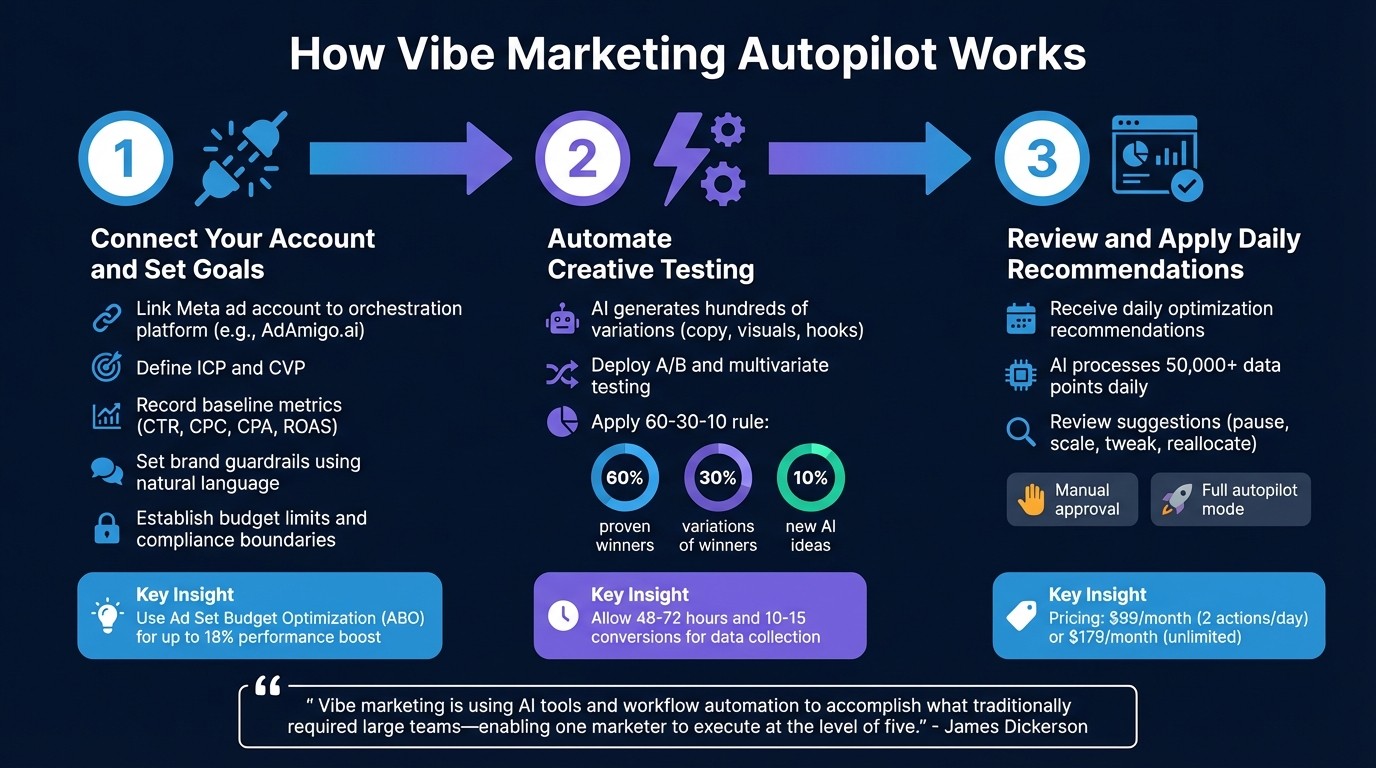
How Vibe Marketing Autopilot Works: 3-Step Implementation Process
This process blends automated creative testing with daily optimizations, all while aligning with your brand's strategic goals. By integrating with your existing Meta ad account, the system automatically generates creative variations and provides daily recommendations that you can either approve manually or let run on autopilot.
Step 1: Connect Your Account and Set Goals
Start by linking your Meta ad account to an orchestration platform like AdAmigo.ai. Define your Ideal Customer Profile (ICP) and Customer Value Proposition (CVP) to ensure the AI creates content tailored to your audience. Record your baseline metrics - CTR, CPC, CPA, and ROAS - to measure progress.
Next, establish your brand guardrails and budget limits. Using natural language prompts, describe your brand's tone (e.g., "confident and value-forward; avoid luxury or aloof tones"), and the system translates these into structured rules for copy, visuals, and hooks. You can also set parameters for manual reviews to keep the AI within your financial and compliance boundaries. Organize your Meta campaigns with Ad Set Budget Optimization (ABO) to avoid auction overlap and budget fragmentation. This approach can boost performance by up to 18% compared to running multiple testing campaigns.
"Vibe marketing is using AI tools and workflow automation to accomplish what traditionally required large teams - enabling one marketer to execute at the level of five." - James Dickerson, Co-creator of Vibe Marketing
With everything set, the system begins generating and testing creative variations right away.
Step 2: Automate Creative Testing
The AI Ads Agent creates hundreds of variations - copy, visuals, hooks, and captions - based on your brand guidelines and competitor insights. These variations are deployed through A/B and multivariate testing in a single campaign structure, avoiding resets in the learning phase. Stick to the 60-30-10 rule: allocate 60% of your budget to proven winners, 30% to variations of those winners, and 10% to entirely new AI-generated ideas.
Allow 48–72 hours and 10–15 conversions for the system to gather enough data before pausing new ads. Throughout this process, the AI tracks key metrics like CPC, conversion rates, and creative fatigue to identify the most effective creative-audience combinations.
Once testing is complete, the system moves into a continuous optimization phase.
Step 3: Review and Apply Daily Recommendations
Every morning, the AI Action Agent provides a list of optimization recommendations based on overnight performance data. These might include pausing underperforming audiences, scaling successful ad sets, tweaking bids, or reallocating budgets to focus on high-performing creative-audience pairings. The system processes up to 50,000 data points daily, such as engagement rates and auction trends.
You maintain control through human-in-the-loop approvals, allowing you to review and apply changes with one click (e.g., "Increase budget by $50/day on Ad Set 3 to capture more conversions at $22 CPA"). Alternatively, you can activate full autopilot mode, letting the system handle optimizations automatically while staying within your CPA and ROAS limits. Platforms like AdAmigo.ai offer plans starting at $99/month for two AI actions per day or $179/month for unlimited actions, making this system accessible for accounts spending under $5,000/month.
For a deeper dive into vibe marketing workflows, check out our guides on What is Vibe Marketing, Vibe Marketing Framework, and Vibe Marketing Tools.
Benefits of Vibe Marketing Autopilot
Vibe marketing autopilot offers a faster, smarter, and safer way to manage campaigns, building on its core workflow to deliver results without compromising your brand or budget. By automating tasks that once required entire teams, these systems ensure efficiency while keeping your brand voice consistent.
Faster Creative Testing and Results
Testing ad creatives manually can be a long process. You brief a designer, wait for mockups, run a few variations, and then wait weeks for enough data to make decisions. Vibe marketing autopilot speeds this up dramatically - turning weeks into hours. With the AI Ads Agent, dozens of ad variations, including copy, visuals, and hooks, are generated in minutes. These are then deployed through structured A/B tests, with performance insights available in just 24–48 hours.
One SaaS brand using vibe marketing AI for TikTok and Meta campaigns saw impressive results: a 45% increase in TikTok click-through rates, a 30% drop in cost per acquisition, and an 80% reduction in content production time. The system analyzes performance data and quickly identifies which creative works best for specific audiences - something that would take humans far longer.
"Manual Meta campaign management doesn't scale. At 20+ active campaigns, you're already underwater - toggling between ad sets, chasing creative fatigue, and making bid adjustments that are outdated by the time you implement them."
Angrez Aley, Senior Paid Ads Manager, Ryze AI
Autopilot systems also address creative fatigue, which now happens in weeks instead of months. These systems introduce fresh variations before performance dips, ensuring campaigns remain optimized and ready to scale.
Daily Optimization and Campaign Scaling
While traditional media buyers might make about 50 optimization decisions a day, autopilot systems handle these tasks continuously and in real time. They adjust bids, budgets, and audience targeting based on predictive data. Over the past two years, automated accounts have consistently outperformed manual ones, with cost efficiency gaps widening by 30–50%.
Scaling becomes hassle-free as these systems scale Meta ad budgets dynamically, based on live performance data. Tools like AdAmigo.ai start at $99/month for accounts spending under $5,000/month, making automation accessible for smaller budgets. For more guidance, check out resources like What is Vibe Marketing, Vibe Marketing Framework, and Vibe Marketing Tools.
Safety Through Brand Guardrails
Brand guardrails ensure that automation doesn’t compromise your budget or your brand identity. Before testing begins, you can set strict CPA and ROAS limits, daily spending caps, and tone-of-voice rules using natural language prompts (e.g., "confident and value-forward; avoid luxury or aloof tones"). These guardrails allow the AI to iterate quickly while staying within the boundaries you’ve defined.
"You cannot automate your brand promise. You cannot automate your brand purpose, and you cannot automate your brand voice. You have to take those steps first, then AI can [create] something that's uniquely yours."
Merry Carole Powers, Founder, Unicorn Kreative
Every draft, edit, and approval is documented through audit trails, ensuring accountability during compliance reviews. The system also monitors creative fatigue and suggests subtle shifts - like moving from an "aspirational" tone to a "practical premium" one - to maintain performance without manual oversight. This balance of speed and control lets you scale campaigns confidently, knowing your brand and budget are protected.
How to Implement Vibe Marketing Autopilot
Implementing vibe marketing autopilot revolves around setting up your brand's identity, integrating the right tools, and overseeing strategy while letting AI handle the details. The process is straightforward, and you can have it up and running quickly, with optimizations starting to show soon after.
Step 1: Set Goals and Define Boundaries
Start by setting clear boundaries for your AI agent. This begins with creating a "Vibe Brief" - a document that outlines your brand's personality in simple terms. Use 3–5 adjectives to describe your tone, like "confident, pragmatic, value-forward", and include one example of what your brand should not sound like. For instance, you might specify, "don’t sound luxury or aloof", to avoid conflicting tones.
"We noticed that moving from 'this is our vibe' to 'this is where our money goes today' was painfully slow. So we created vibe marketing... to remove that friction, merging creative intuition with hard-nosed optimization."
Shaan Bassi, CEO, Scalable
To make your brief even more effective, study how your audience communicates. Browse spaces like Reddit or niche forums to capture the language your customers use, and incorporate that into your brief. Revisit and update this document quarterly, adding notes like "more challenger energy" to reflect any shifts in your market.
Once your goals and restrictions are in place, you’re ready to integrate your Meta ad account through an AI platform.
Step 2: Connect with Tools like AdAmigo.ai
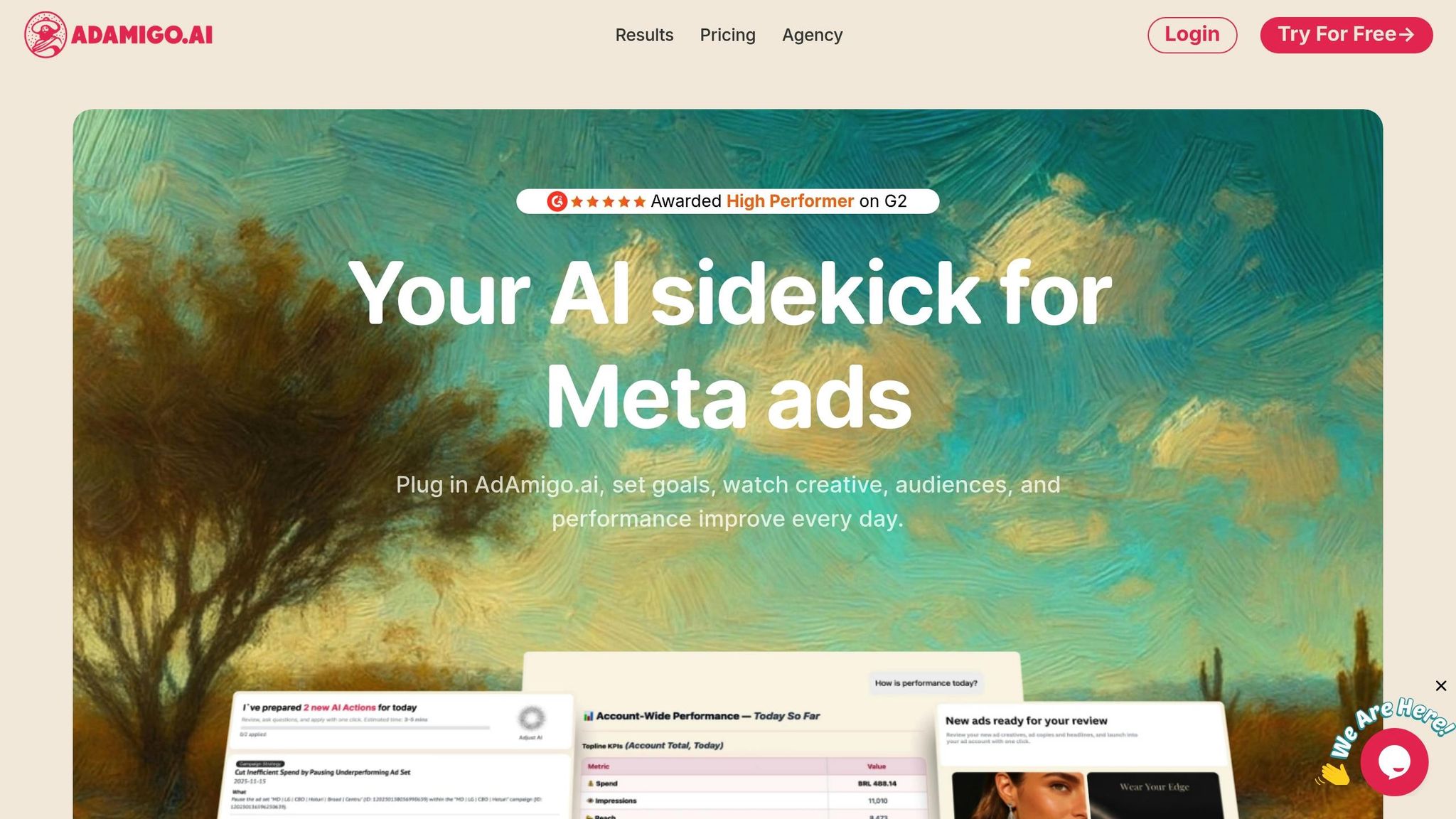
Next, link your Meta ad account to an AI-powered platform. Tools such as AdAmigo.ai make this step simple, allowing you to connect via API in just minutes. These platforms provide user-friendly dashboards where you can set brand rules, budget limits, and targeting preferences.
After connecting, the AI Ads Agent generates a variety of creative options, including ad copy, visuals, and hooks. Meanwhile, the AI Action Agent tracks key performance indicators like cost-per-click, conversion rates, and creative fatigue. For advanced setups, you can integrate CRM or offline conversion data to focus on profit rather than just clicks. The system ensures all your rules - like budget caps, pacing, and geo-targeting - are followed.
For teams managing multiple campaigns, this setup is a game-changer. A single media buyer can oversee four to eight times more accounts by letting AI handle execution while focusing on strategy. This shift allows you to step back from repetitive tasks and concentrate on the bigger picture.
With your tools in place, the next step is to ensure ongoing performance monitoring.
Step 3: Monitor and Refine Campaigns
Your role evolves into one of strategic oversight. Review daily AI recommendations for creative, audience targeting, budgets, and bids. You can approve, tweak, or publish these suggestions with a single click. This "human-in-the-loop" approach keeps you in control while the AI manages the heavy lifting.
Schedule weekly audits to review AI-generated summaries of customer feedback and performance trends. Most platforms provide daily health scores, which highlight urgent fixes and track campaign momentum, saving you from manual data analysis.
"The value is in knowing WHAT to build, not HOW to build it."
James Dickerson, Co-Creator, The Vibe Marketer
As your campaigns grow, the AI reallocates your budget toward the best-performing combinations of audience, creative, and messaging. This dynamic optimization ensures your investment focuses on what works, freeing you to plan for long-term growth.
For more insights on building a comprehensive vibe marketing strategy, check out What is Vibe Marketing, Vibe Marketing Framework, and Vibe Marketing Tools.
Conclusion
By leveraging the principles of automated creative testing and daily optimization tips, vibe marketing autopilot transforms the often time-consuming task of managing Meta ads into a process of strategic oversight. Through AI agents, it handles creative generation, variation testing, and budget optimization - delivering the output equivalent to a team of five to ten specialists, all while keeping you firmly in control.
Users frequently report higher click-through rates (CTR), reduced acquisition costs, and faster content production. These improvements come from an AI-driven system that continuously learns and reallocates budgets toward the most effective ad combinations automatically.
The human-in-the-loop setup ensures you maintain control by allowing you to define brand guidelines and review daily AI suggestions. This balance lets the AI handle repetitive tasks while you oversee the bigger picture.
As Meta continues its shift toward full automation, adopting AI-first workflows has become crucial for staying competitive. Tools like AdAmigo.ai make it easy to integrate these workflows, offering immediate optimizations and faster campaign rollouts. The result? More time for strategic planning, quicker launches, and campaigns that keep improving over time.
For more details, check out What is Vibe Marketing, Vibe Marketing Framework, and Vibe Marketing Tools.
FAQs
Is vibe marketing autopilot safe for my budget?
Vibe marketing autopilot takes the guesswork out of budget management with a mix of automated testing, daily recommendations, and human-in-the-loop oversight. This combination not only helps maximize efficiency but also keeps your ad spend under control, minimizing wasted resources.
What data is needed to optimize Meta ads?
To get the most out of Meta ads, the platform leverages a mix of creative assets, audience data, targeting settings, budget limits, and key performance indicators like CTR (Click-Through Rate), CPC (Cost Per Click), and ROAS (Return on Ad Spend). Additionally, it keeps an eye on real-time factors like trending topics and shifts in public interest to fine-tune ad strategies and targeting for better results.
How quickly will I see results?
You might notice some early boosts in ad performance within just a few days to a week after starting with vibe marketing automation. The bigger changes, however, usually become clear within 1 to 2 weeks as the AI agents fine-tune ad creatives and sharpen their targeting strategies.