
CBO Best Practices for Meta Ads 2025
Guide to Advantage Campaign Budget: setup, ad set structure, creative strategy, budget scaling, and key metrics for efficient ad campaigns.
Campaign Budget Optimization (CBO), now called Advantage Campaign Budget, is a system that automates how your ad budget is distributed across ad sets on Meta platforms. By analyzing real-time data like conversions and cost-per-acquisition, it reallocates funds to the best-performing ad sets, saving you time and Proper campaign setup and goal alignment are essential for this automation to work. improving efficiency. Here's what you need to know:
Best Use: Ideal for scaling campaigns with proven results or running long-term ads (e.g., lead generation). Not suited for small-scale or niche campaigns.
Setup Tips:
Use a weekly budget of at least 50× your target CPA for accurate learning.
Start with 3–5 ad sets targeting distinct audiences.
Follow the "72-Hour Rule" to let the algorithm stabilize before making changes.
Key Metrics: Focus on conversions, CPA, and ROAS. Use automated bid rules to adjust or pause underperforming ad sets that exceed your CPA target by 20%.
For better results, tools like AdAmigo.ai can automate tasks like launching ads, optimizing budgets, and refreshing creatives. You can also use a dynamic creative optimization checklist to ensure your assets are structured for the best performance. This allows advertisers to manage campaigns more effectively while focusing on strategy.
Should You Test Your Meta Ads with CBO or ABO and Why?

When and How to Use CBO
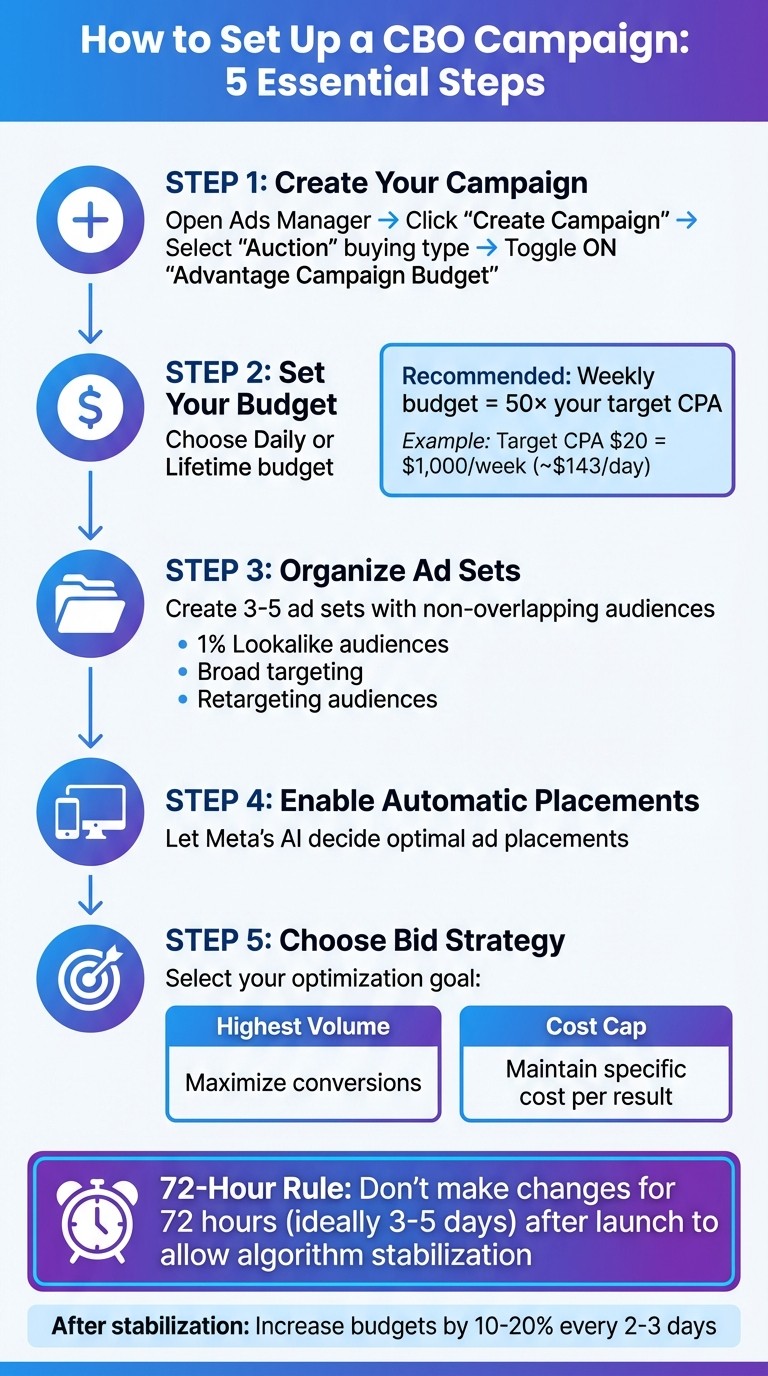
5-Step CBO Campaign Setup Guide for Meta Ads 2025
Best Scenarios for Using CBO
Campaign Budget Optimization (CBO) shines when it's time to scale campaigns that are already performing well. Instead of testing new ideas, CBO is ideal for amplifying the success of proven creatives or audiences. Meta’s internal data from April 2025 shows that switching to CBO resulted in a 17% increase in ROAS within six weeks.
CBO is particularly effective for evergreen campaigns - those consistent, long-term efforts like ongoing lead generation or e-commerce prospecting. It also works well for full-funnel strategies that blend cold prospecting with warm retargeting, especially when audience sizes are similar. For broader targeting, CBO pairs seamlessly with Meta's AI, allowing the algorithm to find potential converters in larger audience pools.
However, if you're working with lower conversion volumes - like niche B2B campaigns - it's better to stick with Ad Set Budget Optimization (ABO) for more precise control.
"CBO in Facebook ads automates budget distribution across ad sets using real-time performance data, making it ideal for scaling proven campaigns."
Ansherina Opena, Digital Marketing Expert
Now that we've covered when to use CBO, let’s break down how to set it up.
How to Set Up a CBO Campaign
Using automated budget rules for CBO’s reallocation can help you run campaigns more efficiently. Here’s a step-by-step guide to get started.
Create Your Campaign: Open Ads Manager, click Create Campaign, and select Auction as your buying type. Then, toggle on Advantage Campaign Budget.
Set Your Budget: Choose between a Daily or Lifetime budget. Daily budgets are more common for consistent pacing, but Meta suggests a weekly budget of at least 50 times your target CPA to give the algorithm enough data.
Organize Ad Sets: Create 3–5 ad sets with non-overlapping audiences (e.g., 1% Lookalike, broad targeting, retargeting). This ensures the algorithm can allocate budget effectively.
Enable Automatic Placements: Let Meta’s AI decide where your ads will perform best.
Choose a Bid Strategy: Select from options like Highest Volume (to maximize conversions) or Cost Cap vs Bid Cap strategies to maintain a specific cost per result.
Once your campaign is live, follow the "72-Hour Rule": avoid making changes to budgets or ad sets for at least 72 hours (ideally 3–5 days) to allow the algorithm to stabilize. Afterward, you can gradually increase budgets by 10–20% every 2–3 days to keep your campaign in the learning phase.
If an ad set - like one targeting a smaller retargeting audience - isn’t receiving enough budget, consider setting a Minimum Ad Set Spend Limit to ensure it gets adequate exposure.
Feature | CBO (Advantage Campaign Budget) | ABO (Ad Set Budget Optimization) |
|---|---|---|
Budget Level | Campaign level | Individual ad set level |
Best Use Case | Scaling proven winners and efficiency | Testing new audiences and creatives |
Control | Automated allocation | Manual, granular control |
Management | Low effort; "set-and-forget" | Higher effort; requires frequent adjustments |
Ad Set Structure and Creative Strategies for CBO
How to Structure Ad Sets
The backbone of any successful CBO campaign lies in how you organize your ad sets. Aiming for simplicity works best - stick to 2–5 ad sets per campaign. Each ad set should focus on a specific audience segment, like custom audiences, lookalike audiences, or interest-based targeting groups, to minimize overlapping impressions.
For 2025, broad targeting is the way to go. Meta's algorithm thrives when it has the freedom to explore larger data sets. Instead of narrowing down with hyper-specific interest groups, give the system room to identify converters within bigger audience pools. However, be cautious when combining vastly different audience sizes. For example, pairing a small retargeting group of 5,000 with a massive cold audience of 2 million can lead the algorithm to deprioritize the smaller set unless you implement budget controls.
To ensure success, each ad set must generate enough conversions to move past the learning phase. If an ad set struggles to get a meaningful budget allocation for over a week, it’s better to remove it - the algorithm has likely deemed it uncompetitive.
A well-organized ad set structure sets the stage for impactful creative strategies.
Creating High-Performing Creatives
In 2025, the quality of your creative content plays a huge role in how effectively your campaigns perform. A strong ad set structure allows your creative variations to shine.
"Creative is the new targeting."
Emanuela Escalante, Senior Performance Marketing Manager, Modo25
Each ad set should include 3–5 creatives, mixing formats like video, static images, carousels, and user-generated content (UGC). Design with mobile users in mind: vertical (9:16) for Stories and Reels, and square (1:1) or 4:5 for feed placements. For videos, grab attention within the first 3 seconds - those initial moments are critical.
Tailor your creative messaging to the audience’s stage in the funnel. Top-of-funnel creatives should focus on storytelling and addressing customer pain points, while bottom-of-funnel ads should highlight social proof, testimonials, or direct offers. Don’t assume video always outperforms static formats - a simple, sharp product image with a clear value proposition can sometimes deliver better results than flashy motion graphics. Test both options and compare them against creative testing benchmarks to see what resonates.
To avoid audience fatigue, refresh your creatives 2–4 times a month. When updating, reuse post IDs to retain likes and comments, which can increase click-through rates by up to 15%.
These steps ensure your creative strategy stays fresh and effective.
Using AdAmigo.ai for Creative Production
Managing the creative volume that CBO campaigns demand can be overwhelming, but AdAmigo.ai’s AI Ads Agent simplifies the process. This tool analyzes your brand identity and top-performing ads to generate on-brand creatives, ready to launch directly into your campaigns with just one click.
AdAmigo.ai’s Bulk Ad Launch feature allows you to deploy dozens - or even hundreds - of ad variations in seconds using a Google Drive spreadsheet. This eliminates the need to manually create each ad in Ads Manager. Additionally, its Autopilot Mode generates new ads weekly, helping you combat creative fatigue without constant manual effort.
For agencies juggling multiple clients or in-house teams with limited resources, AdAmigo.ai acts as a virtual media buyer. By automating execution tasks, one media buyer can manage 4–8× more clients, freeing strategists to focus on big-picture decisions. And with pricing locked at $99/month, it’s an affordable solution for scaling creative production.
Budget Management and Scaling Strategies
How to Set and Adjust Budgets
Start with a weekly budget that's at least 50 times your target CPA to give Meta's algorithm enough data to work with effectively. For instance, if your target CPA is $20, allocate at least $1,000 per week, which breaks down to around $143 per day. This ensures each ad set generates about 50 conversions per week - the minimum needed for optimal performance.
After launching your campaign, stick to the initial budget for 72 hours. This allows the algorithm to stabilize. Once your ROAS (Return on Ad Spend) remains steady, you can begin scaling gradually while monitoring for common performance issues. Advertisers who shifted to CBO and followed this pacing strategy reported an average 17% increase in ROAS within six weeks as of April 2025.
To avoid neglecting smaller or newer audiences, set daily minimums at the ad set level. For example, if your daily budget is $450 across three ad sets, assign a $100 minimum to each. This ensures all ad sets complete the learning phase while leaving room for Meta to optimize the remaining budget dynamically. Additionally, pause any ad set that exceeds a 20% increase over your target CPA once it hits the spend threshold. This keeps your budget focused on top-performing ad sets.
These strategies highlight the differences between CBO and ABO, making it easier to decide which approach fits your needs.
CBO vs. ABO: Key Differences
The choice between Campaign Budget Optimization (CBO) and Ad Set Budget Optimization (ABO) depends on your goals and how much control you want over your campaign. Here’s a quick breakdown:
Feature | CBO (Advantage Campaign Budget) | ABO (Ad Set Budget Optimization) |
|---|---|---|
Budget Control | Centralized at the campaign level with automated allocation | Manual allocation for each ad set |
Optimization | Real-time, algorithm-driven adjustments | Adjustments made manually by the advertiser |
Best Use Case | Scaling proven winners for broad objectives | Precision testing and A/B testing |
Management | Low effort; "set and forget" | Requires frequent monitoring |
Learning Phase | Faster, thanks to pooled data | Slower, as each ad set learns independently |
Cost Efficiency | Typically lower cost per result (around 27% less) | Higher costs due to static allocations |
CBO is ideal for scaling campaigns with minimal effort, while ABO offers more control, making it better suited for testing and fine-tuning specific variables.
Automating Budget Adjustments with AdAmigo.ai
Managing budgets just got easier with automation tools like AdAmigo.ai. Its AI Actions feature provides a daily to-do list with prioritized recommendations for budget adjustments, audience tweaks, and creative updates. The platform follows your pacing rules, geo restrictions, and placement settings, allowing you to stay in control while the AI handles the heavy lifting.
You can choose between Manual Mode, where you review and approve up to two daily suggestions, or Autopilot Mode, which automatically applies optimizations within your predefined limits. Plus, the AI Chat Agent lets you make budget adjustments across campaigns using simple text or voice commands - no need to juggle multiple dashboards.
For agencies managing several clients, this system enables a single media buyer to handle 4–8 times more accounts, freeing up time for strategic planning. At just $99/month, AdAmigo.ai is a cost-effective solution compared to hiring extra staff or relying on multiple tools.
Performance Monitoring and Optimization Techniques
Key Metrics to Track
When managing campaigns with Campaign Budget Optimization (CBO), it's crucial to focus on the right metrics. Start by monitoring total conversions and average CPA to gauge how well the algorithm performs overall.
Pay attention to frequency to spot ad fatigue early. Ideally, keep it between 1.5 and 3.0. If it exceeds 3.0, it often signals that the same audience is seeing your ads too often, which can drive up CPMs. If this happens, it’s time to refresh your creatives or broaden your audience to keep costs in check.
Another critical metric is ROAS (Return on Ad Spend). Aiming for a ROAS between 2.5× and 4.0× ensures automated budget distribution is delivering profitable results. If you’re tracking revenue, consider switching to the "Highest Value" bid strategy to prioritize high-value buyers. Additionally, breaking down performance by age, device, and placement can reveal which audience segments are most effective for future campaigns.
To avoid wasting your budget, set clear kill criteria: pause ad sets that exceed your target CPA by 20% after reaching a predetermined spend. This approach helps focus resources on what’s working while cutting out underperforming ads. These metrics are essential for guiding automated budget reallocations.
Using AdAmigo.ai for Performance Insights
Advanced tools like AdAmigo.ai simplify performance tracking and campaign adjustments.
With AdAmigo.ai’s AI Chat Agent, you can get instant, plain-language summaries of your campaign performance. For example, it can flag drops in ROAS or highlight top-performing placements. You can even adjust budgets across campaigns using simple text or voice commands.
The platform’s AI Actions feature provides a daily list of prioritized tweaks, covering creatives, audiences, budgets, and bids. In Manual Mode, you can review and approve up to two suggestions per day. In Autopilot Mode, the system automatically applies optimizations within your set parameters. It can create new ads weekly and scale budgets by 10–20% every 48 hours, but only when performance justifies it.
AdAmigo.ai also supports bulk operations, allowing you to launch hundreds of ads instantly. Its AI continuously reallocates budgets in real time, focusing on the most profitable opportunities by analyzing conversion volume and CTR. Many users have reported noticeable improvements in ROAS thanks to the platform’s ability to streamline real-time adjustments and optimize performance around the clock.
Conclusion: Simplifying CBO Management in 2025
This guide has walked through the steps to set up, fine-tune, and monitor Campaign Budget Optimization (CBO) for Meta ads. Now let’s explore how to simplify its management in 2025.
CBO has transitioned from manual adjustments to an AI-driven system that demands strategic oversight. The challenge lies in striking the right balance - comparing manual vs AI budget testing to maximize your spend while leveraging automation effectively.
Meta’s move to rebrand CBO as Advantage Campaign Budget features highlights its growing reliance on automation. AI now processes vast amounts of data at speeds no human could match, uncovering opportunities that might otherwise go unnoticed. As LeadEnforce notes, “The algorithmic speed of CBO often outpaces manual interventions, but this comes at the cost of control”. This shift allows advertisers to offload routine tasks to AI while maintaining overall strategic direction using automation rules for scaling.
Tools like AdAmigo.ai are designed to bridge this gap between automation and control. This AI-powered platform lets you ease into automation with Manual Mode, where you can review up to two AI-generated suggestions daily. Once you trust the system, you can switch to Autopilot Mode, which handles budget adjustments, creates weekly ad variations, and respects your set spending limits and performance targets. Its bulk launching feature enables you to deploy hundreds of ad variations in seconds, giving the CBO algorithm a broader pool to identify top-performing ads.
By embracing automation, you can shift your focus from day-to-day operations to broader strategies like creative development and scaling growth. Agencies have reported that automation tools allow a single media buyer to manage 4–8× more clients, thanks to reduced time spent on execution.
For success, set clear ROAS or CPA goals during the initial setup, and avoid interfering with the system during the first 3–7 days to allow it to learn and optimize effectively. With CBO, the emphasis moves away from constant monitoring and toward scaling winning campaigns.
FAQs
What’s the difference between Advantage Campaign Budget and traditional CBO?
Advantage Campaign Budget is Meta’s updated take on what was previously known as Campaign Budget Optimization (CBO). Its main goal? To streamline your ad budget management by automatically allocating funds across different ad sets based on how they’re performing.
This approach adjusts spending in real time, ensuring that your budget flows toward the ad sets delivering the best results. The idea is to make campaign management easier while aiming for a higher return on your investment.
What are the key steps for running a successful CBO campaign on Meta?
To make the most of your Campaign Budget Optimization (CBO) efforts on Meta, start by setting clear objectives and establishing a realistic budget at the campaign level. This approach allows Meta’s algorithm to distribute funds dynamically across ad sets, ensuring better performance while saving you valuable time.
Here are a few strategies to keep your campaign on track:
Avoid audience overlap: Group similar audiences together to minimize competition between your ad sets. This helps Meta’s system work more efficiently.
Refresh ad creatives regularly: Change your ad visuals and messaging every 7–14 days. This prevents audience fatigue and keeps engagement levels high.
Track key metrics: Keep an eye on metrics like CPA (Cost Per Acquisition), ROAS (Return on Ad Spend), and CTR (Click-Through Rate). Regular monitoring will help you tweak your strategy for better results.
If you're looking to take your campaign to the next level, automation tools can be a game-changer. Platforms like AdAmigo.ai use AI to continuously optimize your creatives, targeting, and budgets. This not only improves performance but also frees you up to focus on strategy rather than manual adjustments.
How does AdAmigo.ai improve my Meta ads' CBO performance?
AdAmigo.ai takes your Campaign Budget Optimization (CBO) campaigns to the next level by automating and fine-tuning essential parts of your Meta ads. Its AI-powered system dives deep into your brand, competitor strategies, and top-performing ads to create fresh ad creatives, sharpen audience targeting, and adjust budgets and bids in real time. This means you can focus on the big-picture strategy while the AI takes care of the heavy lifting.
What sets AdAmigo.ai apart is its adaptive learning agent, which evolves based on actual campaign performance. It continuously improves results and accelerates the growth of successful campaigns. By cutting down on manual tasks and ensuring round-the-clock peak performance, AdAmigo.ai helps you boost your ROAS while keeping costs in check, making your campaigns both smarter and more efficient.