
Meta Ads CPA Benchmarks 2026 — Marginal CPA vs. Average CPA & Industry Data
See how your Meta Ads CPA compares to 2026 benchmarks by industry ($38.19 median). Learn why marginal CPA — not average — decides whether you can scale profitably, and how to calculate yours.
Cost-per-acquisition (CPA) is the key metric for Meta advertising success in 2026. It represents how much you spend to acquire a customer or lead. The median CPA across industries is $38.19, but this varies widely based on factors like industry, competition, and sales cycles. Here's what you need to know:
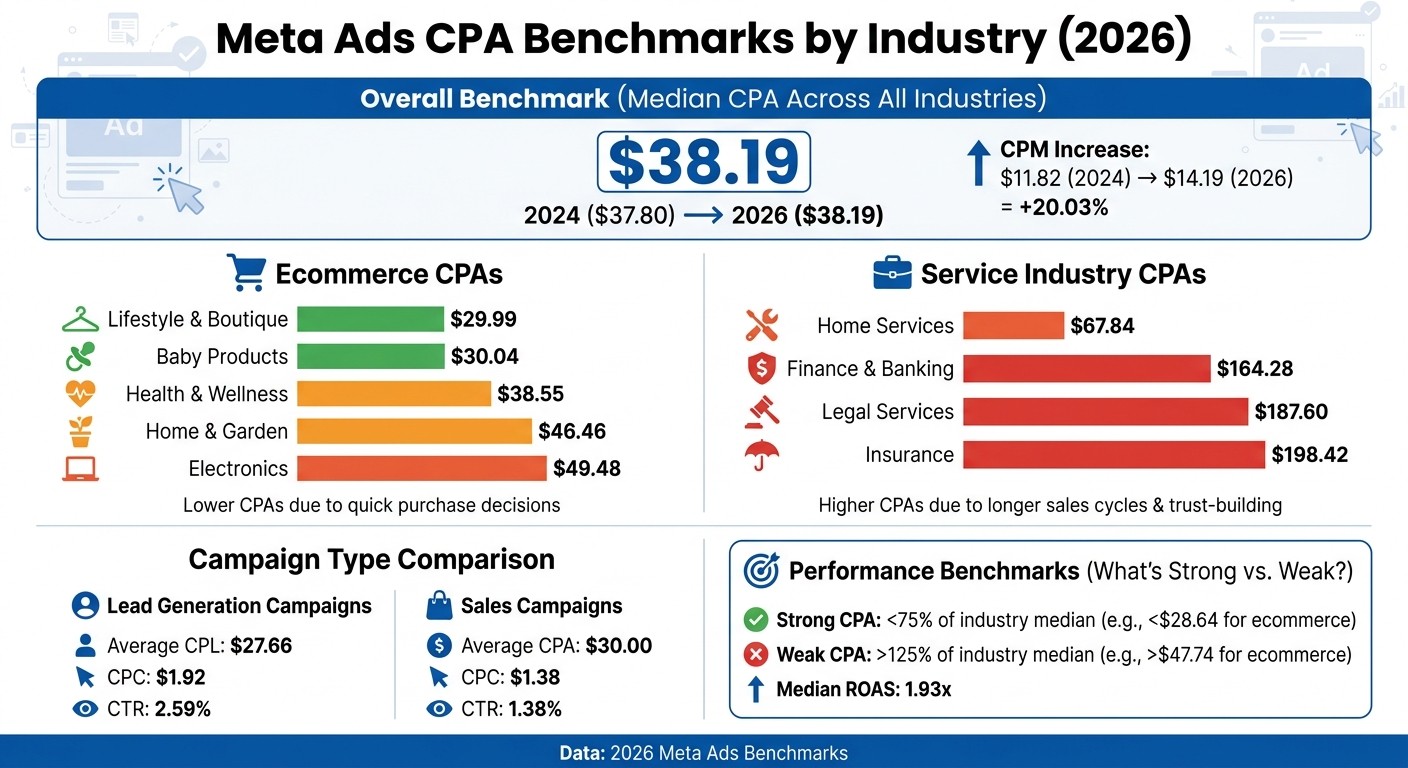
Ecommerce CPA: Lower due to quick purchases. Median is $38.19, with categories like Lifestyle & Boutique at $29.99 and Electronics at $49.48.
Service Industry CPA: Higher due to longer decision-making and trust-building. Examples include Legal Services at $187.60 and Insurance at $198.42.
Sales vs. Lead Generation: Lead generation campaigns average a CPL of $27.66, while sales campaigns average a CPA of $30.00.
Automation tools like AdAmigo.ai are helping businesses lower CPAs by optimizing ad performance, saving time, and improving results. For example, brands using AdAmigo.ai reported up to 73.4% higher ad spend scaling (learn how to scale budgets) and significant time savings. Tracking Meta ad metrics like ROAS benchmarks and creative performance alongside CPA ensures campaigns stay profitable.
Meta Ads CPA Benchmarks by Industry 2026
2025 Meta Ads Benchmarks by Industry (CTR, CPC, CPM, CPL & ROAS)
CPA Benchmarks by Industry
Cost per acquisition (CPA) can differ greatly depending on the industry. Factors like product pricing, competition levels, and customer lifetime value all play a role. Advertisers often focus on ROI optimization to balance these costs. For example, in 2026, the median CPA for Meta Ads across all industries is $38.19, a slight increase from $37.80 in 2024. This is notable considering CPMs (cost per thousand impressions) jumped by 20.03% year-over-year, rising from $11.82 to $14.19. Interestingly, brands that excelled in creative optimization managed to absorb these rising costs with minimal impact on their CPAs.
Below, we break down CPA benchmarks by industry to give advertisers a clearer picture.
Ecommerce CPA Benchmarks
The ecommerce sector stands out for its relatively low CPAs, largely due to factors like impulse buying and the visual appeal of products. Categories such as Lifestyle & Boutique lead with a median CPA of $29.99, while Baby Products follow closely at $30.04. These segments benefit from having well-defined target audiences and high purchase intent, which makes conversions quicker and easier.
On the other hand, Health & Wellness has a CPA of $38.55, reflecting a 12.6% rise in 2025 due to increased competition in the market. Home & Garden sees a higher CPA of $46.46, driven by larger average order values and longer decision-making times as customers weigh their options. The Electronics category tops the ecommerce benchmarks with a CPA of $49.48, as buyers often engage in detailed product comparisons and require multiple interactions before purchasing.
Service Industry CPA Benchmarks
Service industries face a different set of challenges and generally experience higher CPAs compared to ecommerce. The nature of these services often involves longer decision-making cycles and higher customer lifetime values, which contribute to elevated acquisition costs.
Legal Services average a CPA of $187.60.
Insurance leads the pack with a CPA of $198.42.
Finance & Banking follows at $164.28.
Meanwhile, Home Services has a more moderate CPA of $67.84.
These higher costs stem from intense competition in ad auctions, regulatory limitations, and the need to build significant consumer trust in these sectors.
The stark contrast between ecommerce and service industry CPAs highlights how acquisition costs are tied to both the complexity of the decision-making process and the long-term value of the customer. While sectors like legal, insurance, and finance justify their higher CPAs with substantial revenue potential, localized services face less extreme - but still competitive - cost pressures compared to national or professional services.
What Counts as Strong, Average, or Weak CPA Performance
Understanding what qualifies as strong, average, or weak CPA (Cost Per Acquisition) is essential for advertisers looking to fine-tune their campaigns. A common way to evaluate CPA is by comparing it to industry benchmarks for CPM, CPC, and ROAS. For example, a CPA is often considered strong if it is less than 75% of the industry median and weak if it exceeds 125% of the median. Using this framework, if the median ecommerce CPA is $38.19, a strong CPA would be below $28.64, while a weak one would be higher than $47.74.
These benchmarks are helpful for spotting anomalies in performance with an ad performance benchmark tool but shouldn't replace an understanding of your unit economics. For instance, a CPA that seems high might still make sense if your profit margins support it. A luxury brand with an 80% gross margin might remain profitable with a 1.5x ROAS (Return on Ad Spend), while a dropshipping business with 30% margins would likely need a ROAS of 3.0x to stay afloat.
"Benchmarks are useful for one thing: spotting anomalies... but they should never be the thing you optimise toward. You optimise toward your own unit economics." - 27Five
Beyond CPA: Other Key Metrics
While CPA is a critical metric, it doesn't tell the whole story. Metrics like ROAS and conversion rates add important context. For example, the median ROAS is approximately 1.93x, but the ideal target varies depending on your margins. A business with 60% margins might only need a 1.67x ROAS to break even, whereas a company with 30% margins may require a ROAS closer to 3.3x. Additionally, tracking new customer acquisition cost (nCAC) separately from blended CPA can help ensure you're not just retargeting existing customers but are also driving genuine growth.
Creative Performance and CPA Trends
Creative performance signals can give early warnings about shifts in CPA. For instance, metrics like hook rate (targeting 30% or higher) and hold rate (25% or higher) often predict changes in CPA 5–7 days in advance. These indicators allow advertisers to make proactive adjustments to their campaigns. Another factor to watch is ad frequency - when it rises above 3.4, click-through rates can drop by as much as 41%, which typically drives CPAs higher.
Marginal CPA vs. Average CPA: Which One Should Guide Your Optimization?
Most advertisers track average CPA — total ad spend divided by total conversions. It's the number in your Meta Ads Manager dashboard, and it's what industry benchmarks (like the $38.19 median across this page) are built on. But average CPA is a blended number: it smooths out the variance between your cheapest and most expensive conversions.
Marginal CPA is different. It's the cost to acquire your next conversion — the incremental spend required to get one more purchase or lead at your current scale. If you're spending $500/day and getting 13 conversions (a $38.46 average CPA), but that 14th conversion costs you $55 in additional spend, your marginal CPA is $55.
Why marginal CPA matters more for scaling decisions. Meta's ad auction is inherently marginal — every additional dollar of budget competes in a progressively more expensive auction pool. Your average CPA might look healthy at $38 while your marginal CPA is already $55, meaning further scaling is unprofitable even though your dashboard looks fine. In fact, Meta's own Bid Strategy Guide explicitly names marginal cost as a required input for Bid Cap and ROAS Goal strategies — the platform itself treats marginal, not average, cost as the signal that matters most when bidding.
How to estimate your marginal CPA in practice. You don't need complex modeling. Three practical approaches:
Spend-level comparison: Compare CPA across ad sets at different daily budgets. If your $100/day ad set delivers a $32 CPA and your $200/day ad set delivers a $42 CPA, your marginal CPA for that extra $100 is roughly $52.
Day-part segmentation: If you scale budgets during specific hours, compare CPA in those hours versus your baseline to isolate the marginal cost.
Incremental budget tests: Increase spend on a winning ad set by 20–30% for 3–5 days and measure the CPA on only the incremental conversions gained.
Connecting marginal CPA to industry benchmarks. The benchmarks on this page — $38.19 median ecommerce CPA, $29.99 for Lifestyle & Boutique, $187.60 for Legal Services — are average CPAs across thousands of advertisers. They tell you whether you're competitive relative to your industry. But your own marginal CPA is what determines whether you can profitably scale. A home services company with a $67 average CPA (right at the industry median) might discover its marginal CPA is $89 — the benchmarks say "you're doing fine," but the marginal data says "don't scale further."
When average CPA still earns its place. Don't throw out average CPA. It's the right metric for monthly reporting, for benchmarking against competitors, and for high-level account health checks. Use average CPA to know where you stand; use marginal CPA to decide where to go next.
How Business Models and Sales Cycles Affect CPA
The type of business you run and the length of your sales cycle play a big role in shaping your Cost Per Acquisition (CPA). Take an ecommerce store selling a $50 skincare product - it operates on a completely different timeline compared to a B2B software company negotiating $50,000 annual contracts. These differences naturally lead to varying CPA benchmarks.
Sales cycle duration is a critical factor here. For ecommerce, transactions often happen within minutes or hours: a user sees an ad, clicks on it, and makes a purchase. On the other hand, B2B and SaaS sales cycles can stretch over weeks or even months. These longer cycles often require multiple touchpoints, product demos, and input from various stakeholders. For instance, a SaaS company might initially spend $150 to secure a demo request before investing further to close a $10,000 annual deal.
Ecommerce vs. B2B and SaaS CPA Differences
Ecommerce businesses benefit from a quick feedback loop. Since transactions happen so rapidly, platforms like Meta can quickly identify what drives conversions, allowing their algorithms to optimize campaigns efficiently.
In contrast, B2B and SaaS companies focus more on lead generation than immediate sales. This shift in focus leads to different CPA benchmarks. Recognizing these distinctions helps you set realistic campaign goals and adjust your campaign setup and goal alignment accordingly.
Sales Campaigns vs. Lead Generation Campaigns
Another key factor influencing CPA is the Meta ad campaign objectives you're running. Data shows that lead generation campaigns (average CPL: $27.66) tend to cost slightly less than sales-focused campaigns (average CPA: $30.00). Interestingly, while sales campaigns have a lower cost per click ($1.38) compared to lead generation campaigns ($1.92), lead generation campaigns boast a higher click-through rate - 2.59% versus 1.38%. This makes lead generation more effective for attracting attention at the top of the funnel.
For businesses selling high-ticket items or complex services, building a full-funnel Meta Ads setup can be a game-changer. Using lead generation to gather contact information and then nurturing those leads through email campaigns or retargeting often works better than pushing for immediate sales. Lead forms create less friction, leading to more conversions and a larger pool of prospects. These insights can help you design a more efficient funnel tailored to your business goals.
How AdAmigo.ai Reduces CPA Through AI Optimization
Cutting down your CPA often means spending hours testing creatives, adjusting budgets, and analyzing performance metrics. AdAmigo.ai simplifies this process with three AI-powered tools that handle the heavy lifting for you. Its AI Autopilot keeps a constant eye on campaigns, fine-tuning creatives, targeting, bids, and budgets around the clock. The Chat Agent allows you to launch and manage campaigns instantly with simple commands like "Start a new retargeting campaign." Meanwhile, the Creative Generation feature studies top-performing and competitor ads, producing engaging variations tailored to your goals. Together, these systems streamline campaign management and directly support lowering CPAs through AI optimization and smarter campaign management.
With hundreds of automated actions executed every month, AdAmigo.ai takes care of tasks like budget reallocation, creative testing, and audience refinement. This automation not only cuts acquisition costs but also frees up time for advertisers to focus on more strategic decisions. Case studies further illustrate how these tools translate into tangible performance improvements.
CPA Reduction Results from AdAmigo.ai Case Studies
Case studies highlight how AI optimization drives down costs. For example, ecommerce brand The Work Mat Co. switched from a paid media agency to AdAmigo.ai and saw impressive results. Using the AI Recommendation Agent, co-founder Rochelle Dallas oversaw 270 optimization actions within a month. The outcome? A 145.7% increase in purchases, a 28.3% boost in ROAS, and a 73.4% rise in ad spend scaling. On top of that, the automation saved about 33 hours of manual work.
"Our budgets are controlled, our spend is being smartly allocated and our ROAS is up massively. Agencies charging 7 times the cost of AdAmigo have been put to shame quite frankly!"
Rochelle Dallas, Founder, The Work Mat Co.
Similarly, premium skincare brand Dyut.eu utilized AdAmigo.ai's full autopilot mode, enabling it to operate independently. Over the course of a month, the system carried out 163 optimization actions, leading to a 67.8% increase in purchases, a 23% improvement in ROAS, and a 13.2% drop in cost per add-to-cart. This approach saved the team around 18 hours of manual work.
For additional success stories, visit the AdAmigo.ai case studies page.
What AdAmigo.ai Users Say
Numbers aside, user feedback paints an even clearer picture of AdAmigo.ai's impact. Here's what some users have to say:
"As a media buyer juggling tons of campaigns, AdAmigo.ai has been a total game-changer... the AI recommendations are spot-on, so I can make adjustments fast and see results right away."
Sherwin S., Media Buyer
Another user shared:
"The AI recommendations go beyond simply suggesting actions; they provide valuable insights and justifications. This not only improves my results but also deepens my understanding of campaign optimization."
Shubham, Co-Founder, Dyut.eu
For more firsthand accounts, take a look at the G2 Reviews.
Conclusion
CPA benchmarks offer a valuable starting point for assessing the performance of Meta ads. For ecommerce brands, the median CPA sits at $38.19, with ROAS typically ranging between 1.86x and 1.93x. Achieving results above these averages, while maintaining strong conversion rates and customer lifetime value, signals robust campaign performance. These benchmarks help shape realistic goals for your advertising strategies.
The business model and sales cycle play a major role in CPA variations. Ecommerce brands benefit from quicker purchase decisions and lower CPAs, while B2B and SaaS companies face longer sales cycles and higher acquisition costs. Additionally, seasonal trends can influence costs, making it crucial to anticipate and prepare for fluctuations throughout the year.
Automation has become a game-changer in managing these variables. Tools like AdAmigo.ai simplify the process by using AI-driven monitoring, bulk creative testing, and budget automation rules. This proactive approach tackles challenges such as creative fatigue and audience optimization before they hinder campaign performance. Implementing full-funnel AI optimization ensures every stage of the customer journey is covered.
With automated tools like AdAmigo.ai, advertisers can react quickly to market changes and maintain competitive CPAs. For instance, if performance metrics start to drop, refreshing ad creatives can help restore results. Focusing on key metrics for prioritization like new customer acquisition cost (nCAC) rather than blended ROAS ensures campaigns drive real growth.
To see how AI-powered optimization can elevate your campaigns, explore the AdAmigo.ai case studies or read user feedback on G2 Reviews.
FAQs
How do I find my break-even CPA?
To figure out your break-even CPA (Cost Per Acquisition), you'll need to determine the maximum amount you can afford to spend on acquiring a customer while still making a profit. Here's how to do it:
Calculate Customer Lifetime Value (LTV): This is the total revenue you expect to earn from a single customer over their entire relationship with your business.
Determine Your Profit Margin: Take the revenue per customer and subtract all associated costs (like product, service, and operational expenses) to see how much profit you're left with.
Look at Industry Benchmarks: Research average CPAs for your industry to see how your numbers compare.
For profitability, your CPA should always be equal to or less than your LTV.
When should I optimize for leads vs. purchases?
If you're looking to build relationships with potential customers over time - common in fields like healthcare or B2B services - focus on generating leads. This approach works well for industries with longer sales cycles, where nurturing contacts is key.
On the other hand, if your goal is to drive immediate sales, it's better to optimize for purchases. This strategy is ideal for shorter sales cycles, such as in e-commerce, where quick conversions are often the priority.
Whichever route you choose, make sure it aligns with your business model. Keep a close eye on performance metrics to ensure your campaigns are delivering the results you need.
How can AdAmigo.ai lower my Meta Ads CPA?
AdAmigo.ai helps lower your Meta Ads cost per acquisition (CPA) with AI-powered tools that optimize campaigns in real time. It takes care of tasks like adjusting bids, refining audience targeting, and testing ad creatives automatically. This approach not only reduces acquisition costs by up to 30% but also improves return on ad spend (ROAS). By simplifying the scaling process and cutting down on wasted ad spend, AdAmigo.ai makes customer acquisition more efficient with minimal manual work.