
How To Test Meta Ad CTAs for Better Conversions
Test and optimize Meta ad CTAs with A/B tests, track CTR/CVR/CPA, and scale winners to improve ROAS and conversions.
Want higher ad conversions? Start testing your Meta ad CTAs. Small tweaks like switching from "Learn More" to "Shop Now" can have a big impact - Shopify saw a 30% conversion boost in 2023 by refining their CTA. Optimized CTAs can increase click-through rates by 121% and reduce costs.
Here’s the process in a nutshell:
Pick CTAs based on goals: For e-commerce, test "Shop Now" or "Get Offer." For lead generation, try "Sign Up" or "Download."
Run A/B tests: Use Meta Ads Manager to test one variable (the CTA) at a time for at least 7 days.
Track key metrics: Focus on CTR, conversion rate, CPA, and ROAS to find what works.
Scale and refine: Use winning CTAs, gradually increase budgets, and keep testing.
Tools like AdAmigo.ai can automate and speed up testing, saving time while improving results. Don’t leave conversions to chance - start testing your CTAs today.
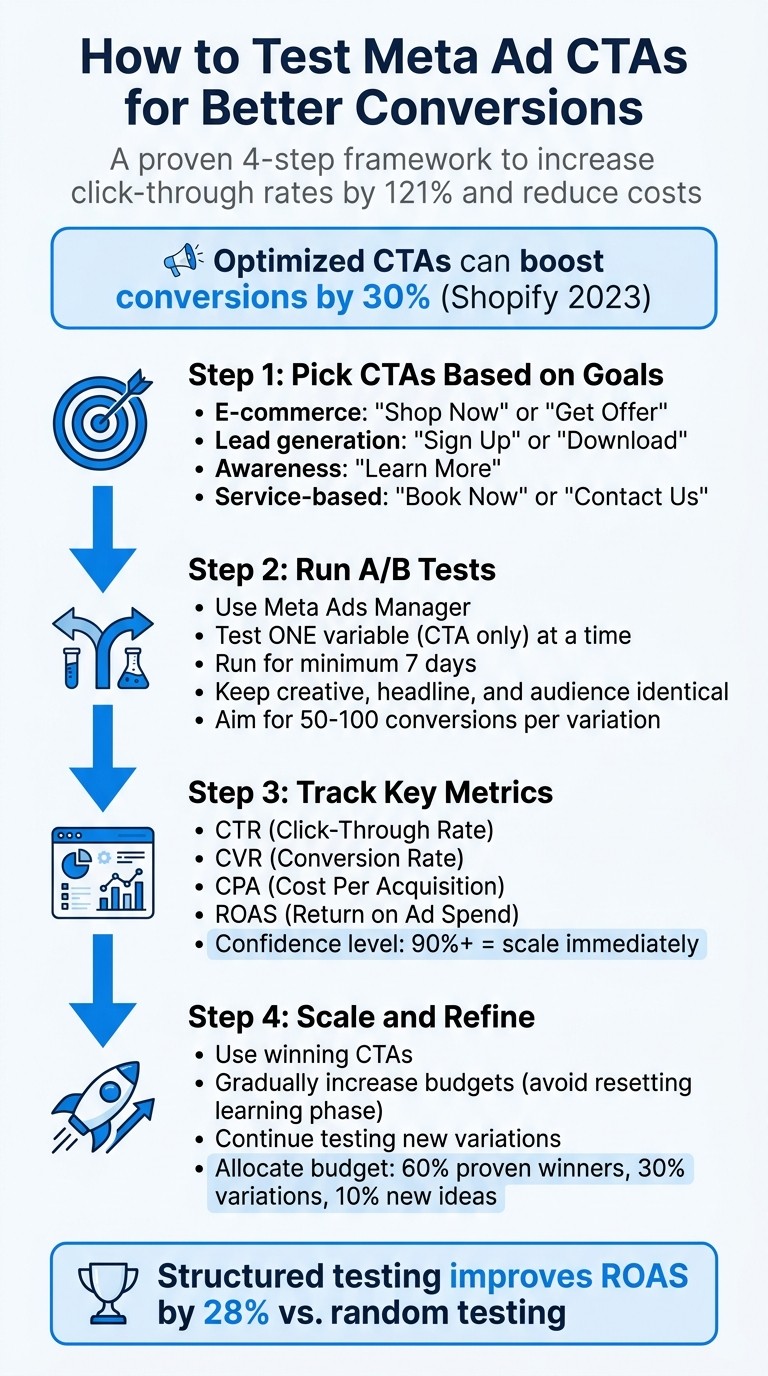
4-Step Process for Testing Meta Ad CTAs to Boost Conversions
Choosing CTA Variations to Test
Matching CTAs to Your Campaign Goals
Selecting the right call-to-action (CTA) is just as important as creating the ad itself. Your CTA button should feel like a natural extension of your ad's message, guiding users toward the next logical step - not just a random button slapped on at the end.
For e-commerce campaigns, focus on action-driven CTAs like "Shop Now", "Buy Now", or "Get Offer." These phrases are perfect for encouraging immediate purchases, especially when targeting audiences who are already primed to buy. On the other hand, for lead generation campaigns, opt for CTAs like "Sign Up", "Subscribe", or "Get Quote." These align with the lower level of commitment involved in sharing contact information compared to making a purchase.
If you're running awareness campaigns, your goal is to spark curiosity and build recognition. CTAs like "Learn More" work well here, as they invite users to explore without requiring a big commitment. For service-based businesses, options like "Book Now" or "Contact Us" help turn interest into action by encouraging direct engagement.
"The key to choosing a CTA is understanding your target audience's position in the buyer's journey. Match your CTA button to their readiness to convert." - Neil Patel, Digital Marketing Expert
Understanding where your audience is in the buyer’s journey is critical, whether you use AI or manual audience creation. Top-of-funnel audiences - those just discovering your brand - respond better to low-pressure CTAs. Meanwhile, bottom-of-funnel users - those closer to making a decision - are more likely to engage with direct, high-intent CTAs. Once your campaign goals are clear, you can create a list of CTA variations to test. For high-volume accounts, bulk ad testing with AI can speed up this process significantly.
Building Your CTA Test List
When testing CTAs, aim to include 3–5 variations. Testing too many can make the results harder to interpret, while testing too few limits what you can learn. A good test list should include a mix of direct-action and softer CTAs to see what resonates best.
Here’s an example of a strong test list based on campaign goals:
For e-commerce sales: Compare CTAs like "Shop Now", "Get Offer," and "Order Now."
For lead generation: Test options such as "Sign Up", "Get Quote", "Download," and "Learn More."
For service bookings: Try "Book Now", "Contact Us," and "Get Showtimes."
Keep one thing constant: only change the CTA. Headlines, creative elements, and audience targeting should remain the same. This ensures that any differences in performance can be attributed to the CTA itself. To get reliable results, aim for 50–100 conversions per variation before deciding on a winner. Anything less, and you risk basing decisions on incomplete data.
One practical limitation to keep in mind: platforms like Meta have a 15-character limit for CTA text in placements such as Stories, Reels, and Desktop Right Column. For example, "Subscribe Today" might get clipped, but "Subscribe" will fit perfectly. Plan your CTA text accordingly.
Campaign Goal | Recommended CTA Options to Test |
|---|---|
Online Sales / eCommerce | Shop Now, Get Offer, Order Now |
Lead Generation | Sign Up, Get Quote, Download, Learn More |
Service Bookings | Book Now, Contact Us, Get Showtimes |
Subscriptions | Subscribe, Start Free Trial, Join Now |
Once you’ve picked your CTAs, the next step is setting up these tests in Meta Ads Manager or using AI automation.
Setting Up A/B Tests in Meta Ads Manager
Using Meta's Split Testing Feature
To test different CTAs (calls-to-action), start by duplicating your ad sets and changing only the CTA. Go to your campaign in Meta Ads Manager, duplicate the ad set, and create new ads where the ONLY difference is the CTA. Keep everything else - creative, headline, body text, audience, and placement - exactly the same. (Choosing the best ad placements is critical for initial setup before testing.) This way, any variation in performance can be attributed solely to the CTA.
When editing your ad, look for the CTA dropdown under the ad preview section. For instance, one ad might feature "Shop Now", while another uses "Get Offer."
Avoid using Dynamic Creative for this purpose. While Dynamic Creative can be useful in other situations, it mixes variables, making it impossible to isolate the effect of a specific CTA. Instead, stick to manual A/B testing for clear and actionable results.
Setting Budget and Test Length
For accurate comparisons, assign equal daily budgets to each variation. Keeping the budget consistent across ads is essential for reliable data.
Run your test for at least 7 days. Meta explicitly recommends this minimum testing period, as shorter tests often result in unreliable conclusions. A full week captures user behavior across both weekdays and weekends, offering a more balanced view of performance.
"For the most reliable results, we recommend a minimum of 7-day tests. A/B tests can only be run for a maximum of 30 days, but tests shorter than 7 days may produce inconclusive results." - Meta Business Help Center
Your budget should also align with your conversion goals. For example, if your cost per acquisition (CPA) is $20 and you need 50 conversions per variation, you’ll want to allocate $1,000 to each variation. This ensures you gather enough data to make an informed decision. Research shows that 1 in 7 A/B tests fails because of insufficient testing time or a limited audience size. Patience is key here - don’t cut the process short.
Before launching, make sure your test audience isn’t being targeted by other active campaigns. Audience overlap can skew your results and lead to inaccurate conclusions.
Reading Results and Scaling What Works
Metrics to Track
After running a seven-day test, focus on four essential metrics to identify the best-performing CTA. Click-Through Rate (CTR) helps measure how compelling your ad is by showing how effectively it grabs attention and drives clicks before any post-click actions are considered. Conversion Rate (CVR) is calculated by dividing the number of conversions by the total link clicks, giving you insight into how well your landing page or offer performs. Cost Per Acquisition (CPA) tells you how much you're spending to acquire a sale or lead, while Return on Ad Spend (ROAS) provides a clear picture of your campaign's profitability.
Keep in mind that even identical ad sets can show up to a 25% performance variance due to randomness. Because of this, avoid making decisions based on small sample sizes. If a CTA achieves a confidence level of 90% or higher, you can scale it immediately. For confidence levels between 80% and 90%, implement the change but keep a close watch. Anything below 80% should be treated as directional rather than definitive. These metrics not only reflect how your campaign is doing now but also help shape future scaling strategies and optimization.
Scaling Winners and Testing Further
Once you've pinpointed a winning CTA, the next step is to scale it effectively. Gradually increasing your budget is key here, as sudden changes can reset Meta's learning phase, leading to unstable performance. Meta typically stabilizes campaigns after hitting at least 50 events within a seven-day period, so avoid making drastic edits that could disrupt this process.
After scaling your winning CTA, the work doesn’t stop. Use the insights you've gained to test and refine new CTA variations. The aim is ongoing improvement, not just a one-time tweak. Make scaling decisions based on profitability metrics like CPA and ROAS, but also keep an eye on engagement metrics to guide your next creative tests. Continuous iteration ensures your campaigns stay effective and competitive.
How To Run A/B Tests on Meta Ads (Step-by-Step for Beginners)
When structuring your Meta ad campaigns for testing, be sure to avoid common mistakes in bulk Meta ad testing to ensure your data remains accurate and actionable. This allows you to analyze Meta ad metrics with confidence to identify winning CTAs. You can also use an ad performance analyzer to simplify the evaluation process.
Using AdAmigo.ai to Automate CTA Testing
A/B testing can be a reliable way to refine your call-to-action (CTA) performance, but it often requires time and effort. That’s where tools like AdAmigo.ai come in, simplifying and speeding up the process.
How AdAmigo.ai Handles Testing Automatically
AdAmigo.ai takes the hassle out of manual split testing by automating the entire process directly within Meta Ads Manager. Its AI Autopilot scans your ad account to spot underperforming CTAs. Once it identifies an opportunity, it creates new CTA variations based on past performance data and campaign objectives. These variations are then tested through duplicated ad sets using an AI testing framework.
The platform tracks key metrics like click-through rate (CTR), conversion rate, and return on ad spend (ROAS) in real time. Within three to five days, it typically identifies a winning CTA. The successful variant gets scaled with a larger budget, while weaker ones are paused. You can either review and approve changes manually or activate full autopilot mode. In autopilot, you’ll receive daily updates explaining the actions taken and the reasoning behind them.
Why AdAmigo.ai Stands Out for CTA Testing
AdAmigo.ai works around the clock, ensuring continuous optimization and cutting down testing times to just a few days. It also combats creative fatigue by leveraging AI Creative Generation. This feature analyzes top-performing ads (including competitor campaigns) and generates fresh CTA options to keep your ads engaging.
Users have praised the platform for its efficiency. One user, Rochelle D. from G2, shared that "agencies charging seven times the cost of AdAmigo have been put to shame quite frankly!" On average, users report they can fully optimize their ad accounts with less than five minutes of manual effort per week.
For agencies, the Bulk Ad Launcher is a game-changer. It allows them to run multiple tests across various accounts in minutes. This capability lets media buyers handle three to five times more clients, freeing up senior strategists to focus on higher-level creative planning.
Common CTA Testing Mistakes to Avoid
Even seasoned advertisers can stumble into common pitfalls that drain budgets and distort results. Being aware of these mistakes can help you save both time and money. Below, we break down some frequent errors in CTA testing and compare manual and automated approaches.
Testing Mistakes to Watch For
One of the most frequent errors is changing too many variables at once. If you modify the CTA, headline, and image all at the same time, it becomes impossible to pinpoint which change caused any improvement - or lack thereof. Stick to testing one variable at a time. For example, if you're evaluating a new CTA button, keep everything else in the ad unchanged.
Another trap is confusing high engagement with effective conversion. Sure, an ad might generate a lot of likes and clicks, but if it's driving up your cost per conversion or failing to improve your ROAS (Return on Ad Spend), it's not doing its job. Prioritize bottom-line metrics like Cost per Purchase over vanity stats like click-through rates.
Ending tests too soon is another common issue. Tests need enough data to produce reliable results. Aim for at least 50–100 conversions per variation before making any decisions.
Lastly, be cautious about auction overlap. Running multiple campaigns simultaneously to test different CTAs can result in your ads competing against each other. This competition can confuse ad algorithms, increase CPM (Cost per Mille), and harm your overall ROAS.
Manual vs. Automated Testing
When it comes to testing CTAs, comparing manual and automated methods reveals some clear advantages to automation.
Manual testing demands constant monitoring and is prone to human error. Studies show that advertisers relying on instinct alone are only correct about 40% of the time. Automated tools, like AdAmigo.ai, minimize these risks by running tests around the clock and basing decisions on statistical data rather than guesswork.
Feature | Manual Testing | Automated Testing (e.g., AdAmigo.ai) |
|---|---|---|
Setup Speed | Takes hours to days for multiple variants | Just minutes using bulk launch or Google Drive sync |
Optimization | Needs periodic manual adjustments | Provides 24/7 real-time monitoring and automatic adjustments |
Error Risk | High (prone to naming, budget, and overlap errors) | Low (uses standardized naming and automated rules) |
Decision Making | Often influenced by instinct or vanity metrics | Driven by statistical significance and ROAS |
Scaling | Linear (requires more staff to handle more ads) | Exponential (one person can manage 4–8× more ads) |
Learning Phase | Frequent resets due to manual edits | Stable, thanks to automated guardrails |
Advertisers who use structured testing frameworks see a 28% improvement in ROAS compared to those who test randomly. A helpful approach is the 60-30-10 budget rule: allocate 60% of your budget to proven winners, 30% to variations, and 10% to new ideas. This method ensures consistent performance while still allowing room for experimentation.
Conclusion
Testing Meta ad CTAs isn’t just a good idea - it’s a game-changer for separating successful campaigns from wasted ad spend. The process is simple: pick CTAs aligned with your campaign goals, choosing the right campaign objectives, run clean A/B tests with isolated variables, let them run long enough to collect reliable data, and then double down on what works. It’s worth noting that creative quality and copy impact drive 47% of ad performance variability, and CTAs are a key factor in whether users convert or keep scrolling.
Structured testing can significantly improve ROAS, with some campaigns outperforming weaker creatives by as much as 8×. This highlights the importance of refining your approach. Relying on manual testing can be slow and prone to mistakes - intuition only proves accurate about 40% of the time. Improving this process could be the difference between running a profitable campaign and wasting your budget.
Automation tools like AdAmigo.ai's AI agents simplify the process by continuously testing and scaling high-performing CTAs. Instead of juggling spreadsheets, you can focus on strategy while the platform tests hundreds of variations simultaneously and delivers actionable insights.
The most successful advertisers aren’t necessarily those with the deepest pockets. As the RedClaw Performance Team aptly puts it:
"The advertisers who win in 2026 are not the ones with the biggest budgets. They are the ones who test the most, learn the fastest, and scale their winners most effectively."
Whether you stick with manual testing or embrace automation, consistent and data-driven testing is the key to unlocking higher conversions. Start by selecting effective CTAs, running isolated A/B tests, and scaling what delivers results. The sooner you commit to testing and refining, the sooner you’ll see improved ROAS and more profitable campaigns. Don’t wait - start testing your CTAs today and turn insights into results.
FAQs
How do I pick the best CTA for my campaign goal?
To pick the most effective CTA, begin by identifying your campaign's primary goal - whether that's boosting ROAS, driving conversions, or increasing engagement. Once you have clarity, test different CTA variations (like "Shop Now", "Learn More", or "Sign Up") through A/B testing. Make sure to keep all other elements consistent to isolate the impact of the CTA. Then, evaluate performance using metrics such as click-through rates or conversion rates to determine what works best. Platforms like AdAmigo.ai can simplify this process by automating tests and refining results based on your specific objectives.
How much budget do I need for a CTA A/B test?
When it comes to CTA A/B tests on Meta ads, there's no one-size-fits-all budget. However, a good rule of thumb is to aim for at least 500 conversions per variant to ensure your results are reliable. The exact budget you'll need depends on several factors, including your industry, the size of your audience, and your specific campaign goals.
If you're looking to streamline the process and possibly save on costs, tools like AdAmigo.ai can be a game-changer. These tools can automate your testing process, manage variations more effectively, and help improve overall ad performance.
How do I scale a winning CTA without hurting performance?
Scaling a winning CTA requires a careful and methodical approach to maintain strong results. The key is systematic testing and gradual scaling.
Start with A/B testing to pinpoint the CTAs that deliver the best performance. Once you identify a high-performing variation, gradually increase the budget allocated to it. While doing this, keep a close eye on metrics like ROAS (Return on Ad Spend) and CPA (Cost Per Acquisition) to ensure your campaign remains stable and profitable.
To simplify the process, consider using tools like AdAmigo.ai. These tools can automate tasks like audits, optimizations, and scaling, making it easier to grow your campaigns while keeping performance intact.