
How To Adapt Meta Ads To Policy Changes
Update Meta ad campaigns to new rules: adjust attribution windows, replace deprecated targeting, prioritize first-party data, and use vertical creatives plus AI.
Meta ads are changing fast, and staying compliant with Meta's 2025 policies is critical. In 2025 and early 2026, Meta introduced stricter policies, impacting targeting, tracking, and campaign optimization. Ignoring these updates can lead to ad rejections, higher costs, and even account bans. Here’s what you need to know:
Attribution Windows: Meta removed 7-day and 28-day view attribution. Now, only 1-day view, 1/7/28-day click, and 1-day engaged view are available. Adjust your reporting tools and strategies accordingly.
Targeting Updates: Detailed targeting exclusions are gone. Broader categories and AI-driven Advantage+ audiences are now the focus.
EU Privacy Rules:Stricter consent requirements limit tracking and personalization. First-party data is now essential for maintaining performance.
Creative Formats: Vertical 9:16 ads dominate inventory. Diversify your visuals and test AI-powered creative tools for better results.
Automation: Tools like Advantage+ and AdAmigo.ai simplify compliance and optimize campaigns. AI is now key to managing Meta ads effectively.
Act immediately to audit your campaigns, update targeting, and embrace automation. Staying ahead of these changes is the only way to avoid disruptions and keep your ad performance strong.
Facebook Ads Tutorial: Meta Just Changed EVERYTHING (New Campaign Structure Revealed)
What Changed in Meta's 2026 Policy Updates
Meta's policy updates since late 2025 have reshaped how advertisers track performance, target audiences, and comply with privacy laws. These changes directly influence how campaigns are measured, optimized, and adjusted for regulatory requirements.
Attribution Window Changes
On January 12, 2026, Meta removed the 7-day view and 28-day view attribution windows from the Ads Insights API. Now, campaigns can only track conversions through the following windows: 1-day click, 7-day click, 28-day click, 1-day engaged view, and 1-day view. This adjustment has particularly affected awareness campaigns, which rely on exposure rather than immediate clicks for measurement.
If you rely on third-party reporting tools or custom dashboards, you’ll need to act fast. Any integration still using the deprecated windows will now return empty datasets. Additionally, Marketing Mix Modeling (MMM) workflows have transitioned to asynchronous API jobs. This means real-time data retrieval is no longer an option, and historical data access has been reduced: unique-count metrics are now capped at 13 months, while frequency breakdowns are limited to 6 months. These changes may require swift adjustments to your campaign strategies and reporting workflows.
Removed Targeting Options
Meta has also revamped its targeting options. As of January 15, 2026, ad sets using discontinued or consolidated targeting options are no longer delivered. Granular interests have been merged into broader categories, and detailed targeting exclusions based on interests have been completely eliminated. Now, only custom audiences can be used for exclusions.
"Starting Jan 15, 2026, ad sets using the unavailable options will stop delivering. Please edit your ad sets and saved audiences to remove them or replace them with alternative options."
Meta Ads Manager Notification
If you notice a black warning banner in Ads Manager saying, "Some detailed targeting options have been combined", your campaigns will pause until updated. Interestingly, Meta’s internal testing revealed that advertisers who stopped using detailed targeting exclusions saw a 22.6% lower median cost per conversion. To adapt, Meta now encourages leveraging Advantage+ audience automation, which uses AI to find audiences based on signals from your Page, website, and product data, rather than relying on manual interest selection.
EU Privacy Requirements
New privacy regulations in the EU, introduced in 2025 and expanded in 2026, have imposed stricter limits on how Meta personalizes ads for European users. These rules require explicit consent for data collection and ad personalization, reducing the effectiveness of conversion tracking and audience targeting. When users opt out of tracking, the Meta Pixel and Conversions API capture less data, which weakens optimization signals and creates tracking gaps.
To counteract these challenges, advertisers are being urged to focus on first-party data. Businesses using both the Meta Pixel and Conversions API (CAPI) have reported 24% more attributed conversions compared to those relying solely on the pixel. Building custom audiences from sources like customer lists, website visitors, and email subscribers can help maintain targeting accuracy, even as third-party data becomes less reliable due to user opt-outs in the EU.
How to Adjust Your Campaigns to New Policies
Audit Your Campaigns for Policy Impact
Start by opening Ads Manager and checking for black banners that highlight combined targeting options. Clicking "See affected ad sets" will reveal which paused campaigns rely on discontinued interests from before June 23, 2025. These ad sets stopped delivering on January 15, 2026, and will remain paused until you make the necessary updates.
Next, review your attribution settings. The available options now include 1-day view, 1-day click, or 7-day click windows. Keep a close eye on your performance columns to identify any drops. Implementing real-time conversion tracking can help you catch these fluctuations immediately. For reference, industry data indicates that 30-40% of conversions for some advertisers came from the 8-28 day attribution windows that Meta has now removed. Compare your performance metrics from before and after January 12, 2026, to measure how these changes have impacted your ROAS (Return on Ad Spend) and conversion volume.
If your campaigns target audiences in the EU, track CPM, CTR, and conversion rates separately from non-EU ad sets. Any significant performance declines through January 2026 may be tied to users opting for limited personalization under the new privacy rules. To better understand the impact, create geo-separated ad sets and focus on first-party data sources, such as customer lists and website visitor data.
Once you've identified the issues through these audits, you can move on to updating your targeting and creatives.
Update Targeting and Creatives
Remove any flagged granular interests from the affected ad sets. For example, replace highly specific interests like "Jazz Guitar" with broader categories like "Jazz Music", as Meta suggests. Save these changes and restart delivery. To ensure the updates are effective, run A/B tests on key variables since manual controls are being phased out in favor of automated systems.
For your creatives, use Ads Manager's compliance checker to avoid policy violations. Shift to vertical 9:16 formats, which now account for 90% of Meta's ad inventory in 2026 and are more cost-efficient in terms of CPM. Diversify your creative assets by including UGC testimonials, cinematic storytelling, and motion graphics. This variety aligns with Meta's Andromeda algorithm, which prioritizes creative diversity over sheer volume. Instead of relying heavily on granular targeting, focus on strong hooks and visually engaging content to capture attention.
Use Meta's AI Tools
Once your campaigns are updated, take advantage of Meta's AI tools for continuous optimization. Use Business AI Breakdown in Ads Manager insights to evaluate how features like Advantage+ creative and delivery optimization contribute to your results. These insights can help you distinguish between first-time and repeat conversions. For instance, if 80% of your conversions are from repeat customers, you may need to shift your strategy toward acquiring new ones. Allocate more budget to high-performing automated features, which are especially useful now that the 28-day attribution window is no longer available.
Consider enabling Advantage+ Sales Campaigns, which automate creative generation, targeting, and budgeting while maintaining your brand's consistency. According to Meta's December 2025 data, Partnership Ads achieved 19% lower CPA and 13% higher CTR compared to standard ads. These tools simplify the challenges of reduced attribution windows and less granular targeting by allowing Meta's AI to handle optimization, freeing you to focus on broader strategic goals.
Automate Compliance with AdAmigo.ai
How AdAmigo.ai Works
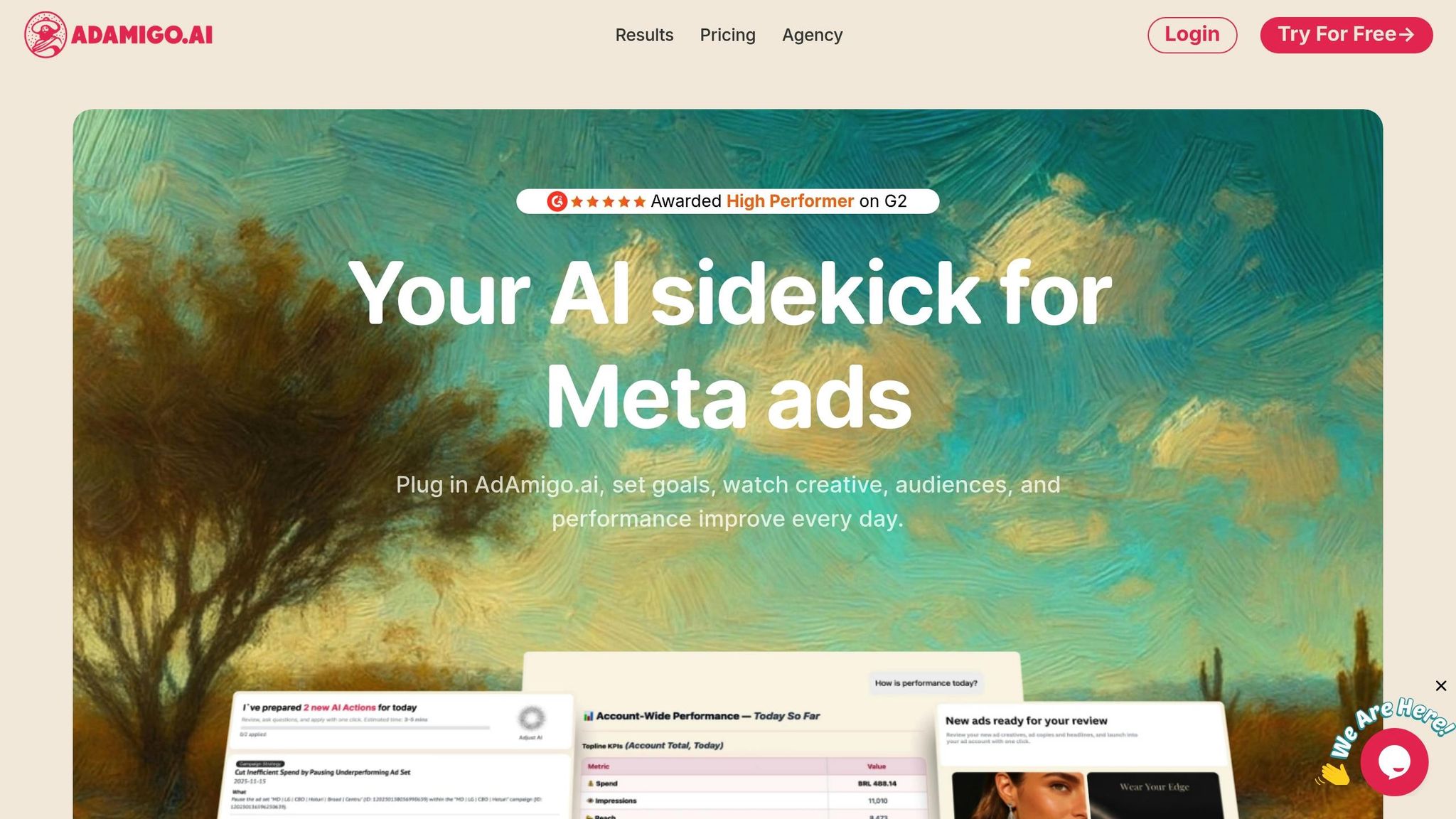
Traditional manual compliance methods often fall short, as they tend to address issues only after they arise. AdAmigo.ai flips the script with a proactive approach. The platform scans campaigns before they go live, catching potential policy violations early. Its AI Ads Agent reviews content for prohibited language and ensures visuals meet guidelines, while AI Actions detects discriminatory targeting and suggests compliant alternatives. For larger campaigns, the Bulk Ad Launch feature pre-screens every creative and targeting combination, ensuring they comply with Meta’s policies right from the start.
AdAmigo.ai also offers a free Meta Ad Policy Checker that can analyze text or images for risks in under two minutes - far quicker than the hours or days manual reviews often require. For large-scale updates, the AI Chat Agent can make bulk adjustments, such as labeling AI-generated content or revising targeting parameters, to meet the latest transparency standards.
Why AdAmigo.ai Works Better
AdAmigo.ai doesn’t just streamline compliance - it transforms how campaigns are managed. Unlike manual methods that rely on periodic checks, this platform provides 24/7 monitoring and completes full compliance scans in under two minutes.
Aspect | Manual Management | AdAmigo.ai (AI-Driven) |
|---|---|---|
Policy Compliance | Reactive; issues found after rejections | Proactive; flags issues before launch |
Response Time | Hours or days to resolve problems | Instant detection and fixes |
Monitoring | Limited to periodic or weekly reviews | Continuous, real-time monitoring |
Efficiency | 1 media buyer handles typical workloads | 1 media buyer manages 4–8× more accounts |
AdAmigo.ai works seamlessly with your existing rules for budgets, pacing, geos, and placements. It optimizes creatives, targeting, bids, and budgets as a unified system. You can let it run autonomously or review and approve changes before they’re implemented.
How Businesses Use AdAmigo.ai
AdAmigo.ai’s features deliver tangible benefits for both agencies and in-house teams. Agencies can empower a single media buyer to manage 4–8× more client accounts, thanks to automation, allowing senior strategists to focus on broader planning. In-house teams can save on costly hires by using the platform as an always-on AI assistant that improves its performance over time.
For smaller accounts spending under $5,000 per month, the Entry Plan costs just $99/month. This includes up to two AI Actions daily, full access to the AI Chat Agent, and unlimited ad account audits - eliminating the need for freelancers or additional tools.
Setup is quick and easy, taking about five minutes. Simply connect your Meta ad account, set KPIs, and provide goals like “Increase spend by 30% while maintaining ≥3× ROAS.” From there, AdAmigo.ai delivers daily AI-driven recommendations for campaigns, audiences, budgets, and creatives. You can choose to approve, tweak, or publish these suggestions automatically - all while staying fully compliant with Meta’s policies.
Manual vs. AI-Driven Compliance Methods
Manual vs AI-Driven Meta Ads Compliance: Key Differences
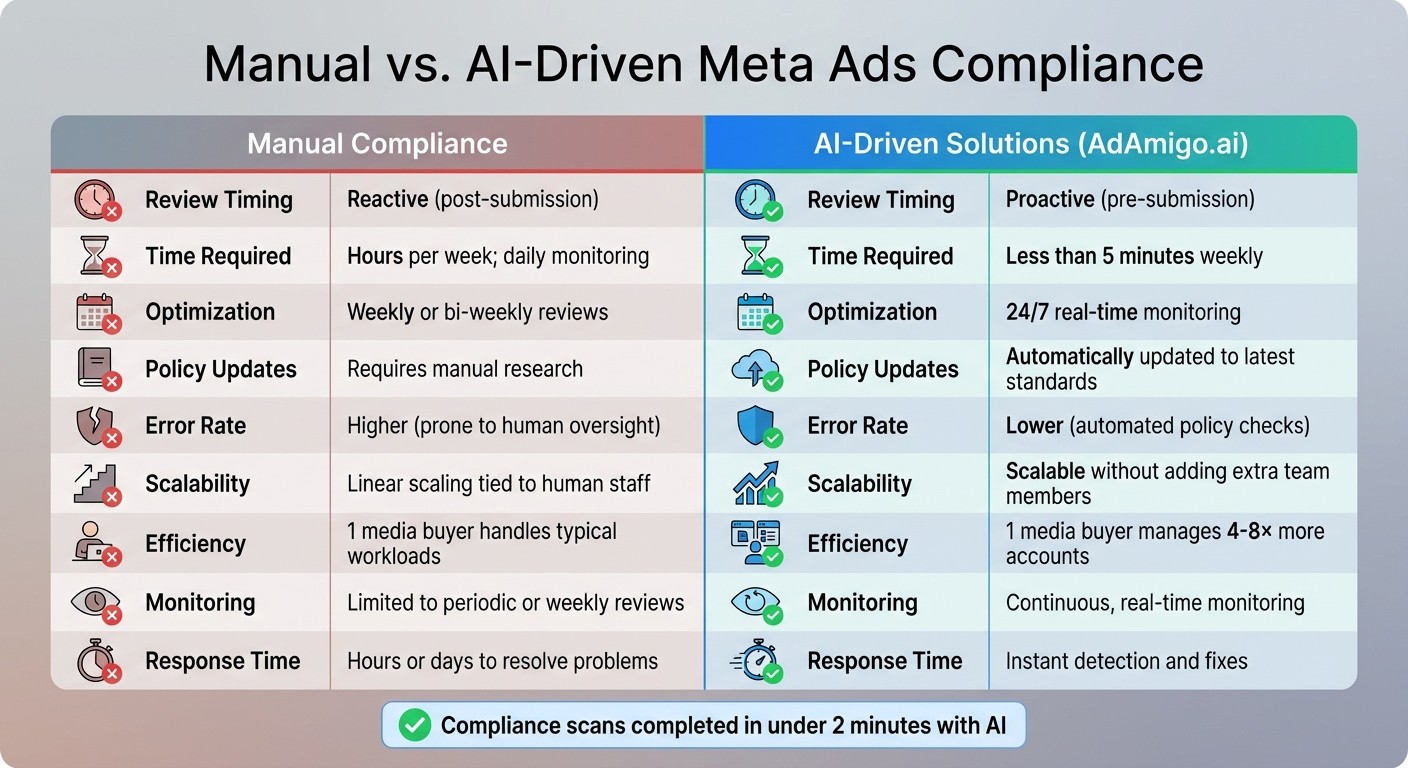
When it comes to ad compliance, manual methods often respond to issues only after Meta flags violations. In contrast, AI-driven tools like AdAmigo.ai take a proactive approach, scanning campaigns before submission and identifying potential problems in under two minutes.
The difference becomes even more pronounced when managing multiple campaigns. A media buyer relying on manual vs. AI-driven campaign management might oversee just a few accounts, conducting reviews weekly or bi-weekly. With AI automation, that same buyer can handle compliance checks and routine tasks continuously, around the clock. This level of oversight is enhanced by setting automated guardrails to control costs and performance.
Drafting ad copy manually also increases the risk of policy violations, as restricted keywords or necessary labels might be missed. AI tools eliminate this risk by automatically generating ad creatives that meet policy requirements, even adding labels like "Synthetic" for AI-generated content.
Comparison Table: Manual vs. AI-Driven Methods
Feature | Manual Compliance | AI-Driven Solutions (e.g., AdAmigo.ai) |
|---|---|---|
Review Timing | Reactive (post-submission) | Proactive (pre-submission) |
Time Required | Hours per week; daily monitoring | Less than 5 minutes weekly |
Optimization | Weekly or bi-weekly reviews | 24/7 real-time monitoring |
Policy Updates | Requires manual research | Automatically updated to latest standards |
Error Rate | Higher (prone to human oversight) | Lower (automated policy checks) |
Scalability | Linear scaling tied to human staff | Scalable without adding extra team members |
For industries with strict regulations, like finance, healthcare, or housing, a hybrid strategy often works best. AI tools can handle the heavy lifting by screening campaigns in bulk, while manual reviews ensure that final decisions align with legal and strategic goals. This approach combines the speed of automation with the precision needed for compliance.
Set Up a Long-Term Monitoring System
A single audit won't keep you compliant with Meta's ever-changing policies. To stay ahead, establish a recurring workflow that quickly identifies issues and ensures compliance - without turning into a daily time sink.
Weekly Audits and Testing
To maintain compliance with Meta's data policies over time, incorporate regular checks into your routine. Dedicate just 30 minutes each week to review the following:
Policy flags: Check Ads Manager for black banners that indicate discontinued targeting options, such as merged interests.
Attribution settings: Reassess your attribution windows (1-day view, 1/7/28-day click). Many advertisers saw a 30–40% drop in conversions when Meta phased out the 8- to 28-day window.
EU campaigns: Keep a close eye on CPM, CTR, and conversion rates for European traffic as new privacy options roll out through Q1 2026. Use separate ad sets to track these changes effectively.
Creative formats: Ensure your ads are optimized for the vertical 9:16 format. By early 2026, 90% of Meta's inventory will be vertical.
If you notice issues, duplicate the affected ad sets and experiment with broader targeting. Run A/B tests comparing your granular audiences to Meta's suggested alternatives. Use Advantage+ audience expansion and monitor results over a seven-day period. For EU traffic, focus on customer lists and website visitors rather than interest-based targeting .
Track Algorithm Changes
Meta's Andromeda algorithm processes ads at lightning speed - 100× faster than before, analyzing 10,000× more ad variations. This makes creative variety more effective than manually selecting audiences. Think outside the box with ad concepts, combining user-generated content with polished, cinematic product stories to maximize reach.
Meta predicts that manual campaign controls will largely disappear by early 2026, with AI-driven tools like the Advantage+ suite taking center stage. Use Flexible Ad Format for AI-enhanced multivariate testing and let Meta GEM handle automatic conversion optimization.
Stay informed by bookmarking Meta's Business Help Center and setting reminders to check the Business AI Breakdown feature. This tool helps you determine whether performance changes are due to your strategy or Meta's backend updates.
To streamline monitoring, consider tools like AdAmigo.ai, which provides a daily prioritized to-do list through its AI Actions. It highlights impactful adjustments across creatives, audiences, budgets, and bids. As a learning agent, it adapts to changes like updated attribution windows or shifts in the Andromeda algorithm. Plus, its AI Chat Agent offers instant insights on performance dips . With these tools and strategies, you can keep your campaigns aligned with Meta's evolving policies while staying ahead of the competition.
Conclusion
Meta's 2026 updates call for immediate action. Campaigns that fail to align with these changes are already experiencing sharp drops in conversions and delivery interruptions.
To stay ahead, audit your campaigns, broaden your target audiences, and make the most of Meta's AI tools like Advantage+ and Business AI Breakdown. Manual campaign management is quickly becoming obsolete - Meta projects full automation by early 2026. With 83 updates rolled out in 2025 alone, it's clear that human teams can't keep up. This shift underscores the importance of adopting AI tools for Facebook and Instagram.
AdAmigo.ai offers a fast, scalable way to ensure compliance. In just minutes, you can link your Meta account, set specific goals (e.g., "Increase spend by 30% while maintaining a ≥3× ROAS"), and let its AI-driven system make daily adjustments to your creatives, targeting, budgets, and bids. Acting as a dynamic learning agent, it refines strategies based on actual performance, making it an excellent choice for tackling challenges like EU privacy regulations, attribution updates, and the rise of vertical ad formats. Agencies using AdAmigo.ai are already managing 4–8× more clients per media buyer. By automating compliance, this tool frees up your team to focus on strategic growth while staying aligned with Meta’s policies.
To complement automation, establish a consistent monitoring routine. Regularly check for policy violations, track EU campaign metrics through Q1 2026, and include creative variation in your weekly audits. Stay informed by visiting Meta's Business Help Center and keeping an eye on algorithm updates that might affect performance. By combining AI tools with disciplined monitoring, you can confidently navigate Meta's shifting policies. Many leading brands are treating these updates as a chance to boost performance - start your audit today and let AI handle the execution, allowing you to focus on strategy.
FAQs
How do I measure performance without 7-day or 28-day view attribution?
To track performance without relying on 7-day or 28-day view attribution, tweak your attribution settings in Meta Ads Manager to focus on shorter timeframes, like 1-day click or 1-day view. Additionally, you can leverage Meta's Incremental Attribution to monitor conversions that are directly linked to your ads, even outside the usual attribution windows. This approach helps maintain accurate results, even with updates to attribution models.
What should I use instead of detailed targeting exclusions?
Meta is moving away from detailed targeting exclusions and encouraging advertisers to use custom audience exclusions instead. This change gives you more control over manual targeting while also aligning with Meta's updated ad policies. By switching to custom audience exclusions, you can maintain precise targeting in your campaigns without compromising compliance.
How can I keep Meta tracking accurate in the EU with consent limits?
To keep Meta tracking accurate within the EU while respecting consent limits, it's crucial to use consent management tools (CMPs) that secure explicit, opt-in user consent. To comply with GDPR, focus on privacy-first strategies like cleaning up URLs to remove sensitive data and modifying tracking methods to align with regulations. Additionally, consider using AI-powered compliance tools to stay updated on policy changes and maintain consistent adherence to evolving requirements.