
AI-Driven Resource Prioritization for Meta Ads
How AI reallocates budgets, refreshes creatives, and auto-segments audiences to boost ROAS and save hours managing Meta ad campaigns.
AI is transforming how advertisers manage Meta campaigns by automating tasks like budget adjustments, ad testing frameworks, and audience targeting. This approach delivers better results faster, saving time and improving performance. For example:
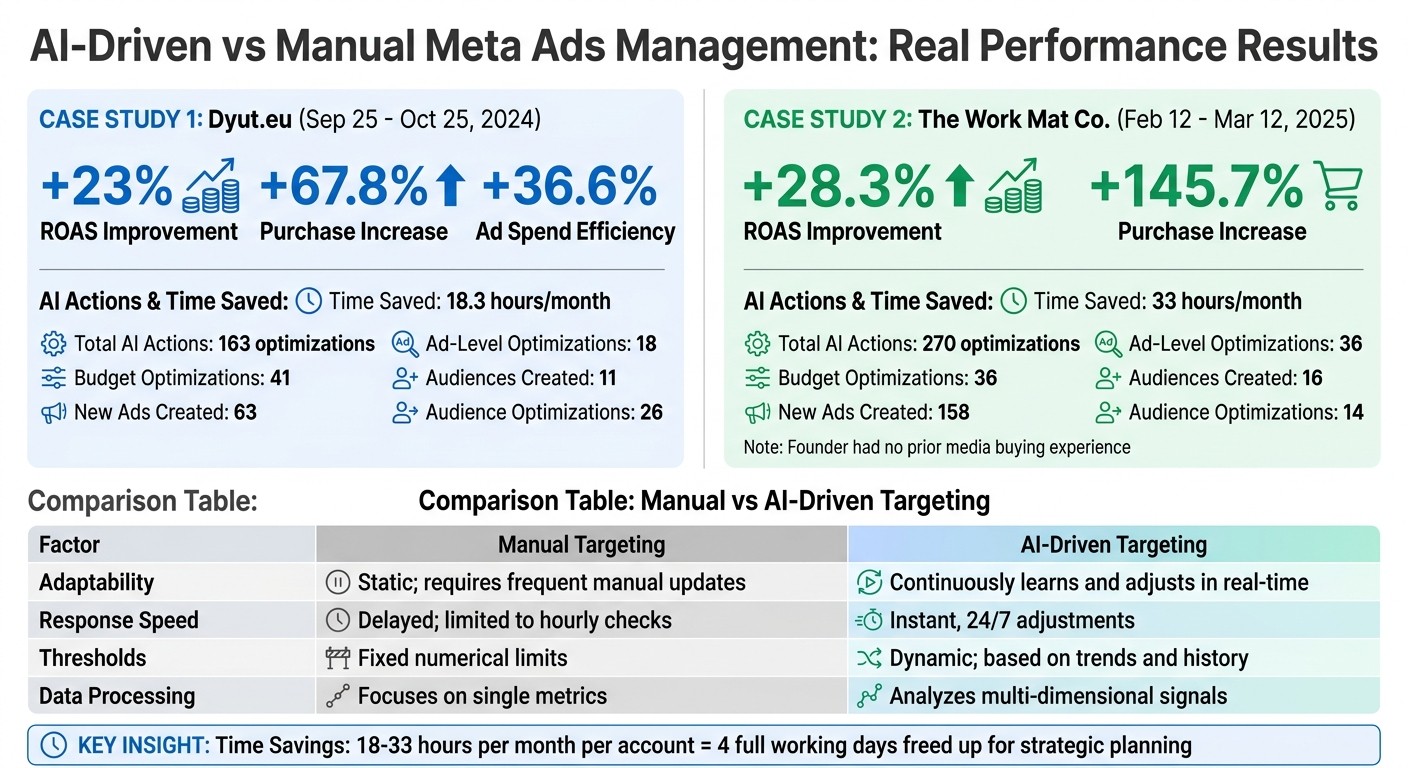
Dyut.eu (Sep–Oct 2024): 23% higher ROAS, 67.8% more purchases, 18.3 hours saved monthly.
The Work Mat Co. (Feb–Mar 2025): 145.7% purchase growth, 28.3% ROAS increase, 33 hours saved monthly.
AI tools handle tasks like predictive budgeting, solving creative fatigue, and audience segmentation, outperforming manual methods. Platforms like AdAmigo.ai automate these optimizations, providing real-time adjustments and actionable insights. The result? Advertisers can focus on strategy while AI manages the heavy lifting.
5 NEW AI That Just Changed Facebook Ads Forever
How AI Improves Resource Prioritization in Meta Ads

AI has transformed how Meta Ads are managed, enabling decisions at speeds and levels of precision that human media buyers simply can't match. By analyzing performance signals nearly in real-time, AI systems can respond faster than Meta's usual hourly or daily checks. This rapid evaluation helps catch potential issues or seize opportunities before they significantly impact your campaign budget.
AI doesn’t just monitor - it actively identifies the best-performing combinations of creative, copy, audience, and placement. Once these patterns are detected, it reallocates spending to prioritize what works. For example, between September 25 and October 25, 2024, Dyut.eu's AI system carried out 41 budget optimizations as part of 163 total actions. Similarly, The Work Mat Co. experienced 36 budget optimizations out of 270 total actions between February 12 and March 12, 2025.
Predictive Budget Allocation
AI takes budget management to the next level by predicting ad performance and adjusting allocations dynamically. While traditional Campaign Budget Optimization (CBO) spreads your budget across ad sets, AI uses trends and historical data to set flexible thresholds instead of relying on fixed numerical limits.
This flexibility is key. Unlike automated bid rules or manual rules, which need constant tweaking and often focus on just one metric, AI systems evaluate multiple factors at once and adjust continuously, 24/7. For instance, AI might set daily spending caps at 2–3 times the usual amount to allow for scaling while preventing overspending. It could also adjust cost caps to be 20–30% above your target CPA, giving the algorithm room to optimize for conversions. To avoid reacting to small, statistically insignificant data changes, the system requires a minimum threshold - like 20 clicks or 5 conversions - before making budget shifts.
Real-Time Creative Optimization
Ad fatigue is a campaign killer, but AI helps keep things fresh by constantly monitoring key metrics like CTR, ROAS, and CPA across all ad variations. Instead of splitting the budget evenly among creatives, AI shifts spending toward high performers and reduces investment in underperforming ads.
Between September and October 2024, Dyut.eu's AI created 63 new ads and made 18 ad-level optimizations. Meanwhile, The Work Mat Co. saw even more activity, with 158 new ad creations and 36 optimizations in just 30 days - even though founder Rochelle Dallas had no prior media buying experience. AI doesn’t just pause ineffective ads; it also generates new variations based on what’s already working, ensuring campaigns stay effective without manual input.
"Our budgets are controlled, our spend is being smartly allocated and our ROAS is up massively", said Rochelle Dallas, Founder of The Work Mat Co.
Alongside these budget and creative enhancements, AI also fine-tunes audience strategies effortlessly.
Audience Targeting and Segmentation
While comparing AI vs manual audience creation shows that building segments is tedious, AI automates this process seamlessly. With Meta’s Andromeda update, modern AI platforms align perfectly, optimizing campaigns and audience strategies to work within the platform's auction system. Using simple text commands, AI can create lookalike audiences and segmentations without the need for constant manual adjustments.
The speed of these optimizations is impressive. Dyut.eu's AI created 11 audiences and performed 26 audience optimizations in just one month - something that would be nearly impossible to achieve manually. The Work Mat Co. saw similar results, with 16 audiences built and 14 audience optimizations in its first 30 days. These frequent updates ensure your ads are consistently targeting the most profitable segments without requiring continuous hands-on management.
Factor | Manual Targeting | AI-Driven Targeting |
|---|---|---|
Adaptability | Static; frequent manual updates | Continuously learns and adjusts in real-time |
Response Speed | Delayed; limited to hourly checks | Instant, 24/7 adjustments |
Thresholds | Fixed numerical limits | Dynamic; based on trends and history |
Data Processing | Focuses on single metrics | Analyzes multi-dimensional signals |
Next, we’ll dive into research findings that quantify how these AI-powered improvements impact campaign performance.
Research Findings on AI-Driven Meta Ad Optimization
AI vs Manual Meta Ads Management: Performance Comparison
Performance Gains Through AI
Recent case studies highlight how AI can significantly enhance Meta ad performance. For example, between September 25 and October 25, 2024, the premium skincare brand Dyut.eu experienced a 23% improvement in ROAS, a 67.8% increase in purchases, and a 36.6% boost in ad spend efficiency. This was achieved through AI-driven autopilot, which executed 163 optimization actions and saved the team around 18.3 hours per month. Another success story comes from The Work Mat Co., which saw a 145.7% jump in purchases and a 28.3% ROAS improvement between February 12 and March 12, 2025. Their AI system carried out 270 automated actions, saving them approximately 33 hours monthly.
Simplified Campaign Management
AI doesn't just improve performance metrics - it also makes campaign management far more manageable. The Work Mat Co.'s AI system, for instance, created 16 audiences and built 158 ads in just 30 days - tasks that would typically require weeks of manual effort. This level of automation enables media buyers to handle four to eight times more clients than they could with traditional methods. Additionally, AI simplifies tasks like creating lookalike audiences or adjusting budgets with quick text or voice commands, streamlining operations for maximum efficiency.
Benchmarks and Case Studies
The time savings achieved through AI are hard to ignore. Both Dyut.eu and The Work Mat Co. saved between 18 and 33 hours of manual labor per month for a single ad account. That’s equivalent to about four full working days each month - time that can now be spent on strategic planning or creative projects instead of repetitive optimization work.
These findings show how AI-driven systems not only outperform manual management but also lighten the workload for media buyers, delivering better results with far less effort.
AI Tools and Platforms for Meta Ads
Specialized AI tools are transforming Meta ad campaigns, offering automated solutions that drive measurable performance improvements through Meta ad optimization.
AdAmigo.ai: Autonomous Media Buying
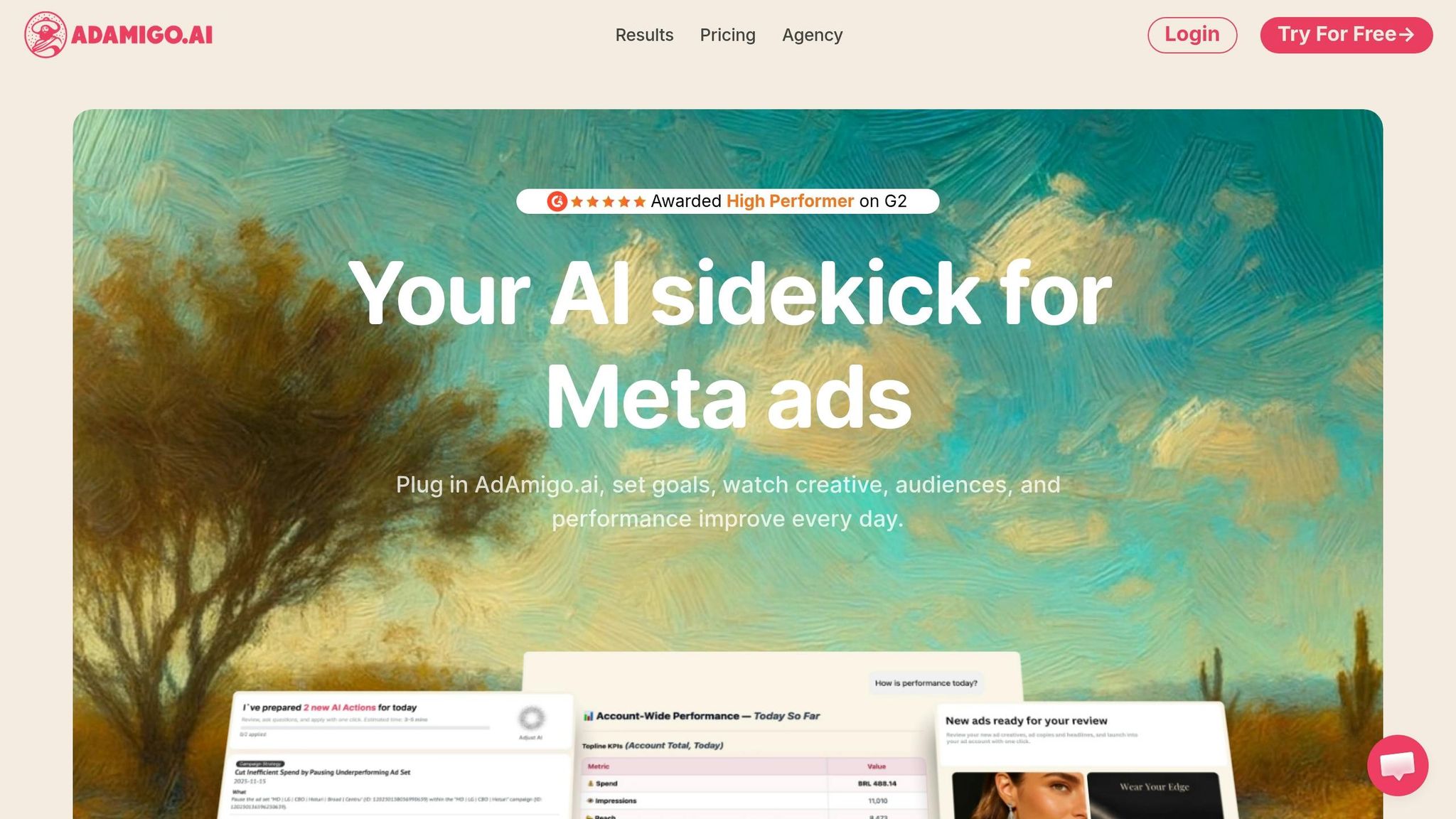
AdAmigo.ai is a comprehensive AI-powered media buying platform designed to manage campaigns with minimal manual input. Its AI Autopilot feature takes charge of your Meta ad account, handling tasks like launching new tests, reallocating budgets, and pausing underperforming ads based on real-time data analysis. The platform also includes an AI Chat Agent, which allows users to manage campaigns conversationally. For example, you can ask, "Why did ROAS drop yesterday?" or instruct it to start a new retargeting campaign. This is a key component of a full-funnel Meta ads setup.
To combat creative fatigue, the Ad Factory generates fresh ad creatives by analyzing top-performing ads and competitor trends. Additionally, AdAmigo Protect ensures smooth operations by detecting and addressing anomalies before they escalate.
As an official Meta Business Technology Partner, AdAmigo.ai integrates seamlessly with Meta’s API. Advertisers can choose between full automation or manual approval for campaign optimizations, offering flexibility and control. Case studies have shown measurable success, reinforcing the platform’s capabilities.
Comparison of AI Platforms
AdAmigo.ai stands out as a fully autonomous solution, but it’s not the only AI automation platform for Meta ads. Platforms like Meta Advantage+ focus on algorithmic automation, while tools such as AdCreative.ai specialize in creative generation, and Trapica caters to enterprise-level multi-channel management. Each platform brings unique strengths to the table.
Platform | Primary Focus Area | Reported ROAS/Performance Improvement | Study Source |
|---|---|---|---|
AdAmigo.ai | Autonomous optimization & creative generation | 23% ROAS increase | Dyut.eu Case Study |
Meta Advantage+ | Native algorithmic automation | 20–30% ROAS lift | Meta Performance Summit |
Behavior-driven ICP clustering | 21% incremental ROAS | Shopify Plus Case Study | |
Multi-domain joint optimization | 8% ads quality improvement | Meta AI Research |
What sets AdAmigo.ai apart is its ability to not only provide recommendations but also execute changes automatically. This feature, combined with 24/7 monitoring and conversational controls, allows agencies to handle significantly more client accounts per media buyer compared to traditional management methods.
Best Practices for AI-Driven Meta Ad Campaigns
Consolidate Ad Sets for Faster Learning
Streamline your campaigns to help Meta's algorithm learn more effectively. For the AI to optimize well, it needs at least 50 conversions per week per ad set. If your budget is spread thin across too many small ad sets, the algorithm won't gather enough data to make smart decisions. Instead, focus on fewer campaigns with multiple ad sets, allowing the system to adjust spending based on live performance.
Consider switching from Ad Set Budget Optimization (ABO) to Campaign Budget Optimization (CBO). CBO automatically allocates your overall budget across ad sets, channeling funds toward what’s performing best. Aim for daily budgets of $20–$30 per ad set to exit the learning phase efficiently. Use cost caps vs bid caps set 20–30% above your target CPA to give the AI room to find conversions while keeping costs in check. Additionally, set maximum daily budget limits at 2–3× your typical spend to enable scaling without overspending.
Once your campaign structure is solid, the next step is fine-tuning your attribution strategy.
### Use Single-Touch vs. Multi-Touch Attribution Models
Effective attribution is crucial for understanding how your campaigns perform across the entire funnel. Rather than relying only on last-click attribution, which can overlook early touchpoints, configure your tracking to capture data throughout the customer journey. This ensures the AI recognizes how awareness campaigns contribute to conversions, even if they don’t get the final credit.
Keep an eye on audience fatigue by monitoring key metrics. For example, if click-through rates (CTR) drop while CPMs remain steady, it may be time to refresh your creative or adjust budgets to prevent performance from slipping.
Combat Creative Fatigue with Iteration
Creative fatigue often shows up as declining CTRs while CPMs stay the same or even increase. The fix? Consistently test and rotate fresh ad variations. Regular creative updates have been shown to improve ROAS, lower cost per add-to-cart, and reduce the need for constant manual adjustments.
"The AI recommendations go beyond simply suggesting actions; they provide valuable insights and justifications. This not only improves my results but also deepens my understanding of campaign optimization."
Shubham, Co-Founder, Dyut.eu
Set up automated rules to identify signs of fatigue, like dropping CTRs, and trigger creative refreshes before performance dips too much. This keeps your campaigns running smoothly and provides the algorithm with fresh data to refine its optimization efforts continually.
Conclusion: The Future of AI-Driven Meta Ads
AI is reshaping the way advertisers approach Meta ads, moving the focus from hands-on campaign management to strategic decision-making. Instead of spending hours fine-tuning campaigns, advertisers can now rely on AI systems that monitor performance in real time and simplify multi-campaign optimization by adjusting budgets on the fly. This shift frees up teams to concentrate on tasks like developing creative strategies or refining competitive positioning, while the AI handles the heavy lifting of optimization. These advancements are setting new benchmarks for the advertising industry.
Recent examples highlight measurable improvements in return on ad spend (ROAS) and significant time savings, showing how autonomous AI media buyers are delivering real-world results.
Looking forward, innovations like multi-agent orchestration promise to take optimization to the next level. Beyond reallocating budgets and optimizing creatives, these systems will integrate multiple specialized AI agents that work together seamlessly. These agents will analyze audience behavior, assess creative performance, and manage budgets - all at the same time. Tools with natural language interfaces are already making it possible to launch campaigns using simple text or voice commands, lowering the barrier for those without technical expertise. This evolution is even challenging high-end service agencies to adapt.
To maintain an edge, it’s essential to go beyond basic analytics and embrace AI tools that provide continuous optimization and predictive insights. Platforms such as AdAmigo.ai, recognized as a "High Performer" on G2, offer fully automated solutions that execute changes directly, rather than just recommending them. The future of advertising belongs to those who adopt AI-driven, autonomous optimization.
FAQs
How much budget do I need for AI to optimize Meta ads well?
The budget for using AI to optimize Meta ads varies based on the scale of your campaign and your goals. For smaller businesses, plans often start at around $99 per month, offering a manageable entry point. However, larger campaigns aiming for more advanced AI-driven automation will likely need a bigger budget. Tailor your spending to match your specific objectives and the level of optimization you’re looking to achieve.
What guardrails prevent AI from overspending or making risky changes?
Guardrails such as budget limits, bid caps, and performance targets act as safety nets for your campaigns. These rules are designed to monitor performance in real time, ensuring costs stay under control and preventing risky adjustments. By setting these boundaries, you can maintain a balance between automation and oversight, keeping your campaigns on track without unnecessary surprises.
How can I tell if performance drops are from attribution issues or creative fatigue?
To figure out why performance is slipping, start by checking if your attribution data aligns properly. Problems with attribution often come from tracking adjustments or outside influences. On the other hand, creative fatigue happens when your audience has seen the same ads too many times, leading to reduced interest or engagement. Look at metrics like ad frequency and engagement rates to spot signs of fatigue.
Using tools like AdAmigo.ai can make this process easier. These tools can help you optimize your ad creatives and track performance, allowing you to separate issues caused by attribution errors from those caused by creative fatigue more effectively.