
Top Meta Ad Placements for eCommerce Brands
Guide to choosing Meta ad placements, using Advantage+, matching creatives, and leveraging AI to improve eCommerce ad performance.
Want better ad results for your eCommerce brand? Choosing the right Meta ad placements is key. With over 20 options across Facebook, Instagram, Messenger, and Audience Network, each placement offers unique opportunities to boost conversions. Here's what you need to know:
Instagram Feed: Higher CPMs (Higher CPMs ($10–$16)0–Higher CPMs ($10–$16)6) but better for high-intent shoppers.
Facebook Feed: Lower CPMs ($8–$14) with broad audience reach.
Reels (Facebook & Instagram): Lower CPMs ($4–$12), great for awareness and engagement.
Instagram Stories: Perfect for retargeting with immersive, full-screen ads.
Messenger Ads: Ideal for re-engagement or nurturing warm leads.
Start with Advantage+ Placements to let Meta's AI optimize for the best results. Use manual placements when customizing creatives or excluding specific options. Align your placements with each stage of the sales funnel for maximum ROI. Tools like AdAmigo.ai can monitor performance and fine-tune budgets automatically.
Takeaway: Focus on matching placements to user intent and stage in the funnel. Use data-driven decisions to refine your strategy and improve ad performance.
Meta Ad Placements: What eCommerce Brands Need to Know
Automatic vs. Manual Placement Selection
When setting up Meta campaigns, you’ve got two placement options: Advantage+ Placements (automatic) and manual selection. Advantage+ relies on Meta’s machine learning to spread your ads across Facebook, Instagram, Messenger, and the Audience Network, all in real time, aiming for the lowest-cost conversions. On the other hand, manual selection allows for precise control over where your ads appear.
For most eCommerce brands, starting with Advantage+ is the smarter move, as it typically delivers 10–20% better cost efficiency compared to manual selection. However, manual selection becomes useful in specific scenarios - like when your creative assets are tailored for a particular format (e.g., a 9:16 vertical video that wouldn’t work well in a square Feed ad) or when you need to exclude placements for brand safety, such as avoiding the Audience Network.
"Advantage+ Placements delivers 10-20% better efficiency for most advertisers - start here and only use manual selection when you have data-driven reasons for exclusions." - Gaultier D'Acunto, Co-founder, Benly.ai
Here’s a quick guide to choosing the right approach:
Scenario | Recommended Approach |
|---|---|
New or broad campaigns | Advantage+ Placements |
Scaling successful campaigns | Advantage+ Placements |
Placement-specific creative (e.g., 9:16 video) | Manual |
Brand safety or Audience Network exclusions | Manual |
Isolated placement testing | Manual |
Your choice here directly impacts how well your campaign performs.
Factors That Affect Placement Performance
Three key factors determine how well your ad placements perform. First, there’s creative-placement fit. Meta’s AI pairs ad formats with the right placements, so if you’re using a vertical video for Reels, it’ll outperform a square banner awkwardly placed in the same slot. To get this right, upload multiple aspect ratios - like 9:16 for Stories and Reels and 1:1 for Feed - using Meta’s Asset Customization feature within a single ad set. This ensures your creative matches the placement, which is critical for success.
Second, conversion volume plays a huge role. Automated placements need at least 50 purchase events per week at the campaign level to exit the learning phase and stabilize. If your budget is spread too thin across too many ad sets, the algorithm won’t have enough data to optimize effectively.
Lastly, tracking accuracy has become a challenge. With privacy changes and ad blockers, browser-based pixel data is now only about 40% reliable as of 2026. That’s where the Conversions API (CAPI) comes in - it’s essential for Meta’s system to accurately track which placements are driving sales. Without it, you’re flying blind.
By addressing these factors, you set the stage for better placement performance.
How AI Tools Optimize Placements
Meta’s automation is impressive, but third-party AI tools can take placement optimization even further. These tools continuously audit performance and reallocate budgets to maximize results. For example, AdAmigo.ai acts like a digital media buyer, analyzing placement-level data to identify which ones consistently hit your target CPA. It can then shift your budget toward the top-performing placements, either automatically or after you approve the changes.
This is crucial because placement performance isn’t static - it shifts over time. A mid-2025 case study showed that a DTC apparel brand cut its CPA by 23% in just six weeks by consolidating from 16 ad sets across five campaigns into two Advantage+ Shopping Campaigns. This allowed purchase signals to pool together, letting the algorithm optimize placements more effectively. Tools like AdAmigo can spot these opportunities and implement changes, ensuring your campaigns stay efficient and profitable, whether you prefer full automation or manual oversight.
Meta Ads Placement Targeting Explained (2026) | Advantage+ vs Manual Placements Guide
Top Meta Ad Placements for eCommerce
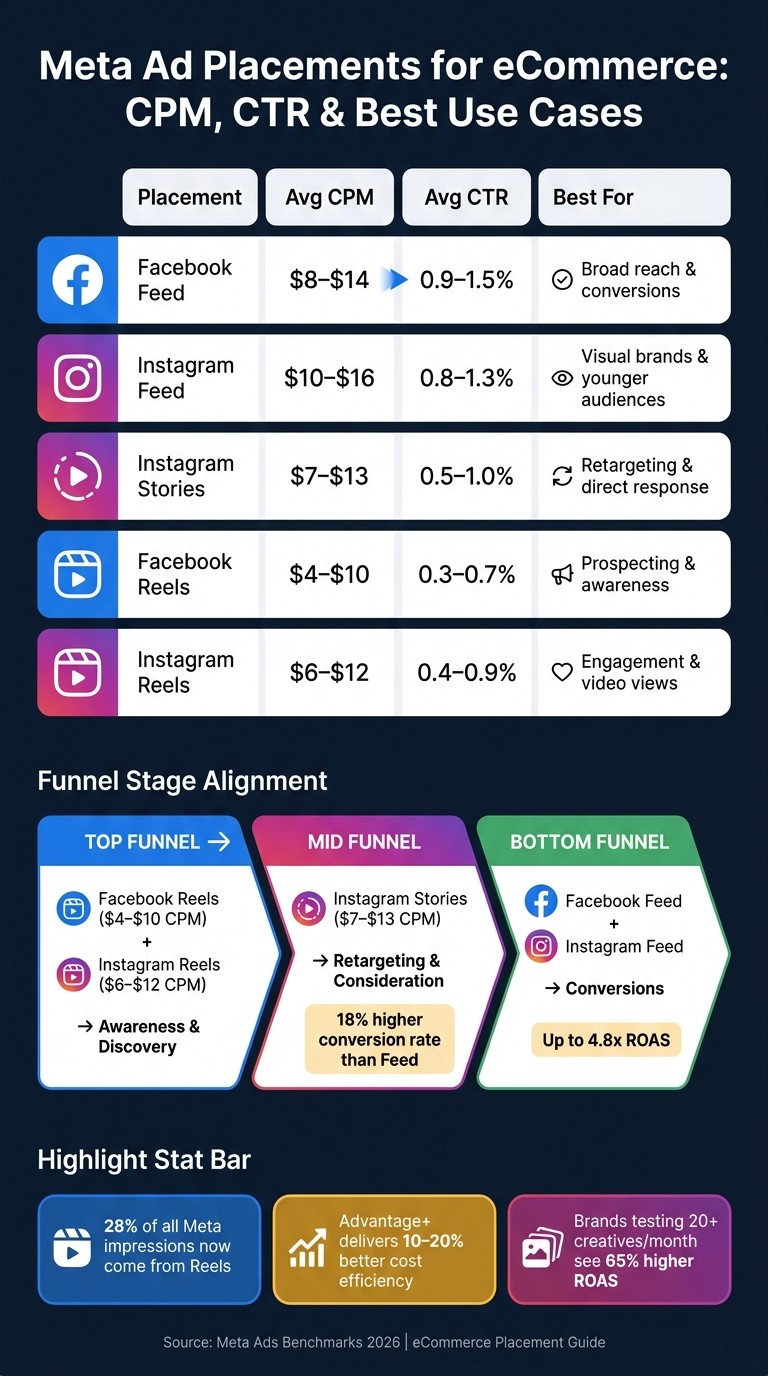
Meta Ad Placements for eCommerce: CPM, CTR & Best Use Cases
Here’s a breakdown of the top-performing Meta ad placements that are driving conversions for eCommerce brands.
Facebook Feed
Facebook Feed remains a dependable option for eCommerce ads. It supports various formats - images, videos, carousels, and collections - making it versatile for campaigns across the sales funnel. With average CPMs between $8–$14 and click-through rates (CTR) of 0.9–1.5%, it offers solid performance. Carousel and catalog ads are particularly effective, as they let users browse multiple products within a single ad, making them perfect for discovery campaigns. Facebook Feed’s broad, older audience often helps deliver lower CPAs, especially for general conversion campaigns compared to Instagram.
Instagram Feed
Instagram Feed is ideal for showcasing visually appealing and lifestyle-focused products. It consistently generates higher engagement than Facebook Feed - sometimes 10x higher in certain niches. Although CPMs are slightly higher, averaging $10–$16, features like product tags and shoppable posts streamline the path from discovery to purchase. If your brand relies on strong visuals, Instagram Feed is a must-have placement.
Instagram Stories
Instagram Stories provide a full-screen, immersive experience that’s hard to match. With CPMs ranging from $7–$13 and a CTR of 0.5–1.0%, Stories are a cost-effective way to retarget warm audiences or promote limited-time deals. The 24-hour lifespan of Stories naturally creates urgency, making them ideal for flash sales or exclusive offers. Ads styled as user-generated content (UGC) tend to perform better than polished brand creatives, delivering a 4.1x ROAS compared to 3.3x for traditional ads. To maximize results, design Stories for sound-off viewing with captions, but ensure they’re engaging with sound on as well. For even greater reach, consider the growing popularity of Reels.
Facebook Reels and Instagram Reels
Reels are quickly becoming one of the most effective placements on Meta platforms.
"Reels represents Meta's fastest-growing placement and offers significant efficiency opportunities in 2026." - Gaultier D'Acunto, Co-founder, Benly.ai
Facebook Reels have CPMs averaging $4–$10, while Instagram Reels are slightly higher at $6–$12. These placements are great for prospecting and brand awareness, as they attract audiences in an entertainment-focused mindset. With over 60% of viewers watching Reels with sound on, audio-first creatives can have a big impact. Success with Reels hinges on grabbing attention quickly - 68% of users decide whether to keep watching within the first 3 seconds. Formats like quick product demos, before-and-after transformations, and trending audio clips often outperform highly polished ads. Reels also boast 15–25% higher engagement rates than Stories for prospecting campaigns.
Messenger Inbox and Sponsored Messages
Messenger placements are tailored for direct, personalized interactions rather than broad discovery. Sponsored messages can only be sent to users who have already interacted with your business via Messenger. This makes them perfect for cart recovery, re-engagement, or selling high-ticket items. For brands with longer sales cycles - like furniture, electronics, or luxury apparel - Messenger can help nurture leads and close sales. While these placements may not generate high volumes, they deliver strong results with warm audiences due to lower competition and CPMs.
Placement | Avg CPM (eCommerce) | Avg CTR (eCommerce) | Best For |
|---|---|---|---|
Facebook Feed | $8–$14 | 0.9–1.5% | Broad reach, conversions |
Instagram Feed | $10–$16 | 0.8–1.3% | Visual brands, younger audiences |
Instagram Stories | $7–$13 | 0.5–1.0% | Retargeting, direct response |
Facebook Reels | $4–$10 | 0.3–0.7% | Prospecting, awareness |
Instagram Reels | $6–$12 | 0.4–0.9% | Engagement, video views |
Matching Placements to Funnel Stages
Not every ad placement delivers the same results across the customer journey. Pairing the right placement with the corresponding funnel stage can significantly improve your return on ad spend.
Upper Funnel: Awareness and Discovery
At the awareness stage, the goal is to introduce your brand to new audiences. Low-cost-per-thousand-impression (CPM) placements like Facebook Reels and Instagram Reels are top choices, according to Meta Ads CPM benchmarks for 2026. Facebook Reels, for instance, typically range from $4 to $10 CPM, making them one of the most cost-effective options in Meta's ad ecosystem. For industries such as Beauty, Reels placements are even more efficient, offering CPMs 23% lower than standard Feed placements. This affordability makes Reels ideal for reaching a broad audience at scale.
"The most successful Reels ads don't feel like ads - they're genuinely entertaining or educational content that happens to feature products or brands." - Benly.ai
To maximize impact, use native 9:16 vertical videos that grab attention within the first three seconds. Pair this with broad age and gender targeting, allowing Meta's algorithm to identify high-intent users based on their behavior.
Once you’ve built awareness, transition to retargeting strategies that keep your brand top of mind.
Mid Funnel: Retargeting and Consideration
At this stage, the aim is to nurture interest and address potential objections. Instagram Stories are highly effective for retargeting, delivering an 18% higher conversion rate than Feed placements. The immersive, full-screen format ensures your message gets undivided attention.
To build trust, incorporate user-generated content, testimonials, and product demos into your ads. Tailor your retargeting approach based on user intent:
Show social proof (like reviews) to people who viewed product pages.
Use friction-reducing messages, such as free returns or satisfaction guarantees, for cart abandoners.
For timing, most retail brands see success with a 7–14 day retargeting window, while higher-ticket categories like Home & Garden often benefit from a longer 30–45 day window.
Once trust is established, guide these users to the final step: conversion.
Bottom Funnel: Converting Ready-to-Buy Shoppers
At the conversion stage, Facebook and Instagram Feeds are excellent for driving purchases. For example, Facebook Feed ads can deliver a 4.8x return on ad spend (ROAS) for supplements and a 4.3x ROAS for home products , which aligns with broader eCommerce ROAS benchmarks, while Instagram Feed achieves a conversion rate of up to 3.8%. Additionally, placements like Facebook Marketplace and Search Results can lower cost-per-acquisition (CPA) by 10–20%.
Dynamic Product Ads (DPAs) are a game-changer here. By using server-side signals like "add to cart" events, DPAs re-serve the exact products users left behind. This type of catalog-based retargeting achieves an impressive 4.7x ROAS, compared to 3.1x ROAS for prospecting campaigns.
Finally, fine-tune your messaging with action-driven calls-to-action (CTAs). Phrases like "Shop the drop" can outperform generic CTAs like "Learn more" by 18–30% for purchase-ready audiences.
Using AI to Optimize Ad Placements
Meta's Built-In Automation Tools
Meta's automation tools have come a long way. Advantage+ Placements (previously known as Automatic Placements) uses machine learning to distribute ads across over 20 placements in real time. This system adapts to auction dynamics and user behavior, often delivering a 10–20% improvement in cost-per-result metrics compared to manual placement selection.
That said, these tools aren’t perfect. For example, Advantage+ Shopping Campaigns often focus too heavily on retargeting existing customers. While this can boost reported ROAS (Return on Ad Spend), it may limit opportunities to attract new customers. To counteract this, consider setting a budget cap of 20–30% for existing customer targeting. This adjustment helps the algorithm prioritize growth instead of just retargeting.
"The advertiser's role shifts from manual placement selection toward providing diverse, high-quality creative that the algorithm can deploy effectively across placements." - Gaultier D'Acunto, Co-founder, Benly.ai
While Meta's tools are helpful, there’s room to push performance further with specialized AI solutions.
How AdAmigo.ai Improves Placement Optimization
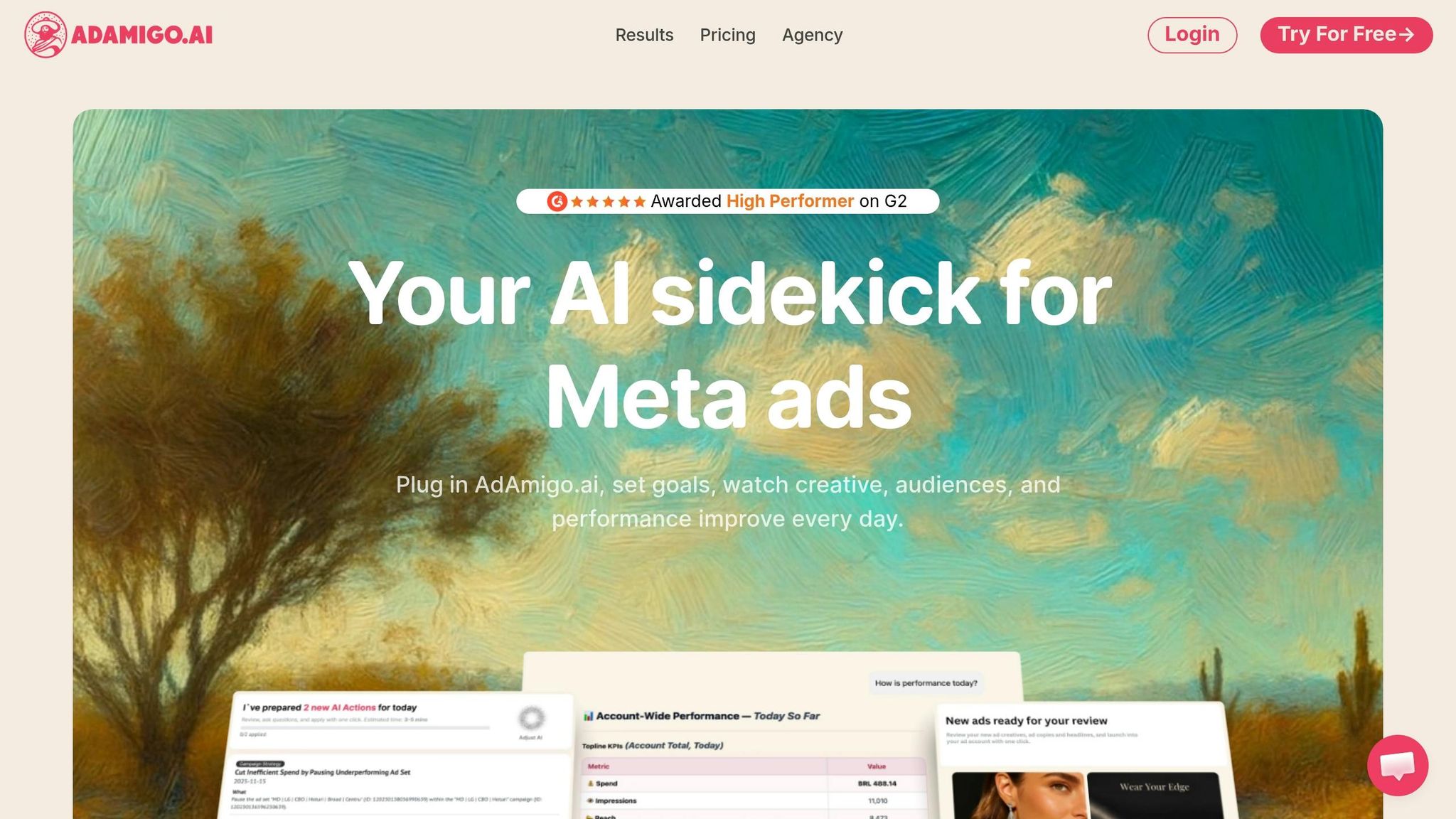
This is where AdAmigo.ai steps in to fill the gaps. The platform continuously audits your account, identifies underperforming placements, and automatically reallocates your ad spend for optimal results. Its AI Autopilot tracks placement performance and adjusts budgets in real time, while the AI Chat Agent simplifies data analysis. You can ask questions like, “Which placements are underperforming this week?” and get actionable insights without digging through Ads Manager reports.
AdAmigo also offers AdAmigo Protect, which monitors your account around the clock. It catches delivery issues or unexpected spikes in spending before they can affect your budget. Users have reported an average 42% performance boost when using AI-generated creatives tailored for specific placements.
"The AI actions are spot-on... it's like having an extra set of super-smart hands helping me hit my KPIs." - Sherwin S., G2 Review
A Framework for Testing and Refining Placements
Combining AI-driven insights with a structured testing approach can help fine-tune your ad placements. Start with Advantage+ Placements to let Meta's algorithm collect data across all available inventory. Avoid making changes during the first seven days to allow the system to hit its 50-conversion learning threshold. After this period, analyze the placement breakdown report.
Exclude a placement only if it has met these criteria:
Achieved at least 1,000 impressions and 50 conversions.
Consistently exceeds your target CPA by 50% or more.
To further optimize, use Placement Asset Customization (PAC) by supplying at least two creative formats for each ad. For example, use 1:1 or 4:5 formats for Feeds and 9:16 vertical formats for Stories and Reels. This ensures Meta’s algorithm doesn’t stretch a single creative across incompatible formats, which can dilute performance.
Conclusion: Getting More from Meta Ad Placements
Key Takeaways
When it comes to Meta ad placements, there’s no universal solution. Facebook and Instagram Feeds continue to lead for direct conversions, while Reels are becoming a standout option for prospecting, now making up 28% of all Meta impressions. Meanwhile, Stories shine in retargeting campaigns, offering lower CPMs and strong mid-funnel performance.
Starting with Advantage+ vs. manual placements and fine-tuning based on results tends to yield the best outcomes. To maximize impact, align your creative with the placement - use 9:16 vertical formats for Stories and Reels, and stick to 1:1 or 4:5 for Feeds.
Creative testing also plays a huge role. Implementing bulk ad testing allows you to identify winners faster. Brands that test 20+ new creatives each month report 65% higher ROAS compared to those testing fewer than 10. For context, the average eCommerce ROAS benchmark is 3.4x for 2026, with a blended CPA of $32.22. These metrics can help you evaluate whether your placements are performing as they should.
Next Steps for eCommerce Brands
To get started, enable Advantage+ Placements and run your campaign for a week. Use a mix of creative formats to give the algorithm enough variety to optimize effectively. Once you’ve collected sufficient data (at least 1,000 impressions and 50 conversions per placement), use the Ads Manager breakdown report to identify where your budget is working best.
For ongoing improvements, tools like AdAmigo.ai can simplify the process. Its AI Autopilot monitors placement performance, reallocates budgets to high-performing areas, and flags underperforming ones - all without requiring manual intervention. As your campaigns grow, this kind of automated optimization can drive consistent ROAS improvements over time.
FAQs
When should I switch from Advantage+ Placements to manual placements?
When considering manual placements, it’s best to make the switch only when you have clear, data-driven evidence supporting the exclusion of specific placements. For the majority of advertisers, Advantage+ Placements tend to deliver 10–20% better efficiency, making them the smarter default choice in most scenarios.
How many conversions do I need before judging placement performance?
There’s no hard-and-fast rule for the minimum number of conversions required to assess placement performance. Instead, keep an eye on performance trends on a weekly basis. Then, adjust your budget by allocating more toward the placements that deliver the best results. This approach helps fine-tune your strategy over time.
Do I need the Conversions API for accurate placement tracking?
The Conversions API works alongside the Facebook pixel to improve the precision of placement tracking. This combination ensures better measurement and attribution, giving you access to more dependable data for optimizing your campaigns.