
Meta Ads Benchmarks 2026: CPM, CPC, CTR, CVR & ROAS by Industry and Country
Meta Ads 2026 benchmarks for CPM, CPC, CTR, CVR and ROAS by industry and country, plus AI vs manual management insights.
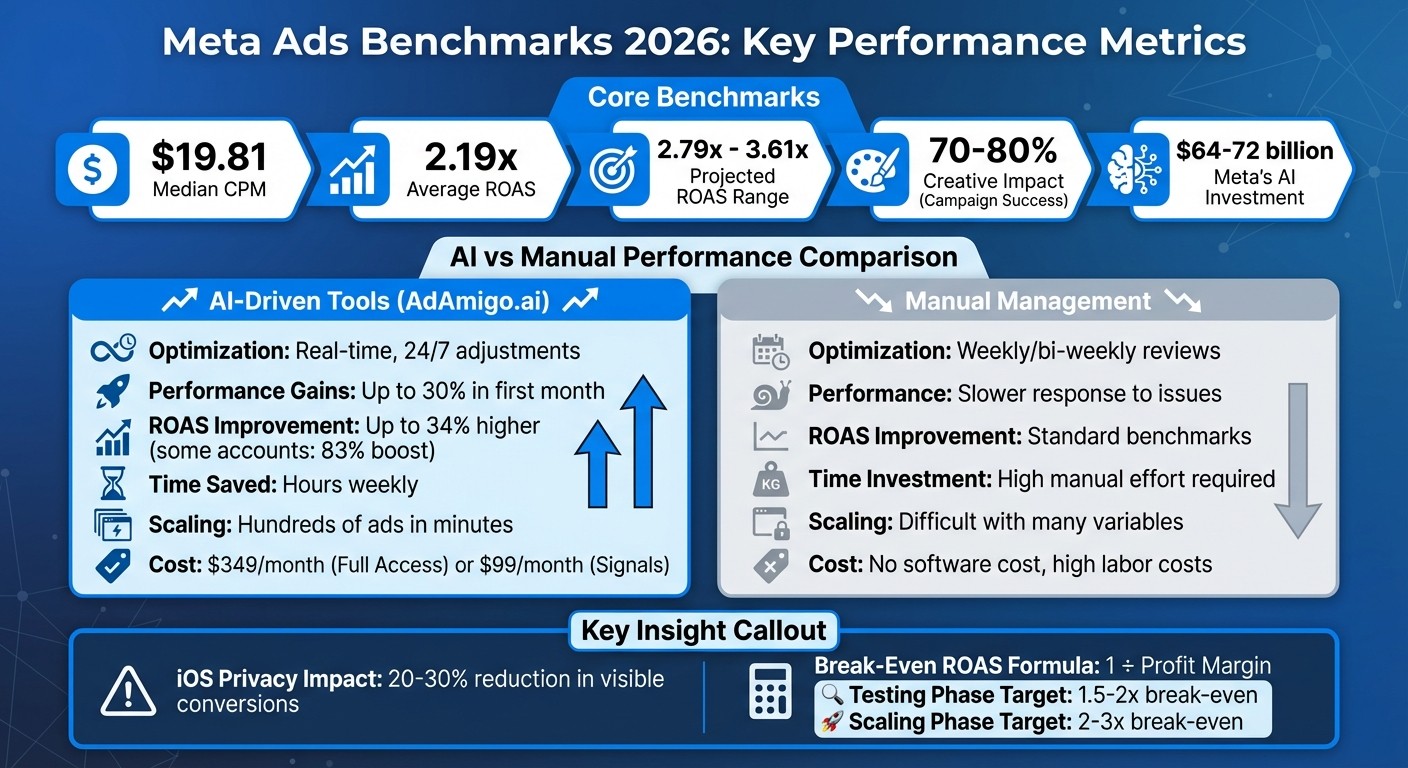
Meta ad benchmarks in 2026 highlight five key metrics: CPM, CPC, CTR, CVR, and ROAS. These metrics help advertisers measure performance and optimize campaigns effectively. Here are the most important insights:
Median CPM: $19.81
Average ROAS: 2.19x
AI's Role: Meta's $64–72 billion investment in AI is pushing ad costs higher, with creative quality now driving 70–80% of campaign success.
AI vs. Manual Management: Tools like AdAmigo.ai outperform manual methods by offering 24/7 optimization, faster scaling, and better ROAS (up to 34% higher). This allows brands to scale Meta ad budgets without the typical performance dips associated with manual adjustments.
Quick Overview: AdAmigo.ai vs. Manual Management
Feature | AdAmigo.ai (AI-Driven) | Manual Management |
|---|---|---|
Optimization | Real-time, 24/7 adjustments | Weekly/bi-weekly reviews |
Time Investment | Minimal (AI handles tasks) | High (manual effort required) |
Scaling | Simplified with AI tools | Difficult with many variables |
Creative Testing | Automated and frequent | Slow and less frequent |
Cost | $349/month (Full Access) or $99/month (Signals) | No software cost, but high labor effort |
Bottom Line: AI-driven platforms like AdAmigo.ai save time, improve performance, and simplify scaling. Manual management offers full control but requires more effort and slower optimization.
Meta Ads 2026 Benchmarks: CPM, CPC, CTR, CVR & ROAS by Industry
1. AdAmigo.ai
AdAmigo.ai is an autonomous AI media buyer designed to manage Meta ad accounts 24/7. It’s a game-changer for advertisers aiming to meet ambitious goals by 2026. Instead of the traditional Ads Manager interface, you interact with the platform through a chat system - or let it operate entirely on autopilot. The AI performs constant audits, spots areas for improvement, and implements changes, ensuring campaigns are always optimized for peak performance.
Performance Optimization
The platform’s AI Autopilot dives into every aspect of your campaigns - creatives, audience targeting, bids, and budgets - to deliver impactful adjustments. It scales up successful ads, pauses those that underperform, and even launches new tests while reallocating budgets in real time. Unlike traditional weekly reviews, this system updates campaigns daily based on live performance data. Additionally, AdAmigo Protect keeps an eye on account health, spotting delivery problems or unusual spending patterns before they become costly issues.
Automation Features
AdAmigo.ai comes packed with AI tools for Meta Ads to simplify campaign management:
AI Chat Agent: Manage campaigns through a conversational interface. You can ask the AI for insights, get explanations about performance trends, and make adjustments - all within the chat.
Bulk Ad Launcher: Create ad copy, structure campaigns, and publish ads at scale effortlessly.
Ad Factory: This feature analyzes your top-performing ads and competitor campaigns to generate new creative ideas, helping you scale creatives with AI and avoid ad fatigue.
These tools are especially useful for agencies and brands looking to scale, as they streamline processes and reduce manual workload.
Ease of Scaling
For agencies, AdAmigo.ai is a powerful ally. By automating repetitive tasks, it allows a single media buyer to handle 3–5× more client accounts. For eCommerce brands, it acts as a full-time media buyer, eliminating the need for a large in-house team. You can customize how much control the AI has - whether you want to approve every decision or let it run entirely on autopilot, the choice is yours.
Cost
AdAmigo offers two pricing tiers:
Full Access plan: Priced at $349/month per ad account, this plan includes unlimited AI actions, access to all features, unlimited team members, and a dedicated account manager.
Signals plan: At $99/month per ad account, this option provides up to two daily AI optimization suggestions that you can apply with a single click. It also includes access to the AI Chat Agent for performance analytics.
For agencies managing five or more accounts, custom pricing and white-labeling options are available upon request.
2. Manual Meta Ad Management

Even with tools like AdAmigo.ai simplifying campaign management, handling Meta Ads manually still feels like a juggling act. From launching campaigns to tweaking budgets and monitoring performance, every task falls squarely on your shoulders. While this gives you full control, it also brings major challenges - especially when you're trying to scale or keep up with the competitive standards expected in 2026. Unlike AI-powered solutions, manual management struggles to keep pace with real-time changes.
Performance Optimization
Optimizing ads manually is a slow and reactive process. Most campaigns are reviewed weekly or bi-weekly, which means problems might linger for days before being addressed. Considering that creative content accounts for 70–80% of ad performance, this delay can be costly. Testing creative variations at scale is particularly difficult without automation, often creating bottlenecks. To get better results, you can streamline your Meta ad account structure by consolidating campaigns with similar objectives. This allows Meta's algorithm to gather data more effectively and learn faster. A good practice is to test creatives every 2–4 weeks using Ad Set Budget Optimization (ABO) before scaling with Campaign Budget Optimization (CBO). However, these manual processes highlight just how much automation could simplify things.
Automation Features
Without automation, every step - launching, adjusting, and scaling ad variations - has to be done manually. This can lead to inconsistencies, such as errors in naming conventions or UTM parameters, which disrupt tracking across multiple markets. On top of that, iOS privacy updates have reduced visible conversions by 20–30%, complicating manual reporting even further. Without automated tools, maintaining accurate attribution and tracking becomes a significant challenge.
Ease of Scaling
Scaling manually is where things really start to break down. Imagine testing hundreds of creative, copy, and targeting combinations - it’s a logistical nightmare. Traditional micro-segmentation strategies are losing their edge as we move into 2026. AI-driven broad targeting has become the go-to approach, especially after Meta removed certain interest-based exclusions in June 2025. To succeed, you now need to feed Meta’s algorithms with diverse, high-quality creative assets rather than relying on granular manual controls. If you’re scaling manually, using Post IDs can help retain social proof like likes and comments, rather than resetting engagement with every new ad set. Still, the time investment required for manual scaling can quickly spiral out of control.
Cost
While managing ads manually might save on software expenses, it comes with hidden costs. Slower optimization leads to higher CPMs and CPCs because you can’t react to issues as quickly. Ultimately, the time and effort spent managing campaigns manually can outweigh any upfront savings.
Pros and Cons
Deciding between AdAmigo.ai and manual vs. AI-powered ad management boils down to your priorities - whether it's saving time, improving performance, or keeping costs under control. The table below lays out the key differences, focusing on performance, time investment, and expenses.
Feature/Metric | AdAmigo.ai (AI-Driven) | Manual Ad Management |
|---|---|---|
Performance Optimization | 24/7 optimization with up to 30% performance gains in the first month; some accounts report an 83% ROAS boost | Weekly or bi-weekly reviews; slower responses to issues can increase CPMs and CPCs |
Time Requirements | Frees up hours weekly; AI automates launching, testing, and scaling | Time-intensive; manual tasks require significant effort |
Creative Testing | Ad Factory continuously generates and tests creatives, avoiding creative fatigue | Typically done every 2–4 weeks, leaving room for fatigue |
Scaling Capability | Bulk Ad Launcher deploys hundreds of ads in minutes; AI simplifies complex scaling | Scaling manually is difficult with numerous creative and targeting combinations |
Cost Structure | $349/month for Full Access or $99/month for Signals plan; unlimited ad spend included | No software fees, but high labor costs or expensive agency retainers |
Tracking & Attribution | Automated tracking ensures consistency across campaigns | Manual tracking increases the risk of errors in naming conventions and UTM parameters |
This comparison highlights how AI-driven tools like AdAmigo.ai streamline ad management, making it faster and more efficient than traditional manual methods.
With AdAmigo.ai, you get continuous optimization and real-time adjustments that can significantly improve performance. On the other hand, manual management vs. AI might work better for those with very small budgets or a preference for hands-on control. However, manual methods often mean slower responses, higher labor demands, and missed opportunities.
The real edge of automation isn’t just in saving time - it’s the ability to continuously refine strategies based on real-time data. This creates a cycle of improvement that can drive better results over time, making AdAmigo.ai a strong choice for optimizing Meta Ads campaigns in 2026.
Conclusion
Looking at the 2026 benchmarks and the analysis above, the decision between AI and manual management becomes more straightforward. If your goal is to scale campaigns with strong ROAS (Return on Ad Spend), AI automation stands out for its ability to simplify multi-campaign optimization. For instance, Meta Ads ROAS for 2026 is projected to range between 2.79x and 3.61x, with optimized campaigns achieving 34% higher ROAS. These benchmarks highlight the efficiency gap between AI-driven strategies and manual management.
With automation, repetitive tasks are taken off your plate, naming conventions and UTM parameters are standardized, and your time is freed up to focus on creative strategy and big-picture planning.
On the other hand, manual management offers you full control but comes with significant time demands and slower response times. As Omega Trove Consulting puts it:
The businesses that win in paid advertising don't chase cheap clicks – they engineer profitable systems.
To evaluate performance effectively, flag any metrics that fall 50% below benchmarks for immediate review. Use the "Break-Even ROAS" formula (1 ÷ Profit Margin) to guide your decisions, aiming for 1.5–2x break-even during testing phases and 2–3x when scaling. This approach highlights the adaptability and speed AI tools bring compared to manual methods.
Ultimately, the choice depends on your priorities. AI tools like AdAmigo.ai excel at continuous improvement and scaling, while manual management provides hands-on control at the expense of slower optimization.
FAQs
What CPM, CPC, CTR, CVR, and ROAS should I target in 2026?
In 2026, the target benchmarks for Meta Ads performance are projected as follows: CPM at about $14.19, CPC near $11.82, CTR between 1.5% and 2.59% depending on the industry, CVR averaging 1.6%, and ROAS around 1.86. These figures vary based on your specific industry and campaign objectives. Consider them as a guide to help assess and fine-tune your campaign results.
How do I calculate my break-even ROAS for Meta ads?
To figure out your break-even ROAS, use this simple formula: divide 1 by your profit margin (as a decimal).
For instance, if your profit margin is 20% (or 0.20), the calculation would be:
1 ÷ 0.20 = 5
This means you’ll need $5 in revenue for every $1 spent on ads to break even.
You can fine-tune this calculation even more by factoring in metrics like your CPA (Cost Per Acquisition), CPC (Cost Per Click), and conversion rate.
When should I use AI automation vs. managing Meta ads manually?
In 2026, AI automation will play a key role in managing complex campaigns and repetitive tasks. Think of things like audience testing, creative rotation, and tweaking budgets. These processes can be streamlined to improve targeting and help campaigns scale more effectively.
For smaller or niche campaigns, though, manual management still holds value. It allows for the kind of precise control that automation might not always provide.
With CPMs on the rise - averaging around $23 in high-cost markets like the U.S. - a smart approach is to combine automation for routine tasks with manual oversight for strategic decisions. This balance can help advertisers manage costs while maintaining effectiveness.