
Meta Ads ROAS Benchmarks by Industry (2026)
2026 Meta Ads ROAS benchmarks by industry, average ranges, creative and Advantage+ impact, plus tracking fixes like the Conversions API to recover lost attribution.
Meta Ads in 2026 deliver an average ROAS (Return on Ad Spend) of 2.79x to 3.61x, but results vary significantly by industry. E-commerce campaigns often see a median ROAS of 2.79x, while Beauty & Personal Care struggles with 1.57x. Meanwhile, standout campaigns in categories like Baby Products can hit ROAS of 4.39x or more.
Key insights:
Meta's Advantage+ campaigns outperform manual setups by 22%.
Rising CPMs in Tier-1 markets require better conversion funnels.
Privacy changes (like iOS updates) have impacted attribution accuracy, but tools like the Conversions API can recover 20–40% of lost data by following attribution reporting best practices. AI-powered automation is also reshaping ad strategies, with platforms like AdAmigo.ai boosting ROAS by optimizing campaigns and lowering creative testing costs.
Quick tip: Use a break-even ROAS calculator to ensure profitability before scaling Meta ad budgets.
2025 Meta Ads Benchmarks by Industry (CTR, CPC, CPM, CPL & ROAS)
ROAS Benchmarks by Industry
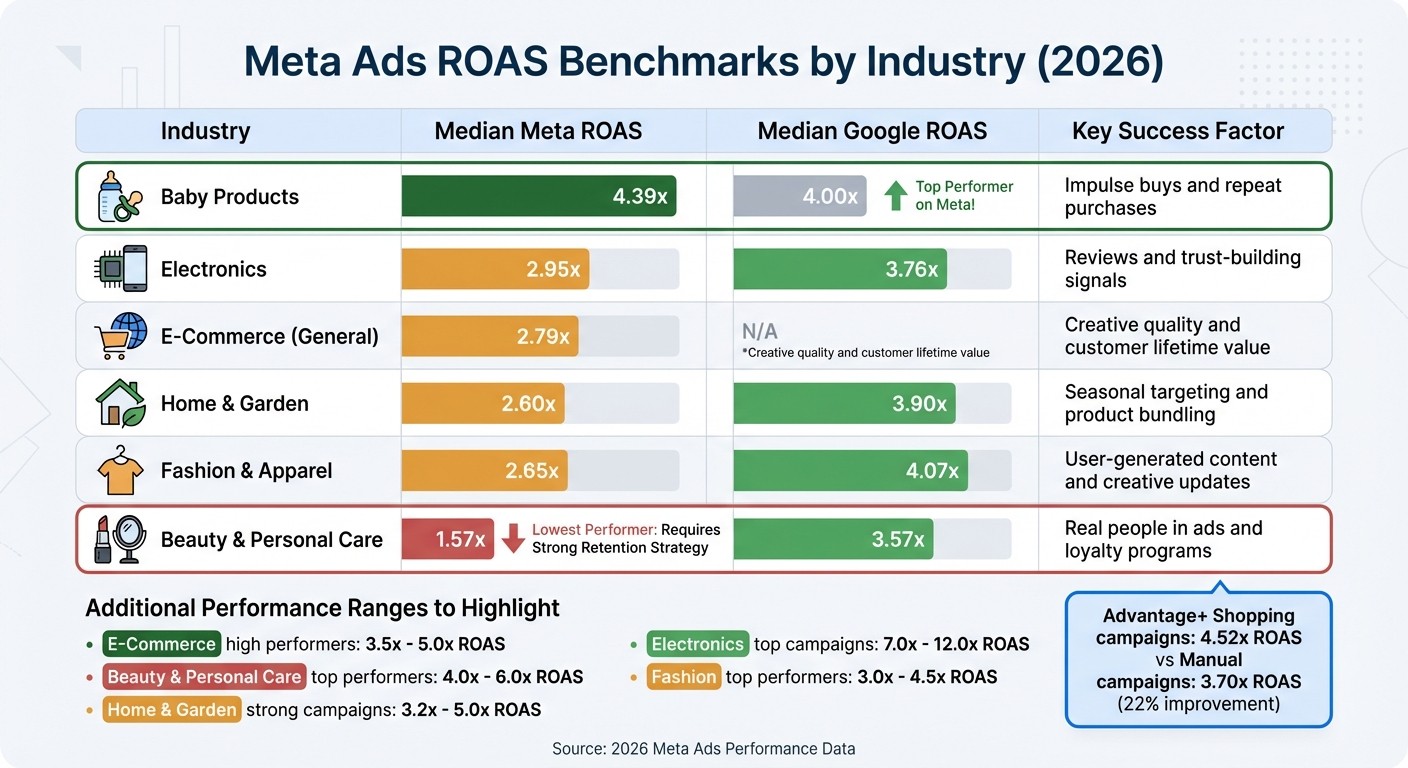
Meta Ads ROAS Benchmarks by Industry 2026 Comparison Chart
As we look at 2026 trends, industry-specific benchmarks offer a clear picture of where advertisers should sharpen their focus. Meta Ads performance varies widely across industries, making it essential to understand your sector's benchmarks to set realistic goals and identify when campaigns need ROI optimization.
E-Commerce Industry
For general e-commerce businesses, Meta delivers a median ROAS of 2.79x in 2026. High performers, however, often see ROAS figures between 3.5x and 5.0x.
This difference often boils down to creative quality and customer lifetime value. Businesses with high-margin products and strong repeat purchase rates can afford a lower initial ROAS, as subsequent orders help drive overall profitability.
Meta's Advantage+ Shopping campaigns show an edge, achieving an average ROAS of 4.52x, compared to 3.70x for manual campaigns - a 22% improvement. For advertisers still relying on manual setups, these AI-driven campaigns can deliver immediate results.
Fashion and Apparel
Fashion brands on Meta see a median ROAS of 2.65x, whereas Google Ads outperforms with a median ROAS of 4.07x in this category. This gap stems from Google capturing high-intent search traffic, while Meta leans on visual discovery and impulse buying.
Although low cost-per-clicks (around $0.45) may seem appealing, challenges like high return rates and sizing issues can cut into net profits. The strongest performers in this space achieve ROAS between 3.0x and 4.5x, often by leveraging user-generated content and frequently updating creatives to avoid ad fatigue. Engaging visuals alone can boost ROAS by 2–3x, even without changes to targeting or bidding strategies.
Beauty and Personal Care
Beauty brands report the lowest median ROAS on Meta at 1.57x — but that blended figure masks enormous variation. Depending on the data source, methodology, and campaign type, beauty ROAS benchmarks range from roughly 1.5x (cold prospecting for low-AOV products like lip balm) to 7.0x+ (retargeting campaigns for high-AOV skincare). AdRiseLab's 2026 dataset puts the beauty average at 4.2x ROAS, while MHI Growth Engine's analysis of 1,247 ad accounts reports 3.7x. The range is wide because the beauty category is wide — and your sub-vertical is the biggest performance differentiator.
Sub-Vertical | Avg. ROAS | Avg. CPA | Avg. CTR | Avg. CPM |
|---|---|---|---|---|
Skincare | 4.5x | $26 | 1.70% | $15 |
Makeup | 3.1x–3.8x | $28–$35 | 1.45% | $17 |
Fragrance | 3.4x | $38 | 1.10% | $19 |
Haircare | 3.5x–4.0x | $25–$32 | 1.35% | $16 |
Skincare leads with the strongest unit economics — high AOVs and strong repeat purchase rates drive a lean $26 CPA and 4.5x ROAS. Fragrance is the toughest sub-category: CPAs climb to $38+ with ROAS around 3.4x, driven by fierce competition and a longer consideration cycle where customers often sample scents in-store before buying online. Makeup and haircare fall in the middle, with CPAs ranging from $25–$35 and ROAS from 3.1x–4.0x. One critical caveat: CPA is meaningless without your AOV. A $45 CPA is disastrous for a $28 face wash but excellent for a $150 anti-aging serum — always benchmark CPA against your product's contribution margin, not an industry average in isolation.
Beauty CPMs run 30–40% above the ecommerce average — typically $18–$34 for cosmetics versus $14–$22 for general ecommerce — which makes creative efficiency even more critical here. The category's overall CTR sits around 1.40%, though skincare and makeup outperform fragrance by a meaningful margin (see table above). Creative format choice is the single biggest performance lever: before/after imagery showing real results achieves 4.9x ROAS with a 2.10% CTR, nearly double the 3.6x ROAS and 1.05% CTR of polished studio stills. UGC-style ads consistently drive 30–50% lower CPAs than studio-produced creative, reinforcing what top beauty advertisers already know — ads featuring real people outperform glossy product shots. That said, beauty creatives fatigue fast: roughly 7 days versus the 8.4-day all-industry average, and makeup creatives fatigue fastest at just 6 days, making a regular refresh cadence essential. AI-powered creative testing helps brands maintain a fresh pipeline without burning manual design hours.
Seasonality hits beauty harder than most verticals. November CPMs spike roughly 48% above the annual median as brands compete for holiday gift-set buyers, while January CPMs dip to their annual low as competition cools. Smart advertisers front-load creative testing in the quiet months and run proven winners during the Q4 rush. The silver lining: beauty's high repeat purchase rates mean you can afford a lower first-purchase ROAS when retention is strong. Established brands with loyal customer bases often average 3.00x or higher, with top performers hitting between 4.0x and 6.0x. Enhancing loyalty programs or subscription models can turn a marginal first sale into a profitable customer relationship — and that's where the real long-term advantage lives.
Home & Garden
In the Home & Garden sector, Meta delivers a median ROAS of 2.60x, compared to 3.90x on Google. Strong campaigns in this space typically range between 3.2x and 5.0x.
This industry faces unique challenges, such as longer decision-making cycles and higher shipping costs. However, larger average order values (AOV) often balance these hurdles. Seasonal targeting - like promoting patio furniture in spring or holiday décor in winter - and bundling products to increase cart values are common strategies for success. Additionally, landing page speed is critical, as a one-second delay can reduce conversions by 7% on desktop and 20% on mobile.
Electronics and Technology
Electronics brands achieve a median ROAS of 2.95x on Meta, while Google Ads delivers 3.76x. Thin profit margins (typically 10% to 35%) mean that brands often need a ROAS of 4.0x or higher just to break even. Top campaigns in this space reach ROAS levels between 7.0x and 12.0x, often by utilizing product reviews and comparison content. AI-driven campaigns further enhance performance by optimizing bidding and targeting strategies..
For high-ticket items, trust-building elements - like customer testimonials and third-party reviews - outperform generic product visuals. In the Baby Products category, Meta stands out with a median ROAS of 4.39x, surpassing Google's 4.00x, due to a mix of impulse buys and high repeat purchase rates.
Here's a quick summary of median ROAS and success factors across industries:
Industry | Median Meta ROAS | Median Google ROAS | Key Success Factor |
|---|---|---|---|
Fashion & Apparel | 2.65x | 4.07x | User-generated content and creative updates |
Beauty & Personal Care | 1.57x | 3.57x | Real people in ads and loyalty programs |
Home & Garden | 2.60x | 3.90x | Seasonal targeting and product bundling |
Electronics | 2.95x | 3.76x | Reviews and trust-building signals |
Baby Products | 4.39x | 4.00x | Impulse buys and repeat purchases |
Factors That Affect Meta Ads ROAS in 2026
Understanding what drives Return on Ad Spend (ROAS) is crucial for businesses relying on Meta ads. Two major factors stand out: privacy-related attribution challenges and how campaigns are structured.
Attribution and iOS Privacy Changes

Attribution accuracy for Meta ads has taken a hit - dropping 40-60% since privacy updates like iOS changes, browser restrictions, and ad blockers became more common. As of January 12, 2026, Meta eliminated its 7-day view and 28-day view attribution windows, creating a tough situation for businesses with longer sales cycles.
With 75% of iOS users opting out of tracking through Apple's App Tracking Transparency (ATT), Meta's attribution has become less reliable for this audience. To complicate things further, iOS 17 and 18 introduced link tracking protection, stripping parameters like fbclid from Safari URLs, which makes it harder for Meta to connect ad clicks to conversions. Switching from a 28-day click window to a 7-day one has led to a 15-30% drop in reported conversions.
Meta now depends on machine learning to estimate 30-50% of conversions for audiences dominated by iOS users. However, businesses can regain 20-40% of lost conversion data by using the Conversions API (CAPI). To make the most of CAPI, aim for an Event Match Quality (EMQ) score of "Good" or "Great" (70%+), achieved by sending hashed customer data like email addresses and phone numbers. Keep in mind that a 20-40% variance between Meta Ads Manager and Google Analytics 4 metrics is now standard due to different attribution models.
Next, let’s look at how campaign setup and spending strategies play a role in shaping ROAS.
Campaign Type and Spend Strategy
The way campaigns are structured and budgets are allocated has a direct impact on ROAS. For example, prospecting campaigns targeting new audiences typically deliver 1.2x to 2.5x ROAS, while retargeting campaigns aimed at website visitors or past engagers can achieve 2.5x to 6.0x ROAS. In some cases, high-performing retargeting campaigns can even hit 15x+ ROAS.
Budget size also plays a big role. Smaller accounts spending less than $3,000 a month often see higher ROAS (2x to 5x) because there’s less budget wasted. On the other hand, larger accounts spending over $30,000 a month typically operate at a lower ROAS (1.2x to 2.0x) due to the need to reach broader, less-targeted audiences.
"The best Meta Ads accounts in 2026 run 3-5 campaigns, not 30. Simplification beats segmentation when the algorithm has enough data." - Distk Team
For optimal results, allocate 60-70% of your budget to Advantage+ Shopping campaigns, 15-25% to retargeting, and 15-20% to testing new creatives. When scaling, increase budgets gradually by 20-30% every 3-4 days to avoid triggering a new learning phase, which could disrupt performance. Creative quality is now a major factor in Meta Ads success, accounting for over 50% of performance in 2026. This makes frequent creative updates a must.
Meta Ads vs. Other Platforms: ROAS Comparison
Let’s dive into how Meta Ads stack up against Google and TikTok in 2026, especially when it comes to Return on Ad Spend (ROAS). Knowing where your advertising dollars work hardest can make all the difference. To protect your budget, it is essential to set guardrails for Meta ads to prevent overspending while scaling.
Meta Ads vs. Google Ads
Google and Meta play distinct roles in the marketing funnel. Google Ads targets users with high purchase intent - those already searching for solutions. Meta, on the other hand, focuses on creating demand through visually engaging ads and precise audience targeting. This fundamental difference is reflected in their performance metrics.
Google Search typically delivers an average ROAS of 3.8x, while Google Shopping performs even better at around 5.2x. Meta Ads, meanwhile, show a broader range, yielding between 2.5x and 6.0x for D2C brands, with retargeting campaigns often hitting 6x to 15x or more. These numbers highlight the platforms' unique strengths: Google thrives on intent-driven searches, while Meta excels at building awareness and desire.
"Google Ads wins when users already have intent. Meta Ads wins when you want to create desire and scale brand visibility." - Digitingsolutions.com
Cost structures also differ significantly. Google Search clicks average $2.10 to $2.69, whereas Meta clicks are generally more affordable, ranging from $0.60 to $1.30. When it comes to click-through rates (CTR), Google Search leads with averages of 3.8% to 4.2%, compared to Meta’s more modest 1.1% CTR. This makes sense - Google users are actively searching, while Meta users are more passively browsing and often require multiple interactions before converting.
Performance also varies by industry. For D2C brands, Meta can deliver 4x to 8x ROAS, compared to Google’s 2x to 3x. However, in sectors like local services, Google often outshines Meta, achieving ROAS of 5x to 10x versus Meta’s 1x to 2x. Similarly, legal campaigns tend to perform better on Google, with ROAS reaching 8.2x compared to Meta’s 3.0x.
A popular strategy in 2026 is the "70/30 split", where 70% of the ad budget goes to Google to capture existing demand, while 30% is allocated to Meta and TikTok for creating new demand.
Next, we’ll explore how Meta compares with TikTok, focusing on discovery and engagement.
Meta Ads vs. TikTok Ads

TikTok has carved out a niche as a discovery powerhouse, especially for younger audiences. While Meta shines in mid-funnel retargeting and storytelling, TikTok’s strength lies in its viral, creative-first approach to top-funnel engagement.
On the cost front, TikTok has a slight edge. The platform’s average cost-per-click (CPC) is around $0.44, compared to Meta’s $0.70. TikTok also boasts a click-through rate of roughly 1.4%, which sits between Meta’s range of 0.9%–1.1% and Google’s higher rates.
When it comes to ROAS, TikTok prospecting campaigns typically deliver between 0.8x and 2.0x under traditional last-click attribution. However, when using Marketing Mix Modeling - a method that accounts for upper-funnel contributions - TikTok’s ROAS can reach 2.1x. This highlights how last-click models often undervalue the incremental impact of platforms like TikTok and Meta.
TikTok also outshines Meta in certain niches. Fashion brands, for example, see 340% better engagement on TikTok compared to Facebook. In 2024, TikTok Shop generated $16.4 billion in sales, while Facebook Shops brought in $32.1 billion globally. TikTok’s short, snappy videos - ideally 21 to 34 seconds long - are particularly effective for impulse purchases and Gen Z audiences.
Both platforms require frequent creative updates to stay effective. Advertisers need to rotate creatives every 3 to 5 days to avoid ad fatigue and maintain performance.
Using AI Tools to Improve ROAS
In 2026, Meta's AI, powered by the Andromeda retrieval engine and GEM (Generative Ads Model), delivers a 10,000x capacity boost. This shift moves the emphasis from manual targeting to creative quality and faster testing. By integrating these advancements with earlier strategies, advertisers can unlock new opportunities to improve ROAS. The best AI tools for Meta Ads are key to making this transformation accessible.
How AI Automation Increases ROAS
AI automation goes beyond just analyzing campaigns - it actively manages them around the clock. This approach tackles the inefficiencies of manual optimization head-on. For example, tools like AdAmigo.ai continually assess ad accounts, pinpoint high-impact opportunities, and implement changes automatically. This eliminates weeks of manual effort, allowing advertisers to concentrate on broader strategy.
The impact is clear. Advertisers using AI-driven Advantage+ campaigns report a 22% increase in ROAS compared to manual efforts. In 2025, retail fashion brand FULLBEAUTY Brands adopted AI-generated creative variations through Meta's Advantage+ Shopping tool. The results? A 45% jump in ROAS, a 22% rise in conversion rates, and a 36% boost in click-through rates. Similarly, Elysian Events Catering saw a 657% surge in website traffic within just one month by leveraging AI for audience targeting and creative optimization.
AI's ability to make thousands of decisions per second is game-changing. It can test 5 to 10 active creatives simultaneously, which is critical in a landscape where creative fatigue often sets in within 7 to 14 days. In fact, by 2026, creative quality accounts for over 50% of Meta Ads performance.
AdAmigo.ai Features for Advertisers
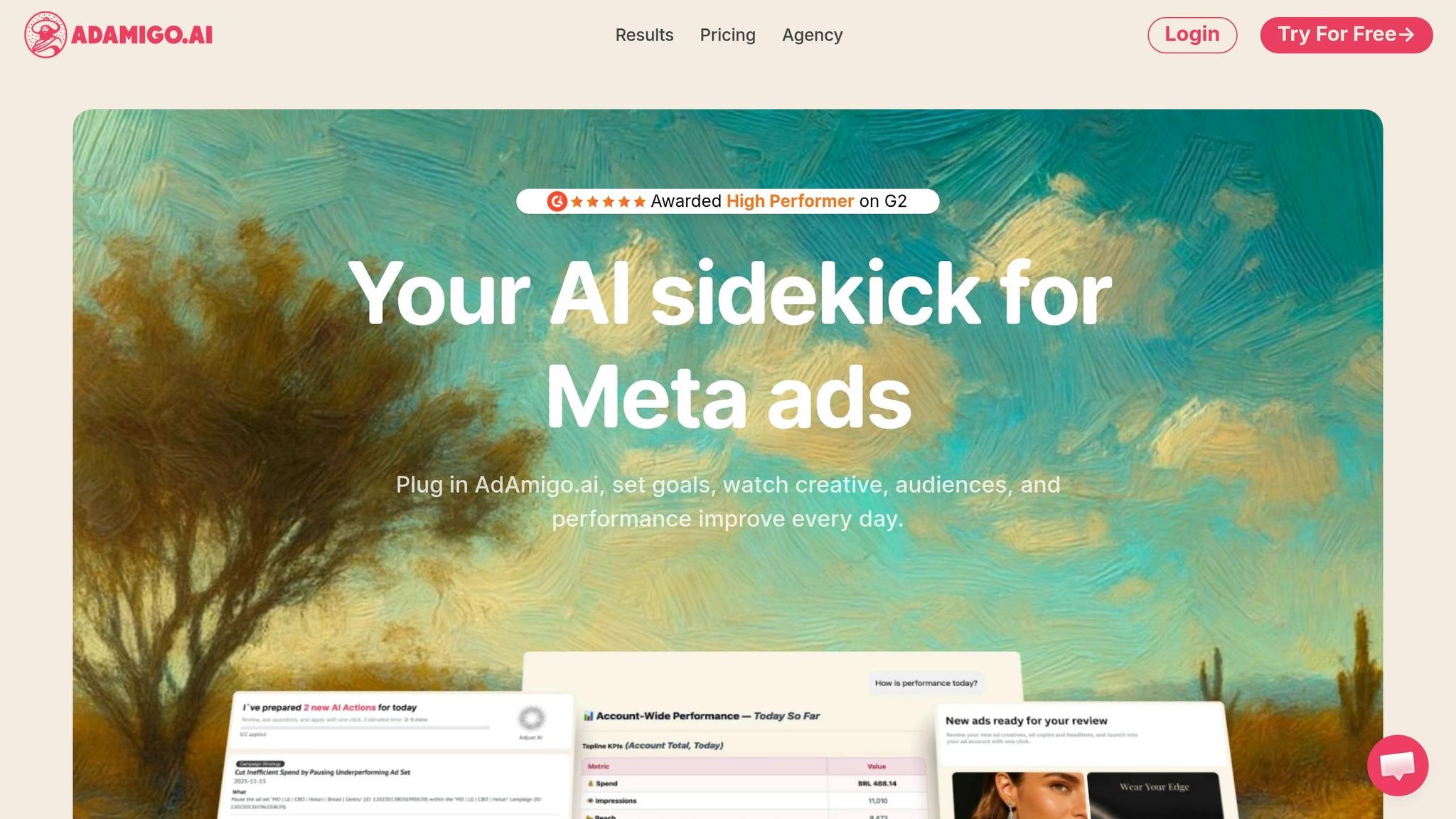
AdAmigo.ai demonstrates how AI can streamline and enhance campaign management. Acting as an autonomous media buyer, it handles campaigns from start to finish. Here’s how its features work:
AI Autopilot: This feature audits your account, launches tests, adjusts budgets, scales successful ads, and pauses underperformers. You can let it act automatically or approve changes yourself.
AI Chat Agent: Manage campaigns through simple conversation. Ask questions like, "Why did ROAS drop yesterday?" or give commands like, "Launch a new retargeting campaign." It analyzes data and makes real-time adjustments directly from the chat.
Ad Factory: This tool analyzes your top-performing ads and competitor creatives to generate fresh variations. It helps maintain a steady flow of new ideas without requiring manual design work.
Bulk Ad Launcher: Quickly deploy dozens (or even hundreds) of ads. Just upload your creatives to Google Drive, provide a brief, and the system handles the copywriting, campaign structuring, and ad publishing directly to your Meta account.
AdAmigo Protect: This feature monitors account health, flagging anomalies, delivery issues, or unusual activity early to prevent unnecessary spending.
These tools build on industry benchmarks and ROAS strategies discussed earlier. With AdAmigo.ai, you can set KPIs, budgets, targeting, and scaling rules, giving you the option to run fully autonomous campaigns or approve actions manually. To keep discovering new winning assets, allocate 15% to 25% of your budget to AI-driven bulk ad testing. Let the AI handle the repetitive tasks while you focus on the creative vision and brand strategy.
Conclusion: Using Industry Benchmarks to Improve Results
Industry benchmarks serve as a reference point for evaluating your performance. For instance, if your e-commerce ROAS is 1.8x while the median is 2.79x, it's time to examine areas like tracking accuracy, page speed, and creative strategy. As Omega Trove puts it:
"Benchmarks don't define success – they define context".
Your ROAS targets should align with your business's financial goals. To determine your break-even ROAS, use a ROAS calculator or the formula: 1 ÷ Contribution Margin. Only scale your ad budgets when you're consistently achieving at least 20% above this break-even point. These benchmarks help highlight the importance of creative quality and precise targeting.
Creative quality is a game-changer, accounting for up to 70% of performance variability. With systems like Meta's Andromeda and GEM automating targeting, the real advantage lies in producing fresh, engaging creative rather than focusing on manual bid adjustments. Regularly updating your creative assets helps combat ad fatigue. Advantage+ campaigns, for example, often outperform manually managed setups, delivering an average ROAS of 4.52x compared to 3.70x.
Meta's CPMs have increased significantly. While Google Search typically offers higher ROAS (3.0x–8.0x) due to strong purchase intent, Meta Ads (2.0x–4.0x) excel at scalable prospecting. TikTok, with lower CPMs (around $9.16), often delivers lower conversion rates. To get a full picture of your campaign's effectiveness, keep an eye on your Marketing Efficiency Ratio (MER) across all channels.
Automation tools can also elevate your strategy. Leveraging AI-powered platforms like AdAmigo.ai simplifies campaign management and creative testing. These tools can audit accounts, run tests, adjust budgets, and scale successful campaigns, allowing you to focus on creative strategy and overall brand direction.
As Omega Trove wisely notes:
"The businesses that win in paid advertising don't chase cheap clicks – they engineer profitable systems".
FAQs
What ROAS should I target for my industry on Meta in 2026?
In 2026, the target ROAS on Meta will vary depending on your industry. For e-commerce brands, the goal is often 3.0x or higher, while businesses in high-margin industries like SaaS may aim for 4.0x to 6.0x or more. These targets are influenced by profit margins and specific business objectives. To achieve the best results, align your ROAS goals with industry standards and your campaign's unique objectives.
How do I calculate my break-even ROAS for Meta ads?
To figure out your break-even ROAS for Meta ads, apply this formula: Break-even ROAS = 1 ÷ Gross Margin Percentage. For instance, if your gross margin is 60%, your break-even ROAS would be 1.67x. If your gross margin drops to 30%, the break-even ROAS increases to 3.33x. This calculation ensures that your ad spend aligns with your profit margin, and any ROAS above this number means you're operating profitably.
How can I improve ROAS with iOS tracking limits and attribution changes?
To boost your ROAS in the face of iOS tracking limits and attribution shifts, consider upgrading your tracking system with server-side tools like Facebook's Conversion API. This helps ensure your measurement remains accurate despite privacy changes.
Shift your focus to creative variety and testing, as strong creative performance now plays a bigger role in driving ROAS than manual targeting methods. Take advantage of Meta's AI-powered tools, such as Advantage+, to streamline and enhance campaign performance.
Finally, stay proactive by continually monitoring campaign results. Use the insights to refine your creatives and offers, keeping your strategies aligned with evolving privacy-focused challenges.