
What Is an AI Media Buyer? Full Definition, Examples, and Tools
Learn how AI media buyers automate Meta ad campaigns — from predictive targeting and real-time bidding to creative optimization. Compare top tools and see real results.
AI media buying uses machine learning and automation to manage ad campaigns more efficiently. It handles tasks like bidding, budget allocation, audience targeting, and even ad creation, saving marketers time while improving campaign performance. Unlike traditional methods, AI tools adjust strategies in real-time based on live data, making them highly effective for platforms like Meta (Facebook and Instagram).
Key Takeaways:
Core Features: Predictive targeting, real-time bidding, dynamic creative testing, and automated reporting.
Benefits: Better Return on Ad Spend (ROAS), time savings, and precise audience targeting.
Challenges: Limited transparency, data privacy concerns, including managing privacy risks while personalizing ads, and the need for human oversight in creative decisions.
Top Tool: AdAmigo.ai, offering features like AI chat commands and budget optimization, is a leading choice for Meta ads.
AI media buyers are reshaping digital advertising by automating complex tasks, enabling businesses to scale campaigns efficiently while focusing on strategy and messaging.
How I trained AI to be my Meta Ads Media Buyer (it's been crazy)
This approach mirrors how brands have scaled purchases using AI instead of traditional hiring. This is why many top AI tools for agencies are now focusing on full automation.
How AI Media Buyers Work
AI media buyers have transformed how ad campaigns are managed, especially when it comes to scaling efforts. By combining machine learning with real-time data processing, these systems handle tasks that would otherwise overwhelm human marketers. Let’s break down their main features and the step-by-step process that makes them so effective.
Main Features of AI Media Buyers
One standout feature is predictive targeting. Instead of relying solely on traditional demographic data, AI systems predict consumer behavior to identify users who are most likely to convert. This approach goes beyond the surface, offering precision that traditional methods can’t match.
Another key capability is real-time bidding optimization. Unlike static bid settings, AI dynamically adjusts bids based on live performance data and market conditions. These systems process vast amounts of information in milliseconds, ensuring each auction bid maximizes return on investment (ROI).
AI also excels at dynamic creative optimization, which matches creatives to specific audiences. By testing various combinations of images, headlines, and calls-to-action, AI determines which elements resonate most with specific groups. This means marketers can deliver tailored messaging at scale without needing to manually tweak every ad.
On top of creative personalization, AI systems simplify data analysis. They don’t just present raw numbers; they interpret performance data and provide actionable recommendations. This helps marketers understand not only what’s happening but also why certain strategies work.
Lastly, budget allocation models ensure ad spend is used efficiently. Instead of sticking to rigid budget splits, AI redistributes funds in real time, focusing on the channels and audience segments delivering the best results. This ensures every dollar is spent where it matters most.
AI Media Buying Process
The process starts with data collection. AI systems gather and analyze large datasets, learning from patterns to refine strategies in real time.
During the learning phase, machine learning models dig into this data to predict audience behavior and uncover optimization opportunities. They determine which audience segments respond best to specific messages, identify peak conversion times, and pinpoint the creative elements that drive the most engagement.
Next comes ad creation, where AI leverages dynamic tools to produce and personalize content for different segments. Advanced platforms can generate ads using insights from past campaigns or competitor analysis, allowing for rapid creative testing and iteration.
The real magic happens in the optimization phase. AI continuously adjusts bids, placements, and budgets based on live campaign performance. If certain audience segments perform better than expected, the system increases bids for those groups while scaling back on underperforming ones. This constant fine-tuning ensures campaigns deliver the best possible results.
The final step is automated reporting, which provides clear performance insights and actionable takeaways. These reports don’t just highlight what worked or didn’t - they explain why, creating a feedback loop that improves future campaigns.
This approach has delivered impressive results. For example, Jura experienced a 77% revenue increase, a 361% boost in ROAS, and an 820% jump in conversion rates after adopting AI-driven media buying.
Benefits and Drawbacks of AI Media Buying
AI media buying stands out for its ability to predictively target audiences and adjust budgets dynamically. While it offers notable efficiencies, it also introduces complexities. Understanding both the advantages and challenges is crucial for making informed decisions about leveraging these tools.
Main Benefits of AI Media Buyers
One of the standout advantages of AI in media buying is its targeting precision. These systems analyze enormous datasets, uncovering high-value audiences that manual approaches often overlook. Instead of just focusing on basic demographics, AI evaluates user behavior, purchase intent, and contextual data to predict which users are most likely to convert.
Another major perk is cost savings. AI continually optimizes bids and reallocates budgets in real time, eliminating unnecessary spending. For instance, Jura's adoption of AI resulted in a 75% reduction in cost-per-sale and a 361% increase in ROAS within eight months.
"We are getting INSANE RESULTS! Our budgets are controlled, our spend is being smartly allocated and our ROAS is up massively. Agencies charging 7 times the cost of AdAmigo have been put to shame quite frankly!" - Rochelle D.
AI also ensures 24/7 campaign optimization, adjusting bids and budgets even when human marketers are offline. This is particularly valuable for platforms like Meta, where audience behavior and competition can shift rapidly.
The time savings are another game-changer. Tasks that once required hours can now be executed with a few simple text or voice commands. Jakob K., a verified user, shares:
"The fact that you can launch campaigns through text or voice commands feels like magic! It handles everything from AI vs manual audience creation to adjusting budgets with just a few prompts. It saves so much time!"
Additionally, dynamic creative optimization allows AI to personalize ad content for multiple audience segments simultaneously, enabling rapid testing and iteration at scale.
Challenges and Limitations of AI Media Buyers
Despite its advantages, AI media buying comes with its own set of challenges that businesses must navigate.
One key issue is transparency. Many AI systems function as "black boxes", making decisions without providing clear explanations. This lack of clarity can complicate strategic planning.
Privacy and data security concerns are another significant drawback. AI systems often rely on vast amounts of user data, raising questions about how this data is collected, stored, and protected. Businesses must ensure their AI vendors adhere to strict data governance and privacy standards, especially under regulations like GDPR and CCPA.
While automation is a strength, the need for human oversight remains vital. AI may falter in unfamiliar situations or when creative strategies and nuanced brand messaging are required. Over-relying on automation can lead to missed opportunities or misaligned decisions.
Lastly, limited creative strategy capabilities can restrict AI's performance. While AI excels at optimizing campaigns, it struggles with developing fresh concepts or capturing subtle brand messaging that requires human creativity and cultural understanding.
Feature | AI-Driven Media Buying | Agentic Media Buying | Manual Media Buying |
|---|---|---|---|
Precision | High (data-driven) | High (AI + human input) | Moderate (human analysis) |
Speed | Real-time | Near real-time | Slow |
Transparency | Low ("black box") | Moderate (some explainability) | High |
Cost Efficiency | High | High | Variable |
Human Oversight | Minimal | Required | Full |
Privacy Risk | Higher (data-intensive) | Moderate | Lower |
Creative Strategy | Limited | Moderate | High |
To get the most out of AI media buying, businesses should choose the best AI media buying platforms that not only automate processes but also offer actionable insights and maintain transparency. Pairing AI automation with strategic human input ensures that campaigns achieve their full potential while minimizing risks.
Top AI Media Buying Tools for Meta Ads
AI media buying tools have transformed how businesses approach Meta ads, offering a range of specialized features and capabilities. Among these tools, one stands out as a clear leader in the field.
AdAmigo.ai: A Standout Solution for Meta Ads
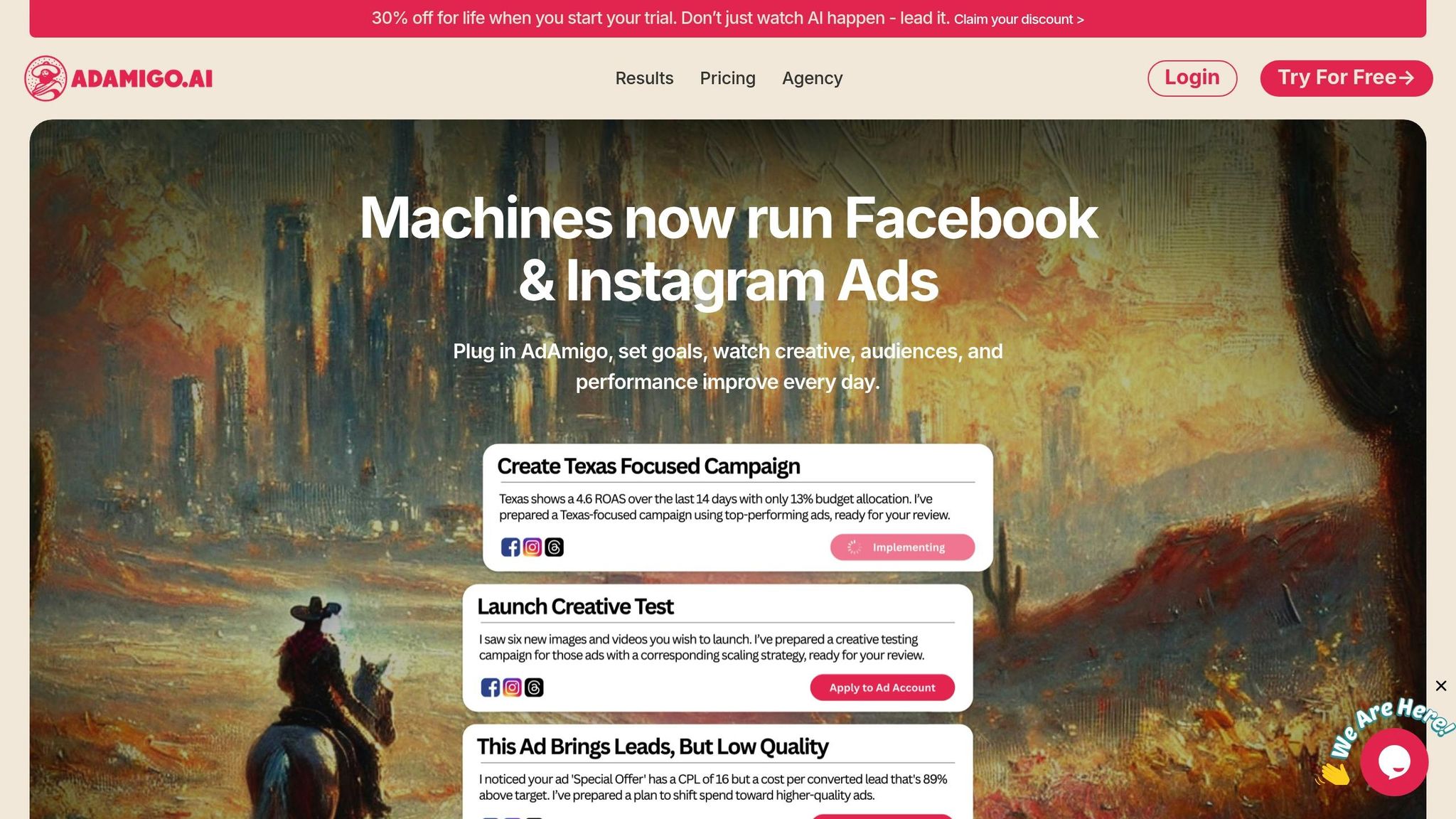
AdAmigo.ai has positioned itself as a top-tier choice for AI-driven media buying on Meta platforms. Its robust suite of features makes managing ad campaigns not only easier but also more effective through Meta ads automation. At the heart of the platform is its AI Ads Agent, which works as an autonomous media buyer. This tool performs daily audits of ad accounts, while AI Actions delivers actionable recommendations for optimizing creatives and budgets using audience data. Each suggestion is backed by detailed insights, ensuring users understand the reasoning behind every adjustment.
"We are getting INSANE RESULTS! Our budgets are controlled, our spend is being smartly allocated and our ROAS is up massively. Agencies charging 7 times the cost of AdAmigo have been put to shame quite frankly!" - Rochelle D., G2 Reviewer
What truly sets AdAmigo.ai apart is its AI Chat Agent, a feature that allows users to manage campaigns using simple text or voice commands. With this tool, tasks like launching campaigns, creating lookalike audiences, custom audiences, adjusting budgets, or generating reports can be accomplished in seconds.
"The fact that you can launch campaigns through text or voice commands feels like magic! It handles everything from creating lookalike audiences to adjusting budgets with just a few prompts. It saves so much time!" - Jakob K., G2 Reviewer
AdAmigo.ai Pricing Plans:
Entry Plan: $99/month (or $79/month annually) – Designed for accounts spending under $5,000/month, this plan includes up to 2 AI Actions per day and full access to the chat agent.
Gringo Plan: $299/month (or $179/month annually) – Offers unlimited AI Actions, bulk ad launching, and dedicated onboarding support.
Additionally, the platform offers a 30% lifetime discount for trial users, making it a cost-effective option for businesses of all sizes.
Other AI Media Buying Tools
While AdAmigo.ai excels in Meta-specific advertising, other tools provide broader solutions for programmatic media buying. These platforms vary in their focus and capabilities, offering alternatives for businesses with different needs.
The Trade Desk is a demand-side platform (DSP) powered by the KOA AI engine, capable of processing over 15 million impressions per second. While it’s not tailored specifically for Meta ads, it shines in omnichannel campaigns and provides custom algorithm options for brands with diverse goals.
Google DV360 focuses on programmatic buying within Google’s ecosystem, featuring automated bidding and audience modeling. However, its Meta integration is limited, making it less ideal for Meta-focused campaigns.
MediaMath emphasizes cross-channel optimization and real-time data analysis, catering to businesses managing multi-platform campaigns. Like DV360, it lacks dedicated Meta-specific features but is a solid choice for broader digital strategies.
Tool | Meta Specialization | Key AI Features | Pricing Model | Best For |
|---|---|---|---|---|
AdAmigo.ai | High | AI Ads Agent, Chat Agent, Creative Tools | $99–$299/month | Meta-focused campaigns, agencies, SMBs |
The Trade Desk | Moderate | KOA AI engine, Custom Algorithms | % of ad spend | Large enterprises, omnichannel efforts |
Google DV360 | Low | Automated Bidding, Audience Modeling | % of ad spend | Google ecosystem campaigns |
MediaMath | Low | Real-Time Optimization, Cross-Channel | % of ad spend | Multi-platform campaigns |
For businesses prioritizing Meta advertising, AdAmigo.ai’s specialized focus delivers unparalleled advantages. Its seamless integration with Meta platforms, combined with its ability to autonomously manage campaigns and provide actionable insights, makes it a highly effective tool. By adapting to real-time campaign performance while respecting budget and placement constraints, AdAmigo.ai exemplifies the future of AI-powered media buying.
The Future of AI and Agentic Media Buying
Advertising is stepping into a new era where autonomous AI systems are taking the reins, managing campaigns from start to finish without human intervention. This shift is more than just a leap in automation - it's redefining media buying as AI agents begin to replace traditional human roles. Welcome to the age of agentic media buying, a groundbreaking approach to ad management.
Agentic Media Buying: The Next Frontier
Agentic media buying represents a significant leap in advertising technology. These autonomous AI agents handle the entire media buying process with minimal human involvement. Unlike traditional programmatic buying, which still requires human oversight, these systems make real-time decisions, adjust strategies on the fly, and directly interact with ad platforms using advanced protocols like AdCP.
These agents analyze vast amounts of data, predict consumer behavior, allocate budgets, and optimize bids - all in real time. By eliminating human delays, they ensure campaigns are more efficient and responsive. They also continuously learn from performance data, keeping strategies aligned with marketing goals while adapting to shifting market dynamics.
The transition from reactive to proactive media buying is particularly noteworthy. AI agents now leverage predictive analytics to forecast consumer actions and fine-tune campaigns before users even show interest. This capability allows them to process data almost instantly, enabling decisions that were once impossible with manual methods.
Take AdAmigo.ai, for example. This platform showcases how AI media buyers outpace rule-based automation by managing every aspect of a campaign - from audience segmentation vs manual targeting to bid optimization. It has shown measurable improvements in ad performance and cost efficiency compared to traditional methods. By using real-time data analysis and natural language protocols, AdAmigo.ai interacts seamlessly with Meta's ad systems, ensuring campaigns can scale and adapt to market changes at lightning speed.
Key Trends Shaping the Future
As agentic media buying gains momentum, several trends are emerging that could redefine how AI manages campaigns. These trends address specific challenges while opening up exciting new possibilities for advertisers:
Multi-language scaling: AI tools are enhancing natural language processing, allowing agents to manage campaigns across multiple languages and regions simultaneously. This means businesses can achieve global reach while maintaining localized messaging.
Compliance automation: Advanced AI systems are now capable of monitoring and enforcing compliance with regulations like GDPR and CCPA in real time. This reduces legal risks and ensures brand safety.
Integration with chat interfaces: Thanks to improved natural language processing, marketers can now manage campaigns using simple text or voice commands. This makes the technology accessible to users with varying levels of technical expertise. As one G2 reviewer noted:
"The fact that you can launch campaigns through text or voice commands feels like magic! It handles everything from scaling lookalike audiences to adjusting budgets with just a few prompts. It saves so much time!" - Jakob K., G2 Reviewer
Hyper-personalization: AI enables advertisers to deliver tailored ad experiences at scale. Instead of targeting broad audience segments, agents can create dynamic, personalized content for individual users based on real-time behavioral data.
Predictive analytics and real-time optimization: AI systems are becoming better at anticipating market shifts and consumer behavior. By making proactive adjustments to campaigns, they ensure optimal performance even in rapidly changing conditions.
Open standards and protocols: The development of protocols like AdCP is enabling smoother integration between AI systems and ad platforms, fostering better interoperability and continuous innovation.
By 2025, AI-driven media buying is set to become the norm, with businesses relying heavily on automation, data intelligence, and predictive modeling. Meanwhile, the role of human media buyers is evolving. Instead of managing day-to-day operations, they’ll focus on creative strategy, messaging, and high-level planning, leaving the technical and repetitive tasks to AI.
These advancements are paving the way for an advertising future defined by speed, precision, and personalization. AI is no longer just automating tasks - it’s creating intelligent systems capable of independent decision-making and continuous learning, fundamentally transforming how campaigns are designed, executed, and optimized.
Conclusion
AI media buying has reshaped the way businesses approach Meta advertising, replacing manual methods with automated, data-driven strategies that deliver real, measurable results. For small and medium-sized businesses (SMBs), this technology levels the playing field, enabling them to compete with larger advertisers without requiring a massive budget or a team of in-house experts.
The numbers speak for themselves: AI-powered media buying can cut the cost per sales-qualified lead by up to 40% while boosting sales-accepted leads by the same margin. These results aren't just theoretical - they're backed by success stories that highlight the potential of intelligent automation to redefine advertising outcomes.
Take AdAmigo.ai, for example. As the world's first AI Media Buyer for Facebook ads, this This platform has become a leader in AI-driven media buying, offering tools that handle everything from audience segmentation to ad creative generation with simple text commands. By simplifying complex processes, AdAmigo.ai makes advanced advertising tools accessible to businesses of all sizes.
Agentic media buying isn’t just a tweak to the old ways - it's a complete reimagining of how advertising campaigns are planned, executed, and optimized. Traditional methods rely on historical data and manual adjustments, while AI systems analyze information in real time, predicting trends and adapting instantly to market changes.
For SMBs aiming to get the most out of their Meta ad campaigns, AI media buying offers a clear path forward. These tools unlock smarter targeting, optimize budgets with precision, and continuously refine campaigns in ways that human teams simply can’t match. By automating execution and optimization, businesses free up their teams to focus on creative strategy and big-picture planning - a winning formula for driving growth in today’s competitive digital landscape. This shift not only enhances current advertising practices but also sets the stage for the future of Meta advertising.
FAQs
How does AI media buying make ad campaigns more efficient and effective compared to traditional methods?
AI-driven media buying transforms how ad campaigns are managed by automating crucial tasks such as ad placement, budget distribution, and performance adjustments. This streamlines the process, cutting down on manual work and reducing the likelihood of mistakes, which helps ensure resources are utilized more efficiently.
With the ability to process vast amounts of data in real-time, AI tools make quicker, more informed decisions compared to traditional approaches. This results in sharper audience targeting, increased engagement, and a stronger return on investment (ROI) for advertisers.
What privacy and data security risks come with using AI media buyers, and how can businesses mitigate them?
AI media buyers often bring up privacy and data security concerns, particularly when managing sensitive customer information or ad performance data. Risks can include unauthorized access, data breaches, or even the misuse of personal details. For instance, if not properly managed, AI systems might unintentionally collect or process data in ways that conflict with privacy laws like GDPR or CCPA.
To mitigate these risks, businesses should adopt strong data protection strategies. This can include using encryption, conducting regular security audits, and setting up strict access controls. Working with AI platforms that emphasize compliance with privacy regulations and maintain clear, transparent data handling policies is equally important. On top of that, training teams on data security best practices can further reduce risks and help maintain customer trust.
How can human oversight work alongside AI media buying to improve creative strategies and maintain brand consistency?
Human oversight is essential in balancing AI-driven media buying with a brand’s identity and core values. While AI shines in crunching data, fine-tuning ad placements, and scaling campaigns, it’s the human touch that adds creativity, cultural sensitivity, and strategic depth.
Marketers can take AI-generated insights and use them to refine ad creatives, craft messages that truly resonate with their audience, and adjust strategies to match shifting trends or brand goals. This partnership ensures campaigns aren’t just efficient but also genuinely connect with customers on a deeper level.