
Best AI Tools to Automate Facebook Ads in 2026
Compare the top AI platforms to automate Meta ads—costs, strengths, and best use cases for agencies and brands.
Running Facebook ads in 2026 is complex and time-consuming, but AI tools can save you hours while improving results. Here are the top Facebook ads automation platforms to consider:
AdAmigo.ai: Best for agencies and small-to-medium advertisers. Offers autonomous ad management and creative generation. Starts at $349/month.
Meta Advantage+: Meta's built-in tool for automation. Free to use but lacks transparency and creative fatigue detection.
Revealbot: Rule-based automation for precise control. Ideal for experienced advertisers. Starts at $99/month.
Triple Whale: Focused on analytics and attribution for Shopify brands. Great for tracking lost conversions. Starts at $179/month.
Hyros: Advanced tracking for businesses with long sales cycles. Improves data accuracy for better ad optimization. Pricing is custom.
Smartly.io: Designed for enterprise-level creative operations and large ad spends. Pricing starts at ~$2,000/month.
ChatGPT/Claude + Meta APIs: Best for DIY automation with natural language commands. Low-cost but requires technical setup.
Manus AI: Meta's new tool for data analysis and campaign insights. Free for Meta advertisers but limited to certain use cases.
Zapier: Easy integrations for lead management and server-side tracking. Requires a premium plan for Facebook Ads.
Make: For complex workflows and data manipulation. Better for advanced users with API knowledge.
Quick Comparison:
Tool | Best For | Key Feature | Starting Price |
|---|---|---|---|
AdAmigo.ai | Agencies, eCommerce | Autonomous ad management | $349/month |
Meta Advantage+ | All advertisers | Native Meta automation | Free |
Revealbot | Experienced media buyers | Rule-based controls | $99/month |
Triple Whale | Shopify brands | Analytics and attribution | $179/month |
Hyros | Long sales cycles | Advanced tracking | Custom |
Smartly.io | Enterprise advertisers | Large-scale creative production | ~$2,000/month |
ChatGPT/Claude + API | DIY automation | Natural language control | Usage-based |
Manus AI | Insights and analysis | Broad data insights | Free |
Zapier | Simple integrations | No-code workflows | Free (Premium $49) |
Make | Complex workflows | Visual API orchestration | Free (Paid plans) |
Choose based on your budget, ad spend, and team needs. Meta Advantage+ is great for beginners, while tools like AdAmigo.ai and Smartly.io suit advanced advertisers managing higher budgets.
This guide focuses on AI-powered tools. For a broader comparison across all categories — native Meta, rule-based, AI agents, creative, and analytics — see our complete Facebook ads automation tools comparison.
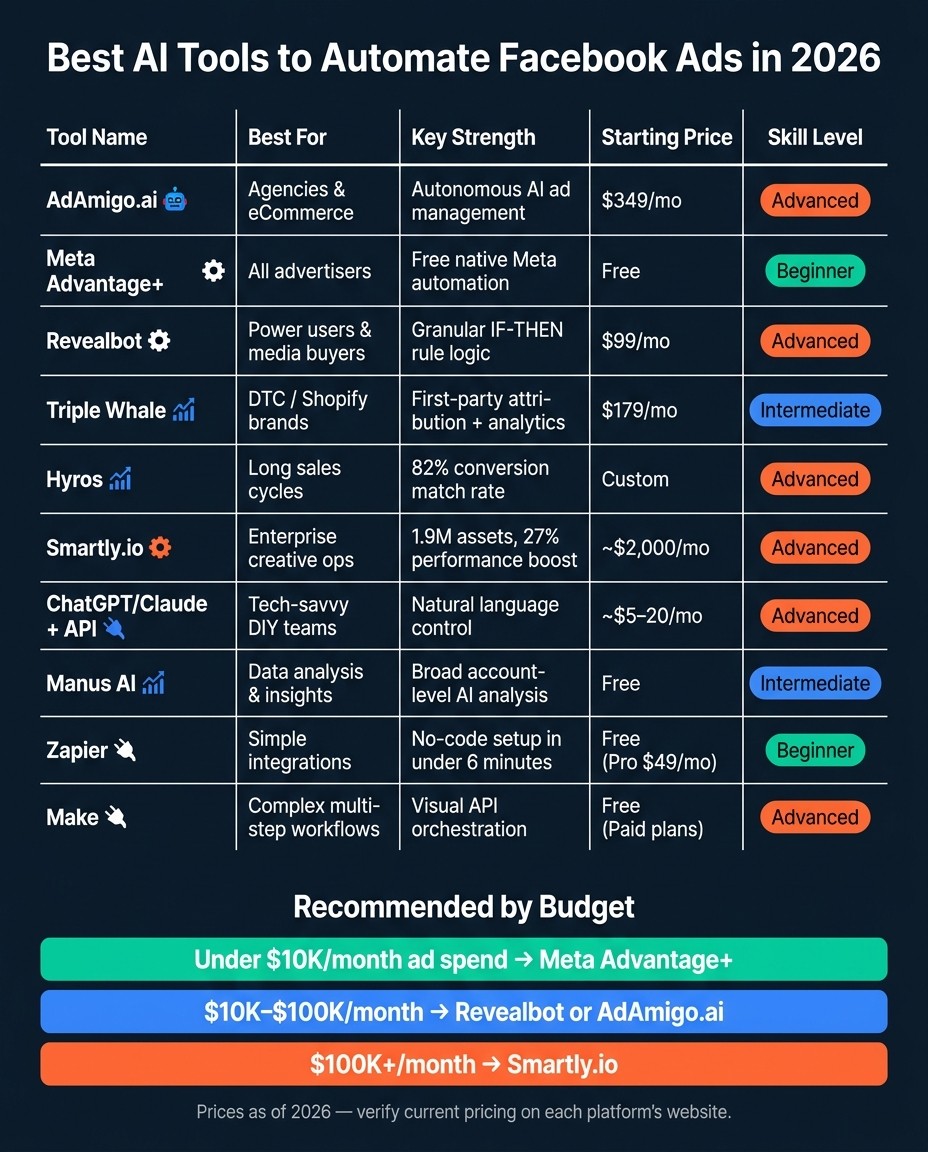
Best AI Tools for Facebook Ads 2026: Side-by-Side Comparison
5 NEW AI That Just Changed Facebook Ads Forever
1. AdAmigo.ai
Best overall AI agent for Meta ads | Best for agencies
AdAmigo.ai stands out with its trio of AI agents - Action (for budget and bid optimization), Ads (for creative generation), and Chat (for conversational control). Instead of forcing users to set up complex rules or navigate intricate dashboards, this system works through simple instructions, making it a refreshing alternative to traditional rule-based tools like Revealbot.
Automation Type
The platform leverages autonomous AI to make real-time decisions on testing, scaling, or pausing ads. This eliminates the need for manual rules, streamlining the ad management process.
Best Use Case
AdAmigo.ai shines for DTC brands and lean agencies managing monthly Meta ad spends between $1,000 and $50,000. Some agencies have reportedly scaled from managing 15 accounts to handling 45 using multi-account Meta ad management without adding extra team members.
Key Strength
One of AdAmigo’s most impressive features is its ability to generate high-volume AI creative content quickly. For example, the Bulk Ad Launcher allows users to upload assets via Google Drive, provide a brief, and launch hundreds of ads within minutes. The platform claims an average ROAS increase of about 28% in the first month, with some users reporting up to an 83% boost in Meta Stories placements. Additionally, its status as an official Meta Business Partner ensures more stable API access compared to unofficial tools.
Main Limitation
AdAmigo is exclusively focused on Meta platforms, so it doesn’t support other ad channels like Google Ads or TikTok. New accounts also require a one-week calibration period before the system can provide accurate recommendations. Pricing starts at $99 per month for the Signals plan, while full AI media buyer access costs $349 per month per ad account. Agencies managing five or more accounts can access custom pricing options.
Next, we’ll take a closer look at Meta Advantage+, a tool tailored for native Meta automation.
2. Meta Advantage+
Best native Meta automation
Meta Advantage+ is Meta's built-in AI suite within Ads Manager, and it doesn’t add extra costs beyond your ad spend. It streamlines five aspects of campaign automation: Shopping Campaigns (ASC), Audience, Placements, Creative, and Lead Campaigns, each focusing on a specific part of the ad workflow.
Automation Type
Advantage+ handles tasks like targeting, budget allocation, placement optimization, and creative adjustments. This includes reshaping aspect ratios and pairing music automatically. Its "Andromeda" ranking model enhances conversion feedback by eliminating the need for manual interest stacks or lookalike audiences, instead autonomously identifying potential converters.
Best Use Case
Advantage+ shines for e-commerce and DTC brands that spend at least $2,000 per month and have reliable conversion tracking in place. For ASC to perform effectively, campaigns require 50+ purchases per week to move past the learning phase. Without this volume, the algorithm's predictions are less reliable. For instance, if your CPA target is $20, you’d need a weekly budget of approximately $1,000 ($140/day).
Key Strength
The standout feature of Advantage+ is its direct access to Meta’s first-party data, eliminating the need for middleware and avoiding delays in signal processing.
"Advantage+ is native to Meta's infrastructure - it has direct access to first-party conversion signals, real-time auction data, and Meta's proprietary audience models." - AI-Ready CMO
On average, ASC delivers a 22% higher ROAS compared to manual campaigns and reduces campaign setup time by 40–60%, particularly for teams without dedicated media specialists.
Main Limitation
The biggest drawback is its "black box" nature. While it provides overall performance results, it doesn’t reveal the specific factors driving those outcomes. Additionally, it lacks built-in creative fatigue detection, which can lead to wasted budget on outdated ads. To avoid this, monitor for rising CPMs and falling CTRs, and refresh creatives every 10–14 days.
"The real question isn't whether to use Advantage+. It is which surface earns the budget, which one quietly burns it, and what you still have to decide before the algorithm gets a vote." - Murat Bock, Founder, adlibrary.com
For more niche B2B markets, local services, or controlled A/B testing scenarios, manual campaigns often outperform ASC. This is because the algorithm reallocates spend dynamically, which can compromise the integrity of testing.
Next, we’ll explore how rule-based automation tools like Revealbot can complement these native Meta solutions.
3. Revealbot
Best rule-based automation
Revealbot, which rebranded as Birch in 2026, is a highly focused rules engine for Meta Ads. It’s not a generative AI tool but instead provides advanced, rule-based automation that gives experienced advertisers precise control over their campaigns. Unlike fully autonomous platforms, it complements these approaches by allowing users to define and enforce their own rules.
Automation Type
Revealbot operates on rule-based logic: you set the conditions, and it executes the actions. The rules can cover a wide range of scenarios, such as frequency caps, rolling time windows (like 7-day or 14-day trends), hourly performance metrics, and learning phase exit conditions. One standout feature is its ability to exclude ad sets still in the learning phase, ensuring rules don’t disrupt Meta’s optimization process prematurely. Rules are evaluated every 15 minutes, and webhook triggers help minimize delays.
"If you are the type of advertiser who wants to specify exactly what happens when CPA exceeds $15 for three consecutive hours on a Tuesday, Revealbot can do that." - Wissam Hallak, Co-founder, AdAdvisor
Best Use Case
Revealbot is ideal for experienced media buyers and agencies managing multiple client accounts. If you have clear performance thresholds - like target CPA, ROAS floor, or acceptable frequency - and want these enforced across numerous ad sets, this tool is a great fit. It also integrates with platforms like Google Ads, Snapchat, and TikTok, making it a versatile solution for agencies handling cross-platform campaigns.
Key Strength
A major advantage of Revealbot is its granular rule builder, which allows users to create complex, chained conditions that go beyond what native Meta rules can handle. It’s highly rated, with a 4.8/5 on G2 and a 4.4/5 in 2026 practitioner reviews, and consistently receives praise for its notification system and fast rule deployment.
Main Limitation
Revealbot’s approach is reactive, not predictive. It acts based on existing performance data but doesn’t forecast potential issues. Additionally, it doesn’t provide native creative insights, meaning it can alert you to threshold breaches but won’t help diagnose the root cause. Pairing it with a creative intelligence tool is recommended. The initial setup can be challenging, especially for non-technical users. Pricing starts at $99/month, scaling to $999+/month for high-spend accounts, with a 14-day full-access trial available.
"Revealbot is the rules engine specialists use. It doesn't generate creatives or expand audiences - it executes complex conditional automation." - Murat Bock, Founder, adlibrary.com
Next, we’ll dive into Triple Whale, which takes a different approach by emphasizing attribution and analytics for Meta ad performance.
4. Triple Whale
Best analytics and attribution
Triple Whale doesn’t just enforce your rules - it takes the next step by making decisions for you. What started as a reporting dashboard has now transformed into an AI Operating System powered by Moby 2, an autonomous agent. Moby 2 can pause ads that aren’t performing, reallocate budgets, and even publish fresh creative directly within Meta Ads Manager.
Automation Type
Triple Whale offers two automation modes: Copilot, where you approve actions before they’re executed, and Autopilot, which acts independently within the boundaries you define. Moby 2 uses a Context Engine that pulls data from over 60 sources, including Shopify sales and inventory levels. It refreshes data every 15 minutes, ensuring decisions like pausing ads are informed by more than just ROAS - like whether a product is even in stock. These advanced capabilities allow for a much more nuanced and efficient approach to ad management.
"Moby actually has context into our business. That's the distinction from Claude or ChatGPT. An LLM is only as powerful as the context it has." - Matt Casciani, Marketing Director, Rhoback
Best Use Case
Triple Whale shines for Shopify-first DTC brands spending between $15,000 and $150,000 per month across platforms like Meta, Google, and TikTok. It’s especially helpful for brands with annual GMV over $750,000, where manual reporting can eat up hours of valuable time. Users report saving 4–8 hours per week just on data reconciliation. For example, in May 2026, OGEE used Triple Whale’s Sonar Optimize feature to sync Meta’s signals with their internal first-party data, leading to a 213% jump in new customer purchases.
Key Strength
Triple Whale’s measurement stack is a standout feature. By combining single-touch vs. multi-touch attribution (MTA), media mix modeling (MMM), and geo-lift incrementality, it provides a more comprehensive view than relying solely on Meta’s self-reported metrics. Its Creative Cockpit is another highlight, grouping ad hooks and identifying creative fatigue before performance takes a hit. With training on over $82 billion in processed GMV, Moby 2 has a practical edge over general-purpose AI tools.
Main Limitation
The platform is Shopify-only for its most advanced features, which can make the experience less seamless for non-Shopify brands. Its pricing, tied to annual GMV, can become steep - brands generating $10–$15 million in GMV might pay around $1,849/month. Another point of criticism is its attribution model, which some say leans toward being "optimistic", aligning more closely with platform-reported metrics rather than conservative incrementality models. This focus on depth over broader platform compatibility is a trade-off to consider.
"Triple Whale is great if you are running one DTC brand. But the moment you have 10 clients... you are managing 10 separate Triple Whale instances." - Performance Marketer via Third i Analysis
Pricing starts at $179/month for the Starter plan, with a free Founders Dash tier available for brands earning under $250,000 in annual GMV.
5. Hyros
Best analytics and attribution
When it comes to AI tools for Meta ads, Hyros stands out for its impressive tracking accuracy. Unlike Triple Whale, which caters to Shopify users, Hyros focuses solely on precise tracking (see how it compares to Meta's built-in attribution vs third-party tools). It doesn’t handle bids or directly pause ads but instead improves the data that feeds Meta’s algorithm. Using server-side "Print Tracking" and first-party scripts, Hyros captures customer actions that standard pixels often miss - especially after iOS 14.5 changes. This refined data is then sent to Meta's Conversions API (CAPI), allowing Meta’s AI to work with 18–40% more conversion data than it would otherwise have access to.
Key Strength
Hyros’ primary strength lies in its ability to recover lost signals. It boasts an 82% conversion match rate, far exceeding the 68% match rate of Facebook Pixel+CAPI and the 54% rate of Google Analytics 4. This is crucial for scaling campaigns effectively. Additionally, Hyros tracks customer journeys over much longer periods than Meta's default 7-day attribution window. This makes it particularly valuable for businesses with high-ticket products or subscription models where conversions happen weeks - or even months - after the initial click.
The impact of Hyros is evident in real-world success stories. For example, the CEO of Regenalight found that Facebook Ads were overestimating performance, leading to wasted ad spend of $80,000–$100,000 per month. By adjusting based on Hyros data, the company’s revenue surged from $1M to $3M per month in Q4. Similarly, Legion Athletics used Hyros to address tracking issues during Black Friday and saw a 25% year-over-year increase in site revenue.
"I like Hyros because it gives me cleaner truth across channels and sends Facebook higher-quality purchase events. That combo steadies scaling and takes the guesswork out of creative calls." - Owen David, CEO, Internet Strategics Agency
These features make Hyros an essential tool for campaigns involving complex customer journeys.
Best Use Case
Hyros is ideal for businesses spending at least $10,000/month on ads and managing intricate sales funnels - like webinars, high-ticket sales calls, or extended lead cycles. For these scenarios, where Meta’s attribution window falls short, Hyros provides the clarity needed to optimize performance. However, for simpler ecommerce setups with short purchase cycles, Triple Whale’s Shopify-focused solution might be a better fit.
Main Limitation
The downside? Setting up Hyros can be tricky. Custom checkouts and non-standard tech stacks often require developer involvement, and maintaining strict UTM parameters is essential to piece together multi-touch attribution paths accurately. Pricing is also a sticking point. Costs aren’t publicly listed but generally range from $199–$299/month for smaller brands to $499–$799+/month for larger accounts. While the 90-day money-back guarantee offers some reassurance, the lack of transparent pricing is a frequent complaint.
6. Smartly
Best enterprise creative ops
Smartly stands out as a top choice for enterprise-level creative operations, offering a platform that streamlines ad creative production across Meta, TikTok, Google, and Amazon DSP. With its centralized dashboard and integration via APIs, it acts as a command center for managing large-scale creative workflows.
Automation Type
Smartly's standout feature is its feed-based creative production. Using its Creative Studio, the platform generates multiple ad variations by pulling real-time data from product feeds into dynamic templates. On the media side, it provides tools like bulk campaign creation, how AI balances budgets, and a rule engine designed to pause ads or adjust bids based on custom performance metrics.
Key Strength
The platform's AI Studio has delivered impressive results, generating 1.9 million creative assets for over 260 enterprise clients. On average, these assets have achieved a 27% performance boost compared to static creatives. Some notable outcomes include:
A 70% increase in CVR and a 9% reduction in CPA through video ad scaling across numerous cities.
A 45% rise in conversions paired with an 8% drop in CPC when used alongside Meta's Advantage+ shopping campaigns.
"Smartly.io is a serious enterprise ad-automation platform built for teams running $250K+ in annual spend... Its feed-based creative automation and cross-channel campaign management are genuinely strong." - Murat Bock, Founder of adlibrary.com
Main Limitation
The platform's pricing and complexity can be major hurdles. Smartly operates on a 2–4% of managed ad spend model, with monthly minimums ranging from $2,000–$5,000 and onboarding fees between $5,000–$15,000. The onboarding process itself is extensive, taking 4–8 weeks for setup and another 4–8 weeks before campaigns are fully operational. For advertisers spending less than $20,000 per month, Smartly is simply not feasible. Even for larger teams, the dashboard can lag under high creative volumes, and complex templates may demand additional support.
Best Use Case
Smartly is best suited for enterprise brands or agencies managing extensive product catalogs across multiple advertising channels. It excels in scenarios where creative production speed is the primary bottleneck, rather than bid strategy. Global players like eBay, Uber, and L'Oréal rely on Smartly for this very reason.
Before committing, consider requesting a 60-day paid pilot with specific success metrics. Additionally, ensure your product catalog is well-organized and error-free, as Smartly highlights feed issues aggressively. For enterprises needing large-scale creative solutions, Smartly complements other tools focused on analytics and campaign management.
7. ChatGPT/Claude with Meta APIs or MCP
Best for DIY experimentation among AI tools for optimizing paid ads
This tool offers a hands-on approach for those looking to move beyond basic rule-based systems. On April 29, 2026, Meta launched its official Ads MCP server, granting full API access through 29 tools. With this setup, you can directly connect ChatGPT or Claude to your live ad account using natural language commands. No more exporting CSV files or manually adjusting settings. The setup is quick - just 15 minutes to install the Claude Code CLI and authenticate using your Meta Business token.
Automation Type
This is an automated agent system, giving the LLM direct read/write access for tasks like bulk operations, cross-account reporting, and monitoring creative fatigue. For instance, Claude can rename 200 ad sets in just 90 seconds - a task that typically takes 20–30 minutes manually. It can also execute weekly prompts to flag ads where frequency exceeds 2.5 or CTR drops by more than 20% week-over-week, helping you address creative fatigue before it impacts ROAS.
Key Strength
The standout feature here is speed combined with strategic reasoning. Claude can analyze 90 days of performance data to uncover winning trends - like effective hooks, emotional triggers, or audience overlaps - and then turn those insights into actionable creative briefs. In early 2026, Advolve integrated Claude with MCP, cutting operational time by 90% and increasing ROAS by 15% for their clients. This allowed their three-person team to scale from managing 8 to 20 client accounts without hiring additional staff.
"This entire loop - analysis, brief, new creative - runs inside one chat session and replaces hours of manual strategist work." - Ahad Shams, Founder of HeyOz
Of course, this setup isn’t without its challenges:
Main Limitation
OAuth tokens expire every 60 days and can fail without warning. Additionally, loading all MCP tool definitions requires about 55,000 tokens. A bigger issue is that the AI cannot visually preview ads - it can’t check if a logo is misaligned or text overlaps in specific placements. This makes human QA in Ads Manager essential. Another potential pitfall is permission mismatches, where the AI might confirm a task, like pausing a campaign, that doesn’t actually execute. These limitations highlight the need for human oversight, even with advanced automation.
"The correct mental model: Claude is an extremely capable analyst and operator who works at AI speed, but you are still the strategist." - Nikhil Tiwari, Product Development Expert
The cost is minimal - standard analysis sessions using the Claude API typically range from $5–$20 per month, and the Meta Ads MCP server is currently free during its open beta. For those who want to avoid token management, third-party services like Pipeboard can handle it for around $49 per month.
8. Manus AI
In December 2025, Meta acquired Manus AI for $2 billion. Just seven weeks later, it was integrated into Ads Manager, granting over 4 million advertisers worldwide access by early 2026.
Automation Type
Manus AI operates on a level above tools like Advantage+, leveraging a multi-agent system that covers planning, execution, knowledge management, and verification. This design allows it to handle complex, multi-step analytical tasks from start to finish. Essentially, it acts as a research and reporting assistant. This includes AI audience profiling to better understand customer segments before launching campaigns.
"Manus is the brain; Advantage+ is the muscle." - AI Automation Global
Best Use Case
Manus is ideal for experienced media buyers who need to process large amounts of campaign data efficiently. It shines in areas like competitor analysis using Meta's Ad Library, detecting anomalies such as sudden ROAS drops or CPM spikes, and creating clear performance summaries from Manus prompts. As of May 2026, Manus is free for all Meta advertisers beyond their standard ad spend. However, its use is limited to accounts with the "Sales" campaign objective and is unavailable for sensitive categories like Housing, Employment, Credit, and Politics.
Key Strength
While Advantage+ focuses on optimizing bids and placements within a single campaign, Manus AI takes a broader view. It analyzes data across your entire account and even the competitive landscape. You can ask it to identify creative trends in the Ad Library, highlight audience expansion opportunities, or flag underperforming ad sets - all via a natural language chat interface.
"A lot of what makes agents valuable is the unique context that they can see." - Mark Zuckerberg, CEO, Meta Platforms
Despite its ability to deliver high-level insights, Manus AI has its limitations.
Main Limitation
Manus cannot take direct actions like adjusting budgets, modifying bids, creating ad sets, or launching campaigns. Additionally, early users have noted that the tool sometimes generates data that seems credible but is inaccurate.
"Right now I'm not taking any of the outputs and sending them to clients because they're just not reliable enough." - Chris Rigas, VP of Media, Markacy
Every Manus report should be treated as a starting point, not a final product. Always verify its outputs against raw Ads Manager data before using them for critical decisions or client presentations. While Manus is a valuable tool for skilled practitioners who can identify errors, it may pose challenges for less experienced teams working without supervision.
9. Zapier
Zapier isn't your typical ad platform or AI tool. Instead, it acts as a connector, linking your Facebook ad account to over 9,000 apps and more than 450 AI tools. Think of it as the bridge between Meta and the rest of your tech ecosystem.
Automation Type
Zapier uses trigger-and-action workflows, which it calls "Zaps." Here's how it works: when a specific event happens - like someone submitting a lead form - Zapier triggers an action, such as adding the contact to HubSpot or sending a Slack notification. You can even incorporate AI steps (via tools like OpenAI or Anthropic) directly into a Zap to clean, categorize, or summarize lead data before sending it to its final destination.
Best Use Case
For Facebook advertisers, Zapier shines in server-side conversion tracking through Facebook's Conversions API (CAPI) vs. Pixel. Why is this important? Browser-based tracking methods, like pixels, often miss 15–30% of actual conversions - a problem that has only grown since the iOS 14.5 update. With Zapier, you can connect tools like Stripe, Shopify, or your CRM directly to Meta. This setup allows you to send purchase and lead events from your server, avoiding browser-related tracking gaps entirely. Cleaner data means Meta's algorithm can optimize more effectively, which can improve your return on ad spend (ROAS).
Key Strength
One of Zapier's standout features is how quickly you can get started. The average user can set up a functional Zap in under six minutes. For teams lacking technical expertise, this makes advanced tasks like server-side tracking and lead management possible without needing to write a single line of code. Plus, Zapier is SOC 2 and GDPR compliant, ensuring that sensitive lead data is handled securely at an enterprise level.
Main Limitation
There is a catch: Facebook Lead Ads is classified as a Premium app on Zapier. This means you'll need to subscribe to at least the Professional plan to access it - the free version won't be enough. Another technical hurdle involves event deduplication when using CAPI through Zapier. If event IDs aren't properly matched, Meta could double-count conversions. This not only skews your reports but also misleads Meta's algorithm, potentially impacting ad performance.
10. Make
Make is a platform that specializes in visual workflow automation, connecting Meta Ads to over 1,000 other apps through intricate, multi-step scenarios. While Zapier focuses on speed and simplicity, Make is built for handling more complex processes that involve branching logic and data transformations - tasks that simpler tools struggle to manage.
Automation Type
Make shines when it comes to creating detailed, multi-step workflows. Acting as an API orchestration tool, it uses a visual interface to link Meta Ads with external platforms. It supports features like iterators and ETL (Extract, Transform, Load) flows, enabling users to pull raw data from Meta, process it, and send it to other systems seamlessly.
Best Use Case
Make is best for teams that need to integrate Meta Ads into larger, more sophisticated business systems. For example, R17 Ventures used Make to connect CRM signals with Meta’s CAPI (Conversions API), improving lead quality. It’s especially valuable in scenarios where offline or CRM data needs to feed back into Meta's algorithm, offering a level of data manipulation and orchestration that simpler tools can’t match.
Key Strength
The platform’s visual interface allows users to build advanced automations without any coding knowledge. This opens up opportunities for teams without dedicated developers to create complex workflows. Additionally, Make’s pricing is based on the number of operations rather than tasks, which can be more cost-efficient for high-volume, intricate workflows.
Main Limitation
Make has a steep learning curve and isn’t ideal for beginners. Using it for Facebook ads requires a strong understanding of API structures and Meta ad account roles and permissions. Problems like silent failures can arise if the System User token lacks proper roles, and there’s no built-in rollback feature - so fixing errors, like paused or deleted campaigns, must be done manually. For accounts spending less than $20,000 per month, Make may be unnecessarily complex.
Pros and Cons of Each Tool
Here’s a clear breakdown of the strengths and weaknesses of each tool in the current Meta ads landscape. Each tool addresses specific needs but comes with its own limitations, so it's essential to match the tool to your goals and budget. This alignment is a core part of Meta ads ROI optimization.
AdAmigo.ai is designed for agencies aiming to scale client accounts by 3–5× with Meta ads scaling benchmarks with full autonomy. However, its price tag of $349 per month per ad account makes it a hefty investment, suitable only when ad spend justifies the cost.
Meta Advantage+ works well for advertisers spending less than $5,000 monthly, thanks to its seamless integration with Meta's auction signals. On the downside, it lacks features like creative fatigue detection and cross-platform reporting, which can limit its utility for more complex campaigns.
Revealbot offers detailed rule-based controls, earning a 4.8/5 rating on G2. While it excels at reacting to past performance, it doesn’t provide forecasting capabilities. Additionally, poorly designed rules can disrupt Meta's learning phase, which may hurt performance during recovery.
Triple Whale and Hyros focus on attribution rather than ad execution. Triple Whale is particularly valuable for DTC brands with Shopify, helping recover 20%–40% of conversions lost due to browser-side pixel limitations post-iOS 14.5. However, it lacks automation features for managing ads.
Smartly.io is tailored for enterprise-level creative automation, making it a powerful tool for large-scale campaigns. But its high cost - often requiring a minimum spend of around $2,000 per month - makes it inaccessible for smaller teams.
ChatGPT/Claude with Meta APIs or MCP offers unmatched customization. For instance, Advolve reported a 90% reduction in operational work time and a 15% boost in ROAS after integrating Claude with a Meta Ads MCP server. That said, the technical setup required can be a significant barrier for most marketing teams.
Manus AI, Zapier, and Make are better suited for connecting Meta Ads with external systems. While these tools add value by enabling integrations, they don’t serve as comprehensive ad optimization platforms.
Here’s a quick comparison of the tools:
Tool | Best For | Key Strength | Key Weakness | Starting Price |
|---|---|---|---|---|
AdAmigo.ai | Agencies & eCommerce | End-to-end autonomous AI | High cost per account | $349/mo |
Meta Advantage+ | All advertisers | Free, native auction access | Lacks creative fatigue detection | Free |
Revealbot | Power users & media buyers | Granular IF-THEN rule logic | Reactive; does not forecast performance | $99/mo |
Triple Whale | DTC e-commerce brands | First-party data integration | Limited execution automation | $100/mo |
Hyros | Attribution-focused teams | Deep conversion tracking | Not an ad management tool | Custom |
Smartly.io | Enterprise creative ops | Creative automation at scale | High cost; requires minimum spend | ~$2,000/mo |
ChatGPT/Claude + API/MCP | Tech-savvy teams | Natural language control, 90% ops reduction | Requires technical setup | Usage-based |
Manus AI | Experimental workflows | Flexible AI agent tasks | Limited Meta-specific capabilities | Varies |
Zapier | Simple integrations | Fast no-code setup | Limited logic complexity | Free tier |
Make | Complex multi-step workflows | Visual API orchestration | Steep learning curve | Free tier |
Each tool has its niche, so the best choice depends on your specific needs, technical expertise, and budget.
Conclusion
Picking the right tool depends on your monthly ad spend, team size, and the specific challenges you're facing. The analysis above highlights the importance of balancing cost with performance when making your decision.
If your ad spend is under $10,000/month, Meta's native Advantage+ tools are the most practical option. At this level, the subscription fees for third-party platforms often outweigh the potential benefits. For those spending $10,000–$100,000/month, platforms like Revealbot (offering rule-based control) or AdAmigo.ai (providing autonomous management) begin to show strong returns on investment. Once you're spending $100,000+/month, Smartly.io becomes a powerful choice, especially for teams managing high-volume creative pipelines and large catalogs. However, it does require thorough onboarding and dedicated operational support.
Your choice should align with your specific structure and needs. Agencies may find top AI tools for client accounts like AdAmigo.ai particularly appealing, as its AI Autopilot can handle tasks like launching tests, reallocating budgets, and pausing underperforming campaigns. This allows a single media buyer to manage three to five times more client accounts. For in-house DTC teams, combining Triple Whale (to address post-iOS 14 conversion tracking issues) with an execution platform offers a well-rounded solution. Enterprise teams, on the other hand, can leverage Smartly.io's capabilities in creative production for large-scale campaigns.
One universal truth to keep in mind:
"Automation doesn't fix a bad angle; it scales it faster. Run a weak hook through a bidding AI and you'll burn your learning phase budget in three days." - Murat Bock, Founder & Fullstack Developer
FAQs
Which tool fits my monthly Facebook ad spend?
For businesses with a monthly ad spend under $5,000, Meta’s free Advantage+ tools are a great choice. These tools manage tasks like budget pacing, audience expansion, and dynamic creative assembly without any additional charges.
If you're looking for more advanced automation, AdAmigo offers plans starting at $99/month, catering to ad spends up to $2,500/month. That said, Advantage+ works well for smaller budgets, while third-party tools like AdAmigo tend to deliver greater value when your ad spend exceeds $5,000/month.
Do I need better attribution before automating?
Getting attribution right is essential before diving into Facebook ad automation. Why? Because automation tools rely on accurate data to make informed decisions, ensuring your campaigns perform at their best.
Since Apple’s iOS 14 update, browser-based attribution has taken a hit, capturing only about 60-70% of conversions. This leaves significant data gaps, making it harder to measure ad performance accurately.
That’s where tools like Triple Whale and Hyros come in. They use first-party measurement to fill in these gaps. By providing a clearer picture of conversions and ad effectiveness, these tools help automation platforms allocate budgets more efficiently and deliver better results.
Can these tools hurt Meta’s learning phase?
Platforms like Meta Advantage+ and Revealbot are built to work seamlessly with Meta’s API, helping to prevent unnecessary resets in the learning phase. However, how you use these tools matters. Actions like making frequent or drastic budget changes or pausing ads too soon can throw the algorithm off balance, leading to longer stabilization times. To avoid this, focus on proper setup and stick to best practices when using automation.