
Best Manus prompts for Meta ads - 15 copy-paste prompts for reporting, insights, and next actions
15 copy-paste Manus AI prompts to automate Meta Ads reporting, audits, audience insights, creative tests, and budget reallocations for faster optimization.
Managing Meta ads just got easier. With Manus AI, now integrated into Meta Ads Manager after its $2 billion acquisition in late 2025, you can automate reporting, analyze performance, and optimize campaigns with AI tools - all without the manual hassle. This tool acts as your "ad account brain", identifying trends, diagnosing issues, and recommending next steps.
Here’s what you’ll get:
Generate Reports: Create polished performance reviews, ROAS comparisons, (using a ROAS calculator) and account health checks in minutes.
Optimize Campaigns: Get actionable insights for budget reallocation, creative updates, and audience targeting.
Save Time: Automate daily tasks like audits, optimize ad placements, and A/B test summaries.
Below are 15 ready-to-use prompts that simplify everything from reporting to scaling your best campaigns. Whether you’re troubleshooting underperformers or analyzing audience data, these prompts will help you spend less time on spreadsheets and more time improving results.
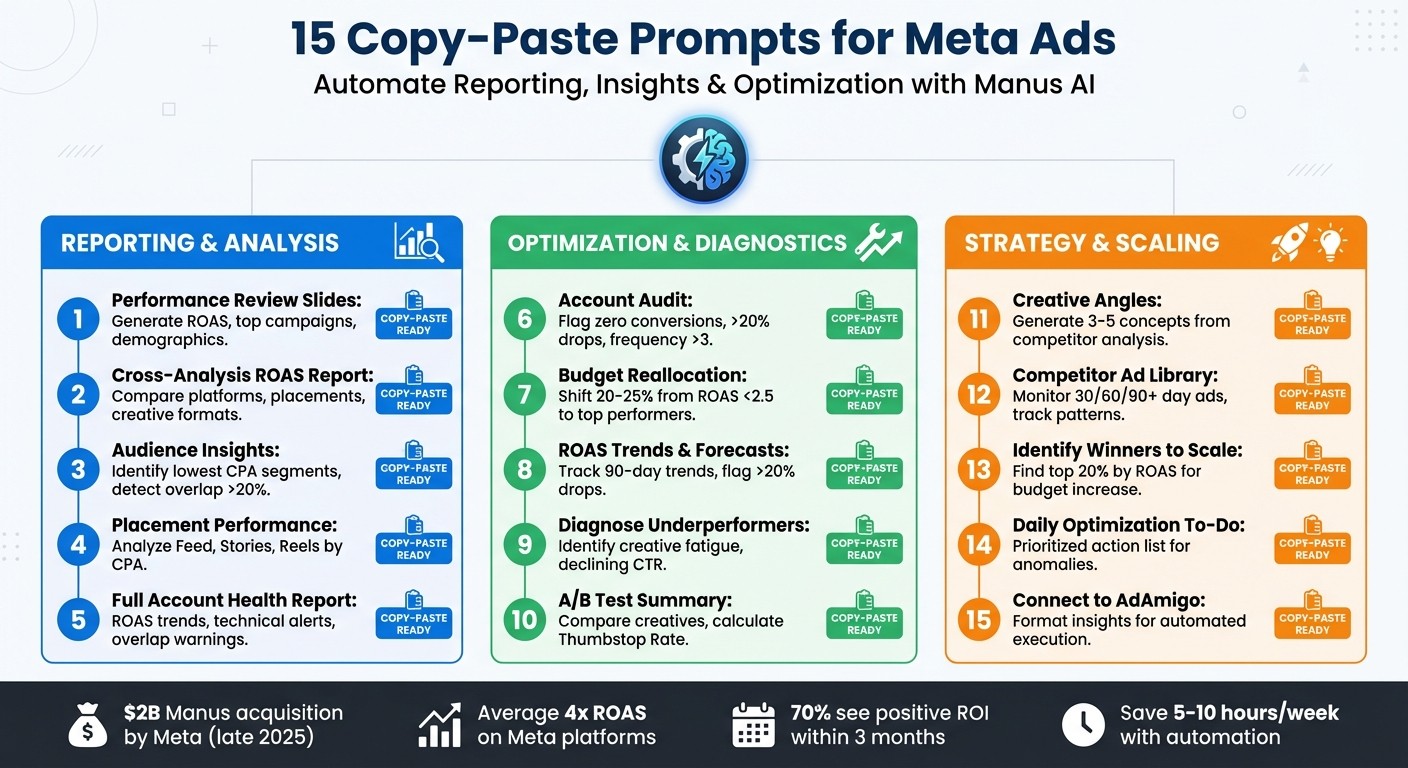
15 Manus AI Prompts for Meta Ads Optimization and Reporting
1. Generate Meta Ads Performance Review Slides
Simplifying Ad Performance Reporting
Creating performance decks used to involve tedious manual work - transferring data, calculating trends, and formatting slides. Manus AI changes the game with its "Design View" and "AI slides", which instantly turn raw data into polished presentations.
To craft a comprehensive narrative, structure your deck to cover key metrics and insights. Include elements like revenue/ROAS, top campaigns, audience demographics, campaign comparisons (CPA/CTR), and week-over-week trends. Manus does the heavy lifting by pulling this data automatically and providing clear explanations about performance drivers. This means you can deliver actionable insights to stakeholders without the usual hassle.
Here’s a ready-to-use prompt:
"Generate a performance review slide deck for [date range]. Include: 1) Overall ROAS and total spend, 2) Top 3 performing campaigns by ROAS with spend breakdown, 3) Audience demographics for winning campaigns, 4) Campaign comparison showing CPA and CTR for all active campaigns, 5) Week-over-week trend analysis highlighting any significant changes in CPM or conversion rate. Format as slides with brief narratives (3-4 sentences each)."
This method turns raw metrics into stories that resonate with clients and stakeholders. For example, Manus can flag potential ad fatigue when frequency exceeds 3–4 or signal a need for creative testing updates if CTR drops significantly between the first and second 30-day periods. Plus, by pulling data directly from your account, Manus eliminates manual errors and speeds up the reporting process.
2. Create Cross-Analysis ROAS Comparison Report
Actionable Insights for Meta Ad Campaigns
Understanding which campaigns, placements, and audiences are delivering the best return on ad spend (ROAS) can help you make smarter decisions and optimize your Meta ad strategy. Manus AI simplifies this process by scanning your account for performance anomalies - like sudden ROAS drops or unexpected CPM increases - and delivering real-time insights to guide quick adjustments. Building on performance review slides, this report dives deeper by cross-analyzing key metrics across different dimensions, giving you a clear path to action.
To get the most out of your analysis, break down performance by these critical dimensions: platform (Facebook vs. Instagram), placement (Feed, Stories, Reels), creative format (Static, Video, Carousel), and audience type (Lookalike 1%, interest-based, retargeting). Manus AI automates this process, ensuring your analysis is both detailed and efficient. For instance, you might discover that Stories outperform other placements in ROAS, signaling an opportunity to reallocate budget. You can also set performance thresholds - like flagging campaigns with a ROAS below 2.5 - to quickly identify underperformers that need attention.
Optimize Budgets, Creatives, and Targeting
A AI-driven budget reallocation strategy can make a significant difference. Start by identifying the bottom 20% of campaigns by ROAS and shifting 20–25% of their budgets to campaigns with higher performance. This ensures you're maximizing returns rather than wasting resources on underperformers.
Creative fatigue is another factor to watch. Compare CTR and ROAS from the first 30 days of a campaign to the following 30 days - if ROAS drops by over 20%, it's time to refresh your creatives. Additionally, check for audience overlap exceeding 20% between ad sets, as this can lead to internal competition and drive up costs unnecessarily.
Here’s a ready-to-use prompt to streamline your reporting:
"Create a cross-analysis ROAS comparison report for [date range]. Break down performance by: 1) Platform (Facebook vs. Instagram), 2) Placement (Feed, Stories, Reels), 3) Creative format (Static, Video, Carousel), 4) Audience type (Lookalike 1%, 3%, 5%, interest-based, retargeting). Include ROAS, CPA, CTR, CPM, and total spend for each segment. Mark campaigns with a ROAS under 2.5 and identify the top 3 and bottom 3 performers. Provide budget reallocation recommendations to shift 20–25% from underperformers to top performers."
This structured approach transforms raw data into actionable insights, helping you double down on what’s working and quickly address what isn’t.
3. Run Account Audit for High-Priority Issues
Actionable Insights for Meta Ad Campaigns
Figure out what's eating up your ad budget without delivering results. A detailed account audit can uncover critical problems like campaigns burning through cash without conversions, creatives that no longer grab attention, or targeting strategies that overlap and compete. Manus AI steps in by scanning active campaigns for red flags, such as sudden drops in ROAS, unexpected spikes in CPM, or signs of creative fatigue - giving you a real-time snapshot of what's going wrong. This audit goes beyond earlier performance reviews by zeroing in on the most pressing issues that need immediate attention.
Forget vanity metrics like impressions or likes. Instead, focus on the numbers that truly matter: Thumbstop Rate, Cost per Purchase, and ROAS. Manus AI analyzes your account history to pinpoint bottlenecks - whether it's high CPMs signaling targeting flaws, low CTRs pointing to weak ad hooks, or high frequency (above 3) paired with falling engagement. By leveraging historical data, it simplifies your decision-making process and helps you act faster.
Optimizing Budgets, Creatives, and Targeting
This quick audit builds on broader insights to address key performance gaps. It highlights campaigns that are spending money without generating conversions, those experiencing week-over-week drops exceeding 20%, budget-capped campaigns with strong ROAS, and ads with high frequency (over 3) but declining CTR. To better understand when performance started slipping, compare the current 3-day average to the initial 3-day performance window. This can help you pinpoint the exact moment things began to decline.
Here’s a ready-to-use prompt to guide your audit:
"Run a rapid Meta Ads account health check and highlight urgent issues or opportunities. Identify and report on: 1. Any campaigns with spend but zero conversions; 2. Any significant week-over-week performance drops (>20%); 3. Campaigns approaching budget caps with strong ROAS; 4. Ads with high frequency (>3) but declining CTR. Include campaign names, spend levels, and AI-driven action recommendations."
Important Note: Some early users have reported occasional "hallucinations", where Manus AI might infer data points that don’t actually exist in your setup. Always double-check critical metrics before making major budget decisions based on AI-generated reports.
4. Extract Audience Insights from Recent Data
Actionable Insights for Meta Ad Campaigns
Understanding who responds to your ads is crucial for scaling effectively. Manus AI goes beyond standard metrics like age, gender, and location, uncovering behavioral clustering signals and demographic trends that often get overlooked. Instead of manually sifting through data, Manus pinpoints audience segments with the lowest CPA (Cost Per Acquisition) or highest ROAS (Return on Ad Spend) over a chosen period, like the past 30 days.
But it doesn’t stop there. Manus dives deeper into your converter data, suggesting three untapped interest-based audience segments you haven’t targeted yet. It can also flag early warning signs of audience saturation, helping you stay ahead of diminishing returns. Additionally, Manus compares the performance of placements - Facebook Feed, Instagram Stories, and Reels - to highlight which channels deliver the most cost-effective results. These insights complement your performance and audit reports, giving you a clearer picture of your campaign’s overall health. This data is essential for full-funnel AI optimization across your entire account.
Optimizing Budgets, Creatives, and Targeting
Audience overlap is an often-overlooked issue that can quietly drain your ad budget. When multiple ad sets target similar groups, they compete in Meta's auction system, driving up costs and cutting into performance. Manus can detect overlaps exceeding 20% and offer recommendations to consolidate ad sets for better efficiency. It also identifies high-performing demographic "sweet spots", which might deserve dedicated budgets or localized lookalike audiences.
Here’s a practical prompt you can use to extract audience insights:
"Analyze my last 30 days of Meta ad data and identify: 1) Which demographic segments (age, gender, location) have the lowest CPA and highest ROAS; 2) Any ad sets with audience overlap above 20%; 3) Signs of audience saturation or frequency spikes above 4 in top-performing ad sets; 4) Three new interest-based audience segments to test based on recent converter behavior. Present findings in an executive summary table with campaign names and recommended next actions."
To stay on top of shifting audience behavior, use audience data to set up Manus to run weekly audience reports automatically. This way, you can monitor trends without pulling data manually. However, before deciding between AI vs manual audience creation and letting Manus suggest changes, make sure you’ve defined budget caps and audience exclusions yourself - keeping you firmly in control of your campaigns.
5. Generate Creative Angles for Testing
Actionable Insights for Meta Ad Campaigns
Manus AI simplifies the process of creating impactful ad angles for Meta campaigns, a task many marketers find challenging. By analyzing your competitors' successful strategies, Manus AI identifies patterns in emotional triggers and creative designs. From there, it suggests 3-5 fresh concepts tailored to position your brand in a unique way. This approach ensures your ads stay relevant and competitive in a crowded marketplace.
Here’s a practical prompt to help you generate competitor-inspired ad ideas:
"Conduct a comprehensive analysis of our top 3 competitors' Meta ad strategies using [insert screenshots/descriptions]. Identify patterns in creatives and emotional triggers, then suggest 3-5 innovative ad concepts that uniquely position the brand."
Optimizing Budgets, Creatives, and Targeting
Manus AI doesn’t just stop at competitor insights - it takes things further by helping you experiment with creative scaling and testing. With its advanced capabilities, Manus can design multivariate testing frameworks to mix and match headlines, visual elements (like colors and layouts), and ad formats like carousels and videos. Additionally, it generates persona-based ad copy variations, ensuring your messaging directly addresses customer pain points.
To set up a comprehensive creative testing framework, consider using this prompt:
"Design a multivariate testing framework for our creatives. Propose 3-5 variations for ad copy, visual elements, and formats. Suggest a testing methodology to identify winning combinations and metrics beyond CTR to track. Comparing these results against industry CTR benchmarks helps determine if your creative performance is truly competitive."
Manus AI also includes a handy Design View feature that transforms basic product photos into polished, high-performing visuals using natural language prompts. This makes it easier to create eye-catching assets without relying on a designer for every iteration. Plus, to stay ahead of creative fatigue, Manus recommends running a detection prompt every 21 days for ads live longer than a week. Ads showing a performance drop of over 15% compared to their initial metrics are flagged for review.
6. Check Competitor Ad Library
Actionable Insights for Meta Ad Campaigns
The Meta Ad Library offers a treasure trove of insights, but combing through it manually takes time. That’s where Manus AI steps in, automating the analysis of competitor activity and surfacing key trends. For example, ads that run for 30, 60, or even 90+ days often signal profitability. Similarly, when a competitor scales a creative concept across multiple variations, it’s usually a sign they’ve hit on a winning strategy. These patterns can guide you in fine-tuning your creative efforts and budget allocations.
Here’s a prompt to help you systematically track your top competitors:
"Set up automated Meta Ad Library analysis for [Competitor Names]. Monitor their ad activity, identify successful creative patterns, compare them against industry benchmarks, and provide optimization recommendations."
Optimizing Budgets, Creatives, and Targeting
Once you’ve gathered competitor insights, Manus AI takes it a step further by breaking down their ads into repeatable components. These include the hook (the crucial first 3 seconds), the angle (highlighting a problem or benefit), the offer (like discounts or bundles), proof elements (such as user-generated content or stats), and the call-to-action. By analyzing multiple ad versions, you can uncover your competitor’s testing strategy, identifying which elements they’re refining and which creative approaches are most effective.
To dig deeper into your competitors’ spending and strategy, try this detailed prompt:
"Generate a comprehensive competitor strategy report breaking down traffic sources, audience profiles, and marketing approaches for [Competitor]."
These insights can also help you identify gaps in your competitors’ strategies. Manus AI highlights opportunities, like overlooked platforms or ad formats. For instance, if your competitors are heavily focused on video ads, understanding how visuals and copy impact performance can help a well-crafted static image stand out. Additionally, analyzing counter-seasonal trends might reveal cost-saving opportunities - potentially cutting costs by 20–25% when competitors reduce their ad budgets.
7. Get Budget Reallocation Recommendations
Actionable Insights for Meta Ad Campaigns
After reviewing top metrics to track in Meta ad historical data and conducting Meta ad audits, the next step is scaling Meta ad budgets. Manus AI actively monitors campaigns for anomalies like sudden drops in ROAS or spikes in CPM and flags them for immediate action. It identifies high-ROAS campaigns that are limited by budget and underperforming campaigns that could benefit from reduced spending. This real-time analysis ensures funds are shifted quickly, preventing further performance decline.
Another key feature is detecting audience saturation early. If a segment starts showing diminishing returns, Manus recommends shifting budgets to fresh lookalike audiences using AI audience segmentation or scaling with multiple lookalike tiers or experimenting with different placements, such as moving from Stories to Reels. This strategy helps scale Meta ads effectively without driving up costs. For context, Meta plans to allocate between $115 billion and $135 billion in capital expenditures by 2026 to enhance AI infrastructure, with Q4 2025 advertising revenue reaching $58.1 billion, marking a 24% year-over-year increase.
Optimizing Budgets, Creatives, and Targeting
To make the most of Manus AI, use specific thresholds when requesting budget insights. For example:
"Analyze Meta campaigns from January 1–31, 2026, with spend above $500. Compute ROAS for each campaign. Suggest a revised budget allocation that shifts 20% of spend from campaigns with ROAS below 2.0 to campaigns with ROAS above 3.5."
This level of detail ensures the AI provides focused recommendations tailored to your campaign goals, rather than broad suggestions. Adjusting budgets dynamically based on these insights aligns spend with performance metrics.
Additionally, Manus can help identify pacing issues. For instance, you might ask:
"Review campaigns from the last 7 days; flag those spending over 110% or under 85% of their monthly budget and list campaign name, budget, and projected end-of-month spend."
Spotting pacing problems early prevents overspending or underspending, ensuring a consistent monthly budget. While Manus provides the intelligence to guide decisions, tools like AdAmigo.ai handle the execution of these changes, making it essential to verify recommendations before implementing major adjustments.
8. Analyze Placement Performance
Actionable Insights for Meta Ad Campaigns
To make the most of your ad budget, it's crucial to analyze how different placements are performing. Each placement - whether it's Feed, Stories, Reels, or Audience Network - delivers results differently. Manus AI can help you figure out where your money is working hardest. Try using this prompt:
"Analyze campaign [Name]: break down spend, impressions, CTR, and CPA by placement (Feed, Stories, Reels, Audience Network) and recommend which placements to scale or pause based on CPA."
For example, you might discover that Reels are driving reduce Facebook ad costs, while other placements are falling short. Manus AI, which became part of Meta Ads Manager in February 2026, can even flag performance anomalies - like sudden CPA increases in specific placements - automatically. By focusing on placement-specific data, you can uncover trends that might not be visible in broader performance reports. Using Meta Ads reporting dashboards can further streamline this process.
Optimizing Budgets, Creatives, and Targeting
Once you've identified the top-performing placements, it's time to shift your budget toward those with the best cost efficiency. Create a performance comparison report across all active campaigns to find placements with the highest Thumbstop Rate for video creatives. Use this data to recommend new placements for your product or service based on both current trends and historical performance.
This process can also reveal if a video works well in one placement but struggles in another. If that's the case, it may be time to tweak your creatives for specific placements or avoid common mistakes in bulk testing. Additionally, keep an eye on frequency by placement - if it exceeds 4, it might be time to refresh your creatives or explore new placements to avoid audience fatigue. You can also use AI tools for interest-based targeting to find fresh audiences.
9. Review ROAS Trends and Forecasts
Actionable Insights for Meta Ad Campaigns
Manus AI can transform raw performance data into insights you can act on, similar to other top AI tools for campaign analysis. By monitoring ROAS (Return on Ad Spend) trends, you can identify potential issues early and make smarter budget decisions. Here's a prompt to get started:
"Review all campaigns from the last 90 days with spend above $5,000. Compute weekly ROAS and CPA trends. Flag campaigns with a ROAS drop over 20% in the last 30 days versus the previous 60 days. Output as a table."
This approach helps separate actual performance issues from normal seasonal fluctuations and learning phase volatility. For example, if your ROAS has recently dropped from 4.2x to 3.1x, Manus can analyze whether the change is due to creative fatigue, increased competition, or temporary market conditions. By comparing recent results to a longer baseline - typically 60 to 90 days - you’ll gain a clearer understanding of what’s driving the change. These insights are essential for reallocating budgets effectively.
Optimizing Budgets, Creatives, and Targeting
When declining ROAS trends are identified, it’s time to adjust your strategy. Start by reallocating budgets - shift 25% of the budget from the bottom 20% of campaigns to the top 20%, based on ROAS performance. Unlike snap decisions, this method relies on long-term trends, ensuring more strategic adjustments. You can use Manus to streamline this process with a prompt like: "Analyze active campaigns from [Date Range]. Identify the top 20% by ROAS. Recommend a reallocation plan shifting 25% of budget from bottom performers to top performers. Show projected impact on overall ROAS."
For accurate forecasting, aim for 30–50 conversions in the last 30 days. AI bid strategies, like Target ROAS, work best when you meet this threshold. If your data falls short, prioritize driving more conversions before making significant budget changes. Manus can also present its calculations and assumptions, giving you the transparency needed to verify recommendations and address potential issues before implementation.
10. Diagnose Underperforming Campaigns
Pinpointing Problems in Meta Ad Campaigns
When your Meta ad campaigns aren't hitting the mark, Manus AI steps in to make troubleshooting easier. It automatically detects performance issues like sudden ROAS drops, often linked to Pixel event prioritization issues, unexpected CPM increases, and creative fatigue - saving you from the hassle of manually sifting through data. Unlike simple chatbots, Manus takes the initiative to complete diagnostic workflows on its own. This targeted approach builds on earlier audit findings, helping you zero in on the specific areas dragging down your campaign's performance.
Need a quick way to spot trouble? Try this Rapid Health Check prompt: "Run a rapid Meta Ads health check. Identify campaigns with zero conversions, >20% week-over-week drops, or frequency >3 with declining CTR." This method highlights critical issues that could be wasting your budget, letting you focus on what matters most - fixes that can actually boost your revenue.
Fine-Tuning Budgets, Creatives, and Targeting
Once you've identified the problem areas, it's time to refine your strategy. creative fatigue is a common culprit behind declining performance, often requiring dynamic creative optimization to maintain engagement. Manus AI can pinpoint when specific ads start losing their edge by analyzing how frequency and CTR trends evolve over time. Use this prompt for actionable insights: "For ads active >7 days, calculate daily CTR and conversion trends; list those with >15% decline and recommend replacement timing."
"It correctly identified which campaigns were suffering from creative fatigue, flagged high-frequency issues in our mid-funnel, and surfaced AI-driven targeting refinements I'd actually consider acting on." – Torsten Sandor, AI-Ready CMO
11. Identify Winning Campaigns to Scale
Actionable Insights for Meta Ad Campaigns
Scaling campaigns effectively starts with identifying the ones that can grow without sacrificing efficiency. Manus AI takes the guesswork out of this process by analyzing your active campaigns for performance anomalies and highlighting the top-performing segments ready for expansion. Instead of manually sifting through data, you can rely on specific, data-driven recommendations to focus on the top 20% of campaigns based on ROAS benchmarks by industry, along with tailored suggestions for using automation rules for scaling to reallocate your budget.
Here’s a Winner Identification prompt to try: "Analyze all active campaigns (last 30 days). Select the top 20% by ROAS. Recommend budget shifts from underperformers to top 20% campaigns." This method ensures your resources are directed toward campaigns with the highest potential, while also cutting inefficiencies by reallocating funds from underperforming efforts.
Optimizing Budgets, Creatives, and Targeting
Once you’ve identified your winning campaigns, take it a step further by analyzing what’s driving their success. Manus AI can break down performance by demographics, providing insights into which segments - like specific age groups or genders - are delivering the best results. For example, use this prompt to refine your approach: "Break down spend, conversions, and CPA by gender and age group for [Campaign Name]. Identify the top three performing segments and recommend budget shifts to prioritize them."
For more strategic, long-term scaling, Manus's predictive tools can help guide your decisions. Try this prompt: "Predict optimal budget allocation using historical data to guide dynamic scaling based on ROAS trends." This ensures your scaling efforts are not only effective now but also sustainable over time.
12. Summarize A/B Test Results
Actionable Insights for Meta Ad Campaigns
Manus AI takes the guesswork out of A/B testing by delivering quick, clear summaries of your test results, enabling fast adjustments to your Meta ad campaigns. A/B testing helps you pinpoint the winning creative and uncover the reasons behind its performance. With Manus AI, you can compare critical campaign metrics side by side and receive a detailed breakdown. Try using this prompt:
"Analyze the results of the A/B test between [Creative A] and [Creative B] in [Campaign Name]. Identify the winner based on ROAS and CTR, detail the performance differences using audience insights, and summarize the next steps for scaling."
This feature doesn't just stop at identifying winners - it also helps refine reporting and optimize budgets for better results.
Streamlining Ad Performance Reporting
Manus AI simplifies the process of analyzing ad performance by calculating essential metrics like the Thumbstop Rate - a key indicator of how well your video grabs attention in its first three seconds. It also evaluates performance across creative formats using dynamic creative optimization best practices for images, videos, and carousels, to identify which elements (like headlines or emotional tones) resonate most effectively with your audience. For example, if product-focused images consistently outperform lifestyle shots, Manus highlights this trend and suggests reallocating your budget to the top-performing creative.
To prevent creative fatigue, Manus compares your ad’s current 3-day performance average with its initial 3-day average. If there’s a noticeable decline, it flags the issue and recommends swapping out the creative before it starts dragging down your campaign’s results.
Optimizing Budgets, Creatives, and Targeting
When a clear winner emerges from your A/B test, Manus provides a detailed breakdown by age and gender to identify audience segments delivering the lowest cost per result. This insight helps you reallocate budgets to maximize returns. If the test doesn’t produce a standout performer, Manus might suggest extending the test duration or experimenting with new variables - like testing alternative hooks or targeting different regions - to fine-tune your campaign’s effectiveness.
13. Build Daily Optimization To-Do List
Actionable Insights for Meta Ad Campaigns
Manus AI takes the hassle out of manual spreadsheet checks by delivering a smart, prioritized action plan. Instead of spending hours sifting through campaigns, you get a focused list of high-priority tasks tailored to your account data. With its intelligent insights, Manus AI flags issues that need attention, helping you stay on top of your campaigns. This daily checklist complements your full-funnel campaign strategy by zeroing in on what matters most.
Here’s an example of how it works:
"Scan active campaigns for performance anomalies. Identify ads showing creative fatigue or high-frequency issues in the mid-funnel. Analyze audience segments from the past 24 hours and recommend targeting adjustments."
This method shifts your approach from reactive problem-solving to proactive campaign management. By consistently tackling these targeted tasks, you can unlock the full potential of Manus AI in your daily workflow with an AI media buyer.
"The recommendations aren't generic best practices pulled from a blog post but grounded in what's actually happening in your campaigns."
– Torsten Sandor and Peter Benei, AI-Ready CMO
Streamlining Ad Performance Reporting
Once you've tackled the proactive diagnostics, focus on three key areas daily: catching sudden performance shifts (anomaly detection), refreshing creatives that need updates, and reallocating budgets to top-performing ads using AI budget planning by comparing manual vs AI budget testing. Manus AI ensures you’re only alerted to the decisions that truly matter, saving time and improving efficiency.
Starting February 2026, Manus AI has been available to all Meta advertisers at no extra cost beyond their regular ad spend. This means every advertiser, regardless of size, can access the same advanced intelligence that once required hours of manual effort.
14. Generate Full Ad Account Health Report
Actionable Insights for Meta Ad Campaigns
A full health report goes beyond basic metrics to uncover the key factors driving your Meta ad performance. Manus AI makes this possible by scanning for anomalies, such as sudden ROAS drops, unexpected CPM spikes, or signs of creative fatigue. It also identifies critical issues like audience overlap, where competing ad sets can drive up costs and hurt overall results.
Operational health is another crucial aspect. The report tracks Learning Phase budget usage and flags technical issues, such as ad rejections, expiring payment methods, or account limits. These insights, combined with earlier diagnostics, give you a complete view of your ad account's performance.
"A lot of what makes agents valuable is the unique context that they can see."
– Mark Zuckerberg, CEO, Meta Platforms
This detailed analysis lays the groundwork for more efficient and effective reporting.
Streamlining Ad Performance Reporting
Forget about juggling CSV files and spreadsheets - try this prompt instead:
"Generate a full account health report covering ROAS trends, CPA by campaign objective, audience overlap warnings, Learning Phase budget allocation, and any technical alerts from the past 30 days."
Manus AI delivers a comprehensive health report in minutes, focusing on key metrics like ROAS, CPA, and LTV rather than superficial numbers. On average, advertisers achieve a 4x ROAS on Meta platforms, with 70% seeing a positive ROI within three months. Use these benchmarks to identify weak spots and fine-tune your campaigns for better ROI.
15. Connect with AI Agents like AdAmigo for Automated Changes
Compatibility with AI Tools like AdAmigo
Manus AI provides detailed insights into your ad performance, but the real magic happens when those insights are put into action. That’s where tools like AdAmigo come into play. While Manus focuses on analyzing your ad data and suggesting improvements, AdAmigo takes it a step further by implementing those changes directly into your Meta campaigns. From launching new creatives to adjusting budgets in real time, AdAmigo ensures your campaigns stay optimized without manual intervention.
The concept of agentic execution allows AI to autonomously handle complex, multi-step tasks. Even though Manus processes an astronomical 147 trillion tokens and powers 80 million virtual computers by December 2025, it remains a read-only tool. AdAmigo bridges this gap by offering features like round-the-clock anomaly detection, automated budget reallocation, and bulk campaign launches - all while adhering to your pacing rules and KPIs.
"I didn't realize when Meta bought Manus that they would turn it into a much better agent for Meta ads. As someone who spent the last 6 months battling with ads APIs, all I can say is thanks heavens." – Austen Allred, Founder of an AI training platform
This integration creates a seamless workflow for optimizing multiple Meta campaigns, moving from data analysis to real-time adjustments effortlessly.
Here’s a prompt to help merge insights with execution:
"Identify the top three optimization opportunities from today's data and format them as action items ready for execution in AdAmigo or another automation tool."
Connect Meta Ads to Manus AI - Businesses Pay Me $1,000s For This (Step-By-Step)
If you're having trouble seeing the tool, check these Manus AI Ads Manager fixes.
Conclusion
These 15 Manus AI prompts offer a practical way to turn raw Meta ad data into insights you can act on. Instead of wasting hours manually compiling reports or searching for optimization opportunities, you can automate the heavy lifting and focus on strategy and creative improvements. As Torsten Sandor, Co-Founder of AI-Ready CMO, explains:
"This is work I would normally delegate to a team member, and the output was comparable. Not perfect, not a replacement, but a legitimate first draft that saves hours."
While Manus identifies what’s working, its read-only nature means you’ll need a tool like AdAmigo to execute changes. Understanding the distinction between analysis and execution is key. From there, refine your workflow by testing prompts tailored to your specific challenges.
Start with 3–5 prompts that address your top pain points - whether it’s streamlining weekly reports, diagnosing creative fatigue, or optimizing budgets. These prompts can simplify daily tasks, making reporting and optimization more efficient. Always treat the AI-generated output as a solid first draft, but manually verify critical metrics, especially in the beginning. As you grow more confident in the results, you can delegate more repetitive analysis tasks and focus on the strategic decisions that drive real impact.
The rise of autonomous agents is reshaping the landscape, with Meta’s $2 billion acquisition of Manus in late 2025 signaling their role as essential tools rather than extras. By integrating these prompts into your routine, you could save 5–10 hours a week while improving the precision of your optimization efforts.
FAQs
Which 3 Manus prompts should I start with first?
Begin with Beginner Prompts to Get Started with Manus to learn the basics and build a strong foundation. Once you're comfortable, move on to the Manus for Meta Ads prompts, which offer practical strategies for creating effective campaigns. Finally, dive into the 5 Powerful AI Prompts for Meta Ads to sharpen your skills and focus on advanced techniques for optimizing ads.
How do I verify Manus AI reports if the data might be wrong?
To ensure the accuracy of Manus AI reports, start by reviewing the data directly in Meta Ads Manager. Customize the reports there to verify the metrics provided. It's a good idea to cross-check Manus AI's insights with manual analysis or other tools to confirm everything matches up.
If you notice any inconsistencies, take a few troubleshooting steps: check your account permissions, clear your browser cache, and confirm that your account complies with Manus AI's requirements. These actions can help ensure that the reporting and insights you’re working with are dependable.
What’s the best way to turn Manus insights into live campaign changes?
To apply Manus insights directly to your campaigns, take advantage of its integration with Meta Ads Manager. You can access Manus through the Tools menu or during the ad setup process. From there, it generates detailed reports and insights that help you make informed decisions. Use these insights to refine targeting, adjust ad copy, or shift budgets - all within the platform.
Manus also simplifies campaign management by automating tasks like optimizations and audience research. This means your campaigns stay agile and adapt quickly to changes without extra manual effort.