
Single-Touch vs. Multi-Touch Attribution in Meta Ads
Multi-touch attribution reveals true social ad impact across the funnel; use single-touch only for tiny, short-cycle campaigns.
When running Meta Ads, understanding how to credit conversions is critical. Single-touch attribution assigns all credit to one interaction (like the first or last click), while multi-touch attribution spreads credit across multiple touchpoints in a customer’s journey.
Here’s the quick takeaway:
Single-Touch Attribution: Simple to implement and works well for short sales cycles or small campaigns (under 100 conversions/month). However, it ignores earlier interactions and may misallocate budgets.
Multi-Touch Attribution: Provides a broader view of the customer journey, helping optimize ad spend and improve cost-per-acquisition (CPA) by 14-36%. Requires more data (300+ conversions/month) and advanced tools like GA4 or AI-based platforms.
AI-powered attribution tools can simplify this process by analyzing customer behavior, distributing credit dynamically, and improving accuracy. If your campaigns involve multiple platforms or longer sales cycles, switching to multi-touch attribution is often worth the effort.
Quick Comparison
Factor | Single-Touch Attribution | Multi-Touch Attribution |
|---|---|---|
Credit Distribution | 100% credit to one touchpoint | Spreads credit across touchpoints |
Data Needs | Low | High (300+ conversions/month) |
Best For | Simple, short sales cycles | Complex, multi-channel campaigns |
Budget Allocation | May overfund final interactions | optimizes spend with full-funnel AI strategies |
Use single-touch for simplicity or small data sets. For deeper insights and better ROI, multi-touch is your go-to. This is a key component of Meta Ads ROI optimization. Tools like AdAmigo.ai can make this transition smoother by automating tracking and analysis.
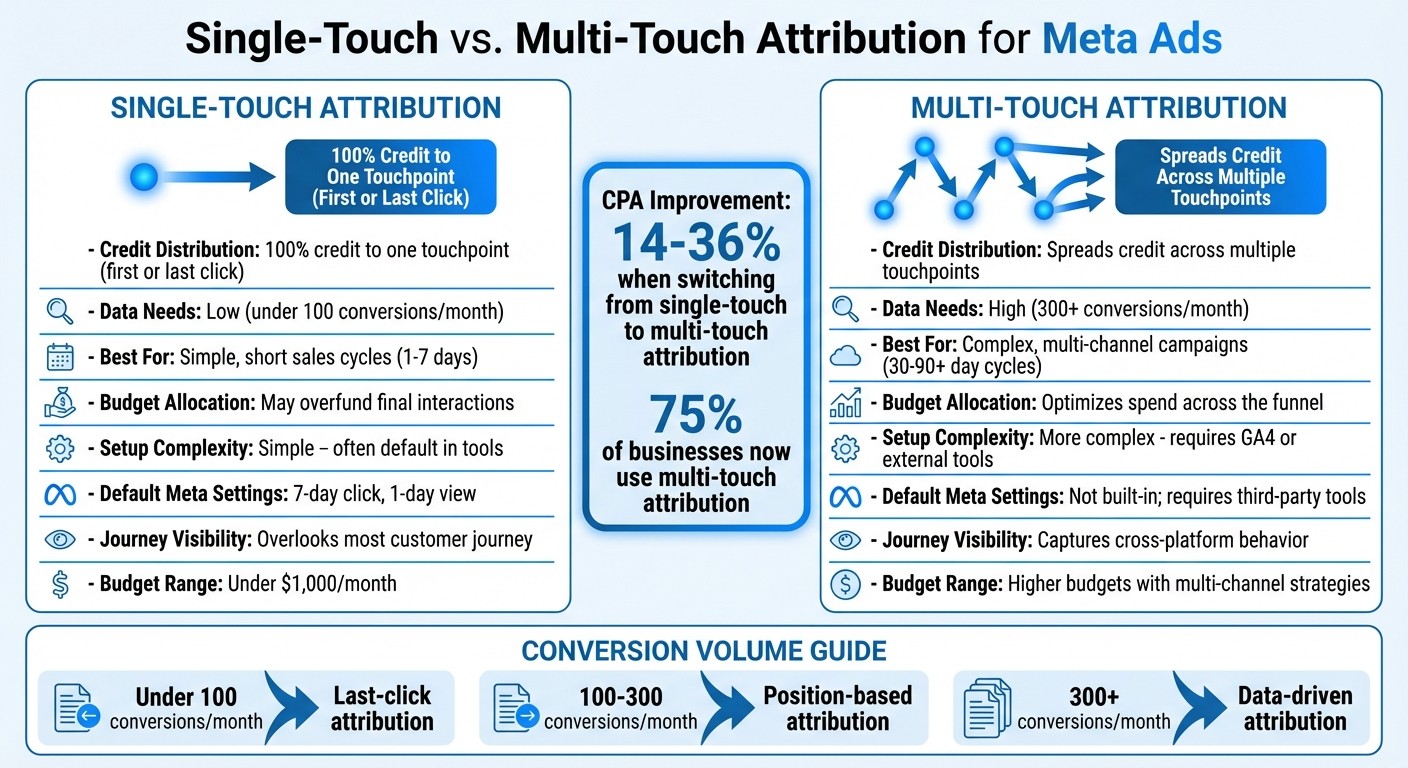
Single-Touch vs Multi-Touch Attribution Comparison for Meta Ads
Single-Touch Attribution: How It Works
What Is Single-Touch Attribution?
In the world of Meta Ads, assigning credit correctly for conversions is crucial. Single-touch attribution simplifies this process by giving 100% of the credit for a conversion to a single interaction, while ignoring all others that may have played a role. There are two main types of single-touch attribution: first-click (credit goes to the first interaction) and last-click (credit goes to the final interaction). Meta Ads typically default to attribution windows of 7-day click and 1-day view, meaning conversions are tracked within these timeframes.
Here’s an example: Imagine a user taps on your Instagram Story, then interacts with a Facebook carousel ad a few days later, and finally converts after clicking a retargeting ad. In a last-click model, that final retargeting ad would get all the credit, completely disregarding the earlier touchpoints that helped generate interest.
Understanding this approach is key to weighing its strengths and weaknesses.
Benefits of Single-Touch Attribution
Single-touch attribution is straightforward and easy to implement. It doesn’t require complex systems and provides clear, digestible reports. For businesses handling fewer than 100 conversions per month, where data may be too limited for more advanced models, this simplicity can be a real advantage.
This model is particularly effective in scenarios with short sales cycles, where the first interaction often directly drives the conversion. It’s also well-suited for bottom-funnel campaigns, especially those focused on retargeting warm audiences who are already close to making a purchase.
Drawbacks of Single-Touch Attribution
The biggest downside? Single-touch attribution ignores much of the customer journey. It overlooks "invisible" touchpoints like word-of-mouth, podcast mentions, or social media impressions that don’t result in trackable clicks. This can lead to misallocated budgets, where measurable channels end up overfunded, while others - like those responsible for initial brand awareness - are underfunded.
"Last-click gives 100% credit to the $0.50 branded search click and zero credit to the $15 LinkedIn click that actually introduced them to your product."
Julia Moreno, Dataslayer.ai
Another issue is how Meta Ads function. They’re often used to create demand, interrupting users’ feeds to spark interest. Last-click models fail to capture this broader role, as they focus only on the final interaction. Things get even messier when users engage with multiple platforms. For instance, if someone clicks on both a Meta ad and a Google ad before converting, both platforms might claim full credit, leading to inflated metrics that don’t reflect the true conversion count.
These challenges often push marketers toward multi-touch attribution, which provides a more complete picture of campaign performance.
Multi-Touch Attribution: How It Works
What Is Multi-Touch Attribution?
Multi-touch attribution (MTA) assigns conversion credit across every interaction a customer has during their journey - whether it's an impression, a click, or a video view. This approach provides a more complete picture of how Meta ads contribute to performance.
There are several models for distributing credit, each with its own method:
Linear attribution: Spreads credit evenly across all touchpoints.
Time-decay attribution: Gives more weight to interactions that happen closer to the conversion.
Position-based (U-shaped): Assigns about 40% credit to both the first and last interactions, with the rest split among the middle touchpoints.
Data-driven attribution: Leverages machine learning to determine credit based on actual performance data.
With customer journeys now spanning multiple devices and formats, MTA captures this complexity, helping advertisers understand which ad combinations are genuinely driving results.
Understanding how attribution models impact Meta ad performance is crucial for evaluating their benefits and limitations.
Benefits of Multi-Touch Attribution
MTA provides a detailed view of the customer journey, highlighting how different channels and touchpoints work together to influence conversions. This is especially valuable for campaigns with longer sales cycles, where early awareness campaigns and retargeting efforts both play key roles.
Switching from single-touch to multi-touch attribution can lead to smarter budget allocation across the funnel. For example, some businesses have reported reducing their cost per acquisition (CPA) by 14% to 36% when adopting MTA. It also enables advertisers to pinpoint which Meta ad formats - like Stories, Reels, or carousel ads - are most effective at various stages. Today, 75% of businesses rely on multi-touch attribution instead of single-touch models.
Drawbacks of Multi-Touch Attribution
While MTA offers deeper insights, it comes with challenges. For one, it requires significant data to work effectively. Platforms like GA4 and Meta, for instance, need at least 300–400 conversions per month to provide reliable results. Smaller campaigns might struggle to generate enough data for meaningful analysis.
Another hurdle is data fragmentation. As customers move between devices (mobile, tablet, desktop) and platforms (Facebook, Instagram, Messenger), cross-device tracking becomes complicated. Cookie restrictions, privacy settings, and browser limitations can further disrupt data collection. With modern customer journeys involving anywhere from 20 to 500 touchpoints, manually assigning credit is nearly impossible.
Additionally, without advanced tools or AI-driven analysis, traditional MTA models might mistakenly over-credit ads for conversions that would have happened naturally. This could lead to poor optimization decisions. These challenges highlight the importance of using sophisticated tools to unlock MTA's full potential.
Single-Touch vs. Multi-Touch Attribution: Side-by-Side Comparison
Key Differences for Meta Ads
The way you measure performance and allocate budgets for Meta ads depends heavily on whether you use single-touch or multi-touch attribution. Let’s break it down:
Factor | Single-Touch Attribution | Multi-Touch Attribution |
|---|---|---|
Credit Distribution | Assigns 100% credit to one touchpoint (first or last) | Spreads credit across multiple touchpoints |
Default Settings on Meta | Uses 7-day click, 1-day view (platform-specific) | Not built-in; requires tracking Meta ads with Google Analytics or external tools |
Journey Visibility | Overlooks most of the customer journey | Captures cross-platform behavior |
Setup Complexity | Straightforward; often the default in tools | More complex; depends on tracking and UTM parameters |
Budget Impact | Can underfund awareness efforts | Optimizes CPA and budget allocation |
Best For | Simple sales cycles; budgets under $1,000/month | Complex funnels; multi-channel strategies |
Single-touch models often inflate metrics by giving full credit to each platform - Meta, Google, and TikTok might all claim 100% of the same conversion. Multi-touch attribution fixes this by distributing credit across the entire customer journey.
Grasping these distinctions is essential for matching your attribution model to your campaign’s scale and complexity.
When to Use Each Model
Choosing the right attribution model depends on factors like conversion volume, sales cycle length, and campaign intricacy.
Here’s a practical guide for conversion volume:
Last-click attribution works best if you’re logging fewer than 100 conversions per month. Complex models won’t yield meaningful insights with limited data.
Position-based attribution is suitable for campaigns generating 100–300 monthly conversions.
Data-driven attribution becomes a viable option once you surpass 300–600 conversions. For GA4, this typically requires at least 300–400 conversions monthly.
Sales cycle length also plays a huge role. For short cycles (1–7 days) like impulse buys or flash sales, last-click or time-decay attribution often suffices. Longer cycles (30–90+ days) benefit from linear or data-driven models, which ensure awareness campaigns get proper credit.
A good practice? Test both models in parallel for 30 days. If you see a difference of 20% or more in results, adjust your budget accordingly. You can also use an ad performance benchmark tool to see how your metrics stack up against industry standards. Companies switching to multi-touch attribution frequently report CPA improvements ranging from 14–36%.
"Last-click modeling will typically underrepresent the results for [Facebook] since there is likely another touchpoint needed before converting."
– Monish Selvamuthu, Part and Sum
To avoid data pitfalls, don’t rely solely on Meta Ads Manager’s self-reported numbers. Use third-party analytics tools or unified dashboards to cross-check conversions and prevent double-counting across platforms. This approach is especially crucial for multi-channel campaigns.
How AI Improves Attribution for Meta Ads
AI-Powered Attribution Analysis
AI is changing the game for attribution in Meta Ads by turning static models into dynamic systems that adapt in real time. Traditional methods, like last-click and first-click attribution, often oversimplify the customer journey by giving all credit to a single touchpoint. In contrast, AI-powered models use machine learning to analyze patterns across multiple interactions, identifying the touchpoints that truly drive conversions. This helps marketers overcome common attribution issues that plague manual reporting.
One of AI's strengths is its ability to continuously update recommendations based on fresh data, eliminating the need for the manual adjustments required by traditional models. For instance, if monthly conversion volumes dip below 300–600, AI can flag that data-driven models might lose accuracy and suggest switching to simpler, rule-based approaches instead.
AI also tackles challenges like cross-device behavior, privacy restrictions, and incomplete data. By recognizing patterns, it estimates the full customer journey, even when data is fragmented. That said, maintaining clean data is essential - consistent UTM parameters and naming conventions across all Meta ads are critical for accurate attribution reporting. Companies leveraging AI to shift from single-touch to multi-touch attribution have reported cost-per-acquisition improvements ranging from 14% to 36%.
With these capabilities, specialized platforms now automate the complex processes behind attribution, making it more accessible and effective.
AdAmigo.ai: AI Attribution in Action
AdAmigo.ai exemplifies how AI can streamline attribution and campaign optimization. Acting as an autonomous AI media buyer, the platform simplifies the complexities of Meta Ads attribution while optimizing campaigns in real time. Supporting both single-touch and multi-touch models, AdAmigo.ai eliminates the need for manual tracking by analyzing performance data across creatives, audiences, budgets, and bids - then making adjustments automatically or with your approval.
One standout feature is the AI Chat Agent, which lets you ask questions like, "Why did ROAS drop yesterday?" and instantly receive detailed analysis of attribution patterns. You can also use it to launch new retargeting campaigns using AI-powered retargeting or adjust budgets on high-performing ads, all directly through the conversation interface.
AdAmigo's AI Creative Generation feature ensures your campaigns stay fresh. It reviews your top-performing ads and competitor content to generate new variations, helping to solve creative fatigue. Meanwhile, the Bulk Ad Launcher allows you to deploy hundreds of ads in minutes, complete with proper tagging for consistent tracking across large campaigns.
As the platform learns from your account's performance over time, it gains deeper insights into which touchpoints are most influential for your business. Whether you're running basic last-click campaigns or intricate multi-touch strategies, AdAmigo adapts its approach to align with your attribution model and conversion goals, ensuring your campaigns remain optimized and effective.
Facebook Ad Attribution Models
Conclusion
Deciding between single-touch and multi-touch attribution boils down to the complexity of your campaigns and the volume of conversions. Single-touch models, such as last-click attribution, work well for campaigns with short sales cycles (under seven days). However, they can miss crucial touchpoints along the customer journey, potentially leading to poor budget allocation. On the other hand, multi-touch attribution spreads credit across various touchpoints, providing a clearer view of how your ads work together. Companies that have transitioned from single-touch to multi-touch attribution report improvements in cost per acquisition ranging from 14% to 36%.
That said, multi-touch attribution isn’t without its challenges. It demands precise tracking through UTM parameters and a solid volume of data to deliver reliable results. For campaigns with fewer than 100 conversions, last-click attribution might be the most practical choice. Position-based models work better for 100–300 conversions, while data-driven attribution is ideal for campaigns with over 300 conversions. It’s worth noting that 75% of companies now rely on multi-touch attribution to measure their campaign performance.
As campaigns grow more intricate, automating attribution becomes increasingly important. AI tools are playing a crucial role in this shift. Platforms like AdAmigo.ai not only automate attribution analysis but also optimize creatives, audiences, budgets, and bids in real time. Their AI Chat Agent can answer questions like "Why did ROAS drop yesterday?" while instantly delivering attribution insights. The platform also adapts its optimization strategies to align with your chosen attribution model, whether it’s a straightforward last-click setup or a more advanced multi-touch approach.
To make the most of your campaigns, align your attribution model with your conversion volume and sales cycle. Ensure your UTM tracking is accurate and track custom conversions to capture every valuable action and consider leveraging AI-powered automation to streamline your efforts and base decisions on actionable data.
FAQs
What attribution window should I use in Meta Ads?
The right attribution window depends largely on your campaign objectives and the typical purchase cycle of your product or service. For most campaigns, the default 7-day click + 1-day view window strikes a good balance, capturing both immediate and slightly delayed conversions.
If you're promoting impulse buys, a shorter window like 1-day click or view might make more sense, as these decisions are made quickly. On the other hand, for more complex purchases with longer decision-making processes, a longer window such as 7-day click ensures you account for all critical touchpoints. Ultimately, your choice should align with how your customers shop and the length of your sales cycle.
How do I stop Meta and Google from double-counting conversions?
To prevent Meta and Google from double-counting conversions, it's crucial to use attribution models that account for the entire customer journey while minimizing overlap. Multi-touch attribution is a helpful approach, as it distributes credit across various touchpoints, avoiding inflated metrics. Additionally, choosing the right attribution windows - like a 7-day click or view-through - can make a big difference.
Tools like AdAmigo.ai are designed to analyze behavior across multiple channels. By leveraging such AI tools, you can improve accuracy and ensure that each conversion is only counted once, giving you a clearer picture of your campaign's true performance.
What tools do I need to run multi-touch attribution?
To make multi-touch attribution work smoothly, you'll need tools that can track and evaluate customer interactions across various channels. AI-driven platforms like Extuitive integrate with your ad accounts and customer data, offering a clear view of how your ads and messages impact the buyer's journey. Specialized attribution tools go a step further by analyzing behavior across channels, assigning credit to each touchpoint, and using AI to fine-tune campaigns with precise, actionable performance insights.