
How AI Matches Creatives to Audiences
AI analyzes creative elements, tests thousands of variations, and optimizes delivery in real time to match ads with the most responsive audiences and boost ROI.
AI has transformed how ads connect with the right people by making content the primary targeting tool. Instead of relying on demographics or manual targeting, platforms like Meta use AI to analyze visuals, messages, and themes to predict which audiences will engage. This approach improves ad performance by:
Analyzing user behavior: AI studies patterns like purchase history or app usage to create precise audience groups.
Testing variations with predictive analytics: Thousands of content combinations are tested in real-time to find what works best.
Adjusting delivery: AI refines automated and manual ad placements continuously based on user interactions.
For marketers, this shift saves time, improves efficiency, and boosts ROI by automating tasks like testing and budget allocation. Tools like AdAmigo.ai simplify this process, offering features like automated content creation, testing, and optimization, making campaigns faster and more effective.
How AI Transformed Creative Strategy for Winning Facebook Ads (The 2025 Evolution)
How AI Matches Creatives to Audiences
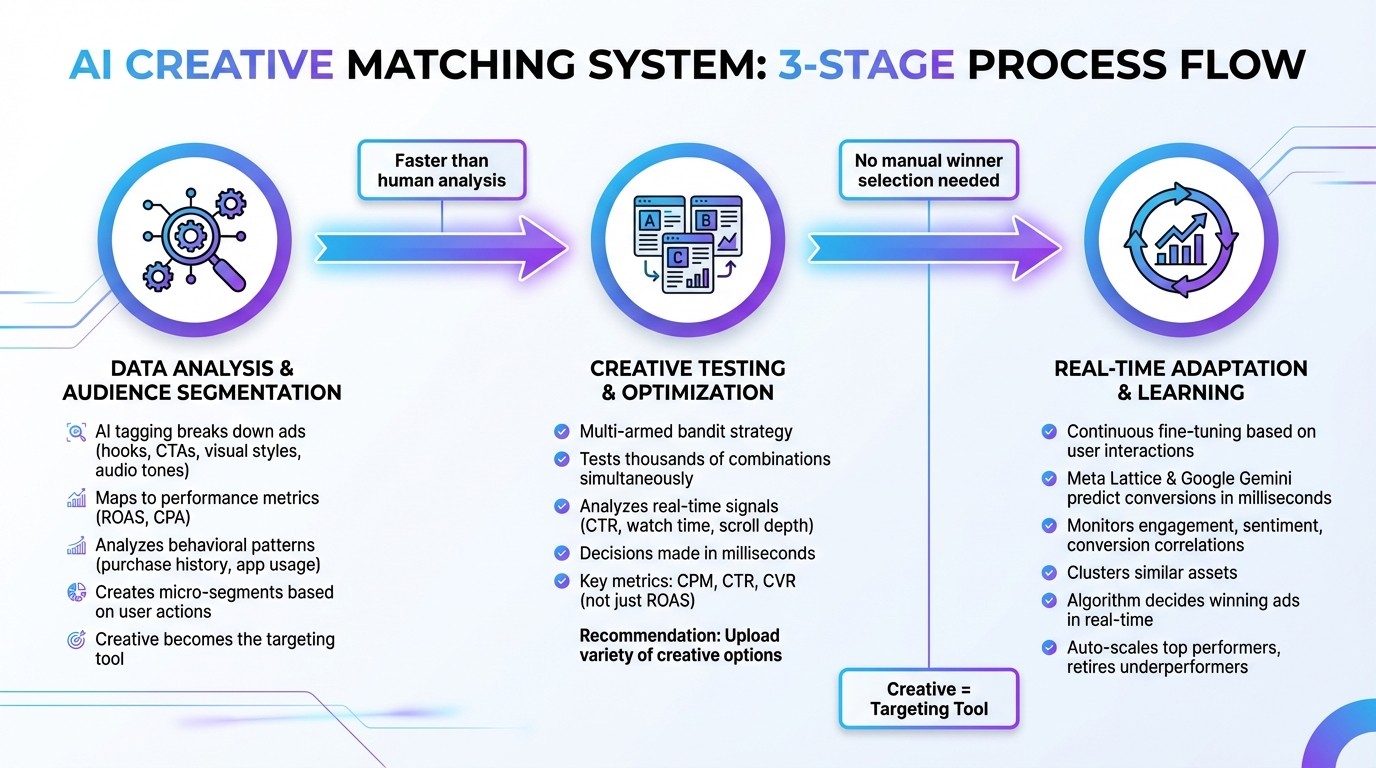
How AI Matches Creatives to Audiences: 3-Stage Process
Data Analysis and Audience Segmentation
AI breaks down ads into their core elements - like hooks, calls-to-action (CTAs), visual styles, and audio tones - through a process called AI tagging. These elements are then mapped to performance metrics such as ROAS (Return on Ad Spend) or CPA (Cost Per Action). Instead of sticking to traditional demographics or interest categories, AI dives into dynamic behavioral patterns, such as purchase history and app usage, to form highly specific micro-segments based on real user actions.
Here’s the twist: the creative itself becomes the targeting tool. The algorithm serves ads to users whose past behaviors suggest they’ll engage with that specific type of content. This approach allows the system to constantly identify which visuals or messages resonate with different groups. As the algorithm learns, it adjusts ad delivery to align with these insights, making creative testing a key component of this process. Following a conversion optimization checklist ensures all technical tracking is in place for the AI to function correctly.
Creative Testing and Optimization
AI testing systems use a "multi-armed bandit" strategy, which means they continuously shift impressions toward the best-performing creative-audience pairings while still experimenting with new variations. Platforms like Meta and Google Ads can test thousands of combinations at once, analyzing real-time signals like CTR benchmarks, watch time, and scroll depth to determine the winners in just milliseconds.
To make this work, upload a variety of creative options so the system has plenty to work with. During testing, focus on early indicators like CPM (Cost Per Thousand Impressions), CTR, and CVR (Conversion Rate) rather than solely relying on ROAS, which tends to lag behind. By analyzing individual elements - like which hooks or visuals perform best - AI gains a deeper understanding of what drives success. This real-time feedback loop allows the system to refine its approach as audience interactions evolve.
Real-Time Adaptation and Learning
Even after testing, AI doesn’t stop. It continuously fine-tunes creative delivery based on ongoing user interactions. Advanced models like Meta Lattice and Google Gemini predict conversion probabilities in milliseconds, adjusting ad delivery faster than any human could analyze the data. These systems monitor metrics like engagement levels, sentiment, and conversion correlations to keep improving performance.
AI also clusters similar assets, comparing variations of the same creative to decide which ones to scale up and which to retire. In this setup, marketers no longer pick the "winning" ad. Instead, the algorithm makes that decision in real time, ensuring that the creative-audience pairing most likely to meet your goals gets the spotlight.
Benefits of AI-Powered Creative Matching
Time Savings and Efficiency
AI takes the grind out of manual tasks. Instead of spending hours tagging creative elements in spreadsheets and cross-checking them with performance data, multimodal AI tagging does the heavy lifting. It links creative attributes - like hooks, calls-to-action, or visual styles - to performance metrics such as ROAS or CPA. This automation can save user acquisition teams up to 20 hours per week that would otherwise go into consolidating data.
With this extra time, marketers can shift their focus from execution to strategy. AI also speeds up campaign optimization by consolidating campaigns and using broader targeting, which helps identify winning patterns faster. To avoid disrupting this process, it's best to let campaigns run through the Meta Ads learning phase for at least one week or until 50–75 conversions are achieved before making manual adjustments.
But AI doesn’t just save time - it also customizes ad experiences for niche audiences like never before.
Personalization at Scale
AI doesn’t just stop at efficiency; it scales personalization to a whole new level. From a single master creative, AI can produce thousands of ad variations and test them across micro-audiences simultaneously. This is a step beyond traditional A/B testing - it’s more like "A/Infinity" testing, where countless variations are tested and refined in real time. As the tests run, impressions are continuously shifted toward the top-performing ads.
This level of personalization uncovers patterns that would be impossible to spot manually. For example, AI can determine which headlines resonate with specific demographics or which visual styles appeal to certain behavioral groups through AI audience profiling. Some models are even advancing toward "emotional inference", where they match ads based on how elements like tone or visual rhythm influence audience mood. To get the most out of this capability, it’s recommended to upload at least 10–15 unique creative variations per campaign, giving the AI enough material to work with.
Higher ROI and Better Budget Allocation
AI doesn’t just make campaigns more efficient and personalized - it also delivers better returns on investment while fine-tuning budget allocation.
Using a multi-armed bandit approach, AI reallocates budgets in real time, ensuring minimal waste on underperforming assets. It continuously shifts impressions to top performers while still testing new creative options. This approach mirrors the real-time creative testing process, amplifying the overall effectiveness of campaigns.
Creative strategy plays a massive role in campaign success, driving up to 70% of results. By maintaining a centralized library of brand-approved assets and past high-performers, the AI can quickly learn your "brand DNA" and allocate budgets more intelligently. This combination of speed, precision, and strategic focus makes AI an indispensable tool for modern marketing.
AdAmigo.ai: Automated Creative Optimization for Meta Ads
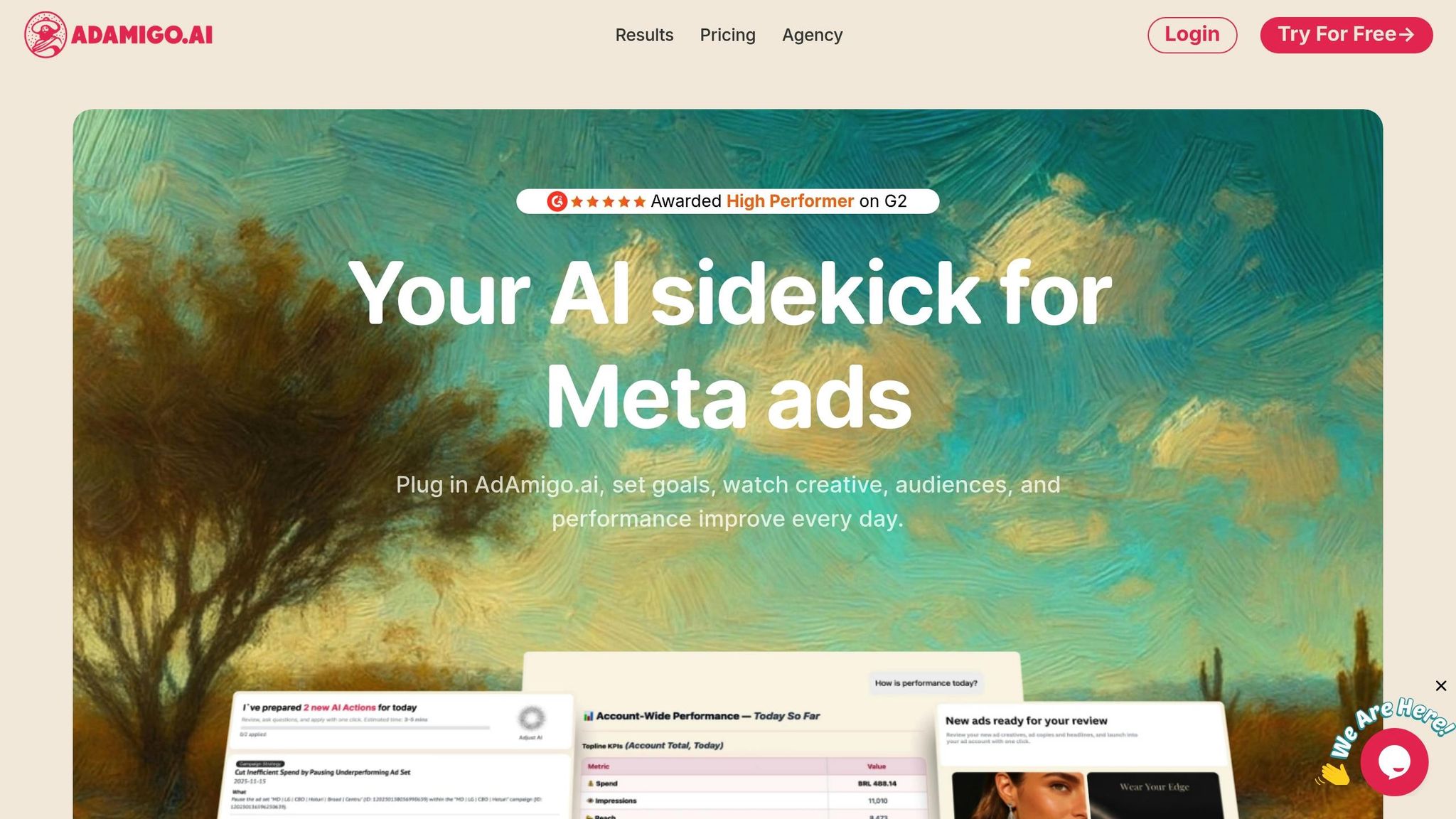
AdAmigo.ai simplifies the way you manage Meta ads by simplifying multi-campaign optimization and bringing automated creative optimization directly into your workflow. It’s an autonomous AI agent designed to handle the entire process - from generating ad creatives that align with your brand to testing, optimizing, and reallocating budgets. This makes it a powerful tool for agencies juggling multiple clients or in-house teams aiming to scale efficiently without adding extra personnel.
Key Features of AdAmigo.ai
AdAmigo.ai streamlines creative optimization with four integrated tools that work as a single, cohesive system:
AI Ads Agent: This tool analyzes your brand identity, competitor tactics, and high-performing ads to create conversion-focused creatives. With just one click, you can launch these optimized ads.
AI Actions: Provides a daily, prioritized to-do list of impactful adjustments across creatives, audiences, budgets, and bids. You can either approve these changes with one tap or let the system handle them automatically.
AI Chat Agent: Answers your questions like “why” and “what next,” provides insights, and allows you to bulk-launch campaigns directly through a chat interface.
Bulk Ad Launch: Lets you create and launch dozens or even hundreds of Meta ads at once, complete with optimized copy, creative, and targeting. Assets can be pulled directly from your Google Drive.
What sets AdAmigo.ai apart is its intelligent learning system, which goes beyond the capabilities of traditional rule-based platforms.
What Sets AdAmigo.ai Apart
Unlike tools that rely on static rules, AdAmigo.ai functions as a learning agent. It continually refines its strategies based on real-world performance data, adapting to what works best for your specific goals. This ensures the system gets smarter over time, optimizing for conversions while cutting CPA and boosting ROAS while respecting your budget, pacing, geo, and placement rules.
AdAmigo.ai offers flexibility in how you use it. You can manually review and approve changes, or let the platform operate autonomously, stepping in only when necessary. It also connects all aspects of your campaign - creatives, targeting, bids, and budgets - into one seamless system. This unified approach mimics the decision-making of an experienced media buyer, enabling faster testing and scaling of successful campaigns than traditional methods allow.
For agencies, this means a single media buyer can manage 4–8× more clients by delegating execution to AdAmigo.ai, freeing up time for strategic planning. In-house teams, on the other hand, gain the equivalent of a tireless AI media buyer whose expertise grows continuously - without the cost of hiring additional staff.
Getting Started with AdAmigo.ai
Setting up AdAmigo.ai is quick and straightforward - it takes about five minutes. Simply connect your Meta ad account, define your KPIs, and provide a brief on your goals (e.g., “Increase spend by 30% while maintaining a ROAS of 3× or higher”). From there, you’ll start receiving daily AI-driven recommendations for optimization.
AdAmigo.ai offers two plans: the Entry Plan for accounts spending under $5,000 per month, and the Gringo Plan, which includes unlimited actions and expert onboarding support.
Once activated, the platform continuously learns from your campaign performance. It shifts impressions toward top-performing creatives and audiences while testing new variations, ensuring your campaigns improve over time - leaving you free to focus on broader growth strategies.
Conclusion
AI has transformed the way creatives engage with audiences, replacing slow, manual A/B testing with real-time systems capable of analyzing thousands of variations. These systems allocate budgets to top-performing ads in an instant. As Spinta Digital aptly states, "The best-performing ad isn't chosen by the marketer anymore - it's chosen by the algorithm in milliseconds." This evolution places a sharper focus on the quality of creative content as a key factor in campaign success.
With tools like AdAmigo.ai, production delays become a thing of the past. These platforms generate and test creatives in just minutes, allowing agencies to automate client ad accounts to launch ads quickly and take on more projects without bottlenecks.
AI also takes ad optimization a step further by breaking down creatives into multimodal elements through dynamic creative optimization - such as hooks, visuals, and emotional tone - and mapping them to performance data. This eliminates guesswork and reduces wasted spending. By tailoring messaging to micro-segments automatically, every advertising dollar is spent more effectively. These advancements in creative-audience matching mark a new chapter in optimizing Meta ads. This includes leveraging AI-powered retargeting to re-engage high-intent users with personalized content.
FAQs
How does AI “read” an ad creative?
AI examines various components of an ad creative - like the text, images, tone, and visual elements - and matches them with performance data. This process pinpoints what resonates most with audiences, helping refine targeting strategies and improve overall effectiveness.
What metrics matter most during AI testing?
When testing AI, the most critical metrics to monitor are real-time performance indicators. These include:
Engagement: How users interact with the content or ads.
Click-through rates (CTR): The percentage of users who click on a link or ad.
Conversion rates: The number of users completing a desired action, like making a purchase or signing up.
Overall ad performance: A broader measure of how well your ads resonate with the target audience.
By focusing on these metrics, you can pinpoint which creatives perform best and adjust campaigns for maximum impact.
How many creative variations should I upload?
To make the most of AI tools like AdAmigo.ai, aim to upload 3 to 5 creative variations for your campaigns. This gives the platform enough material to test and find what connects best with your audience. By providing multiple options, the AI can fine-tune your assets and boost overall campaign effectiveness.