
Scaling Meta Ads: Budget vs. Audience Expansion
Compare budget vs audience scaling for Meta ads — when to raise spend, how to expand audiences, and a hybrid approach to grow without losing efficiency.
Scaling Meta ads boils down to two main strategies: increasing your budget (vertical scaling) or reaching new audiences (horizontal scaling). Each approach has its own strengths and risks. Here’s the key takeaway:
Budget Scaling: Boosts spend on high-performing campaigns but risks diminishing returns, higher costs, and algorithm disruptions. Gradual increases (20–30% every 3–4 days) are safer to avoid common vertical scaling mistakes.
Audience Expansion: Targets new customer groups through lookalike audiences, interest-based targeting, AI-driven behavioral targeting, or geographic testing. It diversifies reach but requires more testing and fresh multi-format creatives.
Quick Tip: Combine both strategies for balanced growth - start by expanding audiences, then scale budgets gradually with bulk launching to avoid performance drops.
The Meta Ads Scaling Method That FORCES Profit in 2025

Budget Scaling: Increasing Your Ad Spend
Budget scaling, often referred to as vertical scaling, involves using a Meta ads budget calculator to put more money into campaigns or ad sets that are already showing strong performance. For example, if a campaign is profitable at $500/day, increasing the budget might seem like a straightforward way to boost returns. However, Meta's algorithm doesn’t always respond in a straight line. As spending increases, the system broadens its reach beyond your core audience - those most likely to convert - and starts targeting users who may be less engaged. This can lead to higher CPMs and lower conversion rates.
One major risk of budget scaling is triggering a learning phase reset. If you increase your budget by more than 20–30% at once, the algorithm may need to pause and recalibrate. This reset can last several days, during which performance becomes unpredictable, with costs potentially rising and conversions dropping.
Another challenge is diminishing returns. Meta’s algorithm prioritizes easy wins at first, but as you scale, it exhausts that pool and shifts to less engaged users. While total profits may increase, efficiency (ROAS) often declines - a trade-off we’ll explore further when comparing this approach to audience expansion.
Before scaling, ensure your campaign is on solid ground. It should deliver at least 50 conversions per week and maintain stable ROAS benchmarks for at least seven days. Campaigns with fewer than 50 weekly conversions may lack the data needed for effective optimization, increasing the risk of poor performance when scaling.
How to Scale Your Budget Without Breaking Performance
The safest way to scale is by following the 20% rule: increase your budget by 20% every 3–4 days. For instance, if your campaign is running at $500/day, you’d raise it to $600, wait 72–96 hours, and assess performance before making another adjustment.
Using Campaign Budget Optimization (CBO) can also make scaling smoother. With CBO, Meta automatically shifts your budget between ad sets in real time, prioritizing the best performers and minimizing waste on underperforming ones.
If you rely on automated rules, set up a rule hierarchy that prioritizes protecting your budget over aggressive scaling. For example, create a rule to pause any ad set that spends above a certain threshold without generating conversions. Only scale budgets for campaigns that meet strict performance criteria.
It’s also important to monitor marginal ROAS - the return on each additional dollar spent - rather than overall ROAS. If incremental spending starts yielding lower returns, you’ve likely hit your scaling limit, and further increases could hurt profitability.
Another option is to use Cost Cap bidding, setting it 15–25% above your target CPA. This helps Meta’s algorithm avoid expensive auctions that could harm efficiency as you scale.
Pros and Cons of Budget Scaling
Budget scaling is a relatively straightforward method for boosting ad performance. By simply adjusting your budget, you let the algorithm continue working with your existing targeting. For campaigns that are already performing well, this can be one of the quickest ways to grow.
However, this approach isn’t without its downsides. One common issue is algorithm disruption - scaling too quickly can cause instability as the algorithm recalibrates. There’s also the risk of audience saturation; as your budget increases, ad frequency rises within the same audience segments. For cold audiences, once ad frequency exceeds 2–3, click-through rates often drop, and costs climb. Additionally, creative fatigue can set in faster with higher ad spend, causing previously successful ads to lose their effectiveness more quickly.
Here’s a summary of the trade-offs:
Advantage | Challenge |
|---|---|
Easy to implement - just adjust the budget | Risk of learning phase reset with large increases |
Requires minimal management | Efficiency declines as spend rises |
Maintains consistent targeting | Audience saturation and higher ad frequency |
Works well with proven campaigns | Faster creative fatigue |
Predictable CPA with gradual scaling | Increased CPMs due to broader bidding |
Research shows that 73% of scaling attempts fail within the first week due to weak campaign fundamentals. To avoid this, ensure your campaign delivers at least 50 weekly conversions, maintains stable ROAS, and has strong pixel data before attempting to scale.
Audience Expansion: Reaching New Customer Segments
When your current audience starts showing signs of saturation, horizontal scaling can be a game-changer. Unlike budget scaling, which pours more money into proven audience segments, horizontal scaling focuses on exploring entirely new customer groups. This approach allows you to tap into fresh audience pools and avoid diminishing returns from overspending on the same campaigns.
If your campaigns are performing well but can't efficiently handle more budget, it's time to test new audience segments. You can experiment with AI vs manual audience creation, explore new interest categories, expand into different geographic regions, or even extend your retargeting window (e.g., from 30 days to 60 or 90 days) using AI-powered retargeting to capture additional warm leads. Let’s dive into some effective ways to expand your audience.
How to Expand Your Audience Effectively
To successfully reach untapped customer segments, start with these strategies:
Lookalike Audiences: Build lookalike audiences based on your highest-value customers. Instead of just using page visits, focus on conversion data to create 1–3% lookalikes. These tend to perform well because they closely resemble your core buyers without being too broad. Once these audiences deliver at least 50 optimization events per week, you can test broader lookalikes (4–6%) to increase reach.
Broad Targeting: Platforms like Meta now favor broad targeting, leveraging machine learning to identify converters without relying on narrow interest categories. This works best for accounts with strong conversion data and high pixel activity. If your campaigns already generate solid results, broad targeting can open up new opportunities for growth.
Interest-Based Targeting: Explore new interest groups that align with your product but appeal to different motivations. For example, a fitness brand might branch out from targeting "gym equipment" to audiences interested in "meal prep" or "wellness coaching." Each interest group introduces a unique pool of potential customers.
Geographic Expansion: If your campaigns perform well in one region, consider testing similar markets with comparable demographics and purchasing power. Expand gradually, keeping a close eye on performance to ensure scalability.
Pros and Cons of Audience Expansion
Expanding into new customer segments comes with its own set of opportunities and challenges. Here’s what to consider:
Advantage | Challenge |
|---|---|
Access to untapped audiences | Higher CPMs in new, competitive segments |
Diversifies your customer base | Lower initial conversion rates during testing |
Reduces reliance on a single audience | Requires close monitoring and frequent adjustments |
Supports long-term growth by avoiding saturation | Needs strong conversion data to exit the learning phase |
Audience expansion is a balancing act. While it opens doors to fresh traffic and reduces the risk of over-relying on a single audience, it also demands patience and careful management. Start small, monitor performance closely, and maintain your core campaigns as a stable foundation while you experiment with new segments.
Budget vs. Audience Expansion: Side-by-Side Comparison
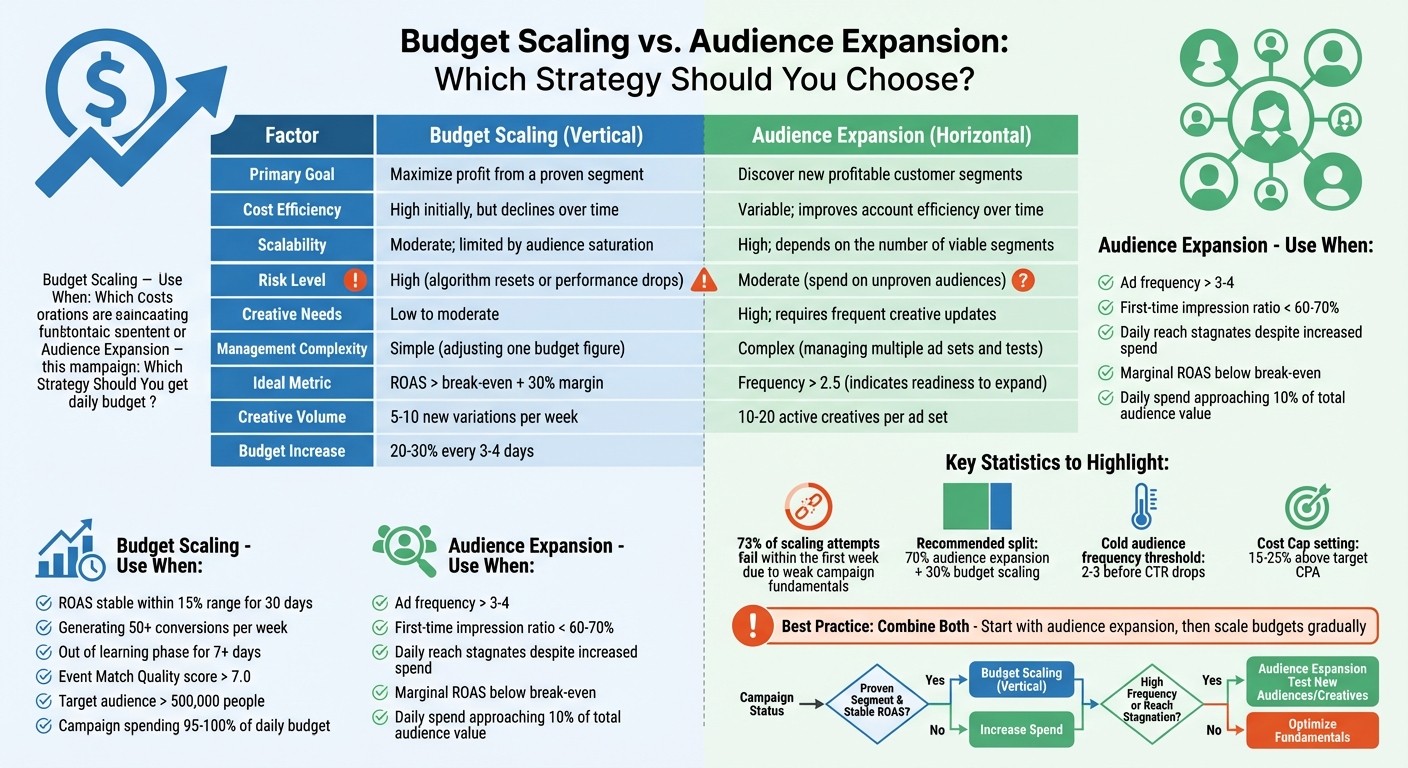
Budget Scaling vs Audience Expansion: Complete Comparison Guide for Meta Ads
Deciding between budget scaling and audience expansion depends on your campaign's current stage, resources, and growth objectives. Each method has its own strengths and challenges, so understanding these can help you make the right choice.
Scaling Meta ad budgets is ideal for quick returns from audiences you already know perform well. However, its efficiency drops as Meta's algorithm expands beyond your core, high-performing group. As AdStellar.ai explains, "The platform doesn't magically discover a hidden cache of perfect customers waiting in the wings. Instead, it expands outward from your core audience to progressively less qualified prospects".
On the other hand, audience expansion focuses on exploring new customer pools. This approach requires patience and upfront testing various ad elements but can lead to significant growth by uncovering untapped opportunities. While not every new audience delivers immediate results, the long-term potential can be worth the investment.
Here's a detailed comparison of the two methods:
Factor | Budget Scaling (Vertical) | Audience Expansion (Horizontal) |
|---|---|---|
Primary Goal | Maximize profit from a proven segment | Discover new profitable customer segments |
Cost Efficiency | High initially, but declines over time | Variable; improves account efficiency over time |
Scalability | Moderate; limited by audience saturation | High; depends on the number of viable segments |
Risk Level | High (algorithm resets or performance drops) | Moderate (spend on unproven audiences) |
Creative Needs | Low to moderate | High; requires frequent creative updates |
Management Complexity | Simple (adjusting one budget figure) | Complex (managing multiple ad sets and tests) |
Ideal Metric | ROAS > break-even + 30% margin | Frequency > 2.5 (indicates readiness to expand) |
This breakdown highlights when each method is most effective. Budget scaling is highly efficient in the short term, as it capitalizes on proven audiences. However, its effectiveness diminishes as you exhaust your core audience, leading to higher costs and reduced returns. Audience expansion, while more resource-intensive upfront, can uncover low-cost customer segments that contribute to a healthier Marketing Efficiency Ratio (MER) over time.
For budget scaling, gradual increases of 20–30% at a time are recommended, and fewer creatives are needed to maintain performance. In contrast, audience expansion requires more frequent creative updates, with 10–20 active creatives per ad set typically necessary to avoid fatigue and sustain results.
When to Use Budget Scaling
Budget scaling is most effective when your campaigns show consistent performance, with a stable ROAS (within a 15% range) over the past 30 days. This stability gives the algorithm the confidence to handle additional spending without negatively impacting results.
Your campaign should also be out of the learning phase for at least 7 days. Meta's algorithm requires approximately 50 optimization events per week to stabilize. If you're hitting that threshold, the system has enough data to manage higher budgets efficiently. Campaigns that regularly spend 95–100% of their daily budget with smooth delivery throughout the day are ideal candidates for scaling.
Make sure your Event Match Quality score is above 7.0. This ensures the algorithm is optimizing based on accurate data rather than incomplete or misleading signals. Without clean pixel data, increasing the budget could amplify common mistakes in Meta ad testing instead of improving performance.
Lastly, your target audience should exceed 500,000. Smaller audiences can quickly hit saturation with increased budgets, so if your audience is too narrow, consider using audience expansion instead.
Tips for Getting the Most from Budget Scaling
Once your campaign meets these criteria, use these strategies to make the most of budget scaling:
Increase budgets gradually using automated rules: Limit increases to 20–30% at a time. Sudden, large jumps can push your campaign back into the learning phase, disrupting performance. Think of it as turning up the heat slowly to avoid overcooking.
Set Cost Caps strategically: Adjust Cost Caps to 15–25% above your target CPA. This prevents Meta from bidding too aggressively during competitive auctions, helping control costs while scaling.
Track marginal ROAS: Pay attention to diminishing returns. Use a ROAS calculator to ensure your returns remain profitable as you scale. A strong overall ROAS doesn’t guarantee that additional spend will maintain the same efficiency. Monitor closely and pause increases if performance starts to decline.
Refresh creatives frequently: Introduce 5–10 new creative variations every week. As your budget grows, ads are shown more often to the same audience, which can lead to ad fatigue. Regularly updating visuals and messaging keeps your campaigns engaging and effective.
When to Use Audience Expansion
When vertical scaling hits its limits, turning to audience expansion can help maintain performance without losing efficiency. This approach becomes essential when vertical scaling no longer yields the desired results. Key indicators include high ad frequency (above 3–4) and a first-time impression ratio dropping below 60–70%. These metrics suggest your current audience is saturated and it's time to broaden your reach. Another clear sign is when your daily reach stagnates, even if you increase your ad spend - this confirms your audience pool is maxed out.
Pay close attention to marginal ROAS (Return on Ad Spend) to measure incremental performance and ROAS. Even if your overall ROAS looks good, focus on what each additional $1,000 in spending delivers. If the incremental return dips below break-even, it’s a sign that vertical scaling has reached its limit, regardless of the average performance. A general guideline is to cap daily spend at about 10% of your total audience value. For instance, if your audience consists of 500,000 people, a daily budget of around $1,600 is appropriate.
To maintain efficiency while increasing spend, distribute your budget across multiple, distinct audience segments instead of overloading a single campaign. This approach helps sustain performance across a broader reach. Unlike budget scaling, which focuses on spending more within the same audience, audience expansion shifts the goal to reaching new people.
How to Test New Audiences the Right Way
Once you’ve identified that your campaign has plateaued, it’s time to test new audiences using AI and manual segmentation strategies. Start with interest stacking. This involves branching out from a successful interest to closely related ones. For example, if "Running" has been effective, try testing interests like "Marathon" or "Trail Running" in separate campaigns. This keeps you close to proven strategies while tapping into fresh audience pools.
Another method is geographic expansion, which allows you to explore entirely new audiences without any overlap. If a campaign performs well in the U.S., consider running parallel tests in markets like Canada, the UK, or Australia. Each new region offers a distinct audience, ensuring no cannibalization of your existing performance.
Before launching new segments, use Meta's Audience Overlap tool to prevent interest-based audience overlap. If overlap exceeds 30–40%, you might end up competing with your own campaigns. In such cases, consolidate those audiences instead of splitting them. For testing, focus on 2–3 new segments at a time, allocate smaller budgets, and give each test at least two weeks to stabilize before deciding whether to scale.
When expanding, set Cost Caps at 15–25% above your target CPA. This prevents Meta from pursuing overly expensive conversions while exploring broader audiences. Allocate 10–20% of your total budget to experimental tests, while keeping 60–70% on proven core campaigns and 20–30% on promising growth opportunities.
Lookalike Size | Typical Audience (US) | Expected CPA vs. 1% | Best Use Case |
|---|---|---|---|
1% | ~2.3M | Baseline | Initial prospecting |
2–3% | ~5–7M | +10–20% | First expansion tier |
4–5% | ~9–12M | +20–35% | Volume scaling |
6–10% | ~14–23M | +35–60% | Broad reach campaigns |
Using Budget Scaling and Audience Expansion Together
The best scaling strategy doesn’t make you choose between increasing your budget or expanding your audience - it combines both. Budget scaling focuses on audiences that are already performing well, while audience expansion brings in new customer segments. Together, they create a balanced approach to growth. Typically, the split is 70% audience expansion and 30% budget scaling. This mix prevents overexposing the same users with higher budgets, which can lead to frequency spikes and a drop in performance. It’s a seamless blend of vertical (budget-focused) and horizontal (audience-focused) scaling strategies.
Before increasing your ad spend, focus on growing your audience. As mentioned earlier, expanding your audience pool - whether through lookalike audiences or interest-based targeting - lays the groundwork for scaling without hurting performance. For instance, if you’re using a 1% lookalike audience, consider broadening it to 3–5% first. After that, gradually increase your budget by 20–30% at a time to avoid resetting the learning phase.
Campaign Budget Optimization (CBO) is ideal for this hybrid strategy. CBO automatically shifts budgets across AI-driven audience segments based on performance, saving you from manually adjusting each ad set. This flexibility is especially helpful when testing new audiences alongside proven ones, ensuring your budget works where it’s most effective.
To simplify managing this hybrid approach, tools like AdAmigo.ai have emerged. This platform automates the entire process - optimizing creatives, targeting, bids, and budgets as one interconnected system. Its AI Actions feature provides a daily list of high-impact recommendations, such as safe budget adjustments or new lookalike audience percentages. You can approve these changes with a single click or let AdAmigo handle everything on autopilot.
What makes AdAmigo stand out is its ability to learn and adapt. Unlike static rules-based systems, it evolves based on real results. It respects your budget, pacing, and targeting rules, and can operate fully or semi-autonomously depending on your preferences. For agencies, this means a single media buyer can manage 4–8× more clients by letting AdAmigo handle execution while focusing on strategy. For in-house teams, it reduces the need for additional hires by acting as an always-on AI media buyer that gets smarter over time.
Getting started is quick - just connect your Meta ad account, set your KPIs, and outline your goals (e.g., "Increase spend by 30% while maintaining a ROAS of 3× or higher"). From there, you’ll receive daily AI-driven recommendations for campaigns, audiences, budget adjustments, and creatives. You can approve, edit, or let the platform publish automatically. AdAmigo ensures you balance audience growth and budget scaling without compromising performance.
Conclusion: Choosing the Right Scaling Method
Budget scaling is a solid option when your campaigns are both stable and profitable. If your Return on Ad Spend (ROAS) has stayed within a 15% range over the past 30 days and you're generating at least 50 conversions per week, you’re in a good position to safely increase your ad spend. To handle the potential volatility of scaling, aim to keep your ROAS at least 30% above your break-even point.
While budget scaling works well for steady campaigns, audience expansion becomes necessary when your campaign starts to hit saturation. If your ad frequency exceeds 2.5–3.0 or your target audience is smaller than 500,000 people, your ads may be overexposed. Expanding into new lookalike audiences, interests, utilizing AI tools for lookalike expansion, or geographic regions can help you reach fresh prospects and grow your budget without inflating costs.
Keep an eye on critical metrics like rising CPM, increasing CPA, or declining ROAS benchmarks. These are signs that it might be time to refine your targeting or even pause campaigns if necessary. For example, consider pausing a campaign if your CPA exceeds your target by 50% or if your ROAS falls below break-even ROAS for more than 48 hours.
A balanced approach often works best. Start with audience expansion to create more room for growth, then gradually increase budgets by 20–30% to avoid resetting the learning phase. Always follow a Meta ads scaling checklist to audit your campaigns before scaling - weak foundations are one of the biggest reasons scaling efforts fail.
Automation tools like AdAmigo.ai can simplify this process by optimizing creatives, targeting, budgets, and bids. This allows you to focus on strategy while ensuring smooth scaling. Choose the approach that matches your campaign’s current performance and leverage automation to keep your scaling efforts on track.
FAQs
How do I know I’m ready to raise my Meta ads budget?
When your Meta ad campaigns demonstrate steady performance across essential metrics - like ROAS (Return on Ad Spend), CPA (Cost Per Acquisition), CTR (Click-Through Rate), and conversion rate - it’s a good indicator that you’re ready to increase your budget. To do this effectively, gradually raise your budget by 10-25% every 3-4 days, keeping a close eye on these metrics to ensure performance doesn’t take a hit.
You can also leverage automation tools to pinpoint the ideal moments to scale up. For example, if your ROAS consistently outperforms your target for several days, that’s often a green light to invest more confidently.
What are the signs of audience saturation?
Signs that your audience is reaching saturation can show up in a few ways: higher ad frequency, increased costs, lower ROAS (Return on Ad Spend), and ad fatigue. You’ll notice these trends by keeping a close eye on key metrics like CPA (Cost Per Acquisition) and tracking performance changes over time. These shifts signal it's time to rethink your approach.
How should I split budget between scaling and testing new audiences?
To keep your budget balanced while scaling effectively, consider gradually increasing spending on campaigns that have already shown success. A good rule of thumb is to adjust budgets by 20-30% every 48-72 hours. This slow and steady approach helps maintain performance without causing disruptions.
At the same time, set aside a portion of your budget for experimentation. Try exploring new audiences by using lookalike audiences, targeting interest groups, or expanding into new geographic areas. Testing fresh creative assets and ad placements can also uncover new opportunities for growth.
To make this process smoother, you can use tools like AdAmigo.ai, which can automate tasks like budget adjustments and audience targeting, saving you time and effort.