
Meta Ads Attribution vs. Third-Party Tools
Compare Meta's built-in attribution and third-party tools: accuracy, cross-channel tracking, costs, and when Pixel + Conversions API or full suites are best.
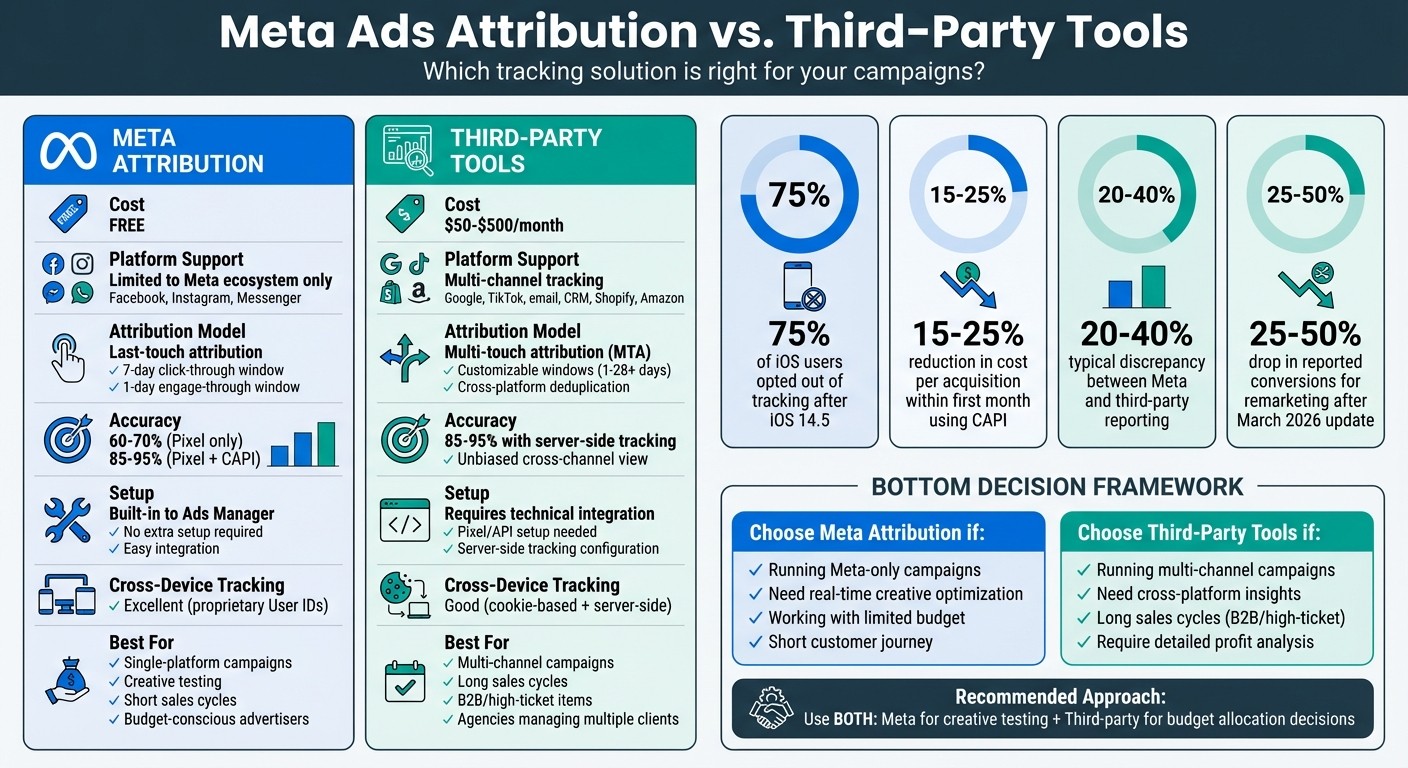
When deciding how to track your ad performance, you’re likely weighing Meta’s built-in attribution tools against third-party platforms. Here’s the quick breakdown:
Meta Attribution: Best for campaigns that run only on Meta platforms (Facebook, Instagram). It’s free, easy to use, and integrates directly into Ads Manager. However, it only tracks within Meta’s ecosystem and heavily relies on last-touch attribution, which can inflate results.
Third-Party Tools: Ideal for multi-channel campaigns. These tools offer cross-platform insights, single vs. multi-touch attribution, and advanced tracking methods like server-side data. They’re more accurate for long sales cycles or when using multiple ad channels but come with added costs ($50–$500/month) and require more setup.
Key Takeaways:
Meta’s tools are free but limited to its platforms and may face common attribution issues that over-credit conversions.
Third-party tools provide a broader view, better for multi-channel strategies, but cost more and may show discrepancies with Meta’s data.
Combining Meta’s Conversions API with Pixel tracking improves accuracy (up to 95%).
Quick Comparison:
Criteria | Meta Attribution | Third-Party Tools |
|---|---|---|
Cost | Free | $50–$500/month |
Cross-Platform Support | Limited to Meta | Tracks Google, TikTok, email, etc. |
Last-touch | Multi-touch | |
Accuracy | 60–70% (Pixel), 85–95% (Pixel + CAPI) | 85–95% with server-side tracking |
Ease of Setup | Built-in, no extra setup | Requires technical setup |
Choose Meta for simplicity and short-term campaigns. Opt for third-party tools or track Meta ads with Google Analytics if you need detailed, multi-channel insights.
Meta Ads Attribution vs Third-Party Tools: Complete Comparison Guide
I Found THE BEST Tracking Software For Facebook Ads
Meta Ads Native Attribution Explained
Meta's native attribution in Ads Manager relies on three key tools: the Meta Pixel, Conversions API (CAPI), and Aggregated Event Measurement (AEM). Together, these elements provide real-time conversion data that powers Meta's algorithm.
Using the Pixel alone captures about 60–70% of conversions as of 2026. However, when paired with CAPI, this figure jumps to 85–95%. This combination also typically reduces cost per acquisition by 15–25% within the first month. A critical distinction to note is that Meta tracks conversions based on the timing of ad impressions rather than when the actual conversions occur, which often leads to discrepancies when compared to third-party tracking tools.
Let’s break down what Meta Attribution provides and where it faces challenges.
What Meta Attribution Offers
Meta's default attribution model for e-commerce campaigns uses a 7-day click-through window, striking a balance between accuracy and completeness. In March 2026, Meta revamped its attribution approach, splitting interactions into two categories: Click-through (link clicks) and Engage-through (likes, shares, saves, and video views lasting more than 5 seconds). Notably, the engage-through category now uses a shorter 1-day window, replacing the longer timeframes previously used.
Another standout feature is Advanced Matching, which sends hashed customer data (like email addresses and phone numbers) to boost your Event Match Quality (EMQ) score. Maintaining an EMQ of 6.0 or higher is crucial for accurate tracking and ensuring the algorithm performs optimally.
Meta also excels in cross-device visibility, tracking users across devices as long as they’re logged into Facebook or Instagram. This capability often surpasses what third-party tools can achieve. When direct tracking is unavailable, Meta uses machine learning to estimate conversions based on historical data. These "modeled conversions" are generally accurate within a 10% to 15% margin.
While these features are robust, Meta Attribution does have its shortcomings.
Where Meta Attribution Falls Short
One of the main drawbacks is platform bias. Meta’s last-touch attribution model assigns 100% of the credit to the final Meta ad interaction, ignoring other touchpoints like organic search or email. This often inflates reported return on ad spend (ROAS) compared to third-party tracking tools.
The privacy changes introduced with iOS 14.5 and Meta Consent Mode also had a major impact - 75% of users opted out of tracking. Without CAPI, this data loss is permanent. Even with CAPI, only 70% to 85% of iOS conversions can be captured, compared to just 25% to 40% with Pixel-only setups.
Another limitation comes from AEM, which restricts tracking to 8 prioritized conversion events per domain. This can be challenging if you’re managing multiple funnels or product lines. Additionally, Meta cannot track conversions that occur outside its ecosystem. For example, if someone views your Meta ad, then clicks a Google ad and converts, Meta will still claim full credit, leading to inflated data across platforms.
"Meta used to give us credit for conversions that probably came from other channels. They stopped doing that. Our actual performance hasn't changed; the reporting is just more honest now." - Magic Mango Blog
After the March 2026 update, remarketing campaigns may show a 25% to 50% drop in reported conversions. This is because social engagements like saves and likes now fall outside the new, shorter 1-day engage-through window.
Third-Party Attribution Tools Overview
Meta's native tracking has its limits, often leaving gaps in conversion data, showing platform biases, and offering limited visibility across channels. This is where third-party tools step in. By leveraging server-side tracking and cross-platform data matching, these tools help uncover what’s really driving your sales. Modern platforms even use AI to improve attribution accuracy by analyzing complex data patterns in real-time.
Some standout examples include Triple Whale, known for multi-touch attribution and CAPI enrichment, Cometly, which uses server-side tracking to bypass browser restrictions, and AdAmigo.ai, an AI-powered platform that optimizes Meta ads while providing clear attribution insights.
Leading Attribution Platforms
Third-party tools generally fall into two categories: CAPI gateways and full attribution suites.
CAPI Gateways: Tools like Stape and Elevar serve as intermediaries, sending conversion data directly from your server to Meta. Implementing these connections requires following Meta API integration best practices to ensure data security and accuracy. These platforms typically cost between $50 and $500 per month, depending on the volume of events processed. They can significantly improve match rates, achieving 85–95% compared to the 60–70% match rates common with Pixel-only tracking.
Full Attribution Suites: These platforms go beyond Meta tracking by integrating data from multiple sources, such as Google Ads, CRMs, and Shopify. This holistic approach provides a unified view of performance and helps resolve the 20–40% discrepancies often seen when comparing Meta's reporting to actual revenue.
Next, let’s dive into how these tools work to improve conversion tracking.
How Third-Party Tools Function
The backbone of these platforms is server-side tracking. Unlike the Meta Pixel, which operates in the user's browser and can be blocked by privacy settings or ad blockers, server-to-server connections send conversion data directly from your backend to Meta. This approach has proven especially effective for iOS users, where 75% opted out of tracking after the iOS 14.5 update.
Another key feature is custom attribution models. While Meta uses a default 7-day click-through window, third-party tools let you tailor this to fit your business. For example, a 1-day window might work best for low-cost impulse buys, while high-ticket items over $200 or B2B services with longer sales cycles may benefit from a 28-day or longer window.
These platforms also excel in cross-platform deduplication. When users engage with ads on multiple channels, the tools rely on backend data to ensure each conversion is counted only once, accurately distributing credit across your entire marketing strategy.
Meta Ads vs. Third-Party Attribution: Side-by-Side Comparison
This section dives into how Meta's native attribution system stacks up against third-party tools in reporting performance and assigning credit. This includes how accurately the platform can track custom conversions on Meta Ads compared to external data sources. The choice between them depends on their data handling and measurement approaches. Meta's reporting is free and seamlessly integrated into Ads Manager, but it only tracks activity within its own ecosystem. On the other hand, third-party tools, which range from $50 to over $500 per month, provide a broader view by connecting data from platforms like Google, TikTok, email, and more. Let’s break down the differences.
One major contrast lies in how they assign credit. Meta uses a last-touch attribution model, meaning it gives full credit to the final ad interaction before a purchase. In comparison, third-party tools often rely on multi-touch attribution (MTA), which spreads credit across all touchpoints that contributed to the sale. This difference can lead to significant discrepancies - up to 99% in some cases - between Meta’s reports and platforms like Triple Whale.
Timing also plays a role in these discrepancies. Meta ties conversions to the time the ad was shown, while third-party tools report conversions based on the actual purchase time. This difference became even more noticeable after Meta’s March 2026 update, which separated "click-through" and "engage-through" attribution into distinct categories. Following this change, remarketing campaigns saw reported conversions drop by 25% to 50%, even though actual revenue stayed the same.
Comparison Table: Performance Metrics
Here’s a quick look at how Meta's native attribution compares to third-party tools across key metrics:
Criteria | Meta Native Attribution | Third-Party Attribution Tools |
|---|---|---|
Accuracy | Correlational; favors Meta channels; impacted by iOS privacy changes. Pixel-only tracking captures 60–70% of conversions. | Causal (with incrementality testing); unbiased; de-duplicates cross-platform data. Pixel + CAPI setup achieves 85–95% match rates. |
Cross-Platform Support | Limited to Meta’s ecosystem; doesn’t track Google, TikTok, email, etc.. | Provides a full view across platforms like Google, TikTok, Klaviyo, Shopify, Amazon, and CRMs. |
Attribution Model | Last-touch (7-day click, 1-day view); engage-through capped at 1-day post-March 2026. | Multi-touch attribution (MTA). |
Integration Ease | Built into Ads Manager; no extra setup needed. | Requires pixel/API integration, server-side tracking, and sometimes data warehousing. |
Cost | Free. | $50–$500/month for tools like Stape or Elevar; higher for platforms like Triple Whale or Northbeam. |
Optimization Features | Real-time feedback for Meta’s algorithm; optimizes only within Meta. | Provides insights for optimizing cross-channel budget efficiency; highlights diminishing returns and channel synergies. |
Granularity | Detailed within Meta (campaign/ad set/ad level). | Detailed across the full customer journey, showing the role of every touchpoint. |
For brands advertising across multiple platforms, third-party tools offer a clearer picture of which channels contribute to revenue and which simply benefit from last-touch credit. This can be invaluable for making informed decisions about where to allocate budget and resources.
Meta Ads Attribution: Pros and Cons
Meta's built-in attribution system, seamlessly integrated into Ads Manager, offers free and instant access to conversion data for Meta's optimization tools. But while it's convenient, it has its limitations - especially for campaigns spanning multiple platforms or involving longer customer journeys.
Benefits of Meta Attribution
One of the standout features of Meta Attribution is its native integration. Since everything is housed within Ads Manager, you can access conversion data in real time. This immediacy allows advertisers to quickly refine ad creatives, reallocate budgets, or pause underperforming campaigns using a conversion optimization checklist to optimize your Meta Ads ROI without waiting for delayed reports.
Meta also shines when it comes to cross-device tracking. By relying on proprietary User IDs, Meta links user activity across mobile, desktop, and tablet as long as users are logged into Facebook or Instagram. This method is far more reliable than traditional cookie-based tracking systems.
Another plus? Instant audience building. Attributed conversions are automatically fed into custom audiences for retargeting. There’s no need to manually export CSV files or sync with external platforms. According to Meta's internal data, 46% of purchase conversions from Reels happen within the first two seconds of engagement - a clear advantage in leveraging quick data for retargeting.
Drawbacks of Meta Attribution
While Meta Attribution is powerful within its own ecosystem, it struggles when campaigns require cross-channel insights. The system only tracks activity within Meta platforms (Facebook, Instagram, and Messenger), leaving it blind to actions on Google Search, TikTok, email, or direct website traffic. This creates a "walled garden" effect, where the full customer journey remains obscured. For example, if a user clicks a Meta ad, later searches for your brand on Google, and then makes a purchase, Meta claims full credit for the conversion.
"Attribution ≠ causation"
Lauren Breen
To address these blind spots, Meta uses modeled conversions - machine-learning estimates to fill in the gaps. However, these estimates aren't always precise, which can lead to inaccuracies.
Another challenge came with the March 2026 attribution split. Meta reduced the engage-through conversion window from 7 days to just 1 day. This change caused reported conversions for remarketing campaigns to drop by 25–50%.
"Meta used to give us credit for conversions that probably came from other channels. They stopped doing that. Our actual performance hasn't changed; the reporting is just more honest now."
Magic Mango Blog
While this adjustment provides more truthful data, it can make performance metrics look less favorable if advertisers don’t adjust their expectations.
These shortcomings are why many advertisers turn to third-party tools for a more complete view of their campaigns.
Third-Party Attribution Tools: Pros and Cons
Third-party attribution platforms aim to fill in the gaps left by Meta's tracking limitations by offering insights into the complete customer journey across multiple channels. However, they come with their own set of trade-offs that advertisers need to consider.
Benefits of Third-Party Tools
One of the biggest strengths of third-party tools is their ability to handle multi-touch attribution. Unlike Meta's last-touch model, these tools analyze the entire customer journey, giving credit to early touchpoints that Meta might overlook. This is especially helpful for B2B campaigns or high-value purchases where the buyer's decision process takes longer.
Another major advantage is cross-channel integration. These tools compile data from various sources - Meta, Google Ads, email campaigns, and even offline channels - into one dashboard. This unified view eliminates the issue of "double-counting", where multiple platforms claim credit for the same conversion. Instead of juggling multiple reports, you get a single, consolidated source of truth.
Third-party platforms also excel at addressing tracking challenges. By combining server-side tracking (like Meta's Conversions API) with AI-powered predictive modeling, they help close data gaps caused by iOS 14.5+ updates and cookie restrictions. Many advertisers report a 15–25% improvement in cost per acquisition within the first month of using these tools.
Some tools, like AdAmigo.ai, go beyond just reporting. They automate campaign optimization by reallocating budgets, pausing low-performing ads, and launching bulk ad tests with predictive analytics in real time based on cross-platform performance. Think of it as having an AI-powered media buyer that handles the day-to-day adjustments, freeing you up to focus on strategy.
While these tools offer improved tracking and optimization capabilities, they aren’t without their challenges.
Drawbacks of Third-Party Tools
The cost of these platforms is a significant drawback. While Meta Attribution is free, third-party tools typically charge anywhere from $50 to $500 per month. For small businesses operating on tight budgets, this can be a major hurdle.
Another issue is data discrepancies. It’s common to see a 20–40% difference between Meta’s reporting and third-party platforms, with some cases reporting gaps as high as 99%. These differences often stem from varying attribution models. For example, Meta uses a 7-day click window, while Google Analytics defaults to a 30-day last-click model. Without clear documentation on how each tool assigns credit, it can be tough to determine which numbers to trust.
Setup complexity is also a challenge. Installing server-side tracking or using the Conversions API requires a higher level of technical expertise compared to Meta Pixel and Conversions API setup. Additionally, many third-party tools lack transparency about how they collect and process data, creating a "black box" effect where you’re left guessing how return on ad spend (ROAS) is calculated.
Lastly, there’s the issue of model conflicts. When Meta uses last-touch attribution and your third-party tool relies on multi-touch attribution, the results often don’t align. This misalignment can make it challenging to get internal teams on the same page or justify budget decisions to stakeholders who expect consistent metrics.
When to Use Meta Attribution vs. Third-Party Tools
Deciding between Meta's native attribution tools and third-party platforms isn't about which is better - it’s about finding the option that aligns with your goals, budget, and the complexity of your campaigns. Here's a breakdown of when each approach makes the most sense.
Best Use Cases for Meta Attribution
Meta's built-in tools are ideal for campaigns that run exclusively on Meta platforms and don’t require tracking across multiple channels. Ads Manager provides free reporting with enough detail to guide decisions about which creatives work best and how to allocate your budget for better ROAS.
If your focus is on testing creative performance rather than tracking revenue with precision, Meta Attribution is a strong choice. The real-time updates in Meta's dashboard allow you to quickly see which ad variations are driving engagement and conversions. When scaling, it is vital to identify the top variables to test to ensure your creative strategy remains data-driven. However, keep in mind that after the March 2026 attribution update, you’ll need to reset your performance benchmarks. Be sure to export your historical data beforehand to avoid misinterpreting changes caused by the new reporting methodology.
Another critical step in 2026 will be implementing and debugging the Conversions API. This can increase match rates from 60–70% to 85–95%, helping you capture up to 25% more conversions that might otherwise be missed due to browser restrictions.
Best Use Cases for Third-Party Tools
If your campaigns run across multiple platforms, third-party attribution tools are essential. These solutions help eliminate duplicate conversion claims across platforms, giving you a more accurate view of your return on ad spend (ROAS). You can use a ROAS calculator to verify these figures against your actual business margins.
For eCommerce brands, third-party tools offer deeper insights by factoring in metrics like cost of goods sold (COGS) and shipping expenses. For instance, Shopify users leveraging Triple Whale can evaluate net profit per campaign, not just revenue, which can lead to more informed budgeting decisions. Similarly, high-ticket B2B brands benefit from tools like Hyros, which excel at tracking long sales cycles, offline conversions, and phone call leads.
Agencies managing multiple clients can gain significant efficiency with automation-focused platforms like AdAmigo.ai. These tools handle tasks like reallocating budgets, pausing underperforming campaigns, and generating new creative variations - all in real time. This kind of automation allows media buyers to effectively manage three to five times more clients.
Third-party tools typically cost between $50 and $500 per month. Expect a 20–40% discrepancy between their data and Meta's reporting. This difference is normal because each platform uses its own attribution model. The key is to choose one system as your primary reference for revenue decisions, while using Meta’s dashboard to guide creative performance strategies.
Conclusion
Deciding between Meta's native attribution tools and third-party platforms comes down to your business needs and the complexity of your campaigns. Meta's built-in attribution is ideal if your ads are limited to Facebook and Instagram. It takes advantage of real-time optimization signals, helping the algorithm perform better while saving you from additional subscription expenses. Following the March 2026 update, Meta's reporting has become more restrained, now separating click-through from engage-through attribution, which provides clearer insights into performance metrics.
However, when your campaigns span multiple platforms, third-party tools become crucial. These tools are indispensable for multi-channel campaigns or when you need a broader perspective that captures interactions across different platforms by aggregating multi-channel conversion data. Keep in mind, though, that differences in attribution models can lead to a 20–40% variance between Meta's dashboard and third-party analytics.
A smart strategy would be to combine both systems for a more comprehensive view. Use Meta's tools to refine creative testing and optimize within its ecosystem, while relying on third-party platforms for broader decisions like cross-channel budget allocation. Additionally, integrating the Conversions API with the Meta Pixel and GA4 has shown significant improvements in capturing conversions.
For agencies or brands juggling multiple clients or high ad volumes, automation tools like AdAmigo.ai can simplify workflows. These tools can handle tasks like reallocating budgets, pausing underperforming ads, and creating new ad variations, enabling media buyers to manage three to five times more accounts. This shift allows teams to focus on strategy rather than getting bogged down in manual adjustments. Whether you stick with Meta's native tools or opt for a subscription-based third-party platform, the key is to commit to one consistent source for revenue data. This consistency is essential for aligning creative testing with broader strategic investments, ensuring your campaigns stay on track.
FAQs
Why don’t Meta and third-party attribution numbers match?
Differences between Meta and third-party attribution numbers arise from the distinct ways they collect and analyze data. Meta relies on its internal tracking systems, using attribution models like click-through and view-through. On the other hand, third-party tools often include cross-channel tracking or use different attribution methods. Variations in factors such as attribution windows and cross-device tracking further contribute to the noticeable gaps in reported conversions.
Do I still need a third-party tool if I use Pixel + CAPI?
Pixel combined with CAPI enhances conversion tracking by collecting data straight from your website and server. This approach helps address challenges caused by browser limitations and iOS privacy updates. However, you might still notice differences between Meta's attribution data and insights from third-party tools. While third-party tools offer a wider, multi-channel perspective on your marketing performance, their results can sometimes conflict with Meta's data. It's important to interpret these insights thoughtfully.
Which attribution window should I use for my sales cycle?
When choosing the right attribution window, it all comes down to how long your customers typically take to make a purchase decision. For quick, impulse buys, a 1-day click window is a solid choice. On the other hand, if your product requires more consideration or research, a 7-day click window is likely a better fit.
Meta’s default 7-day click + 1-day view strikes a middle ground, capturing both short-term and slightly longer decision-making processes. Aligning your attribution window with your sales cycle is key to getting accurate insights and improving your ad performance.