
How to Meet Global Privacy Rules in Meta Ads
Privacy checklist for Meta ads: update policies, manage consent (GDPR/CCPA), secure data, use LDU/CAPI and automate monitoring.
Running ads on Meta platforms means following strict global privacy rules like GDPR (Europe) and CCPA/CPRA (California). These laws impact how you collect and use data, requiring explicit consent (GDPR) or opt-out options (CCPA). Non-compliance can lead to fines, ad rejections, or account suspensions. Key steps include:
Updating your privacy policy to explain data collection and user rights.
Using tools like Meta Pixel, Conversions API, and Consent Mode to manage consent and tracking.
Ensuring data security with encryption, role-based access, and regular audits.
Documenting compliance actions to prepare for regulatory reviews.
Meta offers features like Limited Data Use and Special Ad Categories to simplify compliance, but regular monitoring and automation tools, like AdAmigo.ai, can help catch errors and maintain ad performance while meeting legal obligations. Ignoring these steps risks fines and losing user trust, while compliance improves campaign results and protects your business.
Understanding Global Privacy Regulations
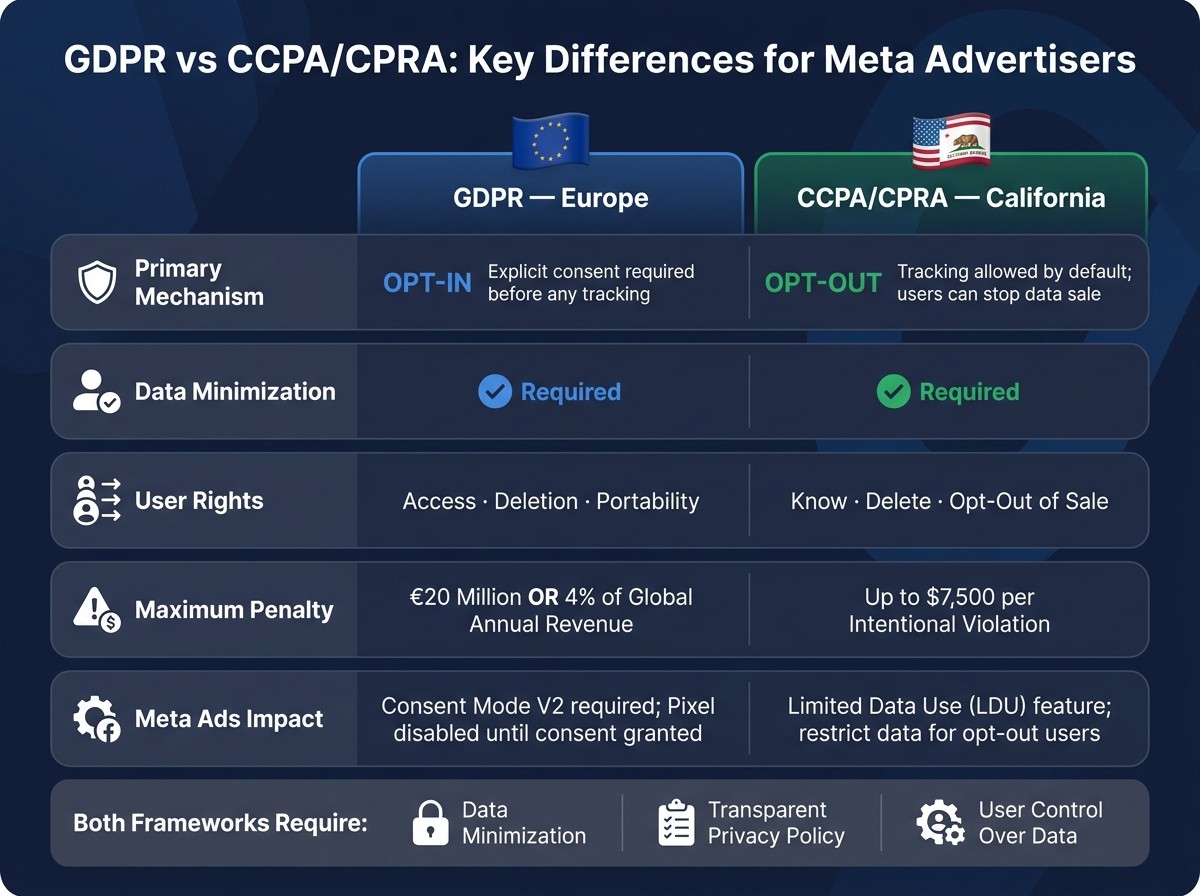
GDPR vs CCPA/CPRA: Meta Ads Privacy Compliance at a Glance
Global privacy laws play a crucial role in shaping how you collect data, target audiences, and disclose information when running Meta ads. Two major frameworks advertisers often encounter are GDPR (Europe) and CCPA/CPRA (California), but they operate quite differently.
Key Privacy Frameworks: GDPR, CCPA/CPRA, and Others
Under GDPR, you must obtain explicit consent from users before collecting or processing their personal data. Without active consent, tracking is not allowed. In contrast, CCPA permits tracking by default but gives users the right to opt out of having their data sold or shared. Both frameworks emphasize transparency, requiring you to clearly communicate what data is being collected and why, but the rules and advertiser responsibilities vary significantly.
GDPR (Europe) | CCPA/CPRA (California) | |
|---|---|---|
Primary Mechanism | Opt-in (explicit consent required) | Opt-out (right to stop sale/sharing) |
Data Minimization | Required | Required |
User Rights | Access, deletion, portability | Know, delete, opt-out of sale |
Max Penalty | €20 million or 4% of global annual revenue | Up to $7,500 per intentional violation |
Other regions, like Brazil (LGPD) and Canada (PIPEDA), follow similar principles: collect only necessary data, be transparent, and give users control. While the details differ, the overarching goal remains the same.
These privacy laws directly shape how you use Meta ad tools.
Privacy Obligations in Meta Ads

Adhering to GDPR, CCPA/CPRA, and similar laws means meeting specific requirements for each Meta ad tool you use. These obligations ensure your ad practices align with global privacy standards and policy changes.
Tools like the Meta Pixel and Conversions API (CAPI), which collect behavioral data from website visitors, require clear disclosure in your privacy policy. For Lead Ads, you must include a working privacy policy link within the Instant Form editor, as failing to do so will result in ad rejection. If you're creating Custom Audiences from customer lists, proper data hashing and deduplication are essential to safeguard user information.
Some ad categories come with even stricter rules. For example, ads related to housing, employment, credit, or finance must be flagged as Special Ad Categories in Meta Ads Manager, which limits targeting options to prevent discrimination. Starting in January 2025, businesses in the health and wellness sector face additional restrictions, such as being prohibited from sending "funnel data" - like past purchases - to optimize ads. If your business falls under these categories, compliance with privacy laws becomes even more rigorous.
Meta offers tools like the Limited Data Use (LDU) feature to help advertisers comply with U.S. state privacy laws. LDU automatically limits how Meta processes data for users who opt out, making it a practical option as more states introduce privacy regulations. This feature provides a straightforward way to meet legal requirements while maintaining ad functionality.
Personal Data in Meta Campaigns: Essential Data Insights for Compliance
Running Meta ads involves managing more personal data than many advertisers realize. Knowing what data is collected and how it flows is crucial for staying on the right side of privacy regulations. Here’s a closer look at the types of data involved and how it moves within Meta campaigns.
Types of Data Collected
Meta campaigns gather several types of data, including:
Event data: Actions like page views, add-to-cart events, purchases, and form submissions tracked through Meta Pixel or CAPI.
Tracking identifiers: This includes cookies, device IDs, and IP addresses.
Personal information: Data from Lead Ads and customer list uploads, which are hashed using SHA-256 for added security.
If you're using both Pixel and CAPI, make sure to implement deduplication between Pixel and CAPI. Without it, you risk double-counting actions, which can lead to inaccurate reporting and potential compliance issues.
Data Flows and Privacy Considerations
Understanding how data moves is just as important as knowing what’s collected. Data often flows across websites, CRMs, and third-party tools. Each step requires clear privacy disclosures and explicit user consent, especially under regulations like GDPR.
Server-side tracking methods, such as CAPI or sGTM, provide a more privacy-conscious approach by hashing data before it’s transmitted. Using Consent Mode V2 ensures your tracking setup respects user consent signals, and regular audits help identify and fix missing signals that could quietly harm campaign performance.
These practices are directly tied to your compliance strategy and play a key role in managing risks while keeping your campaigns effective and legally sound.
How to Implement Privacy Compliance in Meta Ads
To successfully manage privacy compliance while running Meta ads, you need a strong, ongoing strategy. This involves three key steps: updating your privacy policy, managing consent and tracking, and ensuring robust data security. Compliance isn’t a one-time task - it requires regular updates to your privacy policy, tracking configurations, and data protection measures.
Updating Your Privacy Policy
Your privacy policy should clearly outline the data you collect, the purpose behind it, the legal basis for processing (especially under GDPR), any third-party recipients (like Meta), and the rights users have regarding their data - such as the ability to access, delete, or opt out of data sales.
For Meta Lead Ads, you must provide a live, accessible URL to your privacy policy in the Instant Form editor. Without this, your lead form could be rejected, or your account flagged. If your campaign falls under Special Ad Categories (such as housing, credit, employment, or finance), your privacy policy must also reflect the stricter data use rules tied to these categories.
Consent and Tracking Management
Securing user consent before collecting data is non-negotiable. Configure your Meta Pixel to default to a “revoke” status, ensuring no tracking occurs until users actively consent through your cookie banner. For users who opt out, set up the Meta Conversions API to exclude personal identifiers, allowing your data pipeline to function while respecting user preferences.
Consent banners should comply with regional regulations. For example, Consent Mode V2 can help you manage varying consent requirements across different regions effectively.
In addition to obtaining consent, prioritize data security by implementing strict retention policies and protective measures for stored information.
Data Retention and Security Practices
Follow a data minimization approach: only collect what’s necessary for your campaigns. Set clear retention limits for custom audiences, CRM data uploads, and event data. Use role-based permissions in Meta Business Manager to restrict access, and ensure all third-party integrations are encrypted. These steps help lower compliance risks.
Experts emphasize that managing consent and handling data promptly are essential for online businesses today. The financial risks of non-compliance are significant. For instance, Meta faced a €1.2 billion ($1.3 billion) fine from EU regulators for transferring personal data to the U.S. without proper safeguards. Additionally, most privacy regulations require businesses to respond to user data access or deletion requests within 30 to 45 days. Establishing a clear internal process to handle these requests is just as important as implementing technical controls.
Meta-Specific Compliance Tools and Features
Meta's Built-In Privacy Features
Meta provides a suite of tools designed to simplify compliance by aligning with user consent and restricting specific actions when necessary.
Limited Data Use (LDU) helps comply with the California Consumer Privacy Act (CCPA) by limiting data processing for users in California who opt out. Meanwhile, Meta Consent Mode modifies the behavior of the Pixel and Conversions API based on GDPR consent signals. If consent is denied, it employs privacy-preserving measurement techniques. (For a detailed explanation of CCPA and GDPR requirements, refer to earlier sections.)
For advertisers in regulated sectors, Special Ad Categories are a must. These categories - covering housing, credit, employment, and finance - automatically enforce restricted targeting rules to prevent discriminatory practices. Failing to select the correct category can lead to account warnings or suspensions. Below is a quick reference table summarizing Meta's key tools and their compliance focus:
Tool | Primary Function | Compliance Focus |
|---|---|---|
Limited Data Use (LDU) | Limits processing for opt-out users | CCPA |
Meta Consent Mode | Adjusts Pixel/CAPI behavior based on user consent | GDPR / ePrivacy |
Conversions API (CAPI) | Enables server-side event tracking | General Privacy / Cookieless |
Special Ad Categories | Restricts targeting for regulated industries | Anti-Discrimination Laws |
Privacy-Enhanced Match | Matches customer data using cryptographic hashing | Data Security |
Privacy-Enhanced Match is another standout feature. It uses cryptographic hashing to securely match customer data without exposing raw information. This approach helps maintain high match rates while reducing the risk of data breaches. Missteps in data handling can have serious consequences: in 2024 alone, European regulators issued over €2.92 billion in GDPR fines, with increasing scrutiny on the technical aspects of data collection and transfer.
While Meta's tools provide strong compliance controls, incorporating automation can offer an extra layer of protection for your campaigns.
Using AdAmigo.ai to Support Compliance

Even with Meta's built-in tools, account configurations can sometimes drift over time. New campaigns may launch without proper settings, and manual reviews might not happen as often as needed. This is where AdAmigo.ai proves invaluable.
AdAmigo integrates directly with Meta's API and operates within the platform's guidelines. Its Protect feature continuously monitors your account for issues like configuration errors, broken links, inactive ads, and unusual spending patterns - addressing problems before they escalate.
"A swarm of AI agents monitors your clients' Facebook and Instagram ads 24-7, catching setup mistakes, spend anomalies, broken links, disabled ads, and suspicious activity." - AdAmigo AI
In addition to monitoring, AdAmigo offers a full action logbook that automatically tracks every change made to your account. This creates a verifiable audit trail that can be crucial if regulators review your data practices. Its AI-driven audits are completed in minutes, compared to the hours required for manual checks. This efficiency makes it feasible to conduct regular compliance reviews, not just occasional ones before launching a campaign.
Documenting Compliance and Managing Risks
What Compliance Records to Keep
Staying on top of privacy compliance means keeping detailed records of your processes. If a regulator or client questions your practices, proper documentation becomes your best defense.
Here’s a breakdown of the key records every advertiser should maintain:
Documentation Category | Key Records to Maintain | Purpose |
|---|---|---|
Consent Management | Consent Mode V2 logs, sGTM records | Proves the legal basis for data collection |
Operational Audit | Tracks who made changes and why | |
Infrastructure | Ensures secure and accurate data transmission | |
Risk Management | Anomaly detection alerts, setup error logs | Shows active monitoring and risk mitigation efforts |
It’s not just about maintaining records; you need to document the reasoning behind your decisions. For example, a log showing you paused a campaign is helpful, but a log explaining why you paused it provides deeper insight during a compliance review. This level of detail not only proves compliance but also helps refine your risk management strategies over time.
Risk Management Best Practices
Once your documentation is solid, the focus shifts to actively managing risks. In Meta campaigns, privacy risks often result from technical oversights rather than major breaches. For instance, something as simple as a missing Consent Mode V2 tag on a landing page can disrupt consent signals and create a compliance gap. Automated audits can save you time - turning a manual review that takes 4–6 hours into a quick check of 10–15 minutes. This efficiency makes it feasible to run audits weekly instead of quarterly.
A smart move is to implement a privacy infrastructure gate. Before launching any campaign or optimization, confirm that your tracking stack - Consent Mode V2, CAPI Gateway, and event deduplication - is working as expected. Use a pre-launch checklist to catch any tracking issues before they impact live campaigns or user data. If something’s off, you can address it right away.
For businesses in regulated sectors like housing, finance, or credit, the stakes are even higher. These industries require extra vigilance to comply with rules for Special Ad Categories. Regularly auditing these settings is critical to avoid discriminatory targeting risks or account suspensions. A thorough pre-launch compliance review remains one of the best ways to protect your business from regulatory challenges.
Conclusion: Why Privacy Compliance Pays Off
Privacy compliance goes beyond avoiding fines - it's a cornerstone for maintaining effective ad campaigns in an era of tightening regulations. Advertisers who invest in strong consent systems, streamlined data handling, and well-documented processes set themselves up for better performance and long-term success. The effort you put into compliance today safeguards not only your ad account but also your budget and customer relationships.
On top of that, earning user trust leads to higher engagement, while cleaner data improves targeting precision. For instance, AI tools have been shown to deliver a 42% performance boost when paired with high-quality data.
Relying on manual management, however, can leave you trailing behind evolving privacy regulations. Reviews conducted every 6–12 months often fail to keep up with updates, creating potential compliance gaps that can be costly.
That’s where tools like AdAmigo.ai come in. Their Protect feature provides 24/7 monitoring for anomalies, broken links, and suspicious activity, helping you stay compliant at scale without losing visibility.
Neglecting privacy compliance puts your trustworthiness, ad spend, and regulatory standing at risk. By following best practices for Meta ad data privacy, documenting your decisions, and leveraging real-time monitoring tools, you can ensure steady growth. Combining privacy and consent management, secure data storage, and automated solutions like AdAmigo.ai not only keeps you compliant but also drives better campaign outcomes.
FAQs
Do I need opt-in consent for Meta Pixel in every country?
Yes, under GDPR, you must obtain explicit opt-in consent before using Meta Pixel to track users. This isn't just a European requirement - similar consent rules apply in other regions, including the United States, under various privacy laws.
Always make sure you're compliant with the local regulations before implementing any tracking tools. Ignoring this can lead to legal complications.
How do I handle GDPR/CCPA opt-outs without breaking attribution?
Handling GDPR and CCPA opt-outs can be tricky, especially when you want to maintain accurate attribution for your campaigns. The key is ensuring your Meta Pixel respects user consent preferences, such as Global Privacy Control (GPC) signals and opt-in/opt-out settings.
To stay compliant, you can use tools like a Consent Management Platform (CMP) or a tag manager. These tools can help block the Meta Pixel from firing when users opt out. Additionally, Meta offers Consent Mode with features like Limited Data Use (LDU), which restricts data sharing to align with privacy regulations.
For an even smoother process, automated solutions like AdAmigo.ai can help manage compliance and ensure all consent signals are handled correctly. These tools take the guesswork out of managing privacy requirements, making it easier to stay on top of evolving regulations.
What records should I keep to prove Meta ads privacy compliance?
To ensure privacy compliance when using Meta ads, it’s crucial to keep thorough records of your data practices. This includes documenting the types of data you collect - such as contact information or cookies - the legal grounds for processing, like user consent, and your policies for data retention and deletion.
Additionally, monitor and log your compliance efforts. This might involve tracking how you manage incidents, maintain transparency, and handle user rights. These steps help demonstrate that your practices align with privacy laws and Meta’s guidelines.