
How Meta Handles Consent in Ad Accounts
Explains Meta's consent framework for Pixel and Conversions API, why real-time consent signals matter, and how EU 2026 ad personalization rules affect advertisers.
Meta's ad system revolves around consent management, ensuring data privacy and compliance with global regulations. Advertisers must secure user consent before tracking data via tools like the Meta Pixel and Conversions API. Without it, you risk regulatory fines, limited tracking capabilities, and disrupted ad performance.
Key Highlights:
Consent Mode: Meta's framework ensures no data is collected until explicit user consent is granted.
Critical Parameters: Includes
ad_storage,analytics_storage,ad_user_data, andad_personalizationto manage cookies, analytics, and personalized ads.Compliance Risks: Mishandling consent can lead to compliance risks and fines (e.g., up to $38 million under the EU AI Act) and legal challenges.
EU Updates for 2026: New ad models let users choose between Full Personalization or Limited Personalization, impacting data access for advertisers.
To stay compliant and optimize ad performance, advertisers must integrate consent-aware setups for both Meta Pixel and Conversions API, ensure real-time consent signals, and adapt to evolving privacy regulations.
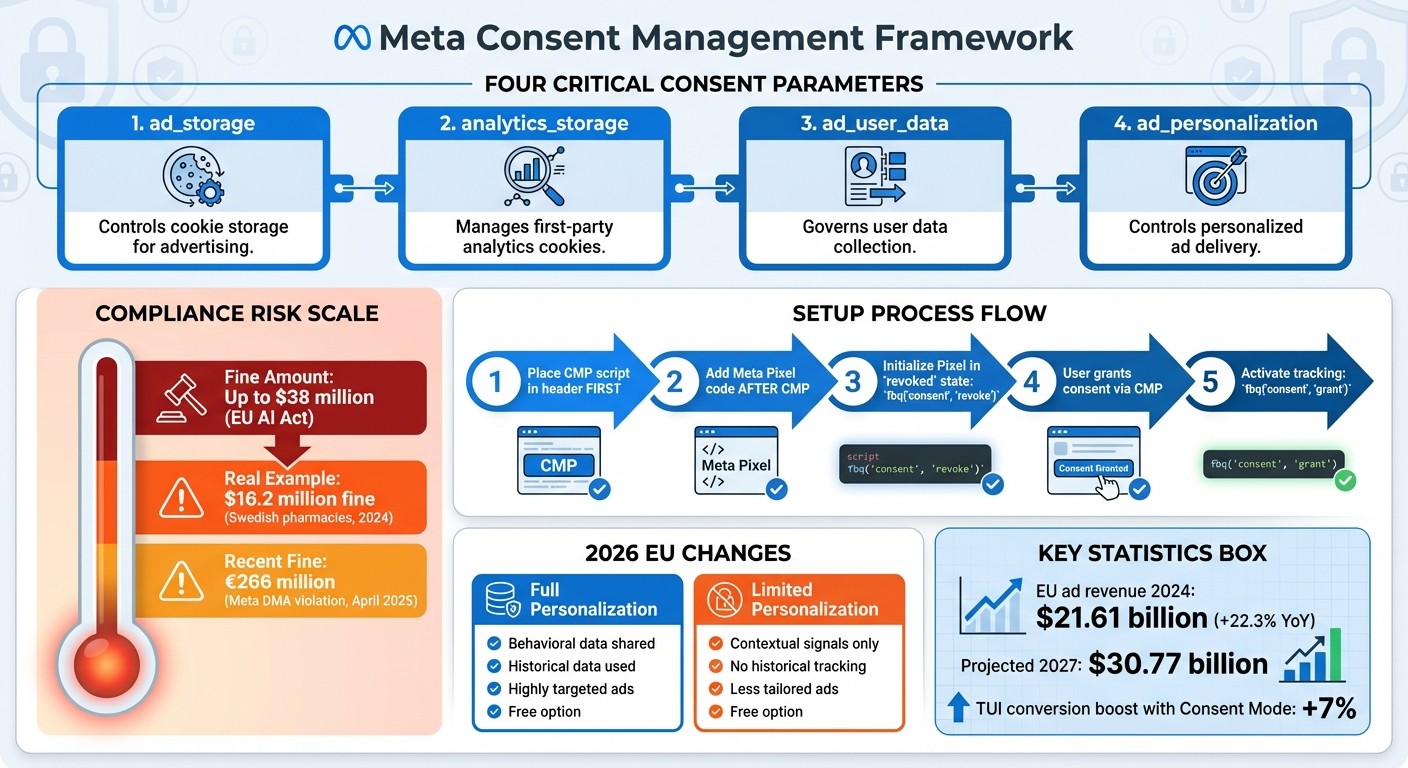
Meta Consent Mode Implementation Guide: 4 Critical Parameters and Setup Steps
Using Meta Ads with Consent Mode in GTM

Types of Consent Required for Meta Ads
Meta's Consent Mode introduces a structured approach to user permissions, breaking down consent into specific categories aligned with tracking capabilities and regulatory standards. For advertisers, understanding these categories is key to staying GDPR compliant while optimizing campaign performance.
Advertising and Marketing Consent
This category determines whether Meta can use tracking tools to deliver personalized ads and assess their performance. Two key parameters, ad_personalization and ad_storage, control the personalization of ads and cookie storage, respectively.
Your Consent Management Platform (CMP) plays a critical role here - it must map user preferences directly to Meta’s parameters. For example, if a user opts for "Personalized" consent, your CMP should automatically set ad_personalization = granted. The importance of compliance was underscored in 2024 when the Swedish Data Protection Authority fined several pharmacy chains $16.2 million (€15 million) for using the Facebook Pixel on pages with sensitive health data without explicit user consent. This case highlighted that compliance responsibility rests with website owners, not Meta.
Analytics and Performance Measurement Consent
The analytics_storage parameter governs the use of first-party analytics cookies for tracking campaign performance. Without user consent for analytics, advertisers face challenges in measuring conversions, analyzing customer journeys, and optimizing ad spending. This can hinder efforts to identify high-performing audiences and creatives.
For instance, TUI, a global tourism company, encountered significant data gaps when users declined cookies. By adopting Meta Consent Mode and leveraging AI-driven conversion modeling, TUI analyzed observable data and historical trends, resulting in a 7% boost in reported conversions.
Cross-Border Data Transfers
Under GDPR regulations, explicit user consent is required for transferring data to non-EU jurisdictions, including the United States. This involves clear communication about privacy risks, often managed through Standard Contractual Clauses (SCCs). On April 23, 2025, the European Commission fined Meta €200 million for its "pay or consent" model, which used pre-selected checkboxes and an "Additional Ads option" - practices deemed insufficient for "informed and freely given" consent under the Digital Markets Act.
Advertisers must now provide detailed privacy disclosures. These should specify exactly what data is collected (e.g., email addresses, IP addresses), how it’s gathered (e.g., via Meta Pixel or Lead Ads), and the specifics of data-sharing arrangements with Meta as a joint controller. Vague statements like "we share data with advertising partners" no longer meet regulatory standards. Instead, advertisers must clearly outline which data is transferred and the legal frameworks governing those transfers.
Setting Up Consent with Meta Pixel and Conversions API
Meta's privacy-first approach emphasizes the importance of correctly setting up the Meta Pixel and Conversions API.
Consent-Aware Setup for Meta Pixel
The Meta Pixel should always begin in a "revoked" state to prevent tracking until users explicitly provide consent. To achieve this, include the command fbq('consent', 'revoke') before calling fbq('init') on every page load.
Placement of the script is crucial. The Meta Pixel code must follow the CMP (Consent Management Platform) script in the header. This allows the CMP to manage the Pixel's initialization. When a user gives consent via the CMP, invoke fbq('consent', 'grant') to activate data collection. To ensure the setup is working, check your browser's Network tab to confirm no Meta Pixel requests are sent before the "grant" signal is triggered.
Consent parameters should be mapped to specific data purposes. For instance, if a user consents to "Site Optimization" but opts out of "Ad Personalization", your CMP should set analytics_storage = granted while keeping ad_personalization = revoked. Additionally, if consent is denied, disable Advanced Matching to stop the Pixel from inferring user data from form inputs.
Finally, ensure your server-side Conversions API setup aligns with GA4 and these consent signals for consistency, following user consent auditing best practices.
Server-Side Conversions API and Consent Alignment
The Conversions API (CAPI) must reflect the same consent state as the Meta Pixel. Since server-side events bypass browser-based restrictions, it's essential to exclude personal identifiers (e.g., hashed emails, phone numbers) when users deny consent. Instead, send only aggregated, non-identifiable event data. Avoid blocking events entirely, as even limited data can help Meta's privacy-safe modeling.
Synchronization between the Pixel and CAPI is key. Use Meta's Events Manager Diagnostics to debug Meta conversion issues and verify that server events include a "Consent" parameter that matches browser signals by testing Meta conversion events. Assign unique Event IDs to both the Pixel and CAPI events to avoid double-counting in reports. If consent signals are delayed or unavailable, your server-side logic should default to the "revoked" state until an affirmative signal is received.
EU Ad Personalization Changes for 2026
User Options for Data Sharing
Starting January 2026, Meta introduced a revamped ad model for Facebook and Instagram users across the EU. Moving away from the previous "consent or pay" structure, this updated framework gives users two clear choices. They can opt for Full Personalization, which involves sharing behavioral and historical data to receive highly targeted ads, or Limited Personalization, which uses only contextual signals - like the content being viewed at the moment - to deliver less tailored ads. Both options remain free, offering a trade-off between ad relevance and user privacy.
This change follows intense regulatory scrutiny. Back in April 2025, the European Commission fined Meta €266 million for breaching the Digital Markets Act, citing that the earlier model failed to provide users with a free, less intrusive alternative. As the European Commission stated:
Meta will give users the effective choice between: consenting to share all their data and seeing fully personalised advertising, and opting to share less personal data for an experience with more limited personalised advertising.
These adjustments demand that advertisers rethink their strategies to comply with the shifting landscape. With more users opting for Limited Personalization, brands will need to adapt their campaigns to align with these privacy-focused changes.
Compliance with EU Commission Agreements
As these updates roll out, advertisers targeting EU audiences will face reduced access to detailed audience signals, especially as more users choose Limited Personalization. These compliance measures build on Meta's existing privacy features, ensuring alignment with regulatory expectations. In 2024, Meta’s EU ad revenue hit $21.61 billion, marking a 22.3% year-over-year increase, and projections suggest it could reach $30.77 billion by 2027, according to Meta ad performance benchmarks. However, maintaining this trajectory will depend heavily on how well advertisers pivot to strategies like contextual targeting and modeled measurement.
The European Commission will actively monitor Meta's implementation throughout 2026 to ensure the consent process remains transparent and free of manipulative design. For advertisers, this shift highlights the importance of diversifying their approach. Strategies should include creative-driven campaigns, contextual ad placements, integrating Meta with GA4 for better data visibility, testing ad variations at scale, and leveraging privacy-friendly tools like Meta’s Conversions API. Additionally, updating privacy policies to designate Meta as a joint controller when using the Meta Pixel and incorporating modeled conversion reporting will be crucial as deterministic tracking signals continue to diminish.
Common Consent Problems and Solutions
This section addresses common challenges related to consent signals that can impact both data accuracy and regulatory compliance.
Delayed Consent Signals
When consent signals are delayed, it can lead to inaccurate conversion data, misattributed events, and even compliance violations. The main issue often stems from non-real-time consent updates - instances where a user's "Accept" or "Reject" choice isn't processed immediately. For example, if your consent management platform (CMP) delays transmitting signals or requires a page reload, the Meta Pixel might fire before the user's decision is recorded. This results in events being logged without proper authorization.
To fix this, modern CMPs should send consent signals instantly. Additionally, server-side configurations must align with these real-time updates to avoid premature data collection. Implementing real-time systems with audit trail capabilities ensures that every event respects the user's most recent consent state. This becomes even more critical in environments where data is shared across different platforms.
Cross-Platform Consent Sync Failures
For advertisers running campaigns across websites, mobile apps, and server-side integrations, synchronizing consent states can be a major hurdle. Imagine a user rejecting personalized ads on your website - if that decision doesn’t carry over to your CAPI (Conversions API) setup, server-side events might still share data. This creates compliance risks and inconsistent data records, which can also reduce the effectiveness of your campaigns.
To address this, you need to map consent categories within your CMP so they align with Meta's consent API states (grant or revoke). This ensures that user choices, such as opting out of "Ad Personalization", are correctly reflected in Meta's systems. Your development team must apply the same logic across both Pixel and CAPI implementations, ensuring that even edge cases - like users toggling consent mid-session or switching devices - are handled consistently.
Using Tools for Consent Management
Manually managing consent across multiple campaigns becomes increasingly challenging as data regulations grow more stringent. Automated platforms simplify this process by detecting privacy threats in real-time and maintaining compliance records. While CMPs handle signal transmission and audit trails, they don’t adapt ad strategies to changing data availability.
This is where tools like AdAmigo.ai come in. These platforms automatically adjust creative elements, targeting, and bidding strategies based on user consent changes. For example, you can connect your Meta ad account, set privacy preferences, and let the system adapt to real-time results - eliminating the need for manual adjustments while staying compliant.
Conclusion
Meta's consent framework plays a crucial role in boosting ad performance by ensuring precise data collection. The difference between using a real-time consent system and sticking with a traditional banner can be dramatic - it often determines whether lost conversions are recovered or reliable conversion tracking is compromised. Real-time consent systems allow advertisers to model data from users who decline cookies, salvaging insights that might otherwise disappear.
The timing of consent signals is critical. These signals need to fire immediately - before the Meta Pixel or Conversions API logs any events. Delays can lead to compliance issues and skewed reporting, while inconsistent consent states across websites, mobile apps, and server-side setups can undermine user trust. This makes automated solutions essential for navigating these challenges.
For large-scale campaigns, manually managing consent tracking is impractical. While modern consent management platforms are effective at transmitting signals, they often fall short when it comes to automatically adjusting ad strategies in response to data shifts. Tools like AdAmigo.ai fill this gap by dynamically adapting creatives, targeting, and budgets based on real-time consent changes. This ensures campaigns remain compliant without sacrificing performance.
With regulatory standards evolving, such as the upcoming 2026 EU ad personalization rules, users will gain more control over how their data is shared. This raises the stakes for advertisers to view consent management not just as a legal box to check, but as an opportunity to optimize performance. Those who embrace this shift can expect more accurate data, avoid costly penalties, and outpace competitors stuck with outdated approaches.
FAQs
What consent signals does Meta require for Pixel and CAPI?
Meta now mandates explicit user consent signals to handle data collection for Pixel and CAPI. The way tracking operates depends on user-selected preferences, such as "Private", "Balanced", or "Personalized." With Consent Mode, these permissions are managed dynamically in real-time, allowing or restricting access based on user choices.
How do I confirm the Pixel doesn’t fire before consent?
To make sure the Meta Pixel doesn't activate before a user gives consent, you can use Meta's Consent Mode. This feature adapts tracking behavior according to user consent choices, relying on cookieless pings and conversion modeling if consent is not granted.
By adding Consent Mode to your Pixel setup, you can adjust data collection dynamically based on user preferences. This helps you stay aligned with privacy laws like GDPR and CCPA while honoring individual consent decisions.
What changes for EU ads in January 2026?
Beginning in January 2026, new EU regulations will demand tighter consent management for Meta ads. Advertisers will need to adopt real-time, documented user consent systems to align with GDPR requirements and steer clear of potential fines.
To help with this transition, tools like Consent Mode will play a key role. These tools will adjust data collection practices based on users' preferences, ensuring businesses stay compliant while honoring individual privacy choices.