
Privacy Policy Mistakes in Meta Ads Campaigns
Avoid ad rejections and fines by fixing vague privacy language, aligning ad claims, and collecting explicit consent for Meta campaigns.
Meta ad campaigns can fail due to privacy policy mistakes, leading to rejected ads, account restrictions, and costly penalties. Here’s what you need to know:
Non-compliance risks: Meta rejected 2 billion ads in 2023, with 19.5% (390 million) failing due to privacy and data use issues. GDPR fines can reach 4% of global revenue, and CCPA violations cost $7,500 per instance.
Common errors:Vague privacy language, mismatched ad claims, and targeting sensitive data without consent are the top mistakes.
Fixes:Clear, detailed disclosures, aligning ad messaging with policies, and proper consent collection are critical steps to stay compliant.
Impact of compliance: Businesses with verified policies see 40% fewer restrictions and faster ad approvals.
New challenges: Post-2024 privacy laws and stricter AI enforcement have increased ad rejections by 25%.
Key takeaway: Avoid privacy missteps by crafting transparent policies, aligning claims with practices, and leveraging tools like AdAmigo.ai for real-time compliance checks.
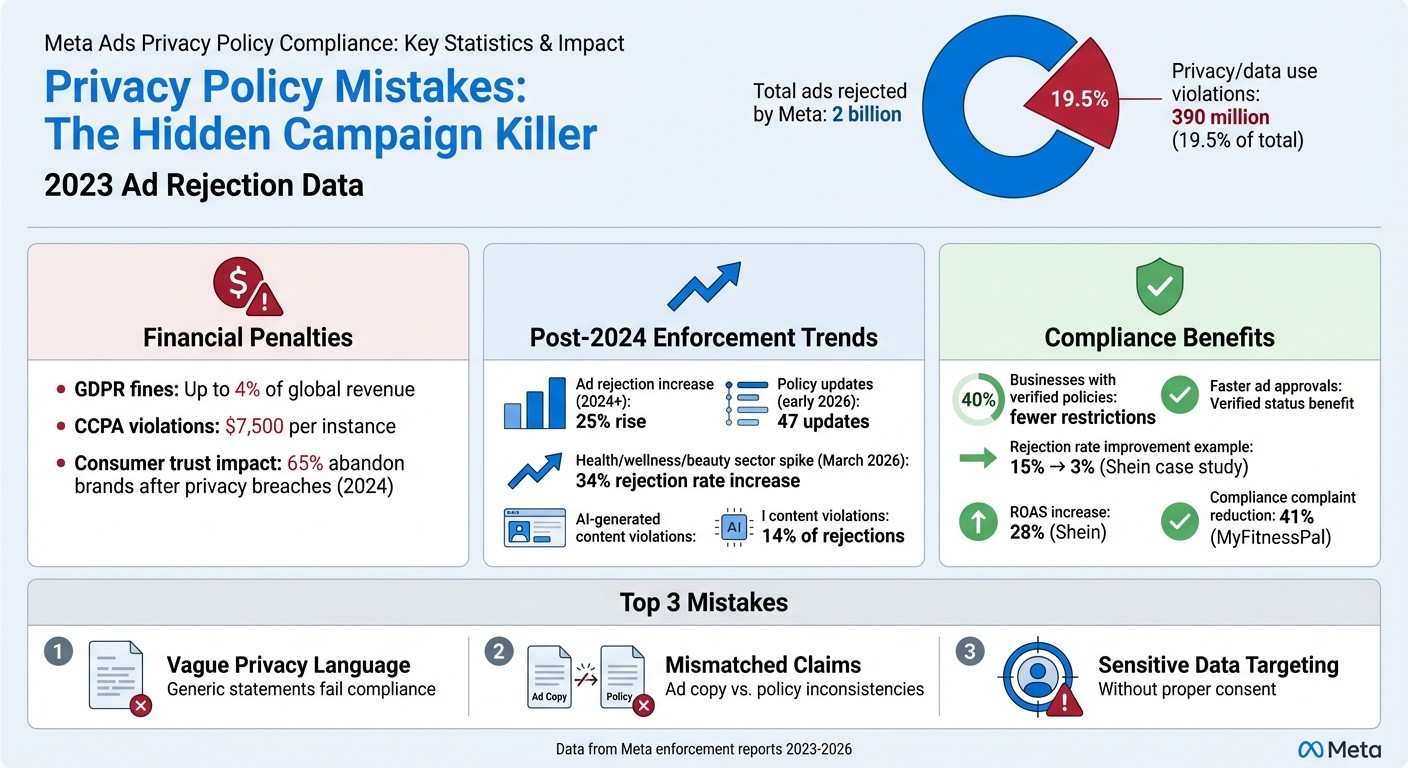
Meta Ads Privacy Policy Compliance Statistics and Impact 2023-2026
Common Privacy Policy Mistakes in Meta Ads
When it comes to running Meta Ads, advertisers often fall into three common privacy missteps. These errors can lead to rejected campaigns or even account suspensions. Let’s break them down so you can avoid them and keep your campaigns running smoothly by training your team on Meta ad policies.
Using Vague or Generic Privacy Language
Saying things like "We value your privacy" may sound reassuring, but it doesn’t cut it when it comes to compliance. Why? Because it doesn’t explain how user data is actually handled. As Justin Sherman, Founder and CEO of Global Cyber Strategies, explains:
"Many companies drown their privacy policies in words like 'could,' 'might,' or 'may'... these hypotheticals don't tell readers what companies are actually doing with data".
Another common mistake is relying on cookie-cutter privacy policy templates. These templates often fail to reflect the specific tools and practices you use, like the Meta Pixel, Conversions API, or Messenger bots. If your policy doesn’t explicitly mention these tools, it creates a compliance gap that Meta's automated systems are quick to flag. Additionally, hiding critical details behind multiple hyperlinks or spreading them across numerous pages can violate FTC standards for "clear and conspicuous disclosure".
Here’s a quick look at how vague language can trip you up - and what to say instead:
Vague Phrase | Why It Fails Meta Review | Recommended Alternative |
|---|---|---|
"We value your privacy." | Doesn’t explain data handling. | "We collect your email to send weekly newsletters and targeted offers." |
"We may share data with partners." | Too ambiguous. | "We share your contact info with Shopify for order fulfillment." |
"Data is used to improve service." | Lacks specifics about marketing use. | "We use browsing behavior to show you relevant ads on Instagram." |
Being clear about how you handle data isn’t just about passing Meta’s review - it’s about avoiding potential penalties and building trust with your audience.
Mismatched Ad Claims and Privacy Practices
Another pitfall is when your ad says one thing, but your privacy policy tells a different story. For example, if your ad claims, "We don’t sell your data", but your privacy policy fails to mention that you share user data with CRM tools or email marketing platforms, Meta will flag this as a compliance issue. These inconsistencies are often labeled as "Unacceptable Business Practices" [17, 19].
This issue is especially common when advertisers fail to disclose data collection for retargeting purposes, like using Meta Custom Audiences. Instead of vague phrases like "data is used for improvements", be upfront about how you’re using customer information. Aligning your ad messaging with your privacy policy is not just a best practice - it’s a requirement to stay compliant.
Targeting Sensitive Personal Data Without Consent
Meta has strict rules about targeting ads based on sensitive personal data. Their Personal Attributes policy explicitly forbids ads that suggest you know a user’s private details, such as unapproved health claims, sexual orientation, religion, or political beliefs. For example, you cannot run an ad saying, "If you have diabetes" or "Struggling with ADHD?" Ads like these violate Meta’s guidelines.
"The Personal Attributes Policy is a core component of Meta's broader commitment to user privacy and data protection. This policy explicitly prohibits advertisers from creating ads that imply knowledge of a person's personal attributes." – LeadSync
If you’re advertising in sensitive sectors, stick to neutral, educational language. For instance, instead of saying "If you have depression", say "Our medication helps manage depression" or "Let’s talk about mental health." Broaden your targeting to focus on interests like "wellness" or "self-care" rather than zeroing in on specific conditions. This approach helps you stay within Meta’s guidelines while still reaching the right audience effectively.
How to Fix Privacy Policy Errors
Fix these issues to keep your Meta campaigns compliant.
Write Clear and Detailed Privacy Disclosures
Your privacy policy should clearly explain what data you collect, why you need it, and how you use it. Avoid vague statements like "We collect data to improve your experience." Instead, be specific. For example: "We collect your email and device ID to personalize Meta ads; data is retained for 30 days and shared with Meta." This level of detail aligns with Meta's requirements and eliminates ambiguity.
Include a breakdown of the data categories you collect (e.g., name, email, browsing history, location) and the tools you use (e.g., Meta Pixel, Conversions API). Then, explain the purpose for collecting each type of data. For instance: "We use browsing data from Meta Pixel to display personalized ads on Facebook and Instagram." Don’t forget to mention retention periods (e.g., "30 days" or "until you request deletion") and detail user rights, such as the ability to opt out via your cookie banner.
Here’s an example of success: In Q2 2023, clothing retailer Shein updated its privacy policy to explicitly mention "behavioral data shared with Meta for ad retargeting." This adjustment reduced their ad rejection rate from 15% to 3% in three months and increased their return on ad spend by 28%. They also added data flow diagrams and consent banners, improving transparency.
Clear disclosures like these not only ensure compliance but also help align your ad copy and consent practices.
Match Ad Copy to Your Privacy Policy
Consistency is key. Your ad claims and privacy policy must align perfectly. For example, if your ad states, "We don't sell your data," but your policy mentions sharing data with CRM tools or email platforms, Meta may flag this as inconsistent.
Double-check your ad copy, verify your data practices, and update your privacy policy to reflect reality. Always link your privacy policy directly in your ads and on landing pages. Use Meta's ad preview tool to test for consistency.
Take a cue from MyFitnessPal. In January 2024, they updated their landing pages to match their privacy policy regarding health data non-use for targeting. Led by Privacy Officer Jane Doe, this effort reduced compliance complaints by 41% and helped them regain ad account access after a suspension.
Set Up Proper Consent Collection
Proper consent collection is non-negotiable. Use granular opt-in forms with separate checkboxes for each data use (e.g., cookie tracking, location data). These boxes should be unchecked by default, requiring users to actively opt in.
Implement a cookie banner with clear "Accept" and "Reject All" options. Additionally, integrate Meta's Conversions API with server-side consent mode to ensure tracking only happens after users give explicit permission. Using a consent management platform like OneTrust can help you document and pass consent data accurately.
This approach not only ensures compliance but also fosters trust with your audience. Combined with clear disclosures and aligned ad copy, robust consent practices create a strong compliance framework.
Automated Privacy Monitoring Tools
As privacy policy updates become more frequent - 47 updates were recorded in early 2026 alone - manual compliance methods are struggling to keep up. Automated tools now offer a smarter way to stay ahead of these changes. By continuously scanning campaigns, landing pages, and creatives for potential compliance issues, these tools help address gaps before Meta flags them. They analyze multiple formats, including text, images, audio, and URLs, aligning closely with Meta's multimodal enforcement methods. This shift from reactive to proactive compliance means violations can be caught and resolved before your ad even goes live.
"Meta's 2026 policy cycle marks the transition from reactive enforcement (reviewing ads after complaints) to proactive enforcement (scanning every ad through AI classifiers before the first impression is served). The era of 'launch and see what happens' is over." – AuditSocials
These tools work hand-in-hand with the disclosure, consent, and data retention practices discussed earlier, ensuring a more comprehensive compliance strategy.
Tools That Audit Privacy Compliance
The most effective privacy monitoring tools go beyond basic checks - they analyze ad copy, visuals, audio, landing pages, and even historical violations. Look for tools that include predictive compliance checks, which review your creatives against the latest policies before submission. For instance, Meta's updated multimodal AI enforcement in March 2026 led to a 34% spike in rejection rates for ads in health, wellness, and beauty sectors.
Another key feature to prioritize is account health tracking. Tools that offer an "Account Health Score" (rated 0-100) provide a clear picture of your risk for restricted delivery or suspension. Advanced systems also scan for restricted content in Housing, Employment, and Credit (HEC) categories, analyzing elements like floor plans or loan calculators - even if your ad copy avoids using flagged keywords.
How AdAmigo.ai Helps Prevent Privacy Violations
Among these solutions, AdAmigo.ai stands out for its proactive compliance features. Its AdAmigo Protect tool provides round-the-clock monitoring of your ad accounts and landing pages, identifying privacy compliance issues, delivery problems, and policy violations in real time. By catching these issues early, AdAmigo Protect helps prevent ad rejections or account penalties.
The platform also includes an AI Chat Agent to assist with compliance questions like, "Does this ad violate Meta's personal attributes policy?" or "Is my landing page consistent with my privacy policy?" This feature analyzes campaigns, highlights risks, and suggests actionable fixes - all through a user-friendly chat interface.
Feature | Manual Compliance | AdAmigo.ai (AI-Driven) |
|---|---|---|
Review Timing | Reactive (post-submission) | Proactive (pre-submission) |
Time Required | Hours per week | Less than 5 minutes weekly |
Monitoring | Periodic or weekly reviews | 24/7 real-time monitoring |
Error Rate | Higher (human oversight) | Lower (automated checks) |
Scalability | Limited by staff availability | Scalable without extra staffing |
AdAmigo's AI Autopilot takes things a step further by continuously auditing your account for compliance gaps. It generates daily action plans based on the latest policy updates and can even adjust campaigns automatically. For example, it pauses ads that violate policies and recommends updates to ensure compliance. This feature is particularly helpful in avoiding the 14% of ad rejections now linked to undisclosed AI-generated content and other emerging issues.
Conclusion
Privacy policy missteps can do more than just disrupt compliance - they can hit your ad performance, drain budgets, and tarnish your brand's reputation. Over 20% of Meta's policy violations stem from issues like unclear privacy language, inconsistent ad claims, or targeting sensitive data without proper consent. The fallout? Ad rejections, account restrictions, hefty GDPR fines (up to 4% of global revenue), and, perhaps most damaging, a loss of user trust. In fact, a 2024 study revealed that 65% of consumers abandon brands after privacy breaches.
To address these challenges, focus on key corrective actions. Start by ensuring your privacy disclosures are detailed and transparent - this helps avoid common pitfalls. Align your ad copy with your privacy policy to eliminate discrepancies, a step that can cut rejection rates by 40%. Use Meta's consent tools or custom forms to collect proper user consent, and verify everything through rigorous testing.
That said, keeping up with Meta's ever-changing policies can overwhelm manual compliance efforts. Automated tools like AdAmigo.ai, highlighted earlier, offer a proactive solution. Its AdAmigo Protect feature monitors your ad accounts and landing pages in real time, flagging privacy issues before they spiral. Meanwhile, its AI Chat Agent tackles compliance questions instantly, and the AI Autopilot adjusts campaigns on the fly to maintain compliance.
Gone are the days of trial-and-error approaches. Continuous monitoring is now a must - not just to protect user trust but also to maintain strong ad performance. Whether you rely on manual audits or advanced AI tools, staying ahead of policy updates is crucial to avoiding costly violations. By combining clear privacy policies with proactive compliance strategies, you can safeguard both your credibility and your campaigns. Stay alert and ready to adapt as Meta's policies continue to evolve.
FAQs
What exact data uses must my privacy policy disclose for Meta ads?
Your privacy policy needs to clearly outline a few key details: what data is collected (like emails or browsing history), how that data is used (whether for targeting or analytics), and who it is shared with (such as Meta or other third-party tools). This level of clarity helps ensure transparency and aligns with Meta's data use requirements.
How can I ensure my ad copy and privacy policy don’t contradict?
To maintain trust and avoid confusion, make sure your ad copy aligns with your privacy policy. Be transparent about how user data is collected, used, and shared. For instance, if your ads highlight personalized targeting, your privacy policy should clearly explain how data is used, whether consent is obtained, and if data is shared with third parties. Use simple, straightforward language, and keep your privacy policy updated to stay consistent and compliant.
How do I collect valid consent for Pixel and Conversions API tracking?
To ensure you gather proper consent for Pixel and Conversions API (CAPI) tracking, it's crucial to use opt-in, explicit, and specific consent methods. Tools like Consent Management Platforms (CMPs) can help manage permissions smoothly. These tools ensure users actively agree to data collection before any tracking starts, helping you stay aligned with privacy laws like GDPR and CCPA.