
Meta Ads Data Privacy: Key Consent Mechanisms
Explains how Meta Consent Mode and AdAmigo.ai manage user consent, preserve privacy, and maintain ad measurement under GDPR and CCPA.
Meta's ad tools prioritize privacy while ensuring compliance with regulations like GDPR and CCPA. Two key solutions - Meta Consent Mode and AdAmigo.ai - help businesses manage user consent and optimize ad performance:
Meta Consent Mode: Adjusts tracking based on user consent. It stops data collection when users opt out, relying on "cookieless pings" to model conversions while following conversion data compliance best practices. This ensures compliance and retains key signals for ad optimization.
AdAmigo.ai: Automates compliance and ad management. It handles audits, data hygiene, and campaign adjustments while respecting user preferences. With a quick setup, it simplifies managing multiple accounts and improves ad performance.
Quick Overview:
Meta Consent Mode: Focuses on tracking adjustments and compliance.
AdAmigo.ai: Automates campaign management and compliance tasks.
These tools work well together, making them useful for businesses of all sizes, from small advertisers to agencies managing large-scale campaigns.
1. Meta Consent Mode
Regulatory Compliance
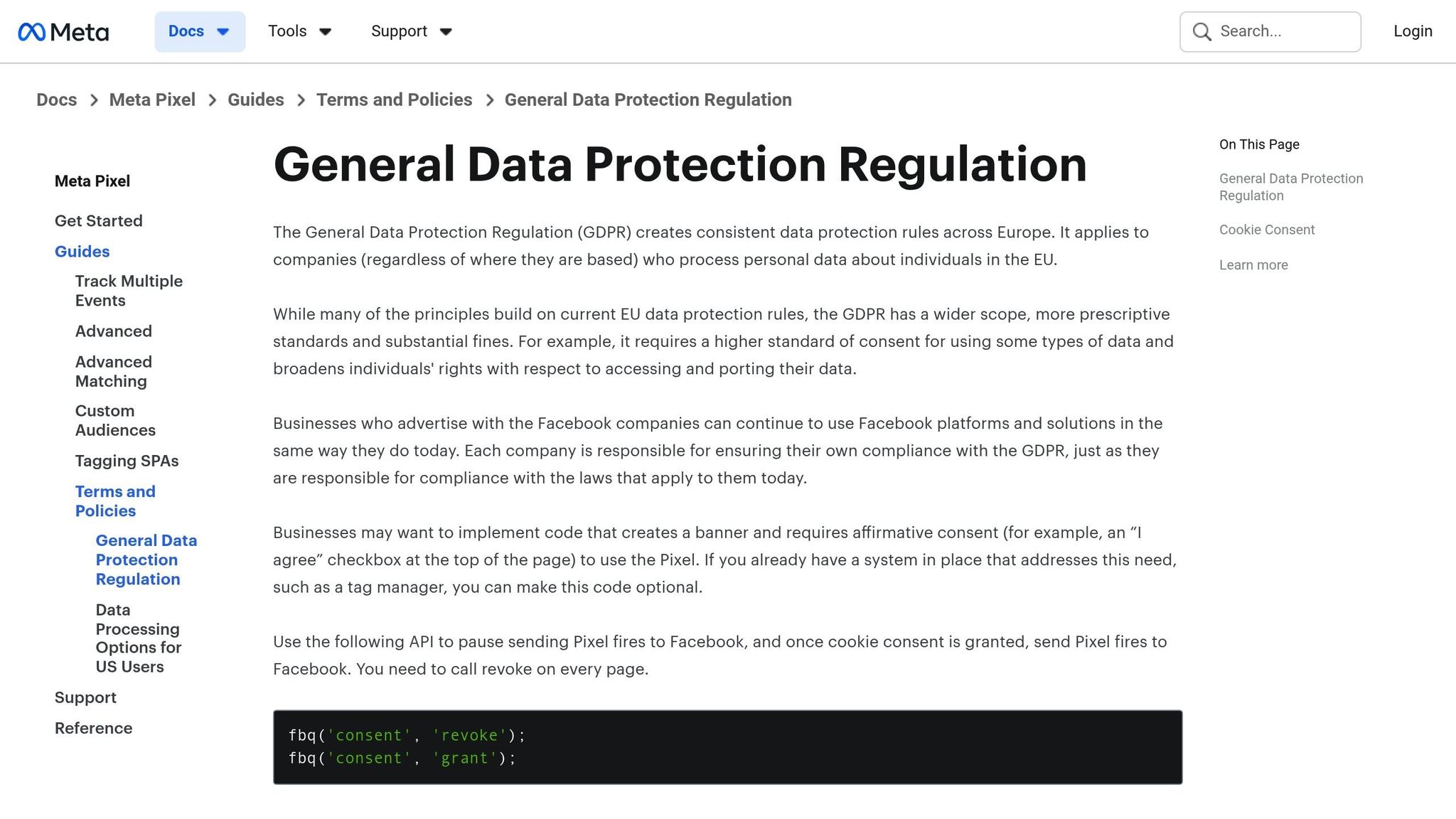
Meta Consent Mode is designed to help businesses navigate regulations like GDPR and CCPA by preventing unauthorized data collection from the start. If a user withdraws consent, the system instantly stops tracking scripts, ensuring no cookies are set and only the bare minimum technical data needed for privacy-focused measurement is processed. For instance, Swedish authorities imposed fines of €15 million on pharmacy chains for improper use of the Facebook Pixel without valid consent. By automating these compliance measures, the system ensures smooth adjustments to user preferences.
Automation Features
One standout feature of Meta Consent Mode is its ability to automate compliance. The system reacts instantly to privacy changes, enabling or disabling tracking scripts without requiring manual input. When users give consent, both first- and third-party cookies function as usual. If consent is revoked, the system shifts to cookieless pings. This automated process integrates with multiple APIs, such as the Pixel and Conversion API, to reduce the risk of accidental data collection. These quick adjustments also contribute to better ad performance.
Impact on Ad Performance
A strong consent framework doesn’t just ensure compliance - it also supports effective ad campaigns, even when users opt out of tracking. Businesses using Meta Consent Mode report conversion modeling accuracy rates above 80%, as AI-driven estimation helps recover lost conversions. Unlike basic consent setups that halt all tracking until consent is granted, Meta’s system uses cookieless pings to fill data gaps. This approach ensures that campaigns remain competitive by retaining enough signals to optimize ads while staying within regulatory boundaries.
Privacy Preservation
Meta Consent Mode is built to prioritize privacy from the ground up. Instead of relying on post-collection filtering, it blocks unauthorized data collection at the source. The system functions like an on/off switch: full tracking is enabled when consent is granted, and strict privacy mode with cookieless signals activates when consent is withdrawn. This setup gives users meaningful control over their data while maintaining compliance and functionality.
2. AdAmigo.ai
Automation Features
AdAmigo.ai is designed to autonomously manage Meta ads while respecting your privacy settings. It connects directly to your Meta ad account and operates within the boundaries you define, such as geo-targeting limits, budget caps, and placement preferences. Setup is quick - just five minutes. You link your Meta ad account, set your KPIs (like "Increase spend by 30% while maintaining a ROAS of 3× or higher"), and start receiving daily recommendations. You can either approve changes manually or let the system run automatically. This flexible setup allows for both compliance and adaptability in your campaigns.
The platform’s AI Actions feature provides a daily list of prioritized adjustments across creatives, audience targeting, budgets, and bids. Meanwhile, the Protect Feature continuously monitors for issues like setup errors, unusual spending patterns, broken links, or suspicious activity, ensuring your campaigns run smoothly.
Impact on Ad Performance
AdAmigo.ai leverages automation to deliver noticeable improvements in ad performance. By optimizing elements like creatives, targeting, bids, and budgets, it scales successful campaigns much faster than manual methods. With these tools, a single media buyer can efficiently manage 4–8× more clients. A G2 review highlights this efficiency:
Our budgets are controlled, our spend is smartly allocated and our ROAS is up massively
Its performance has earned AdAmigo.ai a High Performer badge on G2, further validating its effectiveness.
Privacy Preservation
Committed to Meta's privacy-first principles, AdAmigo.ai ensures compliance while optimizing campaigns. It acts as a learning agent, adapting based on real campaign data without storing or sharing personal information. The platform processes data exclusively from connected ad accounts with explicit user consent, adhering to GDPR compliance standards for cross-border data handling and CCPA’s Limited Data Use policies for users opting out of behavioral ads. Whether operating fully or semi-autonomously, it prevents unauthorized data transfers while complementing Meta’s privacy-preserving models. Even with limited tracking signals, AdAmigo.ai maintains consistent campaign performance by respecting consent boundaries and leveraging privacy-compliant methods.
Using Meta Ads with Consent Mode in GTM

Pros and Cons
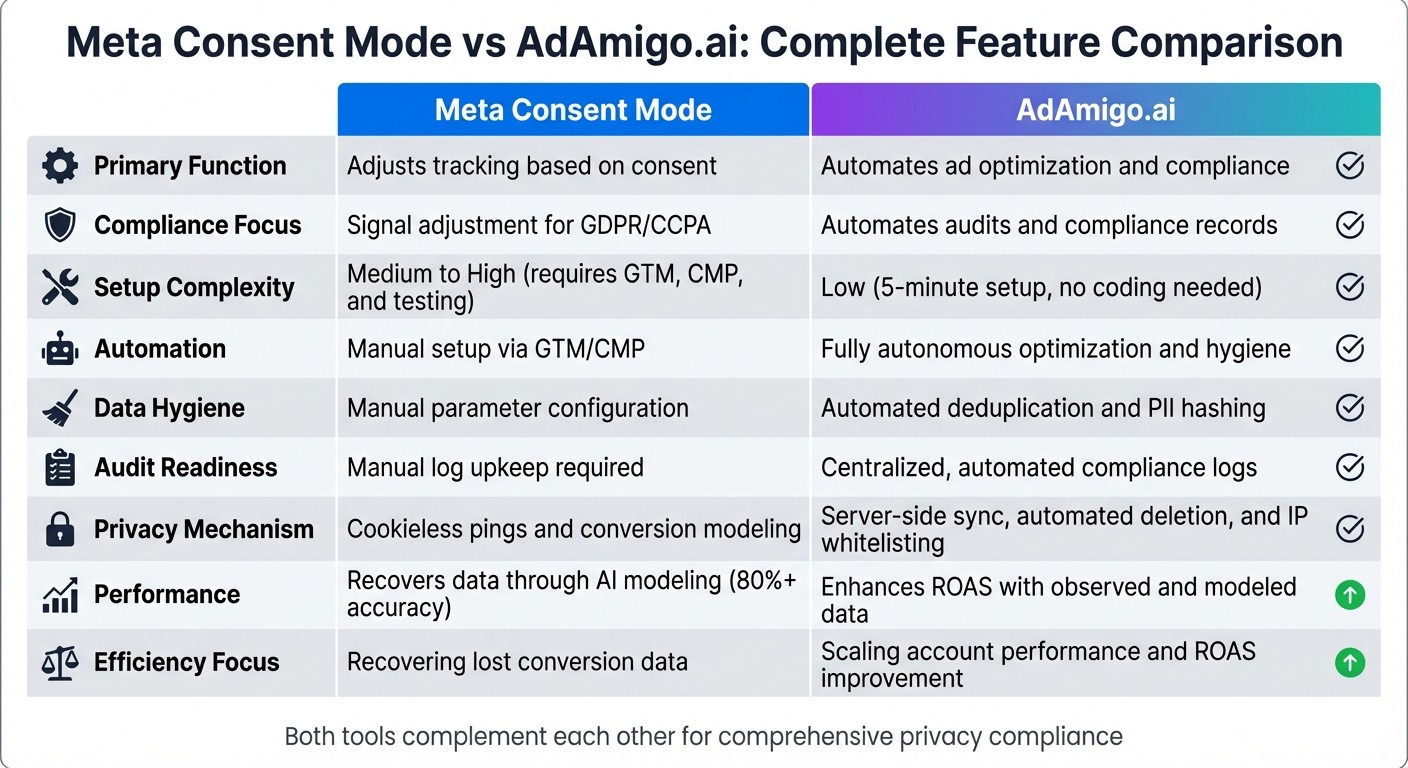
Meta Consent Mode vs AdAmigo.ai: Feature Comparison for GDPR and CCPA Compliance
Meta Consent Mode and AdAmigo.ai approach GDPR and CCPA compliance from different angles, each tailored to specific needs. Meta Consent Mode focuses on adjusting data collection based on user consent, while AdAmigo.ai prioritizes campaign optimization and compliance automation within those legal frameworks. Their respective strengths and limitations reflect these distinct goals.
Here’s a quick comparison to highlight their core features and trade-offs:
Feature | Meta Consent Mode | AdAmigo.ai |
|---|---|---|
Primary Function | Adjusts tracking based on consent | Automates ad optimization and compliance |
Compliance Focus | Signal adjustment for GDPR/CCPA | Automated audits and compliance records |
Setup Complexity | Medium to High (requires GTM, CMP, and testing) and debugging conversion tracking | Low (5-minute setup, no coding needed) |
Automation | Manual setup via GTM/CMP | Fully autonomous optimization and hygiene |
Data Hygiene | Manual parameter configuration | Automated deduplication and PII hashing |
Audit Readiness | manual log upkeep required | Centralized, automated compliance logs |
Privacy Mechanism | Cookieless pings and conversion modeling | Server-side sync, automated deletion, and IP whitelisting |
Performance | Recovers data through AI modeling | Enhances ROAS with observed and modeled data |
Efficiency Focus | Recovering lost conversion data | Scaling account performance and ROAS improvement |
Meta Consent Mode is a robust tool for integrating Consent Management Platforms with Meta’s tracking tools. However, its reliance on manual configurations - like adjusting ad_storage parameters - and the need for ongoing log maintenance can add to the technical workload.
On the other hand, AdAmigo.ai simplifies compliance by automating tasks such as data hygiene, deduplication, and retention. It also optimizes ad performance by managing creatives, targeting, budgets, and bids. With a quick five-minute setup and AI-driven audits, it eliminates the need for technical expertise. Importantly, AdAmigo.ai works alongside tools like Meta Consent Mode rather than replacing them, ensuring a comprehensive compliance and optimization strategy.
Conclusion
Meta Consent Mode and AdAmigo.ai tackle data privacy and tracking challenges in ways that complement each other, especially when adhering to GDPR and CCPA regulations. Each tool has a distinct role: Meta Consent Mode connects your Consent Management Platform (CMP) with Meta's tracking tools, ensuring the Pixel and Conversions API respect user consent signals. However, it requires manual setup and testing to function correctly.
On the other hand, AdAmigo.ai streamlines compliance and campaign management by automating tasks like data hygiene, deduplication, ad policy checks, and audit-ready record-keeping. This makes it especially valuable for advertisers managing large-scale operations or multiple accounts across regions with different legal requirements. For smaller advertisers spending less than $5,000 per month, Meta Consent Mode alone may meet their needs if they have the technical resources for manual configurations.
For agencies and in-house teams managing multiple accounts, manual workflows quickly become unmanageable. AdAmigo.ai steps in to automate repetitive tasks, allowing media buyers to handle significantly more accounts - 4 to 8 times more - while senior strategists focus on broader campaign goals. With a quick five-minute setup and AI-driven monitoring, it removes the need for tedious spreadsheet tracking and manual testing.
FAQs
Do I still get reliable conversion data if users opt out?
Meta's Consent Mode helps maintain accurate conversion data even when users choose to opt out. By utilizing conversion modeling and cookieless pings, it respects user privacy preferences while still allowing for effective measurement.
What do I need to set up Meta Consent Mode correctly?
To configure Meta Consent Mode, you'll need to adjust how the Meta Pixel gathers data based on user consent. This setup allows it to send cookieless pings and utilize conversion modeling when cookies are declined, helping you stay compliant with regulations like GDPR and CCPA.
To make this work, integrate Consent Mode with both your website’s Consent Management Platform (CMP) and the Meta Pixel. This ensures that data collection dynamically aligns with user preferences while still maintaining effective tracking capabilities.
When should I use AdAmigo.ai with Meta Consent Mode?
AdAmigo.ai works seamlessly with Meta Consent Mode to help you stay compliant with privacy regulations like GDPR and CCPA. It ensures that Meta Pixel tracking adapts based on user consent preferences. This allows for cookieless data pings and conversion modeling, all while respecting the privacy decisions of your users.