
Best Practices for Meta Ad Data Privacy
Practical guidance on Meta ad data privacy: manual vs automated approaches, consent tracking, CAPI formatting, data hygiene, and audit schedules.
Managing data privacy in Meta ad campaigns is critical for compliance, performance, and user trust. Mishandling data can lead to account restrictions, wasted resources, and lost conversions. Failure to comply with these standards is a leading cause of Meta ad rejections. Whether you're running a handful of campaigns or scaling across multiple accounts, your privacy strategy must align with your campaign volume and complexity.
Key Takeaways:
Manual Privacy Management: Works for small campaigns but is time-consuming and prone to human error. Tasks include consent tracking, data formatting, and regular audits.
Automated Tools (e.g., AdAmigo.ai): Ideal for scaling. Automates compliance, consent tracking, and data hygiene while reducing errors and saving time.
Quick Overview:
Manual methods suit small budgets but require significant effort.
Automation handles complexity, scales efficiently, and ensures continuous compliance.
Choosing between manual and automated privacy management depends on your campaign size, budget, and risk tolerance. For small businesses, manual methods may suffice. For larger operations, automation offers consistency and efficiency. This allows teams to scale personalization without privacy risks by maintaining strict compliance at high volumes.
How to run Meta-compliant ads for health & wellness brands without Rule break
1. Manual Privacy Management
Managing privacy manually means handling consent tracking, data cleansing, formatting, and audits without relying on automation or external tools. This method can be effective if you're running a small number of campaigns and have the bandwidth to oversee every detail. However, as the scale of operations grows, manual processes often become harder to manage. Let’s dive into the key components of manual privacy management, starting with consent tracking.
Consent Tracking
Tracking consent is at the core of effective manual privacy management. You need to maintain detailed records - like spreadsheets or databases - that document which users have agreed to data collection and which have not. Every user interaction, whether through tools like Meta Pixel or Lead Ads, must be logged accurately. Additionally, you should disclose data use by clearly outlining the types of data collected (e.g., email addresses, IP addresses, phone numbers) and the purposes for which it’s used.
Here’s a comparison of Meta’s minimum disclosure requirements versus recommended best practices:
Disclosure Type | Minimum Requirement | Recommended Best Practice |
|---|---|---|
Data Collected | List categories of personal data (e.g., email) | Specify exact data points and collection methods (e.g., Meta Pixel, Lead Ads) |
Purpose of Processing | State general purposes (e.g., advertising) | Detail each purpose and link it to specific ad campaigns or tools |
Legal Basis | Identify lawful basis (usually explicit consent) | Explain why this basis applies and how consent is managed |
Data Sharing | Name third parties (e.g., Meta) | Describe sharing arrangements, including joint controller status |
User Rights | Inform users of their GDPR rights | Provide clear, step-by-step instructions for exercising rights and withdrawing consent |
Audience Data Hygiene
To maintain clean and accurate audience data, you should regularly inventory all data sources, uses, and storage systems. It’s also important to review URLs to ensure that sensitive information isn’t inadvertently captured by tools like the Meta Pixel. This is especially important when defining Meta custom conversion rules to ensure specific user actions are tracked without compromising privacy.
Data Format Compliance
When preparing data for the Meta Conversions API, you must adhere to specific formatting guidelines. For example:
Hash emails, phone numbers, and names using SHA256.
Include country codes for phone numbers.
Lowercase and trim email addresses.
Use ISO 4217 standards for currency codes.
Failing to follow these formatting rules could lead to your data being rejected by Meta or even result in privacy violations.
Audit Frequency
Regular audits are crucial for ensuring compliance. Conduct a full data inventory every month and an annual Data Use Checkup. Additionally, perform yearly vulnerability tests and enforce TLS 1.2 or higher for securing data in transit and storage.
2. AdAmigo.ai
Managing privacy in advertising can be complex, but AdAmigo.ai steps in as a scalable solution to simplify the process. AdAmigo.ai is an autonomous AI agent designed to optimize Meta ads while seamlessly incorporating privacy compliance into its operations. By leveraging server-side synchronization through Meta's Conversions API (CAPI), it securely transmits data without relying on browser-based tracking. This method minimizes the risk of collecting unintended user data and ensures more reliable campaign metrics. Plus, the platform integrates effortlessly with Meta’s framework, reducing the chances of human error and maintaining compliance.
Consent Tracking
AdAmigo.ai works in tandem with Consent Management Platforms (CMPs) to manage user permissions in real time. It dynamically adjusts ad targeting based on current consent statuses and maintains centralized compliance logs. These logs document consent collection and can be invaluable during regulatory audits.
Audience Data Hygiene
To keep audience metrics accurate, AdAmigo.ai automatically deduplicates events using unique IDs for every tracked conversion, whether through Pixel or CAPI. This prevents double-counting while ensuring clean data. Additionally, automated data retention policies delete personal information as soon as it's no longer required for advertising. The platform also employs strict access controls, like IP whitelisting, to limit API access to trusted systems and flags accounts that lack two-factor authentication (2FA).
Data Format Compliance
With its server-to-server data sharing via CAPI, AdAmigo.ai handles technical formatting automatically. Its AI Actions feature delivers daily recommendations for budgets, audiences, and creative adjustments, all pre-checked against Meta’s privacy standards. This reduces the likelihood of manual errors that could lead to policy violations.
Audit Frequency
Instead of relying on periodic audits, AdAmigo.ai performs continuous audits powered by AI-driven data minimization. Campaigns are updated daily to reflect changes in regulations or Meta’s data policies. By constantly adapting to these shifts, AdAmigo.ai offers a dynamic approach to privacy management that scales effortlessly with evolving requirements.
Pros and Cons
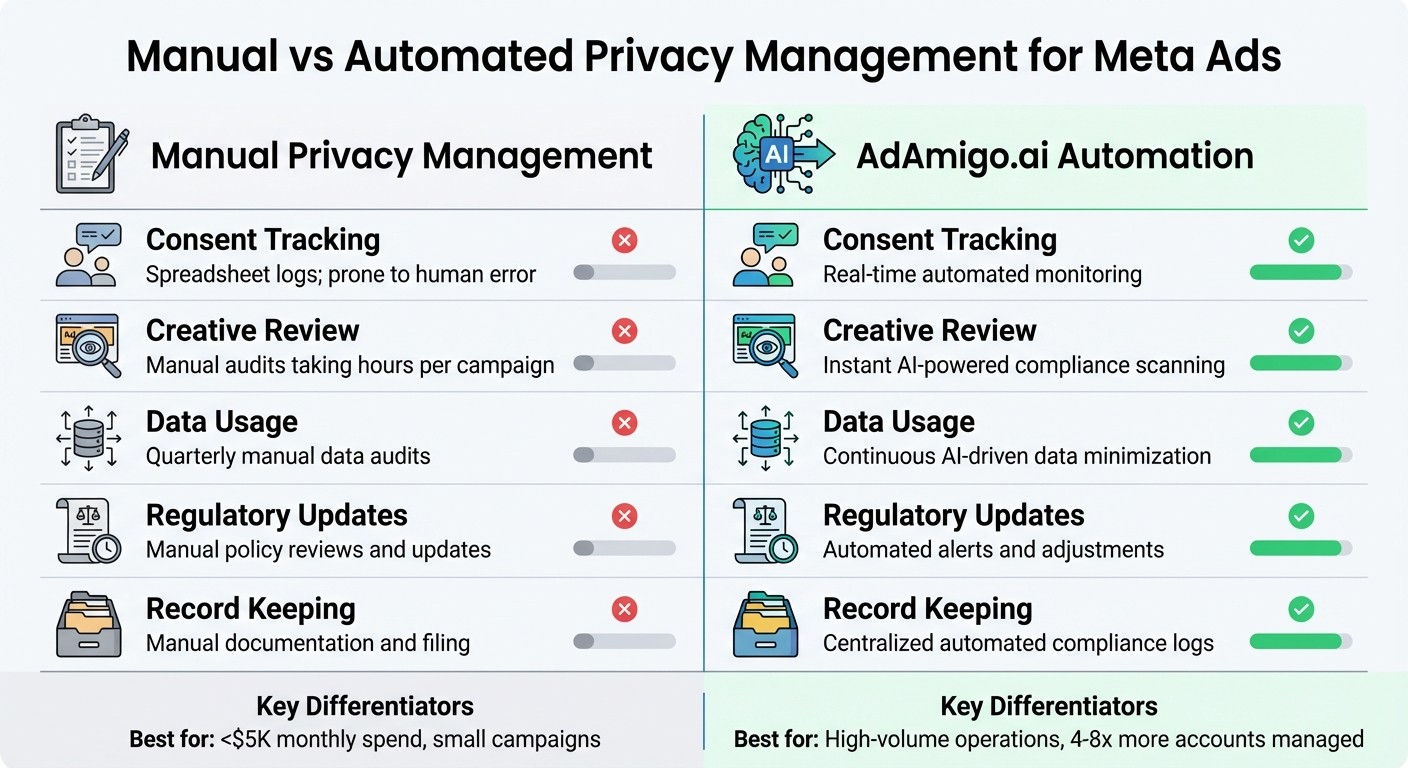
Manual vs Automated Meta Ad Privacy Management Comparison
When deciding between manual privacy management and an automated solution like AdAmigo.ai, it's essential to weigh the trade-offs in key areas. Manual approaches give you direct control but demand significant time and expertise. On the other hand, automation offers speed and consistency, requiring far less hands-on effort.
Here's a quick breakdown of how the two approaches compare across critical compliance tasks:
Compliance Process | Manual Approach | AdAmigo.ai Automation |
|---|---|---|
Spreadsheet logs; prone to human error | Real-time automated monitoring | |
Creative Review | Manual audits taking hours per campaign | Instant AI-powered compliance scanning |
Data Usage | Quarterly manual data audits | Continuous AI-driven data minimization |
Regulatory Updates | Manual policy reviews and updates | Automated alerts and adjustments |
Record Keeping | Manual documentation and filing | Centralized automated compliance logs |
This table highlights how each method handles essential privacy operations, showcasing the strengths and limitations of both.
Manual management involves tasks like maintaining data inventories, coordinating with legal teams, implementing ad policy training, and manually configuring tools such as the Meta Pixel and Conversions API. While it offers transparency, this process quickly becomes overwhelming as the number of campaigns grows.
Automated solutions tackle these challenges head-on. AdAmigo.ai integrates continuous compliance checks, instantly flags Meta ad policy risks, and adapts to Meta’s global privacy rules. For agencies juggling multiple clients or brands scaling rapidly, automation shifts the focus from reactive quarterly audits to proactive, always-on monitoring, ensuring accuracy without the bottlenecks of manual oversight.
The right choice depends on your campaign volume and risk tolerance. Smaller advertisers with fewer campaigns may lean toward manual methods for their simplicity and control. However, for high-volume operations, automation's efficiency and reliability can make all the difference. This comparison can help you decide which approach aligns best with your compliance goals and campaign needs.
Conclusion
When deciding on a privacy management approach, consider your business's size, budget, and risk tolerance. For small businesses spending under $5,000 a month, manual methods can be effective. Following privacy policy best practices, setting up basic consent banners, and conducting quarterly internal audits are practical steps to maintain compliance without relying on advanced tools. However, as your advertising spend increases and account management becomes more complex, manual processes - like tracking data through spreadsheets - can become inefficient and prone to errors. This is where automated solutions for Meta ads step in.
Automation addresses the challenges of scaling. Tools like AdAmigo.ai simplify compliance by enabling media buyers to handle 4–8 times more accounts with greater efficiency. Automated systems can detect potential issues within minutes, compared to the days it might take with manual reviews. They also adapt quickly to changing privacy standards, such as Meta’s evolving regulations, which is especially crucial as regional privacy laws grow stricter in 2025 and beyond. Staying ahead requires a comprehensive Meta compliance checklist to navigate these shifts.
For businesses with smaller budgets, manual methods might be enough. But for larger operations, automation reduces the likelihood of costly mistakes. No matter the approach, maintaining thorough documentation is critical. Meta can request proof of consent at any time, and being able to provide it ensures your account remains active.
Ultimately, your privacy strategy should align with your operational needs. Manual methods suit lean operations, while automation is essential for managing complexity at scale. Both require consistent effort, but only automation can keep up with the rapid pace of modern advertising.
FAQs
Do I need the Conversions API or is Pixel enough?
Using the Conversions API alongside the Pixel helps ensure more accurate data, reduces duplication, and improves attribution. For optimal Meta ad performance and better compliance, it's highly recommended to implement both tools together.
What data must I hash before sending to Meta?
When sending any user data to Meta, it's crucial to hash all personally identifiable information (PII), like emails, phone numbers, or other sensitive details. Hashing is a method that transforms this information into a secure, irreversible format, ensuring privacy and aligning with Meta's compliance policies. This process safeguards user data while maintaining necessary security standards.
How can I prove user consent if Meta asks?
Meta's Consent Mode is a handy tool for managing user consent. It adjusts data collection based on user preferences, allowing for conversion modeling without relying on cookies. This approach ensures compliance with privacy laws like GDPR and CCPA, helping you respect user choices while still maintaining strong ad performance.