
Customizing Privacy Policies for Global Meta Ads
Guide to tailoring privacy policies for global Meta ads—GDPR vs CCPA, Pixel/CAPI settings, consent tools, audits, and AI localization.
Running Meta ads globally requires strict adherence to regional privacy laws like GDPR in the EU and CCPA in California. Without proper privacy policies, your ads risk rejection, reduced performance, and legal penalties. Here's what you need to know:
Privacy Policies Are Mandatory: Meta requires a working, accessible privacy policy URL for Lead Ads. Non-compliance leads to ad disapprovals or account restrictions.
Regional Privacy Laws Vary: A GDPR and CCPA checklist can help navigate these differences, as GDPR demands opt-in consent while CCPA uses an opt-out model. Each region has specific rules for data collection and user rights.
Common Issues: Outdated policies, inaccessible URLs, and failure to address regional laws can disrupt campaigns.
Tailored Solutions: Adjust Meta tools like Pixel and Conversions API for compliance, and follow privacy policy best practices to write region-specific sections.
Ongoing Updates: Privacy laws evolve, so regular audits and updates are critical to staying compliant.
To simplify compliance and boost ad performance, AI tools like AdAmigo.ai can automate privacy management, optimize campaigns, and localize policies for different regions. Staying proactive ensures your ads remain effective and legally sound.
How Privacy is Reshaping the Ad Tech Industry
Global Privacy Laws That Affect Meta Ads

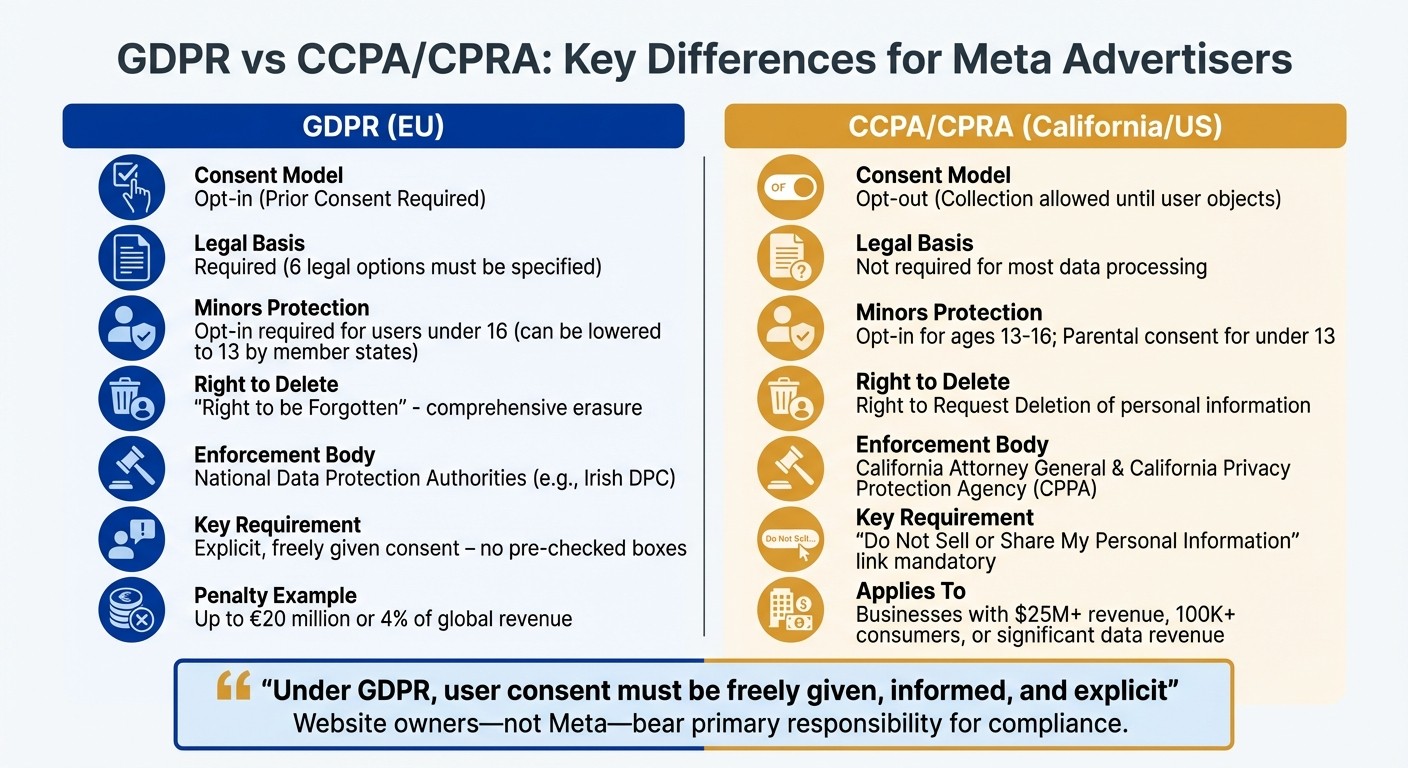
GDPR vs CCPA Privacy Requirements for Meta Ads Compliance
Privacy laws vary widely across regions, impacting how data is collected, targeted, and disclosed in advertising. Understanding how to meet global privacy rules is essential to avoid fines and disruptions to your Meta ad campaigns. Here's a breakdown of key privacy rules and how they influence global compliance best practices.
GDPR (EU) Requirements for Advertisers
The General Data Protection Regulation (GDPR) governs data practices across the European Union, requiring explicit opt-in consent before collecting personal information. This means users must actively agree - pre-checked boxes don't count. Your privacy policy must clearly explain the data being collected (e.g., email or IP addresses), the legal basis for its use (usually consent), and how users can access, modify, or delete their information.
"Under GDPR, user consent must be freely given, informed, and explicit." - CookieYes
For Meta Lead Ads, include a direct link to your privacy policy within the instant form and clearly outline how submitted data will be used. Users must also be able to withdraw consent as easily as they gave it. To comply, you can configure Meta Pixel to block data collection by default using fbq('consent', 'revoke'); until consent is granted.
Non-compliance with GDPR can lead to hefty fines - up to €20 million or 4% of global revenue for severe breaches. For example, in May 2023, Meta faced a record $1.3 billion (€1.2 billion) fine for unlawful EU-to-US data transfers.
"Website owners - not Meta - bear primary responsibility for compliance when implementing tracking technologies." - Secure Privacy
Meta Consent Mode offers a way to balance privacy and data insights. When users deny consent, the Pixel can switch to privacy-preserving measurement through statistical modeling instead of blocking all tracking. These measures help fine-tune your Meta ad privacy settings.
CCPA/CPRA (California) and Other US State Laws
California's Consumer Privacy Act (CCPA) and its updated version, the California Privacy Rights Act (CPRA), use an opt-out model. Unlike GDPR, this approach allows data collection until users actively request otherwise. These laws apply to businesses meeting certain thresholds, such as $25 million+ in revenue, handling data for 100,000+ consumers, or deriving a significant portion of revenue from data.
Your privacy policy must disclose what data is collected, how it’s used, and include a “Do Not Sell or Share My Personal Information” link. While CCPA/CPRA don’t require a legal basis for processing data, they emphasize transparency and user rights. Personal data under these laws extends to households and devices, not just individuals.
For minors aged 13–16, you’ll need direct opt-in consent, and for children under 13, parental consent is mandatory before selling or sharing their data. Meta's Limited Data Use (LDU) feature can help restrict data processing for California residents who opt out.
Feature | GDPR (EU) | CCPA/CPRA (California/US) |
|---|---|---|
Consent Model | Opt-in (Prior Consent) | Opt-out (Right to Stop) |
Legal Basis | Required (6 options) | Not required for most processing |
Minors | Opt-in for <16 (can be lowered to 13) | Opt-in for <16; Parental for <13 |
Right to Delete | "Right to be Forgotten" | Right to Request Deletion |
Enforcement | National DPAs (e.g., Irish DPC) | CA Attorney General & CPPA |
Privacy Laws in the UK, Asia-Pacific, and Emerging Markets
Beyond the EU and California, other regions have their own privacy requirements, often necessitating tailored approaches.
The UK Data Protection Act 2018 closely aligns with GDPR but includes specific exemptions for areas like national security and law enforcement. Since Brexit, the UK operates its own framework, so compliance strategies must account for both EU and UK regulations when targeting these audiences.
In the Asia-Pacific region, countries like Australia, Brazil, and Canada enforce distinct privacy standards. Australia’s Privacy Act demands clear explanations of data collection methods, Brazil’s LGPD mirrors GDPR’s opt-in consent model, and Canada’s PIPEDA emphasizes accountability by requiring businesses to appoint a privacy officer. Each framework has unique demands for handling data collection, processing, and user rights.
Emerging tools like the Global Privacy Control (GPC) signal are gaining traction, allowing users to automatically communicate opt-out preferences across websites. Adapting your Meta ad privacy settings to meet these diverse requirements is key to maintaining compliance worldwide.
How to Customize Privacy Policies for Different Regions
To comply with diverse privacy laws worldwide, it's essential to tailor your privacy policy to meet the specific needs of each region. This means understanding your target regions, configuring tools like Meta's consent settings, and drafting sections of your policy that address local regulations. With 20 U.S. states expected to enforce comprehensive privacy laws by 2026, alongside significant changes in the EU, Australia, and India, adapting your policies is no longer optional. By translating legal requirements into actionable steps, you can ensure your privacy practices align with regulatory demands.
Reviewing Your Ads Manager Geographic Settings
Begin by checking your Ads Manager geographic settings to pinpoint regions where compliance obligations apply. For instance, many U.S. state laws kick in when your business processes data from over 100,000 consumers annually - or just 25,000 if at least half of your revenue comes from selling data. If you're targeting users in states like Kentucky, Rhode Island, or Indiana, you'll need to recognize Global Privacy Control (GPC) signals starting January 1, 2026. Meanwhile, Australia will require disclosures on automated decision-making by December 10, 2026, and the EU's AI Act will be fully enforced by August 2, 2026.
For ads promoting sensitive products, it’s a good practice to set the minimum target age to 18+.
Configuring Meta Consent Tools and Pixel Settings
Next, adjust Meta's consent tools and Pixel settings for each region. For California and eight other U.S. states that mandate GPC support, configure your consent management platform to automatically respond to these signals. In the EU, starting in January 2025, Meta will give users a choice between fully personalized ads (with complete data sharing) or a "less personalized" experience with restricted data collection.
"Meta will give users the effective choice between: consenting to share all their data and seeing fully personalised advertising, and opting to share less personal data for an experience with more limited personalised advertising." - European Commission
Ensure your Pixel setup accommodates both scenarios. Different regions demand specific technical adjustments. For example, under India's DPDP Act, you’ll need to use local consent managers and allow users to withdraw consent at a granular level. Tools like the Conversion API (CAPI) are becoming essential for accurate tracking and audience building, especially as stricter privacy rules limit traditional Pixel tracking methods.
Writing Region-Specific Privacy Policy Sections
Your privacy policy should be layered, starting with a brief highlights section followed by a detailed legal notice. Tailor each regional section to its consent model - opt-in for the EU, opt-out for most U.S. states - and include disclosures like California's "Do Not Sell or Share My Personal Information" requirement.
For Australian users, state explicitly if personal information is used in automated systems that impact individual rights. In the EU, identify any third-country data recipients and explain the legal basis for each type of processing. Use plain language and bullet points to organize data types and their purposes. Be sure to update your policy to cover new sensitive data categories, such as neural data, biometric identifiers, and precise geolocation (defined as within 1,750 feet). Additionally, if you’re using Meta’s generative AI features, include disclosures about "AI info" labels that inform users about the origin of the content.
Adopting a "Privacy by Design" approach can significantly enhance compliance readiness. Research shows that organizations following this principle are 85% better prepared to meet emerging regulations. By embedding these tailored disclosures into your privacy policy from the start, you not only support compliance but also improve ad performance and user trust.
Reviewing and Updating Privacy Policies for Continued Compliance
Keeping up with privacy compliance isn’t a one-and-done task - it’s an ongoing process. Meta regularly reviews ads, and even a minor policy oversight can result in ad rejections. To stay on track, make sure your privacy policy evolves alongside changing regulations.
Running Privacy Audits for Meta Ads
Start by ensuring your privacy policy URL is active and accessible. Broken links or geo-restricted URLs can lead to policy violations. A quick way to check this is by using Meta's Sharing Debugger tool. If you encounter issues with your Pixel or CAPI, you may also need to debug your conversion tracking to ensure data flows correctly. It should return a 200 response, confirming that the URL is functional and accessible to Meta’s systems.
"You will provide, maintain, and comply with a privacy policy that is available through an active, publicly available, easily accessible (including by our crawlers), and non-geoblocked URL." - Meta Platform Terms
Next, review every Instant Form used in your Lead Ads. Each form must include a working, mobile-friendly privacy policy link. Pay close attention to custom questions - avoid asking for sensitive information like government IDs, financial account details, or health data unless you’ve secured prior approval.
Audit Category | Key Action Item | Compliance Standard |
|---|---|---|
Lead Ads | Include a functional privacy policy link in Instant Forms | Meta Advertising Standards |
Technical | Test URL accessibility with Sharing Debugger | Meta Developer Policies |
Once you’ve verified compliance, make it a habit to monitor for updates in regulations to avoid future issues.
Tracking Changes in Privacy Regulations
Meta provides advance notice of significant changes to its Privacy Policy, allowing you time to review and adjust before continuing to use the platform. To stay ahead, set up alerts for regulatory updates in your target markets. Compare any new laws with your existing privacy policy to identify and address gaps.
Conduct quarterly audits to catch potential problems early. Keep privacy policy links functional and disclosures up to date. Taking these proactive steps will help safeguard your ad campaigns and avoid unnecessary disruptions.
Using AI Tools for Privacy-Compliant Meta Ad Management
Managing privacy compliance across various regions while ensuring top-notch ad performance can be a daunting task, even for seasoned teams. Fortunately, AI-powered tools are stepping in to handle both challenges - keeping campaigns compliant and optimizing their effectiveness.
How AdAmigo.ai Simplifies Privacy Compliance
AdAmigo.ai is an autonomous AI platform designed to manage Meta ads while enforcing regional compliance standards. When setting up campaigns, it automatically applies geo-targeting rules and privacy and consent requirements, ensuring everything stays within legal boundaries.
One standout feature, AI Actions, provides a daily to-do list with prioritized recommendations for improving creatives, audience targeting, budgets, and bids. Each suggestion comes with a clear explanation, so you know exactly why it's being recommended. You can either approve changes manually or let the system operate on autopilot - all while staying within your compliance framework while you adapt to Meta policy changes.
For agencies juggling multiple clients, the AI Chat Agent is a game-changer. It can answer complex questions like, "Which campaigns target EU users?" - making compliance audits faster and more efficient. With this tool, a single media buyer can manage four to eight times more accounts than before.
Beyond campaign management, AI also simplifies the localization process for privacy documentation, ensuring it aligns with regional regulations.
Using AI to Localize Privacy Policies
Since December 16, 2025, Meta has used AI chatbots to personalize ads in most regions, excluding the EU, UK, and South Korea due to stricter privacy laws. Meta has also pledged to exclude sensitive data - such as religion, health, and political views - from AI-driven ad targeting. These changes mean privacy policies must be updated regularly to reflect how AI impacts ad delivery and privacy across different markets.
AI tools make this process much easier by drafting region-specific privacy policy sections in multiple languages. When regulations shift - like Meta's recent AI personalization updates - you can quickly adjust the relevant sections instead of rewriting entire policies. This not only saves hours of manual effort but also reduces the risk of missing critical compliance details in specific regions.
Conclusion and Key Takeaways
Running Meta ads globally means navigating a maze of privacy laws, from GDPR in Europe to CCPA in the U.S. and various Asia-Pacific regulations. To stay compliant by following conversion data compliance best practices without compromising your ad performance, you’ll need a solid strategy.
Steps to Meet Global Privacy Regulations
Start by auditing your ad account to pinpoint the regions you’re targeting. Use Meta’s "Core Setup" for Pixels to limit unnecessary data collection, and integrate the Conversions API to minimize reliance on cookies by mapping events between the Pixel and Conversions API.
Your privacy policy should clearly explain how users can request data deletion - whether through an email address or a contact form. This policy must be hosted on a public, unrestricted URL and linked directly in your Meta App Dashboard. Ignoring these steps could lead to ad rejections or reduced performance.
While these steps can feel tedious, AI tools can make the process much smoother.
How AI Simplifies Compliance and Improves Ad Performance
AI-powered solutions can take much of the guesswork out of compliance and even enhance ad performance. For example, platforms like AdAmigo.ai automate geo-targeting and consent management from the outset. Their AI Actions feature provides a daily, prioritized list of tweaks to keep your campaigns compliant and effective. This means agencies can manage four to eight times more clients with the same resources.
When privacy laws change, AI tools can help you quickly adjust specific sections of your policies instead of overhauling them entirely. This turns compliance into an opportunity to scale, rather than a roadblock.
FAQs
How can AI tools simplify privacy compliance for Meta ads?
AI tools can simplify the process of ensuring privacy compliance for Meta ads by taking over some of the more intricate tasks. For example, they can analyze ad content and targeting configurations to confirm they align with Meta's privacy guidelines, such as avoiding claims about personal attributes or improperly requesting user data. These tools can also handle consent tracking, making sure every campaign includes the required permissions and privacy disclosures.
Platforms like AdAmigo.ai take this a step further. They can audit existing ad creatives, generate ads that meet compliance standards, and keep tabs on regulatory updates. With features like flagging privacy concerns, tweaking audience settings, and fine-tuning campaigns to comply with regulations like GDPR and CCPA, these tools make staying compliant much easier. This frees up advertisers to concentrate on strategy without worrying about the nitty-gritty of privacy rules.
What’s the difference between GDPR and CCPA consent requirements?
The GDPR mandates that businesses secure explicit, opt-in consent before they collect or process personal data. In practice, this means users must actively agree to a specific, clearly stated purpose, and businesses are required to keep a record of that consent.
On the other hand, the CCPA (along with its amendment, the CPRA) uses an opt-out model. Under this approach, businesses can collect data by default, but they must offer a straightforward “Do Not Sell or Share My Personal Information” option. This gives consumers the ability to opt out of having their data sold or shared.
To sum it up, the GDPR places the burden on businesses to get explicit permission from users, while the CCPA shifts that responsibility to consumers, requiring them to take action if they don’t want their data shared.
Why should you regularly update your privacy policies for Meta ads?
Keeping your privacy policies updated for Meta ads is crucial to staying compliant with evolving data protection laws like GDPR and CCPA. Staying informed and proactive helps you sidestep potential fines, ad disapprovals, or even account restrictions, all while reinforcing user trust.
Regular updates show that you're transparent and accountable - key factors in earning and maintaining your audience's confidence. Plus, it ensures your business is prepared to meet new regulations head-on, allowing you to run smooth, compliant ad campaigns without interruptions.