
Meta Ads Data Retention: Integration with Governance Tools
Compare tools for enforcing Meta Ads data retention, consent proof, and API-integrated compliance for growing ad campaigns.
Meta Ads now enforce strict data retention rules, requiring advertisers to provide proof of user consent with details like timestamps and identifiers. Non-compliance can result in account restrictions. By 2025, advertisers must navigate 19 U.S. state privacy laws, along with GDPR and CCPA, making proper data governance essential.
Key Challenges:
Data discrepancies: Up to 20% differences between Meta Ads Manager and third-party tools due to tracking and attribution variations.
Manual errors: Spreadsheet tracking is prone to mistakes, while API key permissions and rate limits complicate automation.
Retention policies: Advertisers need automated systems for secure data storage, deletion, and compliance.
Solutions Compared:
Claravine: Focuses on metadata standardization but requires manual steps for data deletion.
Adverity: Automates data extraction and reporting but doesn’t manage retention within Meta Ads.
Funnel.io: Offers long-term storage for historical data but lacks real-time retention enforcement.
AdAmigo.ai: Automates retention policies directly in campaigns, with features like AI-driven audits and real-time compliance monitoring.
For growing campaigns and stricter regulations, tools like AdAmigo.ai stand out by integrating automation and compliance into active workflows. However, smaller budgets may find simpler tools like Claravine sufficient.
Quick Comparison:
Feature | Claravine | Adverity | Funnel.io | AdAmigo.ai |
|---|---|---|---|---|
Retention Automation | Manual | Scheduled | Archival focus | AI-driven |
Meta API Integration | Limited | Moderate | Strong | Native |
Audit Frequency | Quarterly | Monthly | On-demand | Continuous (24/7) |
Compliance Enforcement | Manual | External tools required | Limited | Real-time |
Advertisers must choose tools based on their campaign scale, compliance needs, and budget constraints. AdAmigo.ai offers robust automation for larger, compliance-heavy operations, while Claravine and Adverity suit smaller-scale or reporting-focused needs.
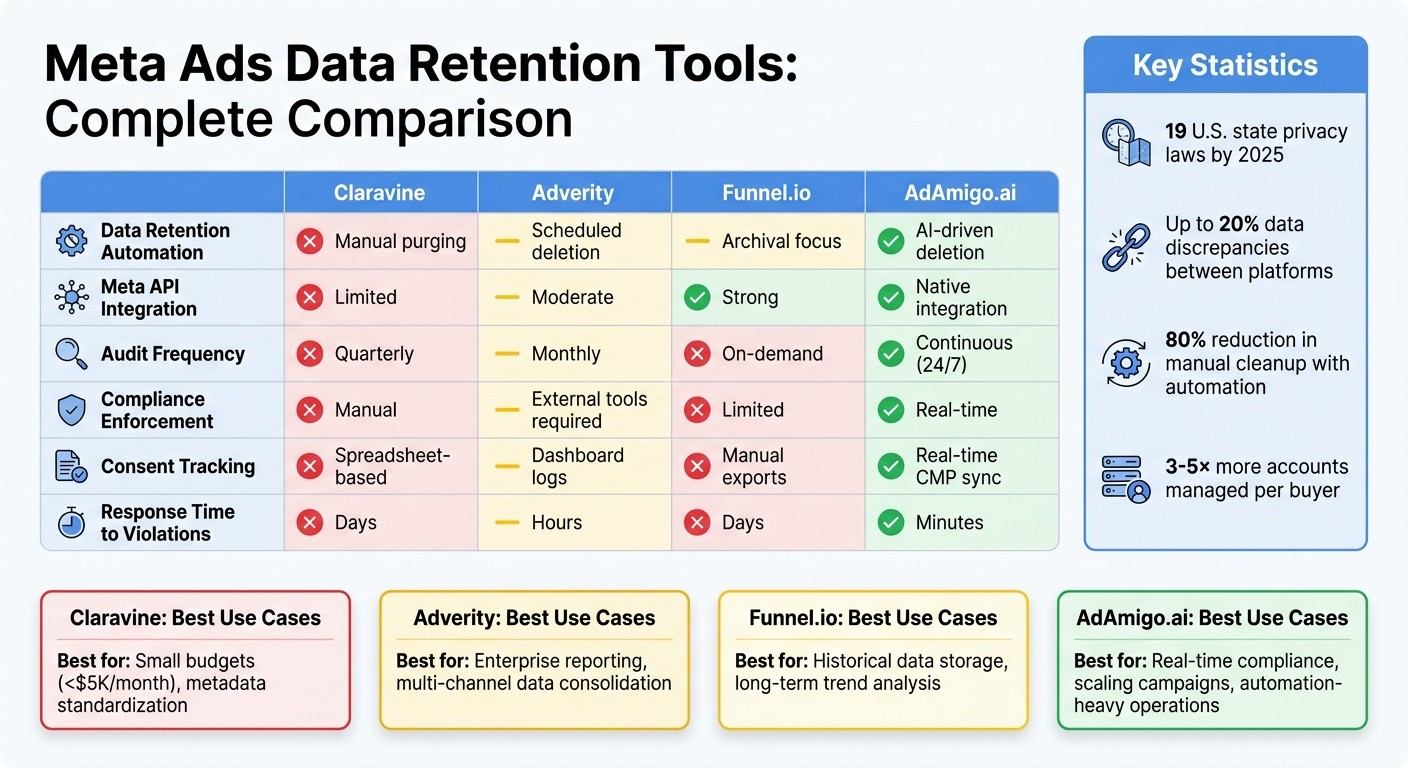
Meta Ads Data Retention Tools Comparison: Features and Capabilities
How to run Meta-compliant ads for health & wellness brands without rule breaks (Part 1)
1. Claravine
Claravine takes a different approach compared to platforms that directly integrate retention actions with Meta's API. Its primary focus is on metadata standardization, offering indirect support for managing data governance.
Data Retention Handling
Claravine is designed as a governance tool that organizes and standardizes metadata but does not directly manage data retention schedules. It won't automatically delete data based on retention policies. Instead, it helps teams establish naming conventions and taxonomies, making it easier to identify campaigns, ad sets, or creative assets that align with company policies for retention or removal.
For advertisers working with Meta Ads, Claravine requires manual steps to align governance rules with deletion workflows. Retention periods need to be tracked separately, and deletions must be carried out through Meta Ads Manager or API calls, or by moving Meta Ads data to BigQuery for long-term storage and custom deletion scripts. This setup highlights Claravine's focus on metadata governance rather than direct involvement in campaign or data retention management.
Integration with Meta API
Claravine's connection to Meta's API is limited to metadata management. It doesn't offer native connectors for syncing campaign performance data or handling bulk actions like pausing or deleting outdated ad sets. Instead, the platform specializes in organizing and enforcing metadata standards, leaving the actual deletion or campaign adjustments to external tools or processes.
Advertisers often need to export governance rules from Claravine and apply them manually using other tools or custom scripts that interact with Meta's API. This additional step adds complexity compared to platforms with direct API integration for campaign management.
Automation Features
While Claravine includes automation for metadata enforcement, its capabilities are focused on business rule management rather than campaign execution. The platform automates tasks like enforcing naming standards and validating metadata, ensuring compliance with internal guidelines.
However, this automation doesn't extend to performing actions like deleting outdated data from Meta Ads accounts. It can flag campaigns that don't meet compliance standards but stops short of taking direct action within advertising platforms. Essentially, Claravine's automation is all about ensuring metadata accuracy, rather than managing campaigns or retention tasks directly.
2. Adverity
Adverity specializes in automating the extraction and integration of data, playing a key role in supporting data retention strategies for Meta Ads. Instead of directly managing retention policies, Adverity acts as a data pipeline, seamlessly exporting Meta Ads metrics into tools like Google Sheets, Looker Studio, or BigQuery. These exports are refreshed on a schedule to ensure data stays up-to-date. Unlike platforms such as Claravine, which prioritize metadata standardization, Adverity focuses solely on automating data transfers.
Data Retention Handling
Adverity doesn't directly enforce data retention policies within Meta Ads accounts. Instead, it facilitates the extraction and storage of advertising data into external systems. This allows users to implement retention rules independently, whether in a cloud data warehouse, analytics platform, or even a spreadsheet. By pulling campaign performance metrics, audience insights, and creative data from Meta's API, Adverity routes this information to your preferred destination for further analysis.
It's important to note that Adverity does not delete outdated campaigns or enforce retention schedules within Meta Ads Manager itself. Its role is limited to securely extracting data in a read-only capacity using Meta's API.
Integration with Meta API
To integrate with Meta's API, Adverity requires a Pixel ID, Business Manager access, and a secure Access Token. Once the connection is established, Adverity can schedule data pulls at regular intervals. However, its functionality is limited to data extraction and does not include campaign management tasks, such as pausing ads or removing old creative assets. For those needing this functionality, an automated campaign pausing guide can help manage these lifecycle tasks.
This means Adverity is designed for reporting and analysis purposes, leaving the structural and content management of your Meta Ads account untouched.
Automation Features
Adverity’s automation capabilities focus on streamlining data movement. The platform automates data pipelines by scheduling metric updates, applying transformations, and loading the results into your analytics stack. It’s built to enhance efficiency in data integration and quality management, leveraging modern tools like AI and machine learning for these processes.
That said, Adverity’s automation doesn't extend to managing the lifecycle of your advertising data within Meta Ads. Tasks like archiving old campaigns or enforcing retention schedules still require manual actions or additional tools.
3. Funnel.io
When it comes to tackling data retention issues, Funnel.io takes a different approach by offering a centralized storage solution. Rather than focusing solely on transferring data, Funnel.io prioritizes long-term storage. The platform connects to Meta Ads using the Meta Marketing API, pulling in performance data at the campaign, ad set, and ad levels. Its Data Core serves as a long-term repository, bypassing the retention limits of Meta Ads Manager.
Data Retention Handling
One of Funnel.io's standout features is its ability to store your Meta Ads data indefinitely within its infrastructure. This means you can access historical campaign performance data far beyond the time limits set by Meta. The Data Core acts as a permanent archive, enabling year-over-year comparisons and long-term trend analysis without worrying about data disappearing. To maintain consistency, Funnel.io includes features like Data Mapping and Custom Dimensions, which help standardize naming conventions and organize data effectively.
Integration with Meta API
Funnel.io integrates seamlessly with Meta's API using OAuth 2.0. Once connected, it retrieves and manages data from various entities, such as AdAccounts, Campaigns, Ad Sets, and Ad Creatives. The platform ensures regular data synchronization within Meta's rate limits, providing a steady stream of up-to-date information into the Data Core.
Governance and Compliance
Funnel.io places a strong emphasis on data governance and transparency. The platform tracks the entire journey of your data - from the Meta API to the final reporting stage - ensuring clarity and accuracy at every step. This detailed audit trail not only helps verify data accuracy but also supports compliance with Meta ads privacy and consent regulations. By documenting every transformation of data from its original source to its final destination, Funnel.io helps businesses meet regulatory requirements focused on accountability and transparency.
4. AdAmigo.ai
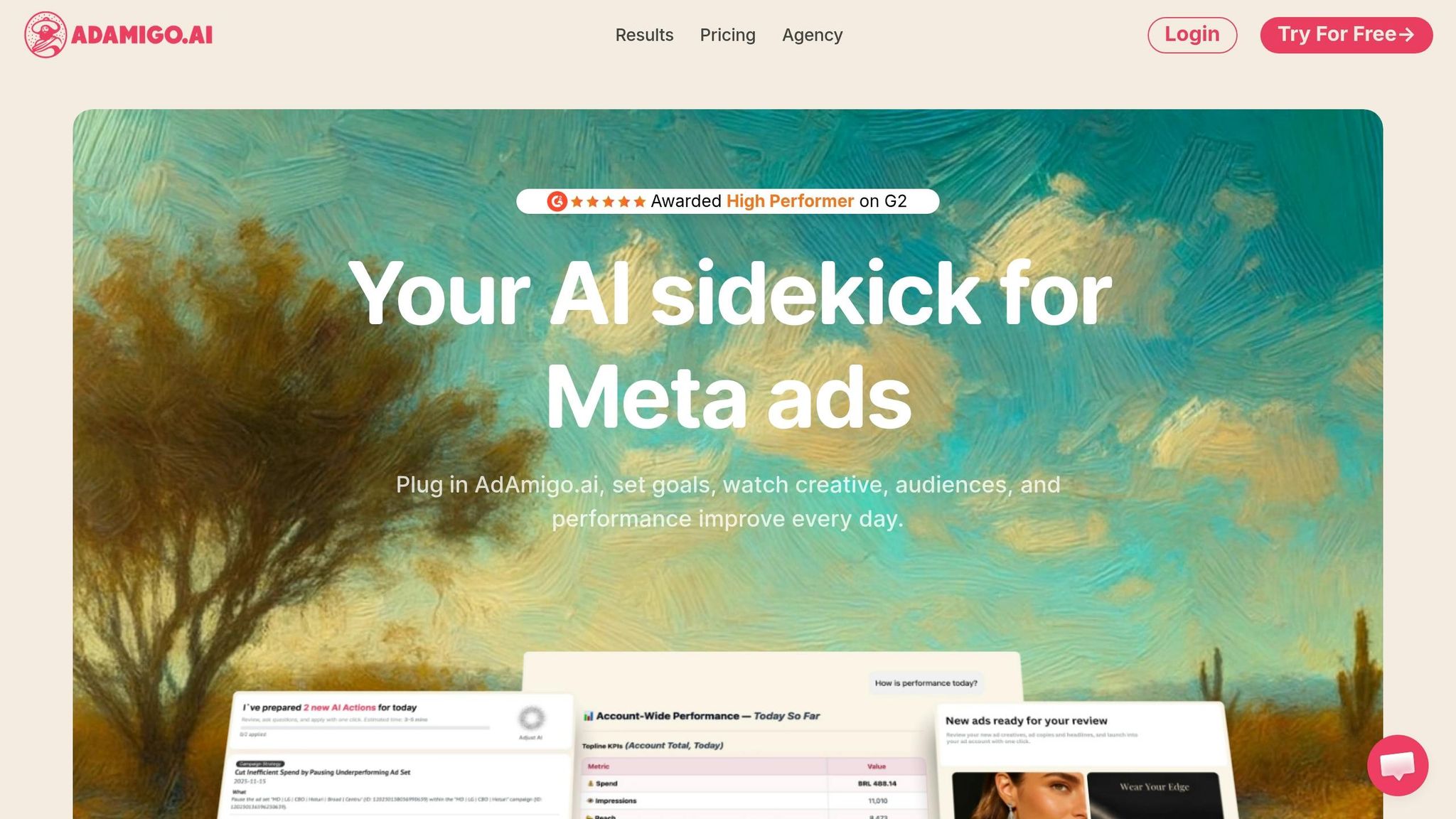
AdAmigo.ai takes a different approach to campaign management by focusing on real-time, automated data retention. While Funnel.io emphasizes archival solutions, AdAmigo.ai integrates retention policies directly into active campaigns.
Integration with Meta API
AdAmigo.ai works exclusively through Meta's official Marketing API (v19.0+ as of 2026), utilizing token-based access for secure connections. The platform is designed to respect Meta's rate limits and operates within the API's 48-hour data freshness window. By pulling incremental daily snapshots of key metrics, AdAmigo.ai ensures smooth implementation of retention policies tailored to Meta Ads.
Automation Features
The platform's AI Autopilot streamlines retention processes by automatically enforcing rules, such as retaining pixel data for 180 days or pausing ads that rely on data older than 30 days. Its Bulk Ad Launcher adds expiration metadata to creatives and audiences as they are deployed, cutting down manual cleanup efforts in Ads Manager by up to 80%, according to agency data. AdAmigo.ai also leverages Meta's Conversions API (CAPI) for server-to-server data sharing, which avoids browser tracking issues and ensures event deduplication through unique IDs for cleaner data.
Governance and Compliance
With AdAmigo Protect, the platform actively monitors account health, flags retention violations, and logs every action with timestamps to create detailed audit trails. For example, a US-based apparel brand using a 120-day retention policy saw a 25% boost in ROAS and successfully managed three times more campaigns. These capabilities align with GDPR's data minimization principle and CCPA's right-to-deletion guidelines, ensuring compliance while optimizing performance.
Advantages and Disadvantages
Each governance tool has its own strengths and trade-offs, making the choice highly dependent on your specific needs. Here's a closer look at how these tools stack up:
Claravine is excellent for standardizing metadata but falls short when it comes to automating the deletion of outdated records. Once retention windows expire, manual intervention is required. On the other hand, Adverity excels at consolidating Meta Ads data with other marketing channels for unified reporting. However, its retention rules operate on scheduled intervals rather than in real time, which can be a limitation for some users.
Funnel.io shines when it comes to storing historical campaign data in formats that meet compliance standards, making it a great choice for audits. That said, its focus on archival data means it’s less equipped for real-time adjustments to active campaigns. In contrast, AdAmigo.ai integrates retention policies directly into live campaign workflows, using AI-driven deletion and continuous auditing. This real-time capability is a standout feature, as highlighted in a G2 review by Sherwin S.:
Adamigo.ai has been a total game-changer. The AI actions are spot-on, so I can make adjustments fast and see results right away. It's like having an extra set of super-smart hands helping me hit my KPIs.
Here's a comparison of their key features:
Feature | Claravine | Adverity | Funnel.io | AdAmigo.ai |
|---|---|---|---|---|
Data Retention Automation | Manual purging | Scheduled deletion | Archival focus | AI-driven deletion |
Meta API Integration | Limited | Moderate | Strong | Native integration |
Audit Frequency | Quarterly | Monthly | On-demand | Continuous (24/7) |
Consent Tracking | Spreadsheet-based | Dashboard logs | Manual exports | Real-time CMP sync |
Scalability | Low-to-medium budgets | Enterprise-level | Mid-to-large teams | 4–8× more accounts per buyer |
Response Time to Violations | Days | Hours | Days | Minutes |
For advertisers managing smaller budgets (under $5,000 per month), manual processes or lightweight tools like Claravine might be sufficient. However, as campaigns grow and regulatory demands increase - especially with Meta’s 2025 policy requiring detailed consent records - automation becomes critical. In such cases, AdAmigo.ai stands out with its unmatched real-time enforcement capabilities.
That said, automation-heavy platforms like AdAmigo.ai can be less cost-effective for smaller campaigns, where continuous AI auditing may not be necessary. However, relying on manual processes introduces risks, such as human error in SHA256 hashing and slower adaptation to regulatory changes.
Ultimately, the best tool depends on your operational needs, budget, and how much manual oversight you’re willing to manage. While tools like Funnel.io and Adverity are ideal for teams focused on historical reporting, AdAmigo.ai is the go-to choice for those requiring real-time enforcement and scalable automation to meet compliance demands and campaign growth. This is often achieved by scaling Meta Ads with real-time API updates to ensure data integrity.
Conclusion
Choosing a data governance tool comes down to what matters most for your specific needs - whether that's historical reporting, real-time automation, or compliance enforcement. If you're managing monthly ad budgets under $5,000, manual processes or simpler tools might get the job done. But as campaigns grow and regulations tighten, automated compliance becomes non-negotiable. Tools like AdAmigo.ai stand out by embedding retention policies directly into active campaigns and leveraging continuous AI audits to detect and address compliance violations in minutes.
This highlights the importance of selecting a governance tool that aligns with your campaign's regulatory and operational needs. As Meta Engineering put it, "We believe that privacy drives product innovation." Platforms that employ automated discovery and real-time monitoring can enforce data minimization effectively. Samadrita Ghosh explains, "The annotation itself becomes the unit of truth; Policy Zones simply read and act upon it". AdAmigo.ai applies this same principle, using Meta's Conversions API to ensure data hygiene through standardized deduplication and SHA256 hashing of sensitive information.
For agencies juggling multiple clients or eCommerce brands running complex campaigns, AdAmigo.ai offers a distinct advantage. Its dual modes - Review Mode for team-approved changes and Autopilot Mode for instant AI-driven optimizations - allow a single media buyer to manage three to five times more accounts without sacrificing control or flexibility.
Ultimately, the right choice depends on whether your focus is on retrospective analysis (as seen with Funnel.io or Adverity) or proactive, real-time enforcement (as offered by AdAmigo.ai). Meta's decision to re-enable Advanced Mobile Measurement reporting on June 17, 2025, underscores the need for tools that can quickly adapt to platform updates. For teams looking to combine compliance automation with campaign optimization, AdAmigo.ai delivers a seamless solution built on Meta's official API and governance framework.
FAQs
What consent proof does Meta Ads require now?
Meta Ads now demand clear, opt-in, and specific consent from users to align with GDPR requirements. This means businesses must use tools like Consent Management Platforms (CMPs) to handle user data responsibly and maintain transparency. These platforms, when integrated with Meta's guidelines, can help simplify and manage the consent process efficiently.
How can I reconcile Meta vs third-party reporting differences?
Reconciling differences between Meta and third-party reporting often comes down to how data is collected, attributed, and timed. To tackle this, start by ensuring proper API integration so data sources align more effectively. Conduct regular audits of both data sets, and consider using automation tools to quickly identify and flag any inconsistencies. Additionally, keeping detailed documentation of attribution windows, conversion tracking methods, and data settings across platforms can help reduce mismatches and improve the overall accuracy of your reports.
Do I need a governance tool, or can I manage retention manually?
Managing data retention for Meta ads manually might seem straightforward at first, but as campaigns expand or compliance requirements change, it can quickly become overwhelming and prone to mistakes. That’s where governance tools step in. These tools automate retention policies, ensuring everything stays consistent, minimizing errors, and making compliance easier to handle.
For example, platforms like AdAmigo.ai connect directly with Meta’s API. They help audit, monitor, and enforce retention policies, making the entire process more efficient and scalable than manual efforts ever could.