
Ultimate Guide to Meta Ads Privacy and Consent
How Meta Ads use consent mode, CAPI, and CMPs to protect user privacy while keeping ad measurement accurate.
Meta advertising in 2026 revolves around privacy and consent. Mismanaging user data or ignoring consent can lead to fines, ad rejections, or campaign failures, making conversion data compliance essential. Here’s what you need to know:
Explicit consent is mandatory:Meta Pixel and tracking tools won’t activate without user approval.
Server-side tracking is key: Meta's Conversions API (CAPI) has replaced browser-based tracking for better compliance and accuracy.
Special Ad Categories face stricter rules: Areas like housing, employment, and credit require extra care to avoid discriminatory practices.
AI content labels are required: Synthetic or AI-generated creatives must be clearly labeled.
Meta Consent Mode ensures compliance: Tracking remains inactive until users opt in, and anonymized data is used for modeling when consent is denied.
Takeaway: Advertisers must prioritize user consent, use robust Consent Management Platforms (CMPs), and leverage first-party data to stay compliant and optimize campaigns.
How Meta Consent Mode Works
Meta Consent Mode serves as a link between meeting privacy regulations and maintaining advertising effectiveness by adjusting data collection based on user consent. When someone visits your site, tracking tools remain inactive until the user explicitly grants permission.
The system operates through straightforward commands to manage data collection. For example, before a user interacts with your consent banner, you can use fbq('consent', 'revoke'); to block tracking by default. If the user agrees to tracking, your Consent Management Platform can then execute fbq('consent', 'grant'); to enable full tracking. This approach prevents any tracking without consent, unlike Google Consent Mode, which still collects data but labels it as non-consented. This default safeguard is just the first layer of a broader compliance framework.
Meta Consent Mode Basics
Meta Consent Mode integrates both client-side and server-side tracking mechanisms. If a user denies consent, the Meta Pixel will not read or write advertising cookies. On the server side, the Conversions API ensures compliance by filtering out personal identifiers, such as email addresses and phone numbers, and only transmitting anonymized, aggregated data.
"Meta Consent Mode is a privacy framework that enables websites to request user consent before activating Meta Pixel and Conversions API for advertising data collection."
– Secure Privacy
This two-tiered system aligns with GDPR and CCPA requirements by halting data collection until explicit consent is provided. Meta reinforces its commitment to privacy through significant investments - over $8 billion since 2019 - and by employing more than 3,000 privacy-focused personnel.
Statistical Modeling for Users Who Decline Consent
Even with these consent-based controls, Meta employs modeling techniques to fill in gaps when users decline consent. While active data collection depends on consent, Meta uses conversion modeling to estimate campaign performance. This statistical method relies on patterns within aggregated, anonymized data to provide insights without accessing individual user information.
"This conversion modeling analyzes aggregated, anonymized data patterns to predict campaign effectiveness without accessing individual user information."
– Secure Privacy
Businesses with strong consent practices often see conversion modeling accuracy rates exceeding 80%. However, these results depend heavily on achieving high consent rates. Low consent rates can lead to larger gaps in measurement. To maintain reliable marketing insights, it's crucial to use clear and user-friendly consent banners that encourage higher opt-in rates, even when direct user tracking is limited.
Building Privacy-Compliant Ad Campaigns
With Meta's updated consent mechanisms, creating ad campaigns that align with privacy regulations now hinges on a properly configured Consent Management Platform (CMP) and smart use of first-party data. Here's how you can set up your CMP and use first-party data to stay compliant with shifting privacy standards.
Setting Up Consent Management Platforms (CMPs)
A CMP acts as the bridge between user consent and data collection. To ensure compliance, update your Meta Pixel to set a default "revoked consent" status by using:
fbq('consent', 'revoke');
This ensures no data is collected until users actively provide consent. Compliance requires syncing both client-side tracking (via the Pixel) and server-side tracking (using the Conversions API). If a user denies consent, your CMP should immediately block personal data from being collected, stopping the process as soon as consent is withdrawn.
To align with various regulations, organize consent into specific categories, such as Advertising, Analytics, and Cross-Border Transfers. This approach not only gives users more control over their data but also helps you meet the requirements of the 19 state-level privacy laws expected to take effect across the U.S. by 2025.
Using First-Party Data for Retargeting
In addition to a well-configured CMP, leveraging first-party data can enable effective retargeting while respecting privacy rules. Before transmitting any personally identifiable information to Meta, use SHA256 hashing to secure the data. Collect only what’s absolutely necessary for your campaign goals, and standardize the data to ensure it is streamlined and compliant.
For users in California, activate the Limited Data Use (LDU) flag in Meta Business Manager to meet the requirements of the California Consumer Privacy Act (CCPA). By adopting server-side tracking through Meta's Conversions API, you can reduce reliance on cookies while maintaining accurate campaign measurement. Lastly, your privacy policy should clearly outline your role - and Meta's - as joint data controllers. It should specify what data is being collected, how users can withdraw consent, and the process for data deletion requests.
AdAmigo.ai: Privacy-Compliant Campaign Optimization
Managing compliance manually can lead to mistakes and slow down your campaigns. AdAmigo.ai (https://adamigo.ai) takes a different approach by automating privacy-safe optimization. It connects directly with Meta's official API and operates within Meta's compliance framework, extending the account-wide compliance strategies mentioned earlier.
AI Autopilot for Privacy-Safe Optimization
AI Autopilot leverages Meta's Conversions API (CAPI) to securely transfer data from servers instead of relying on browsers. This ensures accurate data collection while staying aligned with privacy standards. The system works with your existing consent framework, adjusting ad targeting to focus only on users who have given their permission.
Every optimization step is checked for compliance before it's implemented. The AI continuously performs data minimization audits, using only the data essential for ad performance and automatically deleting personal information when it's no longer needed. For businesses in California, the platform allows you to enable the Limited Data Use (LDU) flag to meet CCPA requirements. Technical processes, like SHA256 hashing of personally identifiable information and ensuring currency codes follow ISO 4217 standards, are all handled automatically.
AdAmigo Protect for Account Safety
AdAmigo Protect goes beyond optimization by safeguarding your account against compliance risks and performance issues. It monitors your account 24/7, flagging issues like missing two-factor authentication, setup errors that could lead to policy violations, and unusual activity that might harm performance. With centralized compliance logs, the platform keeps track of consent collection details, user identifiers, and data processing preferences - offering verifiable records for audits without the hassle of manual documentation.
Every action, from optimization to consent updates, is recorded in an automated audit trail. This means that if Meta or regulators request proof of compliance, you can quickly provide detailed documentation. By eliminating the need for error-prone manual spreadsheets, AdAmigo.ai ensures your campaigns stay compliant as privacy laws evolve across the U.S.
Compliance Checklist and Summary
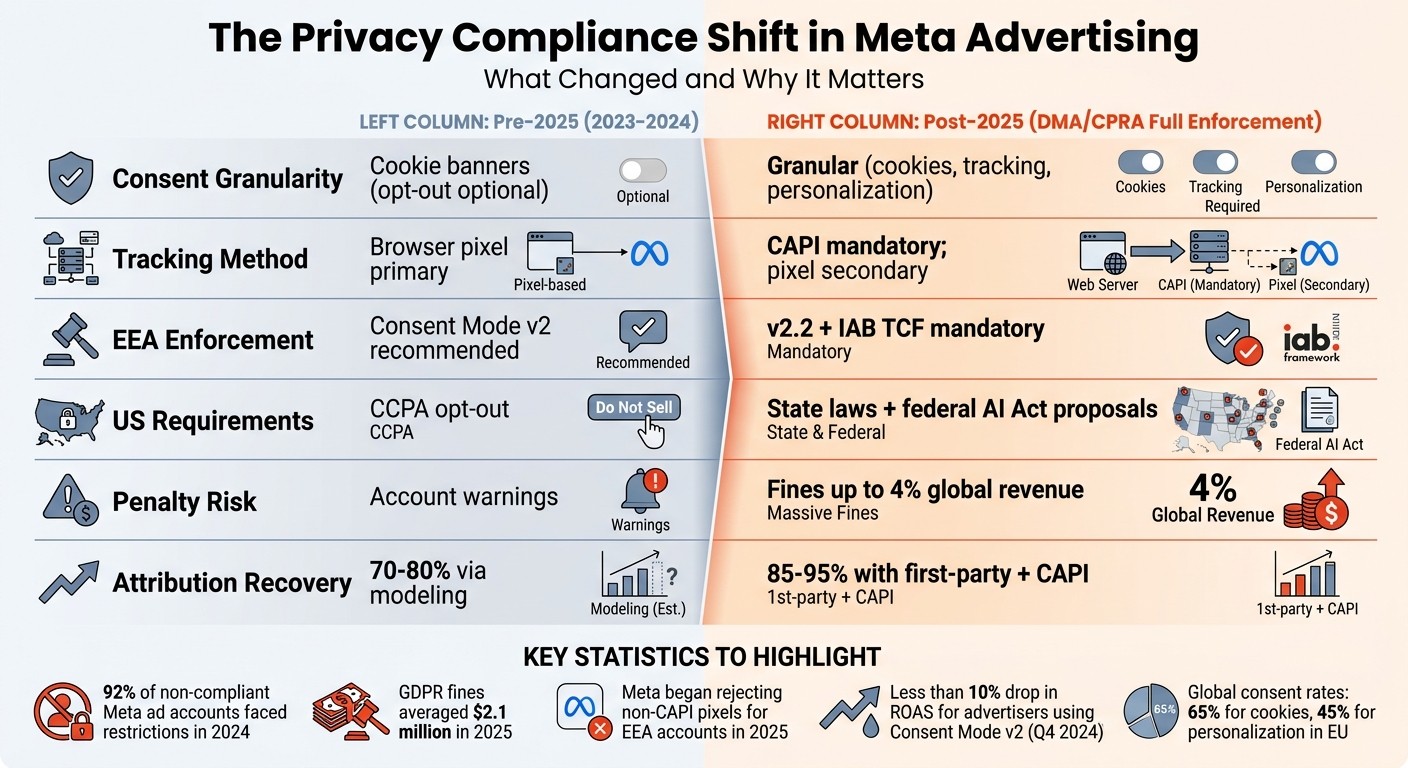
Meta Ads Privacy Compliance: Pre-2025 vs Post-2025 Requirements
This checklist breaks down the essential privacy and consent practices into practical, actionable steps for advertisers.
Meta Ads Privacy Compliance Checklist
The landscape of Meta advertising has changed dramatically. Before 2025, cookie banners with opt-out options and browser pixel tracking were the norm. Now, granular consent is required for cookies, tracking, and personalization. Additionally, the Conversions API (CAPI) has become mandatory, with pixel tracking taking a backseat.
Aspect | Pre-2025 (2023-2024) | Post-2025 (DMA/CPRA Full Enforcement) |
|---|---|---|
Consent Granularity | Cookie banners (opt-out optional) | Granular (cookies, tracking, personalization) |
Tracking Method | Browser pixel primary | CAPI mandatory; pixel secondary |
EEA Enforcement | Consent Mode v2 recommended | v2.2 + IAB TCF mandatory |
US Requirements | CCPA opt-out | State laws + federal AI Act proposals |
Penalty Risk | Account warnings | Fines up to 4% global revenue |
Attribution Recovery | 70-80% via modeling | 85-95% with first-party + CAPI |
In 2025, Meta began rejecting non-CAPI pixels for EEA accounts, resulting in immediate delivery restrictions. The risks are substantial - 92% of non-compliant Meta ad accounts faced restrictions in 2024, and GDPR fines averaged $2.1 million in 2025.
Key Points for Managing Privacy and Consent
To maintain compliance and optimize campaign performance, focus on these critical measures:
Start with your CMP (Consent Management Platform): Ensure it aligns with IAB TCF v2.2 standards. Use Google Tag Manager to configure consent signals, and validate them with Meta's Tag Assistant to catch issues before they affect ad delivery.
Adopt server-side tracking: CAPI vs Pixel tracking is no longer optional. Meta's statistical modeling can recover 10-20% of lost data from non-consenting users, and full compliance can restore up to 90% of attribution accuracy from pre-iOS14 levels. Meta’s Q4 2024 Performance Report shows advertisers using Consent Mode v2 experienced less than a 10% drop in ROAS.
Conduct weekly tag audits: Use Meta Events Manager to monitor consent signal mismatches. Compare "modeled conversions" to "observed conversions" in Ads Manager (and reconcile Meta vs GA4 reporting differences) and aim for a gap of less than 15%. Document consent rates quarterly and update CMP settings as needed. For reference, global consent rates average 65% for cookies but drop to 45% for personalization in the EU.
FAQs
Do I still need the Meta Pixel if I use CAPI?
Absolutely. The Meta Pixel remains essential even if you're using the Conversions API (CAPI). Here's why: these two tools work together to provide a more complete picture of user activity.
The Meta Pixel focuses on client-side tracking, capturing data directly from a user's browser.
Meanwhile, CAPI operates on the server-side, sending data directly from your server to Meta.
By combining both, you improve the accuracy of your data collection. This dual approach also helps ensure better alignment with privacy standards, as it reduces reliance on any single tracking method.
What happens to tracking and attribution if a user declines consent?
When someone opts out of tracking, Meta's platforms face limitations in monitoring user interactions and accurately attributing conversions. This directly affects tools like Meta Pixel, which rely on data to connect actions - such as purchases - to specific ads. As a result, the precision of performance measurement takes a hit.
Privacy regulations like GDPR mandate that data usage without consent must be restricted. This compliance impacts targeting, reporting, and optimization efforts, which can lead to a decline in ad performance and make ROI analysis less effective.
Which CMP features matter most for Meta Ads compliance in 2026?
As privacy regulations continue to evolve, staying compliant with Meta Ads requirements in 2026 will demand a strong focus on consent tracking, transparency, and data control. Here’s what CMPs (Consent Management Platforms) need to prioritize:
Explicit, Opt-In Consent: Users must actively agree to data usage, ensuring compliance with regulations like GDPR and CCPA. Passive or implied consent won't cut it.
User-Friendly Permission Management: Individuals should be able to adjust their preferences easily, giving them full control over their data.
Automated Consent Auditing: Tools that track and document consent in real time help businesses stay ahead of audits and avoid costly errors.
Real-Time Policy Alerts: Instant updates on policy changes ensure your practices align with the latest requirements.
Seamless Meta API Integration: Direct integration with Meta’s API is crucial to avoid ad rejections due to non-compliance.
By integrating these tools and practices, businesses can navigate the tricky waters of privacy regulations while maintaining effective ad performance.