
Ultimate Guide to Real-Time Data for Meta Ads AI
Get 15–30 minute Meta Ads insights using the Conversions API and AI tools to improve ROAS, cut costs, and automate creatives, bids, and budgets.
Want better results from your Meta Ads? Real-time data is the game-changer. Instead of waiting for daily updates, you get performance metrics every 15–30 minutes. This allows AI tools to adjust bids, budgets, and targeting almost instantly - keeping your campaigns efficient and effective.
Here’s what you’ll learn:
What real-time data is: Updates every 15–30 minutes, unlike daily batch reports.
Why it matters: AI can respond to trends immediately, boosting ROAS and cutting costs.
How to use it: Set up Meta’s Conversions API, access live data via the Ads API, and integrate top AI tools for Meta Ads like AdAmigo.ai for automated optimizations.
Proven results: Brands using real-time data have seen ROAS improve by 27–38% and costs drop by up to 22%.
Bottom line: If you’re not leveraging real-time data, you’re leaving money on the table. Learn how to set it up, maintain data quality, and connect it to AI tools for smarter, faster campaign decisions.
Setting Up Real-Time Data Feeds
What You Need Before Starting
Before pulling real-time data, ensure you have Meta Business Manager access with the correct permissions. Specifically, you'll need ads_read to view performance reports, ads_management to manage Custom Audiences, and business_management if you're working with assets across your organization. For server-to-server connections, use system user tokens - they last longer and are more reliable.
It's crucial to set up the Conversions API alongside Meta Pixel for accurate tracking. The Pixel collects data via JavaScript in the browser but has limitations due to browser restrictions. The Conversions API, on the other hand, runs on your server, bypassing these constraints and providing more dependable data. Using both together ensures you capture the most complete dataset.
Querying Data with the Meta Ads API
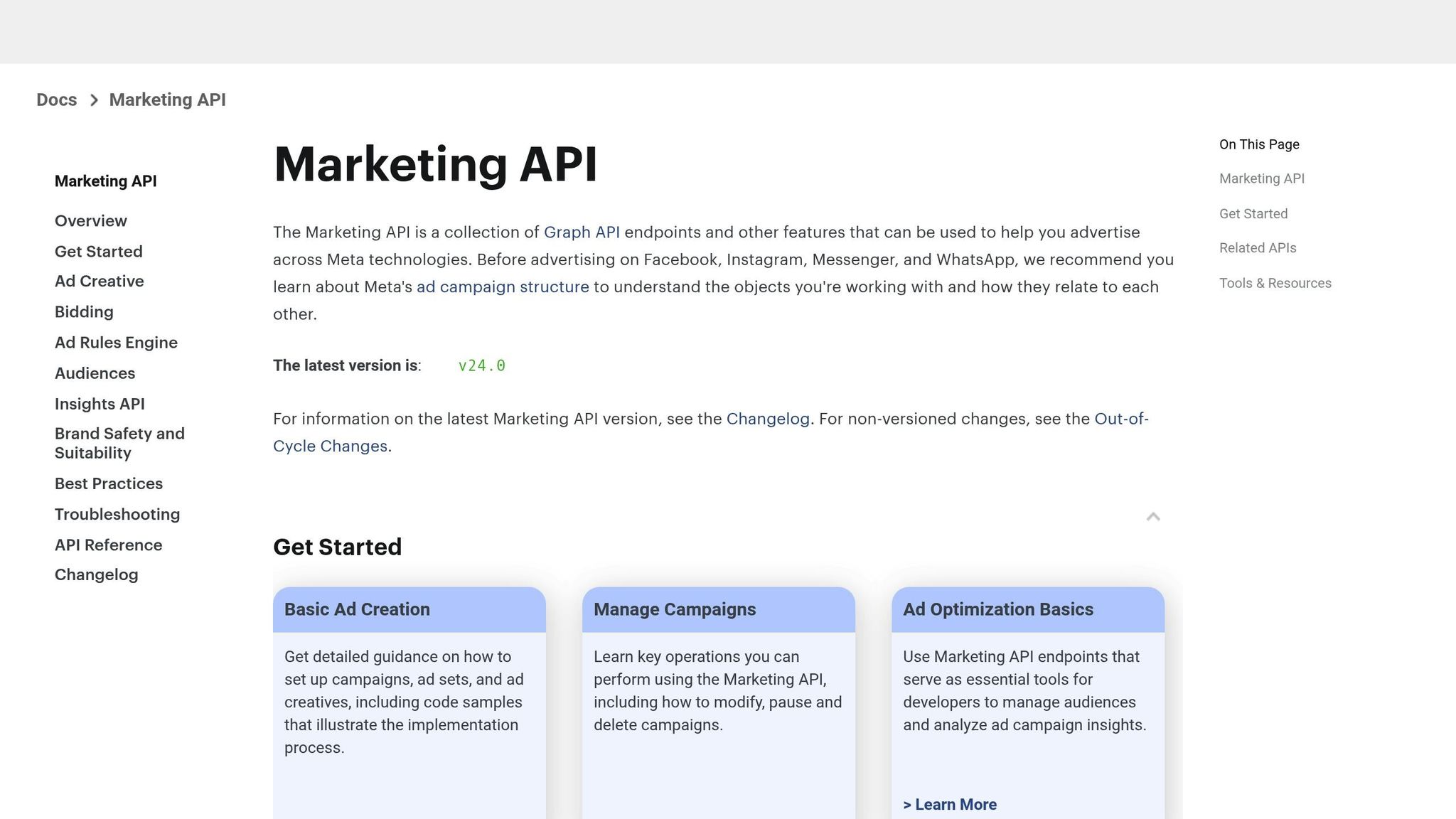
The Meta Ads API operates using Nodes (like Ad Accounts and Campaigns), Edges (connections between nodes), and Fields (the properties you want to retrieve). To access performance data, use the /{object_id}/insights endpoint. Specify the level (account, campaign, adset, or ad), the fields you need (such as impressions, spend, or conversions), and a date_preset like "today" or "last_7d".
"Insights refresh every 15 minutes and do not change after 28 days of being reported." – Meta for Developers
If your dataset spans more than 13 months, use asynchronous jobs to avoid timeouts. Start with a POST request, monitor the job's status, and then retrieve the results with a GET request. To save bandwidth and processing time, Meta supports ETags, which let you check if data has changed since your last request.
Following Meta API integration best practices for data querying lays the groundwork for future AI-driven enhancements.
Maintaining Data Quality
Meta uses Event Match Quality (EMQ) scores, ranging from 1 to 10, to measure how well your conversion data matches user profiles. Scores between 8 and 10 indicate strong matching, while anything below 3 requires immediate improvement. To boost EMQ, standardize conversion data by hashing all personally identifiable data using SHA-256, format phone numbers in E.164 (e.g., "14155551234"), and send email addresses in lowercase with no spaces.
Ensure consistency by using the same event_id for both the Pixel and Conversions API when tracking the same event. Meta automatically removes duplicates within 48 hours for web events and 7 days for offline events. For offline data, upload daily - data older than three days weakens optimization. Additionally, re-authenticate CRM or third-party tool connections every 30 days to avoid disruptions caused by expired tokens.
Next up, explore how to integrate these reliable data feeds into your AI systems.
Connecting Real-Time Data to AI Tools
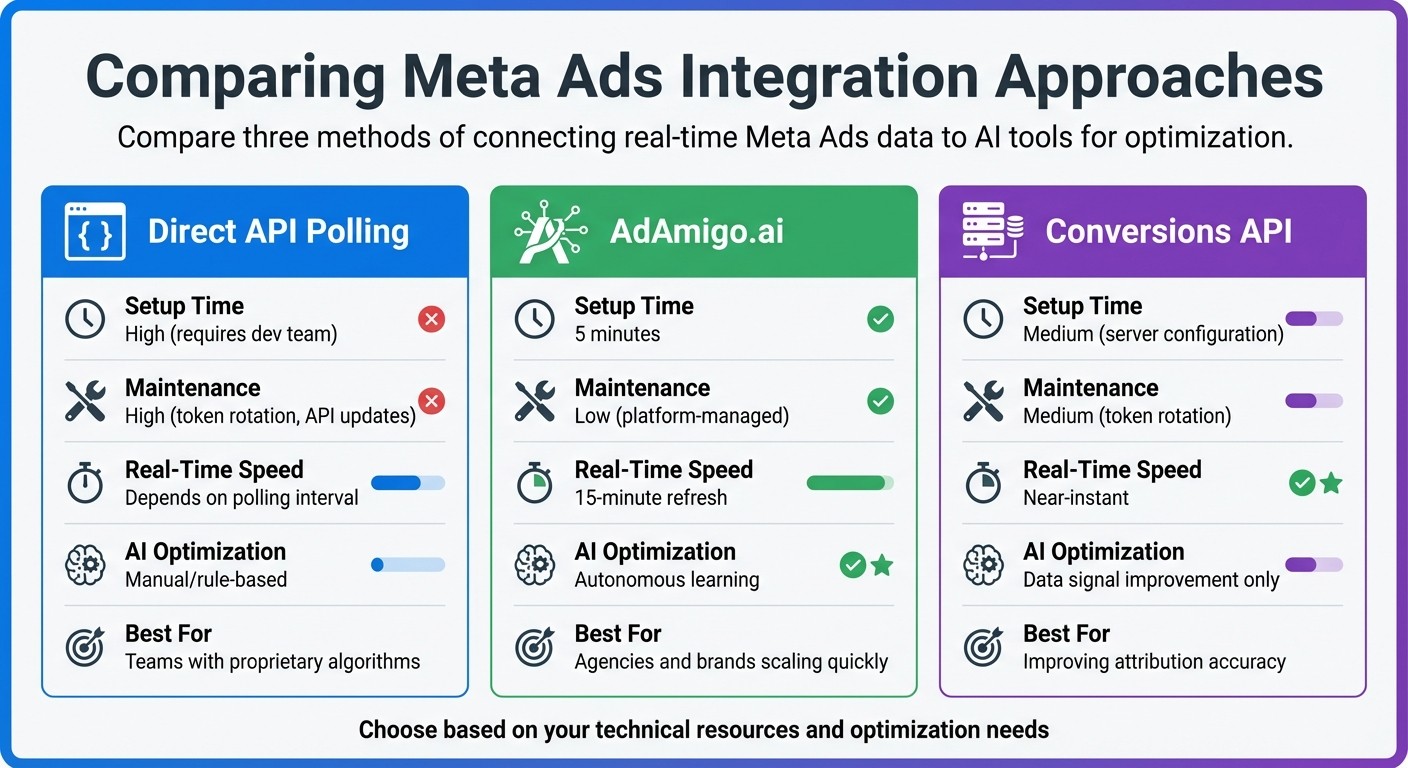
Meta Ads Real-Time Data Integration Methods Comparison
Bringing real-time data into AI tools allows for quick campaign adjustments, a key factor in optimizing Meta ads. Let’s dive into how custom integrations and automated platforms expand on the data feed capabilities we’ve previously discussed.
Building Custom API Integrations
Using custom scripts to connect with Meta’s /insights endpoint provides precise control over pulling and processing data every 15 minutes. However, this approach comes with challenges like managing rate limits (200 calls per hour per user with standard access), handling token expirations, and staying updated with API changes. For technical details on authentication, HTTPS/TLS requirements, and managing asynchronous jobs, refer to the earlier section.
Custom API integrations are ideal for teams with unique needs or proprietary algorithms that off-the-shelf tools can’t address. But keep in mind, this method requires a solid development team to handle ongoing debugging and adapt to API updates.
Now, let’s look at how automated solutions like AdAmigo.ai streamline these processes while offering real-time optimizations.
Using AdAmigo.ai for Automated Data Processing
AdAmigo.ai simplifies Meta ad management by linking your ad account in just five minutes. It processes live data using three AI agents designed to optimize performance:
AI Actions Agent: Audits live performance every 15 minutes and generates a daily to-do list of prioritized tasks. These tasks - such as adjusting budgets, modifying bids, refining audiences, or testing new creatives - can be approved with a single tap or set to run automatically.
AI Ads Agent: Keeps an eye on your top-performing ads and competitor content, then auto-generates on-brand image and video variations ready to deploy directly into your account.
AI Chat Agent: Answers performance-related queries like “Why did ROAS drop yesterday?” or “What should I test next?” It also integrates with Google Drive, letting you bulk-launch campaigns efficiently.
Unlike traditional rule-based tools, AdAmigo.ai uses adaptive learning to refine its strategies based on your results, optimizing creatives, targeting, bids, and budgets as a cohesive system. With flexible pricing plans, it caters to advertisers at different spending levels.
Here’s how custom integrations and automated platforms stack up against each other.
Comparing Integration Approaches
Approach | Setup Time | Maintenance | Real-Time Speed | AI Optimization | Best For |
|---|---|---|---|---|---|
Direct API Polling | High (requires dev team) | High (token rotation, API updates) | Depends on polling interval | Manual/rule-based | Teams with proprietary algorithms |
AdAmigo.ai | 5 minutes | Low (platform-managed) | 15-minute refresh | Autonomous learning | Agencies and brands scaling quickly |
Conversions API | Medium (server configuration) | Medium (token rotation) | Near-instant | Data signal improvement only | Improving attribution accuracy |
While direct API polling works well for teams building complex custom logic, most advertisers will find automated platforms like AdAmigo.ai more efficient. These tools eliminate the technical burden while delivering faster, smarter optimizations. Additionally, the Conversions API can enhance either approach by improving the quality of event data sent to Meta’s algorithms.
Optimization Strategies Using Real-Time Data
Real-time data takes Meta ads from being reactive to actively optimizing performance. By analyzing metrics like CTR, ROAS, and engagement every 15–30 minutes, AI can quickly reallocate budgets, pause underperforming ads, and scale top performers - all in a matter of minutes.
Adjusting Creatives Based on Performance Data
AI leverages real-time signals such as click-through rates, video watch time, and conversion rates to pinpoint successful creatives within the first hour of launch. For instance, if a video ad achieves a CTR above 2% and ROAS greater than 3x early on, AI tools can automatically craft variations in headlines, visuals, and calls-to-action tailored to high-engagement audiences. Meta's Advantage+ Shopping campaigns employ this kind of real-time analysis, demonstrating efficiency gains of 20–30% during tests.
On the flip side, lowering creative testing costs by quickly pausing underperforming creatives is just as crucial. Setting alert thresholds ensures underwhelming ads are paused promptly. Tools like AdAmigo.ai's AI Ads Agent streamline this process by analyzing top-performing ads and competitors, then generating on-brand variations that can be launched with a single click.
Real-Time Budget and Bid Management
Once creatives are optimized, real-time budget adjustments further enhance campaign results. AI reviews CTR, ROAS, and cost-per-acquisition (CPA) metrics every 15–30 minutes, reallocating funds from low-ROAS ad sets (below 2.5x) to high-performing ones (above 4x). Additionally, it can increase bids by 10–20% for top-performing placements.
For example, in one e-commerce campaign, real-time adjustments shifted 60% of a $10,000 daily budget away from underperforming mobile placements (ROAS 1.8x) to desktop placements (ROAS 4.2x), boosting overall ROAS by 35% within 24 hours.
The key lies in setting smart thresholds. If your lead-generation CPA typically averages $25, you might pause budgets or refresh creatives once it exceeds $30. Similarly, a CTR below 1.0% could signal the need for a new hook or visual. By combining Meta API data with cross-channel insights, these automated systems allow for precise, hands-off campaign adjustments.
Daily AI-Driven Campaign Adjustments
Building on real-time insights, AI consolidates daily performance data into a focused, actionable list. What used to take hours - daily audits - can now be completed in under five minutes. Tools like AdAmigo.ai's AI Actions Agent analyze live campaign performance and deliver a ranked list of recommended changes, such as testing new audiences, reallocating budgets, refreshing creatives, or tweaking bids. Users can manually approve each adjustment in Review Mode or let the AI handle everything in Autopilot Mode, operating within pre-set KPI constraints (e.g., "maintain ROAS ≥3x").
This system significantly increases efficiency. Agencies report that a single media buyer can now manage 4–8x more clients by relying on AI for execution, leaving strategists free to focus on broader planning. The AI integrates creatives, audiences, bids, and budgets into a unified system, ensuring that a successful creative is automatically paired with the right audience and budget - not just scaled without context.
Advanced Methods and 2025 Updates
Meta introduced several updates throughout 2025 and into early 2026, significantly altering how data feeds operate. On January 12, 2026, the company removed 7-day and 28-day view-through attribution windows from its Ads Insights API. Any API calls requesting these windows now return empty data, requiring advertisers to immediately update their action_attribution_windows parameters to avoid disruptions. These rapid shifts demand swift adjustments to systems to ensure continued performance. The updates also improve the AI's ability to process and act on real-time data, further refining campaign optimization.
Julia Moreno from Dataslayer.ai highlighted the impact of these changes:
"If you weren't watching the Developer Blog, your reporting changed overnight without warning."
Handling Large Data Sets with Asynchronous Reporting
Managing campaigns that involve thousands of ad sets or retrieving months of historical data can overwhelm synchronous API calls, leading to timeouts or rate limit issues. Asynchronous reporting addresses this by breaking large requests into background jobs, avoiding these problems. Instead of waiting for one massive response, you submit a job, get a job ID, and then poll for its completion - typically within 2–5 minutes for extensive datasets. This approach not only prevents delays but also enables quicker creative testing and more flexible budget adjustments. It lays the groundwork for new attribution models and AI-driven performance improvements.
2025 Attribution Changes and AI Performance
Meta also introduced an incremental attribution model in Q4 2025, focusing on users who converted because they saw an ad, rather than just those who converted after viewing one. This adjustment led to a 24% increase in incremental conversions compared to standard attribution models. Additionally, Meta launched the Business AI Breakdown feature, offering transparency into which conversions were influenced by AI automation tools like Advantage+ creative.
To stay current, advertisers must update their API integrations to remove references to the discontinued attribution windows. It’s also essential to establish new benchmarks using historical 1-day to 7-day view ratios and leverage Meta's updated Value Rules. These rules help refine AI-driven budget allocations by region, device, or customer type.
Getting Instant Insights with AI Chat Agents
To complement these advancements, AI chat agents now offer real-time performance insights. Instead of navigating complex dashboards, these agents allow you to query campaign performance using plain language. For example, AdAmigo.ai's AI Chat Agent can answer questions like "Why did CPA spike yesterday?" or "Which audiences drove the most conversions this week?" by pulling live API data. These agents also enable bulk campaign launches and budget changes directly through chat.
In 2025, Signal Theory Inc. used Improvado's automated pipeline to cut reporting time by over 80%. Tasks that once took four hours were completed in just 30 minutes, allowing a single analyst to manage reporting for more clients. Analyst Shayna Tyler shared this success story.
Beau Payne from CV Marketing also shared his experience:
"I use Improvado AI Agent to get basic analytics and quick solves. I just enter the question, and it gives me the answer I need."
Conclusion
Main Points to Remember
Real-time data takes Meta Ads to the next level by enabling precise, data-driven optimization. As highlighted in this guide, a strong real-time data strategy hinges on three key components: API access to retrieve live metrics, frequently refreshed data pipelines, and AI tools that act on insights faster than any human team ever could. The strategies discussed - like tweaking creatives based on live performance, shifting budgets to high-ROAS campaigns, and quickly pausing underperformers - can significantly impact your results. With real-time data, campaigns can adapt in minutes rather than days, seizing opportunities as they arise.
Jane Mitchell, Chief Digital Officer at MarketDynamics, summed it up well:
"Integrating conversational AI with advertising APIs transformed how we allocate budgets. The system responds faster to market changes, ensuring every dollar spent yields optimal results."
AI tools like AdAmigo.ai take this precision a step further by continuously optimizing campaigns. As Meta rolls out new attribution updates, staying aligned with its API is more important than ever. Tools like AdAmigo.ai simplify this process by functioning as autonomous systems that generate creatives, fine-tune targeting and budgets around the clock, and deliver insights on demand through an AI Chat Agent. Unlike static, rule-based systems, these tools adapt in real time, helping agencies scale efficiently while reducing workload for in-house teams.
How to Get Started
To put these strategies into action, start by linking your Meta ad account, enabling hourly data updates, and setting clear KPIs - like "Increase spend by 30% while maintaining at least a 3× ROAS." Define performance thresholds and guardrails, such as alerting you if ROAS drops below 3.5× or if CPA exceeds your target. For accounts with multiple clients or high ad spend, tools like AdAmigo.ai can make a big difference. It takes just five minutes to integrate and provides daily AI-driven campaign recommendations you can approve, tweak, or automate.
The edge goes to advertisers who can act on data in hours, not days. With Meta’s AI processing billions of signals to optimize bids and placements, your ability to leverage real-time data will determine whether you’re leading the pack or struggling to keep up.
FAQs
How does using real-time data enhance Meta Ads performance?
Real-time data takes Meta Ads to the next level by letting campaigns shift gears instantly as conditions evolve. It allows for dynamic tweaks to budgets, targeting, and creative strategies based on live performance metrics, ensuring your ads stay relevant and hit the mark.
With real-time insights, you can react swiftly to audience behavior, fine-tune your ad spend, and boost your return on ad spend (ROAS). This proactive approach keeps you ahead of trends and ensures your campaigns deliver maximum impact.
How can I integrate real-time data with AI tools for Meta ads?
Integrating real-time data with AI tools for Meta ads requires a few key steps to ensure everything runs smoothly and delivers optimal results. First, make sure your Meta ad account is properly set up with the necessary permissions. This includes securing access tokens and API credentials to enable safe and efficient data sharing. You'll also need to authorize third-party tools like AdAmigo.ai and configure API permissions for tasks like managing ads and tracking conversions.
Once the basics are in place, leverage Meta's Conversions API and Marketing API to access real-time updates on campaign performance, audience behavior, and conversions. To keep your data flowing seamlessly, consider using streaming pipelines to automate data synchronization. This ensures your campaigns remain agile and capable of scaling as needed.
Platforms like AdAmigo.ai can take this a step further by automating essential tasks such as data syncing, campaign adjustments, and performance monitoring. By delegating execution to AI, you can focus on crafting strategies while your Meta ad campaigns remain optimized and responsive in real time.
What are the main challenges of integrating custom APIs for Meta Ads?
Integrating custom APIs for Meta Ads can feel like navigating a maze, thanks to the mix of technical hurdles and security demands it comes with. A key part of this process is managing a secure server setup and handling access tokens responsibly to ensure authentication is airtight. This isn't just about keeping data safe - it’s also about staying compliant with privacy laws like the CCPA.
Another headache? API rate limits. These caps on the number of requests you can make in a given time can throw a wrench into real-time data syncing. To avoid disruptions, you’ll need to plan ahead and automate processes smartly. And let’s not forget the challenge of building and maintaining data pipelines, like real-time computation engines. These systems often require a high level of technical know-how and plenty of resources.
Tackling these obstacles successfully means having a strong infrastructure, careful planning, and a talented team of developers to bring it all together.