
AI Retargeting: Personalization at Scale
Machine learning retargeting that builds behavior-based audiences, creates dynamic ads, auto-manages bids and frequency, and improves ROAS.
AI retargeting uses machine learning to deliver personalized ads based on user behavior, like browsing habits or abandoned carts. Instead of generic ads, it creates tailored messages for micro-audiences in real time. This approach boosts engagement, improves return on ad spend (ROAS), and simplifies campaign management.
Key Takeaways:
Audience Segmentation: AI audience segmentation groups users (e.g., cart abandoners, past buyers) based on behavior for targeted ads.
Dynamic Ad Creation: Combines elements like headlines and images to match ads to user preferences.
Budget Optimization: Adjusts spending and bids automatically for high-value audiences.
Ad Frequency Management: Prevents user fatigue by limiting repetitive ads.
Performance Tracking: Tracks conversions across devices and provides actionable insights.
AI tools like AdAmigo.ai automate these processes, enabling marketers to focus on strategy while achieving better results with less effort.
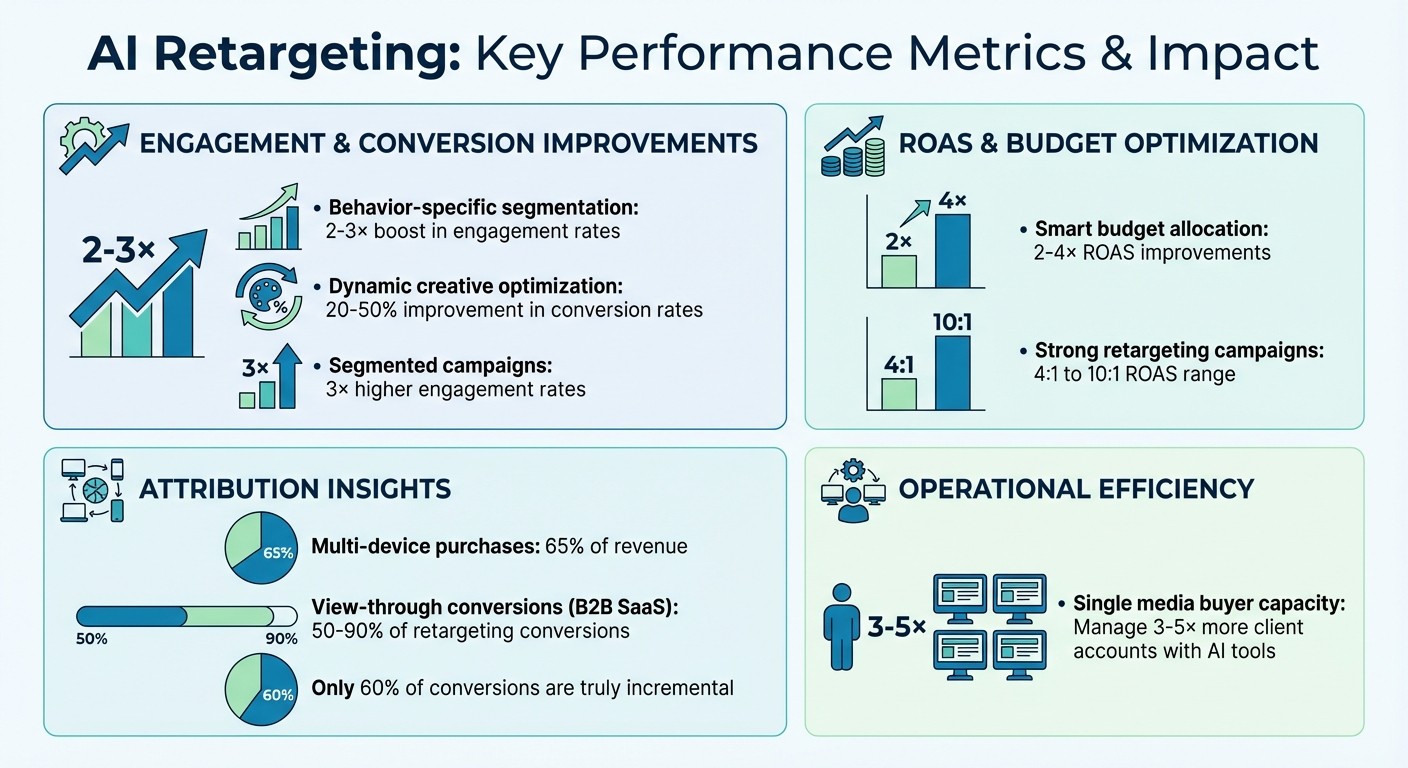
AI Retargeting Performance Metrics and Impact Statistics
How AI Powers Personalized Retargeting
Data-Driven Audience Segmentation
AI takes audience segmentation to the next level by analyzing behavioral data from Meta Pixel, such as browsing patterns, time spent on specific pages, abandoned carts, and user interactions. Instead of treating all visitors the same, AI uses behavioral clustering to categorize users into distinct groups. For example:
Cart Abandoners: Users who add items to their cart but fail to complete the purchase. These individuals might see ads highlighting those exact products, often with urgency-focused messaging.
High-Intent Prospects: Visitors who frequently browse are shown personalized product recommendations tailored to their interests.
Past Purchasers: Customers who’ve already bought from the brand may see upsell or cross-sell campaigns.
This behavioral targeting segmentation can boost engagement rates by 2–3× compared to generic retargeting efforts.
AI also uses predictive modeling to estimate conversion likelihood for different audience segments. This allows advertisers to focus their budgets on high-value opportunities rather than spreading resources evenly across all visitors.
This precise segmentation lays the foundation for creating highly personalized ads.
Dynamic Ad Personalization
Once audiences are segmented, AI steps in to create and test ad variations that align with each user's behavior. Using dynamic creative optimization (DCO), the system combines various elements - like headlines, images, calls-to-action, and product recommendations - to craft the most effective ad for each user.
The personalization even adapts to context. For instance:
Mobile Users at Lunchtime: These users might see quick, punchy calls-to-action designed for on-the-go browsing.
Desktop Users in the Evening: They may be presented with detailed ads, including product reviews and specifications.
Real-time A/B testing and multivariate optimization ensure that the best-performing variations are scaled automatically. This process has been shown to improve conversion rates by 20–50% without requiring manual adjustments.
Tools like AdAmigo.ai enhance this process further by analyzing your brand identity and competitor strategies. They generate fresh, on-brand ad creatives and deliver them directly to your Meta account with a single click, eliminating manual effort while keeping your campaigns consistent and effective.
But AI’s role doesn’t stop at creative optimization - it also manages financial strategies to maximize returns.
Automated Budget and Bid Management
AI-driven systems dynamically adjust budgets and bids using real-time data and predictive analytics. By evaluating factors like conversion probability, user intent, demographics, and device type, the system determines where to allocate resources most effectively. For example:
When high-intent cart abandoners are identified, AI increases bids to ensure these users see retargeting ads.
For low-intent browsers, spending is reduced to avoid wasting ad dollars.
This smart allocation strategy prioritizes high-conversion opportunities, with some campaigns achieving 2–4× ROAS improvements by shifting focus from broad audiences to targeted segments.
AI continuously refines this process through machine learning, updating bids and budgets in real time. Platforms like AdAmigo.ai streamline this further with features like AI Actions, which offer a daily, auto-prioritized list of recommended changes. You can either approve these updates manually or let the system handle them automatically, ensuring your ad spend consistently delivers the best results.
Creative Optimization for Retargeting Campaigns
AI-Driven Creative Testing
AI has reshaped how creative testing works by enabling AI-driven A/B testing of headlines, images, calls-to-action, and ad formats. It doesn’t stop at running tests - it actively analyzes performance data to pinpoint winning combinations and scales them, while underperformers are phased out automatically.
Traditional methods often limit you to testing just one or two variations at a time. AI, on the other hand, can evaluate multiple creative elements simultaneously. By analyzing behavioral data, it identifies which combinations resonate most with specific audience segments. Small changes, like tweaking a headline or swapping out an image, can lead to noticeable performance gains. This constant refresh of underperforming elements ensures campaigns remain effective over time.
After this testing phase, dynamic creative optimization and dynamic product ads take personalization to the next level.
Dynamic Product Ads
Dynamic product ads, powered by AI, build on the insights gained during creative testing. These ads showcase products tailored to each user’s online behavior and browsing habits. By analyzing website interactions - such as items viewed or products added to the cart - the system creates personalized recommendations automatically, eliminating the need for manual setup.
For instance, if a user abandons their cart with a pair of running shoes, they might later see ads featuring those exact shoes. Meanwhile, someone exploring multiple product categories would receive ads tailored to their broader interests. The AI assembles these ads in real time, combining user data with the most effective creative elements to maximize relevance and drive conversions.
But it doesn’t stop at simple product recommendations. AI can design a sequence of ads that guide users through a journey. For example, the first ad might remind them of a product, followed by another showcasing customer reviews, and then a final ad offering a time-sensitive discount. This step-by-step strategy ensures that each interaction builds on the last, rather than bombarding users with repetitive messages.
Maintaining Brand Consistency
Ensuring brand consistency across various creative executions used to require a lot of manual effort. AI simplifies this by learning your brand’s identity and style guidelines, then using AI tools to generate ad creatives that stay true to your brand.
Platforms like AdAmigo.ai take it up a notch by analyzing your top-performing ads alongside competitor strategies to produce fresh, on-brand creatives. With tools like the AI Ads Agent, you can receive fully designed, brand-compliant ad creatives directly in your Meta account with just one click. These ads not only adhere to your visual and messaging standards but also include personalized elements tailored for different audience segments. This approach allows for scaling personalization while maintaining data integrity.
The system continuously tests and scales the best-performing variations while staying aligned with your established guidelines. This allows you to maintain creative control and brand integrity, even when managing numerous ad variations across multiple retargeting campaigns.
Managing Ad Frequency and Fatigue
Automated Frequency Caps
Using AI vs manual audience creation allows systems to manage how often users encounter your retargeting ads, ensuring they don't experience ad fatigue. Instead of relying on one-size-fits-all frequency caps, the system evaluates individual user behavior - like click-through rates or time spent engaging with the ad. From there, it determines the ideal number of ad impressions for each user. If engagement starts to drop, the AI steps in to either reduce the frequency or pause ad delivery altogether. By constantly adjusting these caps based on real-time data, the system ensures users see just enough ads to stay engaged without feeling overwhelmed or bombarded by repetitive content.
Audience Rotation and Exclusion
AI also helps keep your audience targeting fresh by rotating ad variations and excluding users who no longer need to see your ads. For instance, once someone makes a purchase, they’re immediately removed from the retargeting pool for that product. Similarly, users who repeatedly ignore your ads are temporarily excluded to avoid wasting ad spend. The system even detects when certain audience segments are becoming oversaturated and shifts the focus - and budget - to newer, more responsive groups. This constant rebalancing keeps your campaigns efficient and ensures you're targeting the right people at the right time.
Balancing Retargeting and Prospecting
AI doesn’t just optimize retargeting; it also helps balance it with prospecting and retargeting efforts. By monitoring key metrics like click-through rates (CTR), cost-per-click (CPC), and return on ad spend (ROAS) in real time, the system reallocates budgets where they’ll have the most impact. For example, if retargeting audiences show signs of fatigue - like declining engagement or rising costs - the AI shifts spending toward prospecting new customers.
Platforms such as AdAmigo.ai make this process even easier with tools like AI Actions, which provide daily recommendations for prioritizing budgets and audience adjustments. These tools ensure you’re not overspending on retargeting while still making the most of warm audiences when they’re most likely to convert. Together, these strategies create a seamless cycle of optimization, improving both customer acquisition and overall campaign performance.
Retargeting with AI-powered dynamic ads - Business Guide
Measuring Success in AI-Optimized Retargeting
Measuring the success of your campaigns is essential for making the most of AI's ability to refine and improve results.
Multi-Touch Attribution Tracking
AI understands that conversions don’t usually happen after just one ad impression. Instead, it tracks the customer’s entire journey across devices and platforms, assigning value to every interaction by choosing between single-touch vs. multi-touch attribution. For instance, position-based models focus more on the first and last touchpoints, while time-decay models give more credit to interactions closer to the conversion. The most advanced method, data-driven attribution, uses algorithms to improve attribution accuracy by analyzing campaign data and distributing credit among all touchpoints to see how attribution models impact performance.
Here’s a key stat: 65% of revenue comes from purchases involving multiple devices. Picture this: someone might spot your ad on their phone during lunch, research the product later on a tablet, and finally make the purchase on their desktop. AI also tracks view-through conversions - when users see an ad, don’t click, but later convert. For B2B SaaS businesses with longer sales cycles, these conversions can account for 50% to 90% of all retargeting conversions.
Conversion and ROI Metrics
AI doesn’t just track how many people convert - it digs deeper into metrics like cost per acquisition (CPA), return on ad spend (ROAS), and customer lifetime value (LTV). By analyzing these, it fine-tunes your campaigns in real time. A strong retargeting campaign often delivers an ROAS between 4:1 and 10:1, and AI works to keep your results within - or above - that range.
AI also segments performance based on user behavior. For example, it compares how cart abandoners respond versus casual blog readers. Why? Because segmented campaigns drive engagement rates that are three times higher.
Another critical metric is incremental lift, which measures how many conversions are directly caused by retargeting. Research indicates that only 60% of retargeting conversions are truly incremental, meaning the rest would have happened anyway. To address this, AI uses holdout groups and control testing to pinpoint the impact of your campaigns, helping you avoid overspending on customers who don’t need the extra nudge.
Automated Reporting and Insights
AI simplifies reporting by offering daily performance updates and highlighting areas for improvement. Tools like AdAmigo.ai's AI Actions provide a prioritized to-do list every morning, suggesting impactful changes to creatives, audiences, budgets, and bids. You can even ask the AI Chat Agent specific questions like, “Why did CPA increase yesterday?” or “Which audience segment is spending the most budget?” and get instant, data-driven answers.
The system doesn’t just report - it monitors your campaigns around the clock. It detects issues like audience fatigue or unexpected cost increases and sends alerts with actionable recommendations. This shift from static reports to real-time adjustments means you’re not just analyzing past performance - you’re actively improving campaigns as they run, potentially making thousands of adjustments per hour.
Conclusion
AI retargeting is reshaping the way personalized advertising works. Forget the days of manually segmenting audiences and juggling multiple campaigns - AI steps in to handle it all. It analyzes user behavior, tailors ad creatives, and adjusts budgets in real time. The result? You can serve highly relevant ads to thousands of users without spending hours micromanaging your campaigns.
What’s more, AI retargeting takes over tasks that used to require an entire team, freeing up time and resources. Tools like AdAmigo.ai work around the clock, allowing a single media buyer to manage three to five times more client accounts without sacrificing performance. For in-house teams, it’s like having a tireless assistant that constantly learns and optimizes using real-time data. Many marketers are now evaluating the best AI tools for optimizing paid ads to stay competitive.
Another major benefit is the boost to your return on ad spend (ROAS). AI doesn’t just run campaigns - it continuously fine-tunes them, reallocating resources automatically to ensure better results over time.
AI also removes the guesswork from campaign management. It keeps an eye on ad frequency and creative fatigue so you don’t have to. Wondering why your CPA spiked? Just ask, and you’ll get instant, data-backed insights. This shift from reactive troubleshooting to proactive optimization means your campaigns are always improving and staying ahead of the curve.
When it comes to scaling Meta retargeting efforts, AI doesn’t just simplify execution - it lets you focus on the bigger picture, like strategy and creative innovation.
FAQs
What data do I need to start AI retargeting?
To get started with AI retargeting, you'll need to gather user action data. This includes things like website interactions, abandoned carts, and product views. Tools like the Meta Pixel and Conversions API are commonly used to track and collect this data effectively.
How does AI decide who sees which retargeting ad?
AI decides who gets retargeting ads by analyzing user behavior through tools like Meta Pixel and Conversions API. It identifies patterns based on actions such as viewing a product, leaving items in the cart, or simply visiting the website. This ensures ads are targeted at people who’ve already shown interest in the brand.
With machine learning, AI continuously fine-tunes these audience segments. Over time, it improves ad relevance, increases return on ad spend (ROAS), and reduces wasted advertising dollars.
How do I know AI retargeting is truly boosting ROAS?
To see if AI retargeting is boosting your ROAS, keep an eye on key metrics such as higher conversion rates and lower cost per acquisition (CPA). For instance, case studies reveal that businesses have achieved up to a 25% increase in ROAS while maintaining a low cost per impression (CPI). Tools like AdAmigo.ai make this process even more effective by automating tasks like audience targeting, creative optimization, and real-time budget adjustments - all of which contribute to delivering measurable improvements.