Meta Ads Weapons & Explosives Policy: Banned Items, Exceptions, and Compliance Guide
Does Facebook allow gun ads? No. Meta bans weapons, ammo, and explosives from ads — see retailer exceptions, age-targeting rules, and how to appeal rejections.
If you're wondering whether you can run ads for firearms, ammunition, or related products on Meta, the answer is almost always no — and getting it wrong can cost you your ad account. Meta strictly prohibits ads promoting weapons, ammunition, explosives, or related accessories to maintain user safety and comply with global laws. This includes firearms, firearm parts, self-defense tools, non-culinary blades, and any content teaching weapon assembly or use. Ads for safety training or accessories like holsters are allowed under strict age-targeting rules. This is especially critical when avoiding teen targeting risks for restricted products.
Key points:
Banned items: Firearms, ammunition, explosives, self-defense tools, and weapon accessories.
Exceptions: Physical retailers can promote certain products off-platform with age restrictions (21+ for firearms, 18+ for accessories).
Enforcement: Ads are reviewed by automated systems and a global team of 15,000 reviewers within 24 hours.
Appeals: Advertisers can request reviews for rejected ads via the Account Quality tool.
Advertisers must ensure compliance by targeting the correct audience by following Meta ads age compliance FAQs, adhering to Meta's guidelines, and monitoring ad performance regularly. Violations can result in account restrictions or ad rejections.
Does Facebook Allow Gun Ads? A Quick Answer
No — Meta prohibits ads that promote the sale or use of weapons, ammunition, or explosives. This includes firearms, firearm parts and accessories, self-defense tools, non-culinary blades, and any content that teaches weapon assembly or modification. Even paintball guns and BB guns are off the table.
There is one narrow exception: verified brick-and-mortar and online retailers can advertise firearms, ammunition, and explosives — but only when the actual sale happens off of Meta's platforms (on the retailer's own website or in-store), and only when the ads are targeted exclusively to users aged 21 and older. Accessories like holsters, gun safes, and protective vests can be advertised to users 18 and older. If you're not a licensed retailer meeting those criteria, weapon-related ads are a non-starter.
Posting vs. Advertising: Two Different Sets of Rules
One of the biggest sources of confusion is the difference between what you can post on Facebook and what you can advertise. They're governed by two completely separate policies:
Meta's Community Standards govern organic posts — what you share on your timeline, in groups, or on your Page. These rules are more permissive: you can post pictures of firearms, discuss guns, and share hunting content, provided you're not coordinating private sales or promoting violence. The Community Standards focus on safety and preventing harm, not on restricting commerce.
Meta's Advertising Standards govern paid ads — what appears in the News Feed, Stories, and Reels with a "Sponsored" label. These rules are far stricter. You cannot promote the sale or use of weapons, ammunition, or explosives in ads, period — regardless of how benign the content might seem.
This distinction matters because many advertisers assume that if they can post about something, they can run ads for it. That assumption is what gets ad accounts flagged. If you're uncertain which set of rules applies to your content, understanding the difference between organic and paid weapons content rules is the first step toward staying compliant.
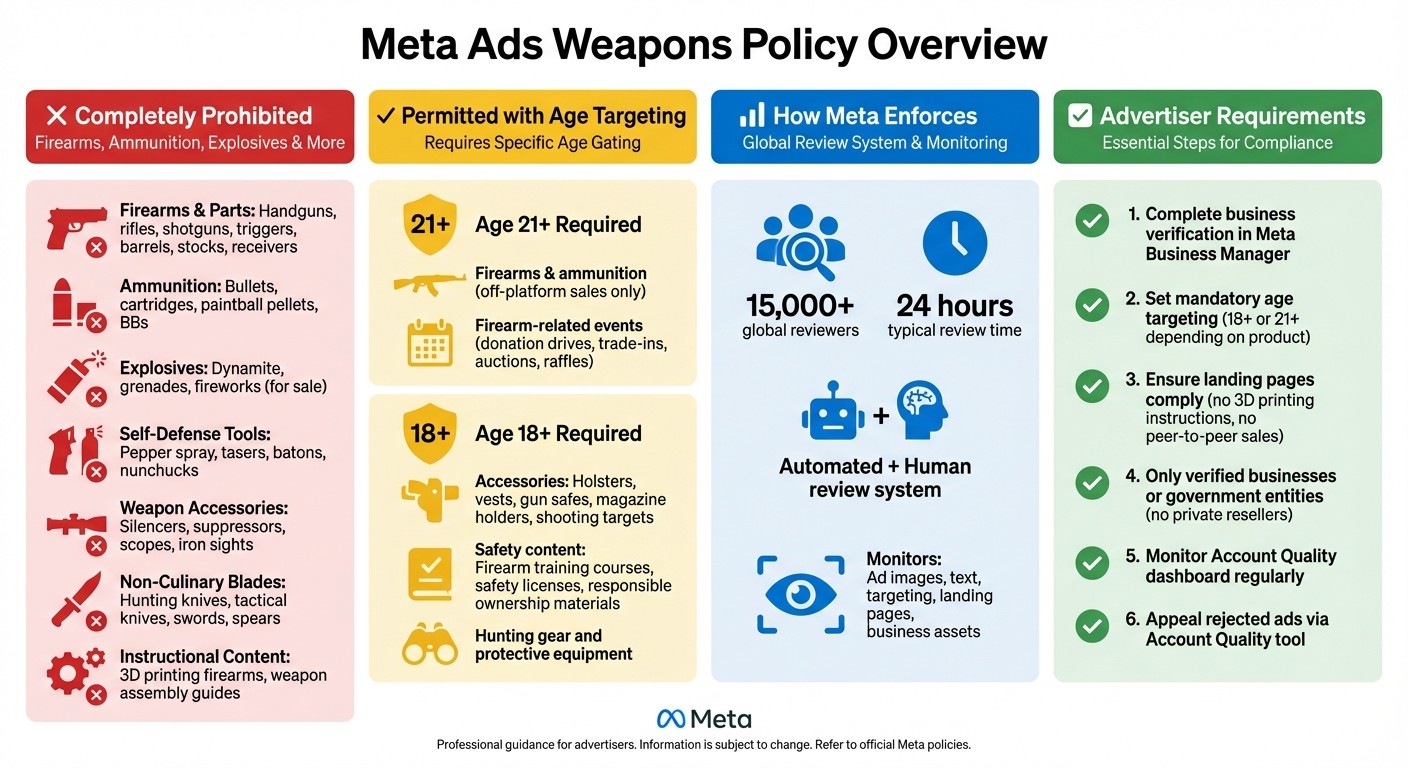
Meta Ads Policy: Banned vs Allowed Weapons-Related Content
How To Legally Run Facebook or Google Ads In A Restricted Industry (Firearms, Cannabis, etc.)
What Weapons Are Banned in Meta Ads
Meta's policy on weapons is strict, prohibiting any item designed to harm people or animals. This includes firearms, firearm parts, ammunition, and accessories like silencers, suppressors, and scopes. The ban isn't limited to firearms — it also applies to non-firearm weapons, such as paintball guns, BB guns, and self-defense tools like pepper spray, tasers, nunchucks, and batons. Even knives and blades that aren't meant for culinary use, along with spears, fall under the restriction.
Additionally, any content that reviews these weapons or provides instructions for making them, such as 3D printing firearms, is also prohibited. Meta has outlined these rules in clear terms, and the examples below shed more light on the specifics. To ensure your creative assets don't trigger a rejection, you can set guardrails for Meta ads to maintain control, you can follow a checklist for avoiding illegal products or use a Meta ad policy checker before submitting.
Examples of Banned Weapons
Here are some specific examples of items that fall under Meta's ban:
Firearms: This includes handguns, rifles, shotguns, and all related parts like triggers, barrels, stocks, and receivers.
Self-defense tools: Items such as pepper spray, tasers, batons, and nunchucks are not allowed.
Weapon accessories: Items that modify or enhance a weapon's functionality, such as silencers, suppressors, scopes, and iron sights, are banned.
Non-culinary blades: Hunting knives, tactical knives, swords, and spears are prohibited, although kitchen knives are permitted.
Meta also restricts advertisements for businesses where the primary focus is the exchange of weapons.
Why Meta Bans Weapon Advertising

Meta's rationale for these restrictions ties back to its commitment to user safety and maintaining a positive experience on its platforms. By banning weapon-related content, Meta aims to prevent violent or harmful material from circulating. These rules align with the company's broader Community Standards, including policies on "Coordinating Harm and Promoting Crime", "Dangerous Organizations and Individuals", and "Violent and Graphic Content".
"To help keep both businesses and organizations who use our ad tools safe, and create a welcoming environment for everyone who uses our products and services, we have put in place our Advertising Standards to guide what is allowed across Meta technologies." - Meta Advertising Standards
Meta enforces these rules through a global team of over 15,000 reviewers, who typically review ads within 24 hours. These measures also help Meta comply with political and regional advertising laws while maintaining consistent safety standards across its global platform. This approach reflects Meta's dedication to fostering a secure and welcoming online environment, as outlined in its Community Standards.
Banned Ammunition and Explosives
Meta has a strict no-tolerance policy when it comes to advertising ammunition. This includes bullets, cartridges, and even recreational ammunition like paintball pellets and BBs. Ads promoting the sale or use of any of these items are strictly prohibited.
The same goes for explosives. Items such as dynamite, grenades, and fireworks are banned from advertisements. Fireworks, in particular, are classified as explosives due to safety concerns. However, there's an exception: you can feature fireworks or other explosives in ads as long as the context is celebratory, non-violent, and doesn't involve any sales.
What Types of Ammunition Are Banned from Meta Ads?
Meta's ban covers all forms of ammunition. This includes:
Standard bullets and cartridges for firearms
Specialized rounds for hunting or target shooting
Non-lethal ammunition like paintball pellets and BBs
Even these non-lethal options are explicitly off-limits for ads.
"Ads must not promote the sale or use of weapons, ammunition or explosives. This includes ads for weapon modification accessories." - Meta Advertising Standards
What Explosives Are Banned from Meta Ads?
Meta also prohibits the advertising of all explosives. This includes:
Industrial products like dynamite
Military-grade items such as grenades
Consumer-grade products like fireworks
This policy aims to prevent the promotion of items that could lead to harm. Staying ahead of these restrictions requires knowing how to adapt to Meta policy changes effectively. For products that are allowed — like gun safes or protective gear — advertisers must ensure strict compliance through team training. This includes targeting only users aged 18 and older by following age-restricted content rules and ensuring all ad elements (images, text, landing pages) meet Meta's guidelines.
Exceptions for Physical Retailers and Approved Advertisers
Meta's weapons policy includes specific exceptions that allow verified physical retailers to advertise certain products, provided they adhere to strict age restrictions and verification processes.
How Physical Retailers Can Advertise Certain Products
Physical retailers are permitted to advertise firearms, ammunition, and explosives, but only if the sales take place outside of Meta's platforms. These ads must be targeted exclusively to individuals aged 21 and older.
Retailers can also promote firearm-related events, such as donation drives, trade-in programs, auctions, and raffles, as long as the audience is restricted to users aged 21+. When it comes to accessories like holsters, vests, gun safes, magazine holders, and shooting targets, as well as safety-related content, the target audience can include users aged 18 and older. Safety-related content includes ads for firearm training courses, safety licenses, and materials focused on responsible gun ownership.
"Brick-and-mortar and online retailers may promote firearms, alcohol, and tobacco items available for sale off of our services; however, we restrict visibility of this content for minors." - Meta Advertising Standards
These guidelines ensure that promotional content complies with Meta's policies while maintaining a strong emphasis on age-appropriate targeting.
Disclosure and Documentation Requirements
To implement these targeted advertising strategies, Meta enforces rigorous business verification processes. Advertisers in sensitive categories may be required to complete additional verification steps if flagged by Meta's systems. Completing all available verification steps in Meta Business Manager is recommended to minimize the risk of automated restrictions.
Mandatory age targeting is a cornerstone of these policies. Ads for firearms and ammunition must specify an audience aged 21 and older, while ads for accessories and hunting equipment must target users aged 18 and older. Additionally, landing pages linked to these ads must follow Meta's guidelines, which prohibit content like 3D printing instructions for firearms or tools enabling direct peer-to-peer sales. Only verified businesses or government entities — not private resellers — are allowed to run these promotions.
Facebook Marketplace vs. Meta Ads: A Separate Set of Rules
Another common point of confusion: Facebook Marketplace has its own Commerce Policies, and they are not the same as the Advertising Standards this page covers. If you're asking "can you sell guns on Facebook Marketplace" or "are you allowed to list gun holsters," you're asking about commerce rules — not ad rules.
Here's the distinction:
Facebook Marketplace prohibits the sale of firearms, ammunition, and explosives entirely. Even accessories like holsters and gun cases face restrictions. Meta's Commerce Policies ban person-to-person weapon sales, and attempting to list prohibited items can result in Marketplace access being revoked.
Meta Ads (the focus of this page) govern paid promotions. While the ad policies are similarly strict about weapons, they do carve out exceptions for verified retailers — something Marketplace does not offer.
If your goal is to sell firearm-related products commercially, advertising through a verified Business Account with proper age targeting is your path. If you're trying to list items person-to-person, you'll need to understand the Marketplace weapons commerce policies instead. The two systems operate independently, and compliance with one doesn't guarantee compliance with the other.
How Meta Enforces Weapons and Explosives Policies
Meta uses a combination of automated tools and human reviewers to enforce its policies on weapons and explosives. This system is designed to complete checks within 24 hours, ensuring swift action when violations occur. Their enforcement team includes over 15,000 reviewers globally, working alongside automated systems that analyze ad images, text, targeting criteria, and landing pages for any breaches of policy.
Despite these systems, enforcement gaps are well-documented. A 2024 investigation by the Tech Transparency Project found that Meta approved 237 ads selling guns, gun accessories, or ammunition in violation of its own policies — including 34 ads for illegal auto sears (conversion devices that turn semi-automatic handguns into fully automatic weapons) and 107 ads for Glock handguns. More than 90% of these violating ads appeared on Instagram.
"Our global team of over 15,000 reviewers work every day to keep people on Facebook safe." - Meta Transparency Center
Meta also keeps a close watch on advertiser behavior and business assets, such as Pages and ad accounts, to detect potential misrepresentation or suspicious activities. Reports from users, government agencies, and NGOs can prompt additional scrutiny — even after an ad has been approved and is live.
Common Policy Violations
While Meta's monitoring system is extensive, challenges remain. A 2022 Tech Transparency Project report identified 173 ads with weapons-related content actively running on Facebook and Instagram during a two-week period. Notably, 78% of those ads — 135 out of 173 — disappeared from Meta's Ad Library within 60 days because they weren't categorized as political or issue ads, making independent oversight difficult. Between 2017 and 2021, law enforcement recovered an estimated 9,130 privately made silencers, marking a 176.8% increase compared to the prior five years. Repeated or severe violations can lead to ad rejections or restrictions on Business Accounts, Pages, or ad accounts. To address these issues, Meta offers advertisers a clear process for appealing decisions.
How to Appeal a Rejected Ad
If your ad is rejected, you have two options: remove the prohibited content and resubmit it (ensuring the landing page complies with policies), or request a manual review through the Account Quality section. Keep in mind that even ads that initially pass reviews can be re-evaluated later.
"If you think your ad was mistakenly rejected, or if you think your Business Account or its assets were mistakenly restricted, you can request a review of either decision in Account Quality." - Meta Transparency Center
Why Is My Advertising Access Restricted?
If you're seeing "Your Advertising Access Is Restricted" in your Meta account, and you've been running ads anywhere near the weapons, hunting, or outdoor gear space, a weapons-policy violation is one of the most common triggers. Here's how to diagnose and address it.
Single Ad Rejection vs. Account-Level Restriction
These are two very different situations — and knowing which one you're dealing with determines your next move:
A single ad rejection means one specific ad was flagged. You'll see it in Account Quality with a policy explanation. The fix is usually straightforward: edit the ad to remove the prohibited content (or appeal if you believe it was a mistake), and resubmit. Your other campaigns continue running.
An account-level restriction means Meta has restricted your ability to advertise across your entire ad account or Business Account. This is far more serious. It often follows repeated policy violations, a pattern of rejected ads, or a single severe infraction. When this happens, all your active ads are paused, and you cannot create new ones until the restriction is resolved.
Common Weapon-Policy Triggers That Get Accounts Flagged
Meta's automated systems look for specific signals. If your ads or landing pages include any of the following, a restriction is likely:
Images or video showing firearms, even in a lifestyle or outdoor context
Ad copy mentioning "buy," "sale," "shop," or "order" near weapon-related terms
Landing pages that list firearm accessories, ammunition, or tactical gear for sale
Targeting parameters that combine age ranges under 21 with outdoor or hunting interests
Using the same ad account to test weapon-adjacent creatives after a prior rejection
How to Appeal and Restore Access
If your advertising access is restricted, the path to recovery depends on the severity:
Go to Account Quality (business.facebook.com/accountquality) and identify the specific restriction. Meta will show which policy was violated and on which asset.
If it's a single ad rejection, remove the violating content and resubmit, or request a manual review if you believe the rejection was an error. Ads that are edited to comply typically get re-reviewed within 24 hours.
If it's an account-level restriction, you'll need to request a review through Account Quality. Be prepared to explain what went wrong and what you've changed. Meta evaluates your entire account history, so a clean track record helps. Follow the steps to recover disabled Meta ad accounts for a detailed walkthrough.
For persistent or weapon-specific restrictions, understanding the process for fixing restricted advertising access for weapons violations can help you navigate the appeal with the right framing. Restoring access often takes multiple review cycles — patience and thorough documentation are key.
The Washington Post reported that Meta operates on a "10-strike" policy for gun sale violations on its platforms — meaning users can accumulate multiple infractions before losing access entirely. But for advertisers, the bar is lower: even a few rejected ads can trigger broader account scrutiny. Staying proactive with your Account Quality dashboard is your best defense.
How to Optimize Meta Ads While Staying Compliant
Staying compliant with Meta's weapons policy doesn't have to mean sacrificing ad performance. The trick is to incorporate compliance checks into your workflow before your ads are submitted to Meta's automated review system. Catching potential issues early protects your ad account from restrictions and ensures smoother approval within Meta's compliance framework.
Using AdAmigo.ai for Compliant Ad Optimization
AdAmigo.ai is a powerful tool for ensuring your ads align with Meta's policies. It scans ad creatives and copy for restricted content — like weapons, ammunition, or modification accessories — before submission. This automated process identifies elements likely to trigger rejections. It also checks targeting parameters to ensure compliance, such as restricting audiences to users aged 18 or older for items like holsters or hunting gear.
When risks are detected, AdAmigo offers compliant alternatives. For example, if you're promoting tactical gear, the system might adjust the creative to highlight non-violent uses, like sporting or hunting contexts, which Meta allows. The AI Chat Agent is another helpful feature, offering real-time guidance on complex policy questions. Even after ads go live, Meta's review process continues, so AdAmigo's daily monitoring ensures you stay ahead of potential issues by providing ongoing compliance recommendations. This tool works alongside Meta's policies to help you avoid common pitfalls and keep your campaigns running smoothly.
Best Practices for Policy-Compliant Advertising
Audit your landing pages. Meta evaluates the destination URL during the ad approval process, so make sure your landing page is free of issues like broken links, intrusive pop-ups, or prohibited products, ensuring landing-page consistency to avoid penalties. Sensitive content should be targeted to the right age groups and must not display weapon modification accessories.
Monitor the Account Quality dashboard regularly. Checking this daily helps you catch sudden drops in reach or new policy flags before they affect multiple campaigns. Enable real-time alerts in Meta Business Suite to get immediate notifications if an ad is disapproved. Keeping a compliance log of policy changes and past violations can also help your team spot trends and avoid repeat mistakes. Keep in mind, Meta tracks advertiser behavior across all assets, meaning a single violation can impact your entire Business Account.
Conclusion
Meta's policies on weapons and explosives might seem restrictive, but they don't prevent effective advertising campaigns. Ads for firearms, ammunition, explosives, and weapon modification accessories are entirely prohibited by the platform. That said, there's room to promote related content like safety courses, firearm licenses, educational materials, and hunting gear such as holsters, gun safes, and protective vests — as long as these ads are targeted to users aged 18 and older.
Staying compliant is critical to protecting your Business Account security from restrictions on ad accounts, Pages, or user access. Meta's automated review process, which usually takes about 24 hours, is a key part of this vigilance. Regularly monitoring for updates and ensuring adherence to policies is essential.
"Our policies require all advertisers to comply with the laws in their jurisdiction, not engage in discriminatory practices, and not sell illegal or unsafe substances." - Meta Advertising Standards
To keep your campaigns running smoothly, make compliance part of your routine. Double-check your creatives and landing pages for conversion data compliance before submitting ads, confirm that age targeting is properly set, and keep a close eye on your Account Quality dashboard to detect and fix Meta Ads anomalies. If an ad gets rejected and you believe it's an error, you can always appeal using the Account Quality tool.
Focus on promoting approved content like safety training, educational resources, and legal accessories to achieve strong campaign results while staying within Meta's guidelines.
FAQs
Can I advertise hunting knives or swords on Meta?
Meta has a strict policy against ads for hunting knives, swords, or any items considered weapons. This includes a ban on promoting weapons, weapon accessories, or anything that could cause harm to people or animals.
What age targeting is required for firearm accessories like holsters?
Meta enforces strict guidelines for advertising firearm accessories, such as holsters. These ads must exclusively target audiences aged 18 or older. Promoting the sale or use of weapons and related accessories to minors is strictly prohibited.
Why are weapon-related ads approved and then later removed?
Meta may approve weapon-related ads during the initial review if they align with the platform's policies. However, these ads can still be removed later. This might happen if they violate updated guidelines, are flagged by users, or are identified by automated systems for promoting restricted items such as weapons, ammunition, or explosives. Meta frequently updates its policies to stay in line with community standards.
Can gun shops advertise on Facebook?
Yes — but only if they are verified brick-and-mortar or online retailers and the ads direct users to complete purchases off of Meta's platforms. Gun shop ads must be targeted exclusively to users aged 21 and older, and the shop must complete Meta's business verification process. Ads cannot promote in-platform transactions or person-to-person sales.