
How Transparent Ads Build Trust on Meta
Meta ad transparency, consent rules, and practical tips to boost CTR, ROAS, and reduce ad rejections.
Transparent ads on Meta are not just about compliance - they're about building trust and improving performance. Here's how:
Clear Policies: Meta enforces strict ad labeling and disclosure rules. Tools like the Ad Library and "Why am I seeing this?" explain ad targeting to users, fostering trust.
Data Transparency: As of January 2025, advertisers must secure active user consent for custom audience targeting. Lead forms must clearly disclose data usage.
Global Standards: The EU Digital Services Act (DSA) sets stricter transparency rules, such as archiving all ads and banning targeted ads for minors.
Better Results: Transparent ads lead to higher click-through rates (CTR), better Return on Ad Spend (ROAS), and fewer ad rejections. Users respond positively to clear pricing, terms, and data practices.
Tools for Compliance: Platforms like AdAmigo.ai automate compliance and improve ad performance by integrating transparency into ad creation and management.
Transparent advertising isn’t just ethical - it drives better engagement, reduces ad rejections, and builds long-term customer relationships.
Meta Ads Policies Explained (How to Avoid Ad Rejection) - Media Buying Course
Meta's Transparency Policies and Requirements
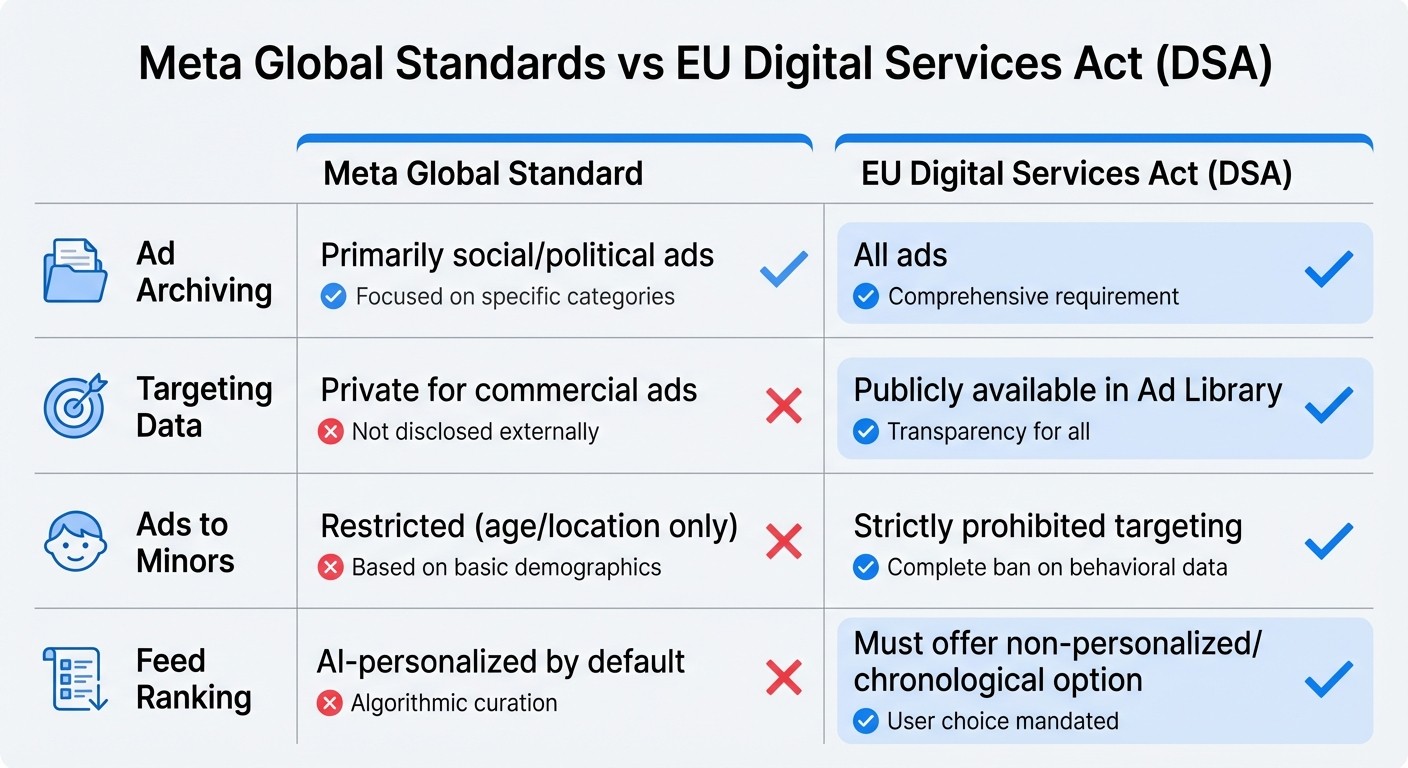
Meta Global Standards vs EU DSA Transparency Requirements Comparison
Meta enforces strict guidelines around ad labeling, user consent, and disclosure to ensure transparency across its platform. These rules apply to all advertisers, from small businesses with local campaigns to agencies managing extensive budgets. Knowing these policies not only helps you stay compliant but also strengthens trust - an essential ingredient for better ad performance.
Ad Labeling and Disclosure Rules
Meta mandates clear labeling for AI-generated content, especially for ads featuring photorealistic or heavily AI-edited human images. If Meta's AI tools are used, the platform automatically adds a label, visible in the three-dot menu or near the "Sponsored" tag. However, for ads created using third-party AI tools, advertisers must manually disclose AI usage to avoid rejection.
"We are committed to providing clear information about how our generative AI tools contribute to the ads people see on our services." - Pedro Pavón, Director, Monetization Policy, Meta
For political or social issue ads, Meta requires identity verification and includes a "Paid for by" disclaimer to identify the funding source. This label is mandatory and prominently displayed on all such ads. To ensure compliance, review all creatives for proper labeling before launching campaigns.
Next, let's explore how these policies extend to the management of user data in lead ads.
Data Transparency in Lead Ads
Starting January 1, 2025, advertisers must obtain active user consent before uploading any contact information for custom audience targeting. This includes email lists, phone numbers, and CRM data. Lead ad forms must prominently display data use disclosures - ideally above the submit button - so users clearly understand how their information will be used.
To comply, ensure opt-in boxes are unchecked by default and maintain documentation of user consent for potential audits. Meta’s AI-driven "Policy Zones" system monitors billions of consent checks hourly, ensuring uploaded data aligns with user permissions. Additionally, the "Why am I seeing this?" feature provides users with the name of the business that uploaded their data and the date it was added.
Beyond these domestic requirements, Meta must also adhere to stricter international transparency standards.
EU DSA and Global Transparency Standards
The EU Digital Services Act (DSA) imposes higher transparency requirements than Meta's global policies. In the EU, Meta must archive all ads - both commercial and political - for one year in the Ad Library. This archive includes publicly searchable targeting details such as age, gender, and location. Outside the EU, only social, electoral, and political ads are subject to this level of scrutiny.
The DSA also bans targeted ads directed at minors and prohibits profiling based on sensitive attributes like ethnicity, religion, or health status. Globally, Meta has adopted some of these protections, limiting teen ad targeting to age and location. In December 2025, the European Commission fined X €120 million for failing to meet transparency requirements, including maintaining an unusable ads library.
Feature | Meta Global Standard | EU Digital Services Act (DSA) |
|---|---|---|
Ad Archiving | Primarily social/political ads | All ads |
Targeting Data | Private for commercial ads | Publicly available in Ad Library |
Ads to Minors | Restricted (age/location only) | Strictly prohibited targeting |
Feed Ranking | AI-personalized by default | Must offer non-personalized/chronological option |
If you're running campaigns in the EU, it’s crucial to audit your targeting settings. Avoid using sensitive categories that are prohibited under the DSA. Remember, targeting details and audience reach data will remain publicly searchable for a year, embedding transparency into every campaign.
How to Create Transparent Ad Messaging
Creating transparent ads isn't just about avoiding rejections - it’s about building trust with your audience through honest and clear communication. By aligning with Meta’s policies, you can craft messaging that not only complies with guidelines but also resonates with potential customers.
Clear Disclosures in Ad Copy and Visuals
Start by being upfront in your ad copy. Clearly state pricing details, renewal terms, and any restrictions. For example, a compliant ad might say:
"Sponsored: Get 50% off your first box! $29.99/month after, cancel anytime. Free shipping in US. [Shop Now]"
This straightforward approach avoids misleading tactics and, according to Meta case studies, can increase click-through rates by 15–20%.
When it comes to visuals, the placement and size of disclosures are critical. Ads with fine print buried below the fold or occupying less than 20% of the image area are often rejected by Meta. Use bold, prominent fonts to highlight key details like "Subscription required after trial" directly on the product image. To ensure compliance, utilize Meta's ad preview tool to confirm that disclosures are clearly visible on both mobile and desktop devices.
Your landing page needs to match your ad perfectly. If your ad promises "$29.99/month", that pricing should be immediately visible on the landing page - without hidden fees or unexpected terms. Misaligned messaging led to Meta rejecting over 10 million ads in 2023 for misleading claims. Consistency between your ad and landing page builds trust and reduces confusion.
Privacy Notices and Follow-Up Communication
Transparency doesn’t stop at the ad - it extends to how you handle user data and follow-up communication. When using lead forms, include explicit consent options. For instance, add a mandatory checkbox with a clear statement like:
"I agree to receive communications and understand my data will be used per our privacy policy",
and provide a direct link to your privacy policy. Meta’s Instant Forms allow you to customize notices such as:
"We collect name, email, and phone for follow-up; data not sold to third parties."
After a user converts, send a confirmation email within 24 hours. This email should acknowledge receipt of their data and include a direct link to your privacy policy. Avoid pushing a hard sell in this communication. Instead, focus on delivering value, such as providing a promised free guide or resource. Use double opt-in systems to track opt-outs and honor them promptly. Meta’s lead center can help log these interactions, ensuring an audit trail if needed. Consistency from ad to landing page to follow-up communication reinforces trust.
Compliant vs. Non-Compliant Ad Examples
Transparent ads tend to perform better. They see 25% higher ROAS and experience 18% fewer rejections compared to campaigns with vague or misleading messaging. Testing different ad variables reveals that ads with clearly disclosed pricing convert 12% more effectively than those that obscure terms.
Practice | Compliant Example | Non-Compliant Example |
|---|---|---|
Ad Copy | "Sponsored: Get 50% off your first box! $29.99/month after, cancel anytime. Free shipping in US." | "50% off!*" (terms buried in image footer) |
Visuals | Bold text overlay: "Limited time offer. Terms apply." | Tiny asterisk footnote unreadable on mobile |
Data Handling | Unchecked opt-in box with a linked privacy policy | Pre-checked "Agree to all" boxes |
Consent Language | "We use your email to show you relevant ads on Facebook." | "Data processing for algorithmic optimization." |
To simplify compliance, third-party compliance tools like AdAmigo.ai's AI Ads Agent can help. This tool generates ad creatives with built-in disclosures, analyzes Meta’s policies alongside your brand style, and creates new compliant variations with just one click. It’s a scalable way to maintain transparency as your campaigns grow.
Benefits of Transparent Ads on Meta
By following Meta's transparency guidelines and creative best practices, transparent ads not only improve ad performance but also ensure better compliance with policies.
Better Ad Performance and ROAS
Transparent ads consistently deliver stronger results compared to vague campaigns. For example, swapping out generic phrases like "affordable" with specific details such as "starting at $29/month" enhances credibility and attracts more clicks. This clarity helps users set accurate expectations, which leads to higher click-through rates (CTR).
Meta’s algorithms also reward transparency, reducing CPMs and boosting ROAS. The financial benefits are undeniable: 96% of organizations report seeing a positive ROI from investments in privacy and transparency. Additionally, clear messaging reduces customer churn because buyers come in with realistic expectations, leading to extended customer relationships and higher lifetime value.
"Transparency signals respect. It shows that you see your audience not just as clicks, but as people who deserve clarity." - LeadEnforce
Transparency also shifts user perception. When users understand why an ad is relevant to them, they’re more likely to engage instead of ignoring it. This shift in mindset translates into better conversion rates and improved ROAS.
Beyond performance, transparent ads simplify compliance with Meta’s policies, reducing the likelihood of ad rejections or disruptions.
Fewer Rejections and Better Policy Compliance
Meta’s transparency guidelines emphasize clear messaging, which doesn’t just improve ad performance - it also helps marketers avoid policy violations. Ads that clearly disclose pricing, terms, and data usage are less likely to face disapprovals. This means fewer delays from resubmissions and a reduced risk of sudden account restrictions that can throw off your marketing schedule.
Trust is another key factor. 44% of consumers say they are more likely to trust a brand that clearly explains how their data is used. By addressing privacy concerns directly in your ads and lead forms, you’re not just meeting compliance standards - you’re also laying the groundwork for stronger customer relationships.
Benefit Category | Impact on Performance | Metric to Track |
|---|---|---|
Engagement | Higher CTR due to honest, specific messaging | |
Cost Efficiency | Lower CPMs as Meta rewards relevant ads | Cost Per Mille (CPM) |
Compliance | Fewer ad disapprovals and account issues | Ad Rejection Rate |
Retention | Reduced churn from realistic expectations | Customer Lifetime Value (CLV) |
User-Focused Features that Build Trust
Meta’s transparency tools work to your advantage when your ads are upfront and honest. Features like "Why am I seeing this ad?" and the Ad Library allow users to verify your targeting logic, which builds trust. For example, users might see messages like "You're seeing this because you visited our website" or "You're in our target age range for this product." This level of clarity reassures users and reinforces your credibility.
Other tools, such as AI labeling for synthetic content and Consent Mode for privacy preferences, show users that you respect their choices while still enabling you to track conversions through modeling. These features transform potential concerns into opportunities to strengthen trust and accountability.
Tools for Transparency and Compliance
Using the right tools can make a big difference when it comes to maintaining transparency in your ad campaigns and staying compliant. Transparent advertising on Meta doesn’t have to mean micromanaging every detail. The right tools can help you streamline the process while still optimizing performance.
AdAmigo.ai: Automated Transparency and Performance
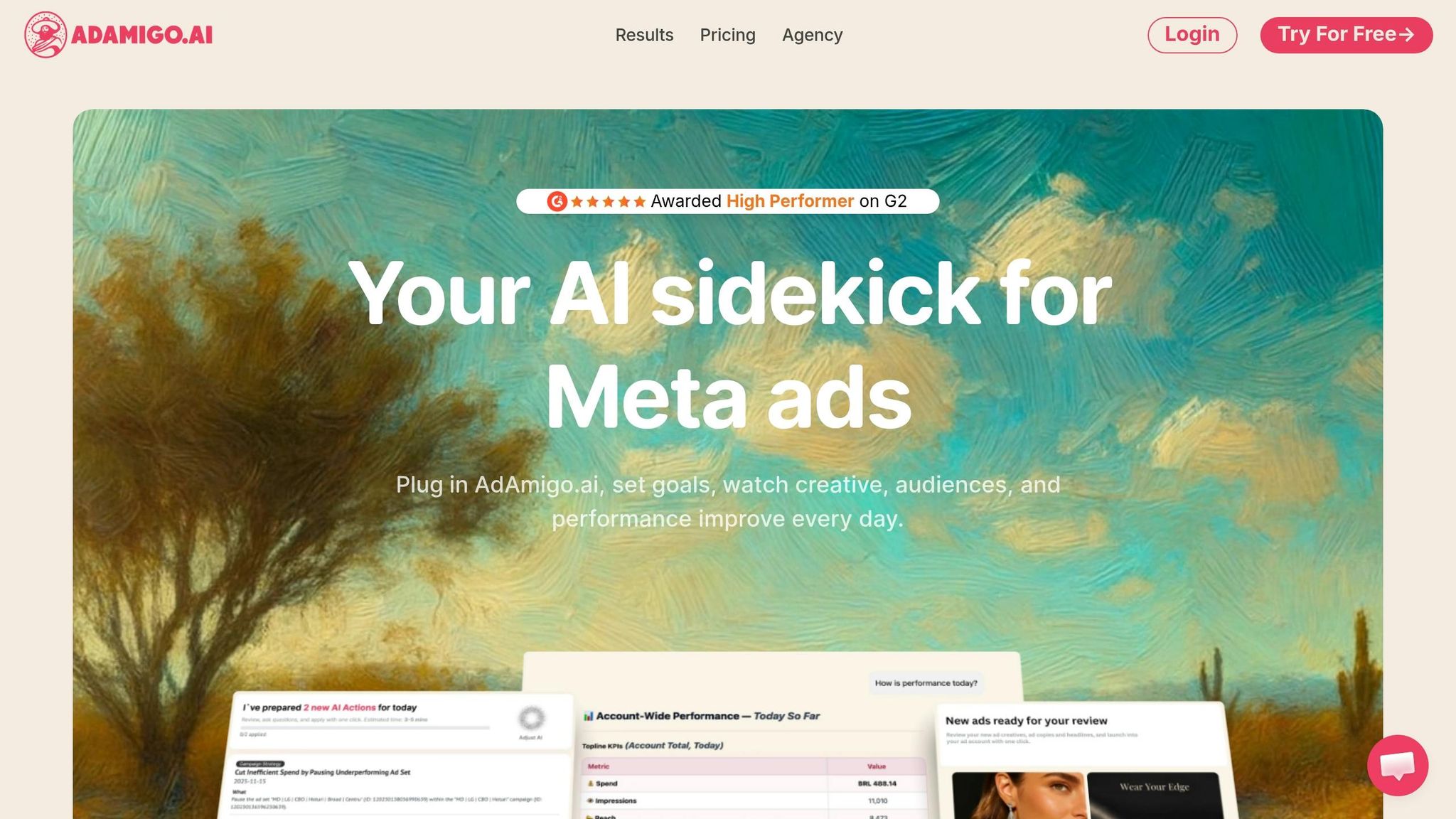
AdAmigo.ai is an autonomous platform designed to optimize campaigns while providing clarity around every decision it makes. Unlike Meta’s built-in tools, which often operate as a “black box,” AdAmigo.ai offers a clear explanation for every action it takes - whether that’s pausing an underperforming ad, reallocating a budget, or generating a new creative.
This tool goes a step further by analyzing your brand identity and competitor performance to create ad creatives that are not only effective but also compliant. Its AI Actions feature provides a daily, prioritized list of recommendations for creatives, audiences, and budgets, explaining why each suggestion matters. Plus, it proactively identifies potential policy risks, helping you avoid ad rejections before they happen. AdAmigo.ai also generates detailed reports that outline every change and the reasoning behind it, which can be a great way to build trust with clients.
"Providing transparency around our home-grown generative AI tools is a first step on our ads generative AI transparency journey." - Pedro Pavón, Director, Monetization Policy, Meta
AdAmigo.ai offers flexibility in how you implement its recommendations. You can either approve changes manually or set predefined parameters for automatic implementation. The onboarding process is quick - just five minutes - and lets you set clear KPIs, such as “Increase spend by 30% while maintaining a 3× ROAS.” Pricing starts at $99/month for the Signals plan or $349/month for Full Access.
On the other hand, Meta provides its own suite of transparency tools to assist advertisers, though you can compare Meta Ads Manager and AdAmigo.ai to see how different platforms handle these insights.
Meta's Built-In Transparency Tools
Meta has developed several tools to help advertisers maintain transparency. Starting in early 2025, Meta will automatically label ads that are created or heavily edited using its in-house generative AI tools, particularly those featuring photorealistic human images. Additionally, its Consent Mode requests user permission for tracking but still employs statistical modeling to measure conversions if consent is declined.
Meta’s Ad Library is another essential feature. It allows anyone to view active ads and understand why specific ads are being shown through the “Why am I seeing this ad?” feature. These tools not only enhance user trust but also reinforce your credibility as an advertiser.
While these tools are helpful, combining them with more customizable automation options can take transparency management to the next level.
Customizable Automation Options
The most effective approach involves blending automation with human oversight. AdAmigo.ai offers a customizable level of control, letting you decide how much autonomy the AI should have. You can choose to manually review every change or allow the system to operate autonomously within the parameters you set.
Automation is best used to handle repetitive tasks, such as reallocating budgets or testing creatives, while you focus on broader strategic decisions. Regular weekly reviews of AI-driven changes, using campaign logs, ensure that adjustments remain consistent with your branding and goals. This balanced approach allows one media buyer to oversee multiple accounts more effectively.
Feature | Meta's Built-In AI Tools | AdAmigo.ai |
|---|---|---|
Decision Logic | Limited explanation, often a "black box" | Offers detailed rationales for every adjustment |
Optimization | Focused on platform-wide efficiency | Tailored to specific KPIs as a learning agent |
Control | Primarily automated within platform constraints | Allows manual approval or automated workflows |
Compliance | Reactive (flags issues during review) | Proactive (identifies risks before rejections occur) |
Reporting | Standard performance metrics | Includes strategic reasoning behind changes |
Measuring Transparency's Impact on Performance
If you're aiming to see how transparency affects your ad performance, the metrics you're already tracking with an ad performance analyzer can provide plenty of insight.
Key Metrics to Track
Click-Through Rate (CTR):
Ads that are upfront with details - like "$29/month" instead of vague terms like "affordable" - tend to connect better with audiences. This clarity builds trust, making users more likely to engage.
Ad Disapproval and Rejection Rates:
Check Meta's Account Quality dashboard regularly. Ads with clearer disclosures often face fewer flags or rejections, a process increasingly streamlined by AI compliance tools, which can lead to smoother, more consistent campaigns.
CPM (Cost Per Mille) and Relevance Scores:
Transparent ads generally create a better user experience, which Meta rewards with higher relevance scores and lower CPMs.
Reach and Delivery:
Ads with heavy text overlays might technically pass Meta's review with an "OK" rating, but they often experience reduced reach compared to simpler, more transparent designs.
Customer Lifetime Value (LTV) and Churn:
Setting clear expectations through transparency can reduce customer churn. When users know exactly what to expect, they're less likely to feel misled and more likely to stick around.
Also, keep an eye on conversion volume during Meta's learning phase. Hitting the 50 conversions per week target is key to optimizing performance.
Before-and-After Performance Comparisons
Want proof that transparency works? Comparing performance metrics before and after adopting a transparent approach can show measurable gains. A/B testing is a great way to do this: Create one ad with specific, clear messaging (like pricing) and another with more generic language. Let the test run for at least two weeks to allow Meta’s algorithm to adjust.
Metric | Before Transparency Strategy | After Transparency Strategy |
|---|---|---|
Click-Through Rate (CTR) | Lower due to vague messaging and user skepticism | Higher as clear, honest claims resonate better with audiences |
ROAS | Inconsistent due to unclear targeting and messaging | Improved thanks to trust-driven engagement and better attribution |
CPM (Cost Per Mille) | Higher, with lower relevance scores | Lower, as transparent ads earn better placements from Meta |
Ad Rejection Rate | Higher, often due to unclear or non-compliant practices | Lower, as clear disclosures reduce policy violations |
Customer Lifetime Value (LTV) | Lower, with users feeling misled by vague promises | Higher, as informed customers are less likely to churn |
To stay on top of changes, set up automated alerts in Meta Ads Manager. These can flag any major shifts in metrics like cost per result, reach, or frequency, helping you detect Meta Ads anomalies after implementing transparency updates. Weekly audits of your ad creatives and budgets can help you spot trends and pinpoint which transparency practices are driving the biggest improvements. Keeping a detailed log of campaign changes - including AI-driven updates - can also help you connect specific actions to performance results.
The numbers don't lie: Transparent practices can build trust and lead to better ad performance on Meta.
Conclusion
Transparency isn’t just about checking a compliance box - it’s a proven way to boost performance. When you’re clear about pricing, data usage, and what users can expect, you build trust. And trust drives results. Metrics like higher click-through rates (CTR), better return on ad spend (ROAS), and lower rejection rates all show that transparent ads consistently outperform vague or unclear messaging. The numbers make it clear: staying transparent isn’t just good ethics - it’s good business.
Keeping up with Meta’s changing policies and global regulations, like the EU DSA, can feel overwhelming. That’s where tools like AdAmigo.ai come in. AdAmigo.ai simplifies compliance by identifying and resolving potential policy issues before they become problems. It creates ad creatives with transparency baked in - pricing, disclaimers, and privacy details are all handled upfront, so you’re not scrambling to fix things later.
What sets AdAmigo.ai apart is how it documents every decision. Whether it’s a budget adjustment, audience tweak, or creative change, there’s always a clear explanation. You can review daily AI actions, decide between manual approval or full automation, and manage accounts more efficiently. Starting at $99/month for Signals or $349/month for full automation, it’s a game-changer. Agencies can scale their operations, with one media buyer managing three to five times more accounts while staying compliant across different regions. For in-house teams, it’s like having a tireless media buyer who’s always learning and never misses a policy update.
FAQs
What counts as “transparent” in a Meta ad?
When Meta uses the term "transparent" in the context of advertising, it refers to being upfront about how user data is collected, used, and shared. This includes laying out details such as the criteria used for targeting ads, the sources of the data, and ensuring that these practices align with privacy regulations like GDPR and CCPA.
By making these processes clear and accountable, Meta aims to build trust with users, showing that their ad practices are open and straightforward.
What consent is required for Custom Audiences in 2025?
In 2025, businesses will need to secure explicit user consent before collecting and using data for Custom Audiences. This means being upfront about how user data is handled and ensuring users have clear, easy-to-find options to opt out if they choose. Staying compliant with privacy regulations like GDPR (General Data Protection Regulation) and CCPA (California Consumer Privacy Act) will be non-negotiable. Transparency and respect for user privacy will be key to maintaining trust and avoiding potential legal issues.
How can I prove transparency improved my ROAS?
To prove that adopting transparency has boosted your Return on Ad Spend (ROAS), start by comparing key campaign performance metrics from before and after you introduced transparent advertising practices.
Focus on how clear data disclosures and AI decision explanations have influenced your results. Look for measurable changes in ROAS - did your ad spend deliver more revenue after making these adjustments? By analyzing the data, you can pinpoint the improvements and demonstrate how transparency directly contributed to better performance.