
Ad Copy vs. Visuals: What Impacts Meta Ads More?
Learn how visuals drive 75–90% of Meta ad performance while copy boosts conversions; test creatives first, then refine headlines and CTAs.
When running Meta ads, visuals and ad copy work together, but their roles differ. Visuals grab attention, accounting for up to 90% of ad performance, while ad copy persuades users to take action, boosting conversions by as much as 30%. Here’s the breakdown:
Visuals: The most critical element for engagement and click-through rates (CTR). Videos outperform static images, delivering 480% more clicks but costing 24% more per purchase. Bold text overlays and vertical formats improve results significantly. To maintain this performance at volume, many advertisers use AI-powered creative scaling.
Ad Copy: Drives conversions by addressing objections and emphasizing benefits. Strong hooks, urgency, and clear calls-to-action (CTAs) can lift CTR by 15–25% and lower cost-per-acquisition (CPA).
Key takeaway: Weak visuals mean no engagement; weak copy means no conversions. To maximize results, test variables like visuals first (while avoiding common testing mistakes) to capture attention, then refine ad copy to drive action.
I Found a Brand Running 400+ Meta Ads. Here’s Why It’s Working
Performance Metrics: Ad Copy vs. Visuals
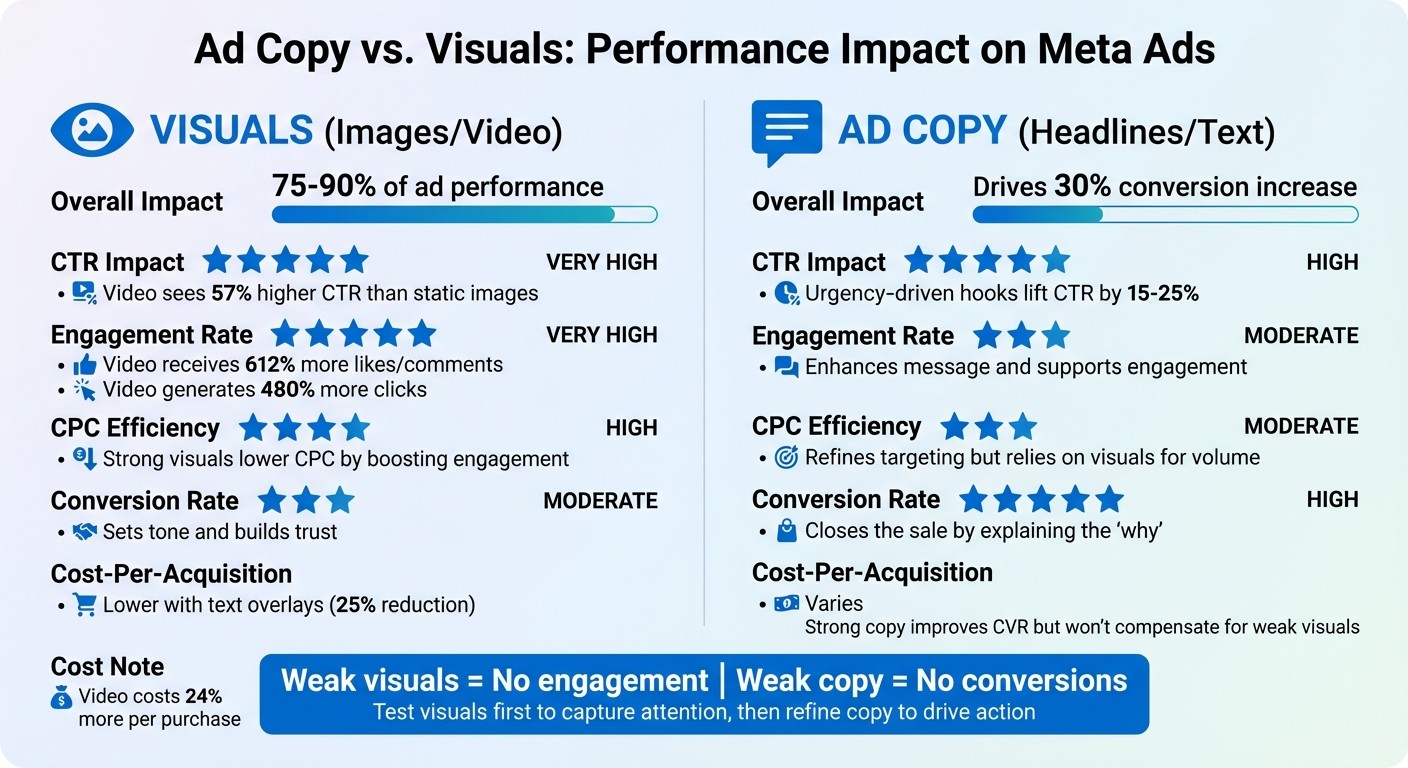
Meta Ads Performance: Visuals vs Ad Copy Impact Comparison
Understanding how visuals and ad copy impact key metrics can help you allocate testing resources more effectively. Implementing structured A/B testing conversion rules ensures these tests yield statistically significant results. Visuals play a major role in the early stages of the funnel - they account for 75% to 90% of an ad's overall performance by grabbing attention and encouraging initial engagement. On the other hand, ad copy shines when it comes to driving conversions. A well-crafted headline or hook can boost click-through rates (CTR) by 15% to 25%.
Here's what the data tells us: video ads outperform static images by 57% in CTR, and Reels featuring curiosity-driven hooks and subtitles within the first three seconds deliver 44% higher CTRs. Videos with bold text overlays also reduce cost-per-acquisition (CPA) by 25%. When it comes to engagement, video ads generate 480% more clicks and receive 612% more likes and comments compared to static images. However, video ads tend to cost 24% more per purchase, making static images a better option for bottom-of-funnel retargeting, where the audience is already familiar with the offer.
Side-by-Side Metrics Comparison
Metric | Visuals (Images/Video) | Ad Copy (Headlines/Text) |
|---|---|---|
CTR Impact | Very High - primary driver of clicks; video sees 57% higher CTR than static | High - urgency-driven hooks lift CTR by 15–25% |
CPC Efficiency | High - strong visuals lower CPC by boosting engagement rates | Moderate - copy refines targeting but relies on visuals to drive volume |
Engagement Rate | Very High - video receives 612% more likes/comments | Moderate - enhances the message and supports engagement |
Conversion Rate | Moderate - sets the tone and builds trust | High - closes the sale by explaining the "why" and the offer |
Cost-Per-Acquisition | Lower with text overlays (25% reduction) | Varies - strong copy improves CVR but won’t compensate for weak visuals |
This breakdown highlights the strengths of each element, laying the foundation for A/B testing for landing pages and creatives. By focusing on these performance metrics, you can fine-tune your approach to maximize results. You can also use an ad performance analyzer to track these metrics automatically. Up next, we’ll dive deeper into how ad copy drives conversions and when it takes center stage.
How Ad Copy Impacts Meta Ads
Visuals might grab attention, but it's the copy that seals the deal. While eye-catching images or videos draw users in, the words you choose are what persuade them to act. This dynamic highlights just how crucial ad copy is when it comes to driving conversions.
On mobile, ad copy gets cut off after 100 characters. That means your hook needs to hit hard and fast. Every word matters. Clear, benefit-focused language consistently outperforms clever or abstract phrases because users need to grasp the value of your offer in seconds. If your ad has high engagement but low conversions, it’s often a case of "great visuals, weak copy" - people stop to look but don’t feel compelled to take action.
"The image may capture attention – but it's the copy that closes people." - Joanna Wiebe, Founder, Copyhackers
Given these mobile limitations, the structure of your copy becomes even more important. A curiosity-driven hook, a clear benefit, and a strong call-to-action (CTA) are the backbone of effective ad copy, which you can test for Black Friday success or any major campaign. To keep budgets efficient, follow a strategy to lower creative testing costs while identifying winning hooks. Urgency works wonders here - phrases like "Shop the Drop Today" have been shown to boost click-through rates (CTR) by 15–25%. And when it comes to CTAs, specificity can make all the difference. For instance, one SaaS company reduced their cost-per-acquisition by 14% simply by switching "Book a demo" to "Start free trial".
Ad Copy's Role in Driving Conversions
When done right, ad copy doesn’t just engage - it converts. Well-optimized copy can increase conversions by 30% by focusing on benefits rather than features. For example, instead of describing a product as an "automated scheduling tool", highlight the result: "Save 10 hours a week." The key is to create an emotional connection - users care more about how your product improves their life than its technical details.
Real-world examples back this up. In 2025, Minimalist, a skincare brand, paired live product demos with bold text overlays like "Dermat-tested. Results in 5 days." This combination of visual proof and benefit-driven messaging boosted their click-through rate by 2.3×. Similarly, The Derma Co. used tailored copy at different funnel stages. This approach is a core part of full-funnel AI optimization for scaling performance. They ran acne-story Reels with curiosity hooks at the top of the funnel and static "final call" urgency ads at the bottom. Their bottom-of-funnel ads achieved a 6–7% conversion rate.
When writing ad copy, focus on "5-foot benefits" - the immediate, tangible results (e.g., "Connect with an expert") - rather than distant, long-term outcomes like "Profit from real estate". Test different approaches: keep headlines short (under five words), use action-oriented verbs, and tie benefits directly to user actions. These small adjustments can make a big difference in turning interest into conversions by optimizing your landing pages. To speed up this process, you can use AI prompts for creative tests to generate and iterate on copy variations quickly.
How Visuals Impact Meta Ads
Visuals grab attention; copy closes the deal. Did you know that humans process images up to 60,000 times faster than text? This makes your ad's creative the first - and sometimes only - opportunity to catch someone's eye. In fact, creative quality drives 56% to 80% of total ad performance, making it far more influential than budget or targeting. Meta even suggests starting with visuals: set your goals, pick your images, and then craft your copy.
"With Facebook, images matter more than copy. Images are everything in Facebook ads." - Joanna Wiebe, Founder, Copyhackers
Mix it up for better results. Running the same ad too many times can backfire - ads seen six or more times can lower purchase intent by 16%. Campaigns with 8–12 distinct visual concepts tend to perform much better than those relying on minor tweaks to a single image. Top brands refresh their visuals about every 10 days to keep things fresh and engaging.
Visuals also play a role in attracting different audience segments. By experimenting with styles - from clean, minimalist designs to dynamic, user-generated content (UGC) - you can figure out what resonates with your audience. For instance, a Shopify brand expanded its creative library from 5 similar product images to 15 varied concepts, including lifestyle shots and before/after comparisons. The result? A 47% improvement in cost per acquisition. This shows how diverse visuals can directly boost ad performance. For a deeper dive into maximizing your returns, see our guide to Meta ads ROI optimization.
Images vs. Videos: Performance Differences
When it comes to visuals, should you go with static images or videos? The answer depends on your goals.
Videos tend to perform better in terms of engagement. They generate 612% more likes and comments compared to static images. However, static images are great for quick, cost-effective testing. They’re faster to produce and ideal for validating ideas before investing in video production. Experts recommend testing 10 to 15 static images with consistent copy to identify the most effective visuals. Static images also excel at showcasing products clearly and simply.
If you choose video, format matters. Vertical Reels ads average a 48% lower cost-per-acquisition compared to non-vertical video ads. For Feed placements, the 4:5 vertical format outperforms 1:1 square videos by up to 15%. And since 85% of Meta users watch videos on mute, bold captions and graphic calls-to-action are essential. Ads with bold text overlays see a 25% lower cost per acquisition.
Interestingly, production quality isn’t always about polish. "Lo-fi" UGC and selfie-style videos can outperform high-end studio ads by 31% because they feel more genuine and relatable. For example, a B2B SaaS client saw minimal results from AI-enhanced "talking head" videos. But after incorporating bold text overlays and visual metaphors in the first second, their click-through rate jumped by 34%.
Visual Element | Performance Impact | Best Use Case |
|---|---|---|
4:5 Vertical Video | 15% higher engagement than square | Main Feed placements |
UGC/Lo-fi Video | 31% better than studio ads | Building trust and social proof |
Bold Text Overlays | 25% lower CPA | Capturing attention during silent viewing |
Static Images | 24% lower cost-per-purchase | Top-of-funnel awareness and testing |
Advantage+ Creative Optimization
Once you’ve nailed your visuals, automation tools like Meta's Advantage+ Creative can take them further. These tools adjust brightness, contrast, and text placements based on audience behavior. Across 50 campaigns, Advantage+ delivered an average 23% improvement in cost per conversion. Even small tweaks, like adjusting brightness, can lower CPA by 3%.
The real power of Advantage+ lies in its ability to find unexpected combinations. It pairs images with headlines and descriptions in ways that may outperform human-made pairings by over 30%. Instead of treating your ad as a single unit, Advantage+ breaks it into modular assets and creates thousands of variations tailored to user behavior.
"The algorithm is a multiplier, not a miracle worker. You can't AI your way out of insufficient creative investment." - Synergist Digital Media
To get the most out of Advantage+, provide 8–12 genuinely different creative concepts rather than minor variations. Include assets in three aspect ratios (1:1, 9:16, and 1.91:1) using a creative format converter to ensure your ads render well across all 26 Meta placements. And remember, even the smartest AI can’t save a dull opening frame. Hook viewers within the first 1–2 seconds for the best results. While Advantage+ is great for scaling and quick wins, it’s essential to maintain brand consistency, especially for luxury or technical B2B campaigns where precision is key.
A/B Testing Ad Copy and Visuals
Testing is how you find what works. The only way to figure out if your ad copy or visuals are driving results is through systematic testing. Since the quality of your creative plays a huge role in performance, even small tweaks can have a big impact on your cost per acquisition (CPA) and return on ad spend (ROAS).
Focus on one variable at a time. For example, test one image with several different headlines or one headline with multiple images. This approach allows you to pinpoint exactly which element is driving performance. If you test both a new image and a new headline at the same time, it becomes impossible to tell which change made the difference.
Budget allocation can affect testing accuracy. During testing, it’s better to use ABO instead of CBO. Why? CBO can prematurely favor one variant, skewing your results before you’ve gathered enough data. To get reliable insights, aim for at least 100 conversion events per variant or run your tests for 7 to 14 days. This timeline accounts for Meta’s learning phase and any weekly performance fluctuations.
Since visuals often have the biggest impact on ad performance, many experts suggest testing images or videos first. Start with 10 to 15 visuals while keeping your copy consistent. Once you’ve identified the best-performing visual, move on to optimizing your text. Focus on testing high-impact elements like headlines, visuals, and formats rather than minor details, such as button colors.
How to Test Ad Copy and Visuals
For video ads, the first 3 seconds - the "hook" - are crucial for grabbing attention. Test different opening visuals, bold text overlays, or engaging metaphors to see what makes users stop scrolling. For static images, try comparing product-focused shots with lifestyle imagery or clean backgrounds with more contextual, busier settings.
When it comes to copy, headlines matter most. Test different styles, such as testimonials ("This saved me 10 hours a week"), questions ("Tired of wasting ad budget?"), or surprising stats ("87% of advertisers miss this"). Headlines are what draw people in, so experiment with variations that highlight different pain points or benefits.
Define success metrics upfront. Use Click-Through Rate (CTR) to measure how well your visuals grab attention. Then focus on CPA and ROAS to determine if your copy and offer are actually converting. A high CTR is meaningless if those clicks don’t lead to customers.
Keep your testing process simple and organized. For instance, test headlines with a consistent image first. Once you’ve found the best headline, test visuals with that winning text. This step-by-step approach helps you build a library of proven elements you can reuse and combine in future campaigns. Consistent testing drives better results over time.
Tools That Simplify Testing
Automation tools can make testing faster and easier. Platforms like AdAmigo.ai connect directly to your Meta account and use AI to analyze your competitors’ top-performing ads. They also generate ad variations tailored to your brand. With features like Bulk Ad Launch, you can test multiple combinations of copy, visuals, and targeting all at once, speeding up the entire process.
Meta offers built-in tools for streamlined testing. Ads Manager A/B Testing lets you directly compare different headlines, visuals, or calls-to-action (CTAs). Meanwhile, Advantage+ Creative adjusts elements like brightness, aspect ratio, or text placement automatically, tailoring each ad to the user’s preferences. Campaigns that tested just two creative assets saw an average 21% lower cost per website conversion and a 19% lower cost per link click.
Dynamic Creative Optimization (DCO) 2.0 takes things to another level by analyzing performance at the element level. It identifies which specific headline and image combinations drive the most conversions. However, for DCO to work effectively, you need to provide enough variety upfront. Campaigns with 8 to 10 distinct creative concepts gave the AI enough data to find meaningful patterns, while those with only 3 to 4 concepts saw minimal improvement.
Document all your test results in a creative playbook. Include details like the audience, season, and winning elements. Over time, this library of proven ideas becomes a valuable resource you can remix and reuse in future campaigns. Businesses that commit to testing and learning see stronger performance as their data-driven decisions build on each other.
When to Focus on Ad Copy vs. Visuals
How to Decide What to Prioritize
At the top of the funnel, visuals capture attention; at the bottom, copy seals the deal. When you're introducing your brand to a cold audience - people who've never heard of you - visuals are your best bet for stopping the scroll and sparking interest. Once you’ve nailed down visuals that resonate, shift your focus to the bottom of the funnel. This is where ad copy takes center stage, helping you close the sale. Phrases that create scarcity ("Only 3 spots left"), urgency ("Sale ends tonight"), or offer clear incentives ("First box free") are especially effective in optimizing for conversions. This strategy aligns with earlier testing insights, ensuring every element performs its best at the right stage of the funnel.
For products that need explaining, lead with strong copy. If you're selling something that isn’t self-explanatory - like SaaS tools, financial services, or wellness products - clear, compelling copy is essential. If you're stuck, an ad copy idea generator can help kickstart the process. You’ll need to highlight the value of your offering and address customer pain points in a way visuals alone can’t do. As Joanna Wiebe, Founder of Copyhackers, explains:
"With Facebook, images matter more than copy... they're responsible for some 75 to 90% of an ad's performance".
Your audience’s preferences should guide your approach. Younger audiences often respond to bold, chaotic visuals designed to stand out in a crowded feed, while older or more professional demographics lean toward structured formats, like interviews or founder-led Q&A videos. And don’t forget: 85% of Meta users watch videos with the sound off. That means bold text overlays and captions are crucial for delivering your message without relying on audio. For AI-powered retargeting campaigns aimed at warm leads - people already familiar with your brand - descriptive headlines like "Your summer wardrobe, sorted" can help remove any hesitation and drive the final click.
Using Automation to Guide Decisions
AI tools can simplify decision-making and boost results. Building on manual testing strategies, platforms like AdAmigo.ai take the guesswork out of campaign optimization. These tools analyze your live campaign data and provide daily recommendations, such as when to refresh visuals, test new headlines, solve common ad copy issues, or fine-tune targeting. They even study your brand identity and your competitors’ top-performing ads to create tailored creatives for your niche. With features like Bulk Ad Launch, you can test dozens of copy and visual combinations all at once, scaling your efforts efficiently.
Automation bridges the gap between visuals and copy with actionable insights. For example, over an eight-month period ending in late 2024, a finance client used Meta’s AI to optimize their ad headlines. The AI replaced the human-written "Maximize Your Returns" with "Stop Leaving Money on the Table", resulting in a 28% increase in conversions. Instead of manually deciding whether to tweak an image or rewrite a headline, automation delivers a clear, data-backed game plan every day.
Conclusion
Main Findings
Visuals and ad copy work hand in hand to deliver results. While visuals grab attention - accounting for 75% to 90% of ad performance - ad copy steps in to deliver the message, address concerns, and drive action.
"Creative = The Hook → It stops the scroll and grabs attention. Copy = The Persuasion → It delivers the message and encourages action".
Creative quality influences about 56% of Meta ad performance, outshining factors like targeting, budget, or bidding strategies. This makes visuals the cornerstone of your ads. Start by perfecting your images or videos, then fine-tune headlines and body copy to push conversions further. Video ads, in particular, hold viewers’ attention five times longer than static images, making them a highly effective tool for engagement.
These insights pave the way for actionable strategies to improve ad performance.
Next Steps
The findings offer a clear roadmap for your creative testing process. Start by testing visuals first, then optimize the copy once you’ve identified a strong performer. Allocate 10%–20% of your daily budget to creative testing. This ensures you can scale Meta ad budgets effectively once you find a winning creative. Experiment with 10 to 15 variations of images or videos while keeping the ad copy consistent. After finding a visual that resonates with your audience, shift focus to testing headlines or calls-to-action to refine your messaging. To ensure accurate results, isolate variables - change only one element at a time.
Automation tools like AdAmigo.ai can simplify and scale this process by using AI agents to test creatives daily. This platform analyzes live campaign data and provides daily recommendations, such as refreshing visuals, testing new headlines, or tweaking targeting. It also studies your brand identity and competitors’ top-performing ads to create tailored creatives. With features like Bulk Ad Launch, you can test dozens of combinations at once. Since purchase intent drops by 16% after users see the same ad six or more times, making AI frequency control essential to prevent ad fatigue, automation ensures your campaigns stay fresh and effective without the hassle of constant manual updates.
FAQs
What’s more important for Meta ads: visuals or ad copy?
Visuals play a huge role in the success of Meta ads, contributing to about 75–90% of the results. To get started, test a range of images - ideally 10–15 variations - while keeping the ad copy consistent. Once you’ve identified the visuals that perform best, you can shift your focus to fine-tuning the accompanying text.
One effective strategy to structure your testing is the 3-2-2 method: test three distinct visual concepts, pair each one with two options for the primary text, and add two headline variations. This approach helps you manage your testing efforts efficiently while letting visuals guide your copy adjustments.
To make this process more efficient, tools like AdAmigo.ai can help by automating creative testing, optimizing combinations, and rolling out the winning ads with ease. By putting visuals first and refining the copy afterward, you can build Meta ads that are backed by data and deliver strong results.
What should I focus on first when testing visuals and ad copy for Meta ads?
When running tests for Meta ads, start with visuals first. Research indicates that visuals account for a whopping 75–90% of ad performance. A smart approach? Test 10–15 different image variations while keeping the ad copy the same. This helps you zero in on the most effective design before tweaking the copy.
Stick to testing one variable at a time - either visuals or copy. Keep the audience, placement, and budget settings consistent to ensure your results are accurate. Before you begin, establish clear success metrics like Click-Through Rate (CTR) or Return on Ad Spend (ROAS), and make sure your budget and timeline are sufficient to gather meaningful insights.
Once you’ve nailed the visuals, shift your attention to high-impact elements like the headline or primary text. Test 2–4 variations at a time to avoid spreading your budget too thin. Regular testing is key to keeping your creatives fresh and combating audience fatigue. Don’t forget to document your findings - this will serve as a valuable resource for improving future campaigns and boosting long-term performance.
What role does automation play in improving Meta ad performance?
Automation takes Meta ad performance to the next level by managing tasks that usually demand a lot of manual work. With AI tools in the mix, placements, bids, budgets, and audience targeting get optimized in real time, ensuring your ads hit the most promising opportunities.
What’s even better? AI doesn’t just stop there. It learns from your campaign results, speeding up the scaling of successful creatives, generating new ad assets, and channeling budgets toward the top-performing combinations. The result? Faster testing cycles, improved return on ad spend (ROAS), and reduced cost per acquisition (CPA) - all while saving you time and effort.