
FTC Compliance for Meta Ads: Guide
How to meet FTC and Meta 2026 ad rules: truthful claims, clear #ad/AI disclosures, HEC targeting limits, and landing-page consistency to avoid penalties.
Running Meta ads in 2026 without following FTC rules can lead to major problems. The FTC and Meta now use advanced AI systems to enforce strict advertising standards. Here's what you need to know:
Truthful Ads Only: Claims must be accurate and supported by credible evidence. Meta's AI checks ads and landing pages for consistency within 60 seconds.
Clear Disclosures: Use terms like "#ad" or "Sponsored" visibly in captions and overlays. For videos, disclosures must appear in the first three seconds.
AI content rules: Ads with AI-generated visuals require specific labels to avoid misleading viewers.
Targeting Restrictions: Ads for Housing, Employment, or Credit (HEC) must follow strict targeting rules, including age and location limits.
Landing Page Alignment: Your ad and landing page must match in claims, pricing, and offers. Inconsistencies can lead to rejections or penalties.
Meta's AI system, MARS, ensures compliance by flagging violations before ads go live. Regular account audits and AI compliance tools can help avoid account penalties like reduced impressions or longer review times. Stay vigilant to protect your campaigns and maintain a strong Account Health Score. Implementing team policy training can further reduce the risk of accidental violations.
Don't Let FACEBOOK Ban Your Ad Account Follow These Rules
FTC Rules for Digital Advertising
The Federal Trade Commission (FTC) sets clear guidelines for digital advertising, emphasizing three key principles: ads must be truthful, claims must be backed by evidence, and deceptive practices are prohibited. Although these rules have been in place for years, Meta's 2026 introduction of AI-driven enforcement and transparency have added a new layer of scrutiny. This system identifies potential violations before ads even go live. Below, we’ll break down how to adapt Meta ads to policy changes regarding claims and targeting practices.
Truth-in-Advertising Requirements
To comply with truth-in-advertising standards, every element of your Meta ad must be both accurate and non-deceptive. Meta’s Multimodal Ad Review System (MARS) evaluates the overall message of your ad, considering all components. For instance, pairing a supplement bottle with an image of a fit individual could lead to rejection if it implies unsupported weight-loss benefits. Similarly, phrases like "For people managing blood sugar" can be flagged as violations for suggesting knowledge of personal health conditions. This highlights the importance of Meta conversion data compliance when handling sensitive user information. In fact, stricter enforcement led to a 34% increase in rejections within health, wellness, and beauty ads during Q1 2026.
Backing Up Your Claims
Every performance claim in your ad must be supported by credible evidence. The FTC doesn’t wait for consumer complaints, and Meta’s AI tools now proactively scan for unverified claims. Advertisers can use AI tools to generate ad creatives that are both compliant and high-performing. This applies to both direct statements and implied promises. For example, a phrase like "See results in 7 days" is treated as a guarantee. Without clinical studies, verified customer data, or third-party testing to substantiate such claims, your ad will likely be rejected. Specific industries face even stricter requirements: supplement ads must include disclaimers like "This product is not intended to diagnose, treat, cure, or prevent any disease", while financial services ads must adhere to Meta’s pre-approved risk warning templates to avoid rejection.
Misleading Practices to Avoid
The FTC has ramped up its focus on deceptive practices that erode consumer trust. Industries like fashion, automotive, and telehealth have faced steep penalties for tactics such as fake reviews, bait-and-switch schemes, misleading pricing, and review manipulation. A notable example is NextMed, which received a final FTC order in January 2026 for deceptive practices tied to its GLP-1 weight-loss programs. Whether it’s false advertising, inflated reviews, or misrepresented pricing, the message is clear: if your ad suggests one thing but delivers another, you risk non-compliance. Meta’s AI enforcement system is designed to catch these discrepancies before your ad even reaches the audience is designed to catch these discrepancies before your ad even reaches the audience.
Disclosure and Endorsement Requirements
When running Meta ads that involve any kind of material connection - whether it's through paid partnerships, free products, or affiliate commissions - the FTC has clear rules: you must include upfront disclosures. These disclosures need to be "clear and conspicuous", meaning they should be easy to spot, read, and understand. Simply tucking "#ad" into a long list of hashtags or behind a "See More" button doesn’t meet the standard.
Using Meta’s Paid Partnership tag alone isn’t enough. You’re required to add a plain-language disclosure at the very start of your caption. Phrases like "#ad", "Sponsored", or "Paid partnership" work well and meet the guidelines. However, vague terms like "collab", "partner", "sp", or "thanks" are not sufficient and could lead to enforcement actions.
For video ads and Reels, the rules are stricter. You need both a visual overlay and a verbal disclosure, and these must appear within the first three seconds. The text should be in high-contrast colors and at least the equivalent of 24-point font. It must stay on screen long enough for viewers to read it. For Stories, the overlay should persist for at least three seconds, and for live streams, the disclosure should be repeated periodically to ensure viewers joining later don’t miss it. Brands are also responsible for ensuring their influencers follow these rules, so it’s smart to have a review process in place to verify proper disclosures before anything goes live.
Required Disclosures (#ad, #sponsored, etc.)
To ensure disclosures are visible, always place them at the beginning. For Facebook Feed and carousel ads, include "#ad" or "Sponsored" above the "See More" link, and for carousel ads, make sure the disclosure appears on the first card. For Instagram Reels and Stories, use multiple layers of disclosure: combine the Paid Partnership tag with "#ad" in the caption and a high-contrast text overlay that appears within the first three seconds. Always test your ads on mobile to confirm the disclosure is visible without requiring users to click "More."
Here’s a quick breakdown of disclosure requirements by Meta ad format:
Ad Format | Required Disclosure Method | Key Placement Rule |
|---|---|---|
Facebook Feed/Carousel | Caption (#ad/Sponsored), Paid Partnership tag | Above "See More"; first card for carousels |
Instagram Reels/Stories | Text overlay, verbal (first 3s), Paid Partnership tag | Overlay persists for at least 3 seconds; high contrast |
Meta Video Ads | Audio (verbal), visual text overlay, caption text | Integrated throughout; not limited to the description |
AI-Generated Content Disclosures
Starting in 2026, Meta will require "AI info" labels for ads featuring photorealistic synthetic media. If your ad includes a photorealistic AI-generated human, the label must appear prominently next to the "Sponsored" tag. For AI-generated backgrounds, the disclosure can be placed in the three-dot menu or as an "AI info" label. Ads related to political or social issues face even stricter rules: you must disclose all digitally altered realistic content with both a "Paid for by" disclaimer and an AI disclaimer.
Minor edits like color adjustments or cropping don’t need to be disclosed. However, if you’re using third-party AI tools, make sure the metadata isn’t stripped during export - Meta uses these signals to identify synthetic content. For virtual influencers, it’s mandatory to label them as "virtual" or "synthetic" to avoid misleading viewers. The FTC’s increasing focus on transparency in AI-generated content reflects a broader trend, so when in doubt, it’s always safer to disclose more than less.
Targeting Restrictions and Meta Policies

In 2026, Meta and regulatory bodies introduced stricter rules for ad targeting. Advertisers running Housing, Employment, or Credit (HEC) ads are now required to select a designated Special Ad Category. This category enforces specific restrictions designed to prevent discriminatory practices. For instance, targeting must stay within an 18–65+ age range, maintain a minimum radius of 15 kilometers (9.3 miles), and exclude gender or ZIP code filters. Additionally, as of March 2026, the Credit category has been expanded to include Buy Now Pay Later services, crypto lending platforms, and student loans.
Meta has also implemented a compliance tool called MARS to ensure adherence to these rules. MARS reviews every ad component - text, images, audio, and landing pages - within 60 seconds. It identifies elements like floor plans or loan calculators, automatically applying HEC restrictions even if advertisers forget to select the appropriate category. This proactive system ensures ads are vetted before they gain impressions, moving away from the previous "trial-and-error" approach.
Prohibited Targeting Criteria
Some products face additional restrictions based on age. For example, weight loss ads cannot target users under 18, and cryptocurrency ads are restricted from targeting individuals under 25 as of March 2026. HEC ads also face tighter limitations: Lookalike Audiences are disabled, and interest-based targeting is largely restricted. Instead, advertisers are encouraged to focus on broad creative strategies, using content to qualify audiences rather than relying on detailed demographic filters.
Meta's Personal Attributes Policy
Meta's Personal Attributes Policy (Policy 4.3) explicitly bans ad content that implies knowledge of user-specific traits, such as race, religion, health status, financial condition, disability, or even their name. In early 2026, violations of this policy accounted for 24% of ad rejections.
Starting in March 2026, Meta tightened its rules further by flagging "indirect second-person framing." For instance, phrases like "For people managing diabetes" are now treated the same as direct statements such as "Struggling with diabetes?" because they suggest knowledge of sensitive user information. This change led to a 34% increase in rejection rates for health and beauty ads during Q1 2026. To comply with these updates, advertisers should pivot to service-based messaging. For example:
Use "Start your morning with intention" instead of "Are you tired?"
Say "Tools for smarter budgeting" rather than "Struggling with debt?".
These policies are part of a larger compliance framework established by the FTC and Meta, which advertisers must navigate to run successful campaigns in the evolving digital landscape.
Ad-to-Landing Page Consistency
When it comes to FTC compliance, ensuring consistency between your ads and landing pages is a must. Every claim, price, and promise in your Meta ad needs to be reflected on the landing page. Meta's MARS system checks destination URLs in real time - usually within 60 seconds - to confirm that the landing page content aligns with the ad. In 2026, inconsistencies between landing pages and ads caused 11% of Meta ad rejections, while misleading claims were responsible for 19%.
MARS doesn’t stop at just scanning text. It also reviews images, video frames, metadata, and even flags deceptive practices like dark patterns or misleading checkout processes. For example, if your ad promotes a specific product or discount, that offer should be prominently displayed on the landing page - ideally above the fold. Hiding it or making it hard to find could be seen as a bait-and-switch tactic, which undermines transparency.
Additionally, MARS performs retroactive checks, meaning ads can be paused if later changes to landing pages create inconsistencies or violate policies. These mismatches can harm your Account Health Score, which can lead to restricted ad delivery or longer review times. To avoid these issues, regularly audit your landing pages. Make sure personal attribute language (like "for people managing diabetes") is used appropriately, required disclaimers are present on both the ad and landing page, supported by robust compliance governance tools, and that checkout flows remain clear and straightforward.
Best Practices for Staying Compliant
Following the FTC rules and Meta's ad consistency guidelines, here are some practical steps to help ensure your ads meet compliance standards.
Pre-Launch Compliance Checklist
Before hitting publish on any Meta ad, take a moment to run a thorough compliance check. Start by ensuring that every claim in your ad is backed by proper documentation. For example, if you state "clinically proven", make sure you have the evidence to support it. Scan your ad copy for language that references personal attributes like "struggling with diabetes" or "for seniors", as these can trigger compliance issues. In fact, personal attributes violations were responsible for 24% of all ad rejections in 2026.
Pay close attention to your visuals, especially for health and wellness campaigns. Ads that suggest transformations - like showing a product next to a fit individual - can be flagged as unapproved health claims like before/after photos. Make sure your disclosure tags (e.g., #ad, #sponsored, or "Paid partnership with") are clearly visible and easy for users to spot. For AI-generated content, include a clear disclosure as well. In 2026, undisclosed AI content became the third most common reason for Meta ad rejections, accounting for 14% of all flagged ads.
Your landing page should align perfectly with the claims, pricing, and offers in your ad. If you're running Housing, Employment, or Credit (HEC) ads, confirm that you've selected the correct Special Ad Category to avoid "Evasion" violations. Lastly, double-check your targeting settings to ensure you're not using restricted criteria, such as age, gender, or ZIP code, for sensitive categories. For larger campaigns, consider pairing manual audits with automated compliance tools to catch any oversights.
Automated Compliance Tools
While a pre-launch checklist is vital, automated tools provide continuous monitoring and are essential for large-scale campaigns. Manual checks alone can’t keep up with the demands of high-volume advertising. Automated tools work around the clock, identifying compliance issues before they affect your account's health score. Meta’s Ads Manager includes a 0–100 Account Health Score, and falling below 25 can result in Restricted Delivery, limiting your ad’s reach. Automation helps you stay above that threshold by preventing policy violations.
"Meta's 2026 policy cycle marks the transition from reactive enforcement... to proactive enforcement (scanning every ad through AI classifiers before the first impression is served)." - AuditSocials Compliance Report
Platforms like AdAmigo.ai offer advanced AI-driven compliance solutions. These tools can scan creatives for missing disclosures, broken landing page links, and policy violations before submission. AdAmigo's AI Autopilot goes a step further by continuously auditing your ad account, flagging risks in real time - whether it’s a landing page mismatch or a missing AI disclosure. It can even generate compliant ad copy and ensure all necessary legal language is included, saving you hours of manual effort.
Feature | Manual Compliance | Automated Compliance (e.g., AdAmigo.ai) |
|---|---|---|
Monitoring | Periodic manual checks; prone to human error | Continuous 24/7 real-time monitoring |
Speed | Changes take days to implement | Minute-level adjustments and instant alerts |
Scalability | Limited to 10–15 campaigns per person | Manages hundreds of ads simultaneously |
Error Detection | Relies on staff spotting buried tags | AI detection of missing disclosures and broken links |
Meta's MARS system conducts retroactive audits, meaning an ad that initially passed review could be flagged later if policy thresholds change. Automated tools are invaluable here, as they continuously re-scan active campaigns and notify you if an ad falls out of compliance. This is especially helpful for agencies managing multiple accounts, allowing one media buyer to oversee a larger number of campaigns without sacrificing compliance oversight.
FTC Enforcement and Penalties in 2026
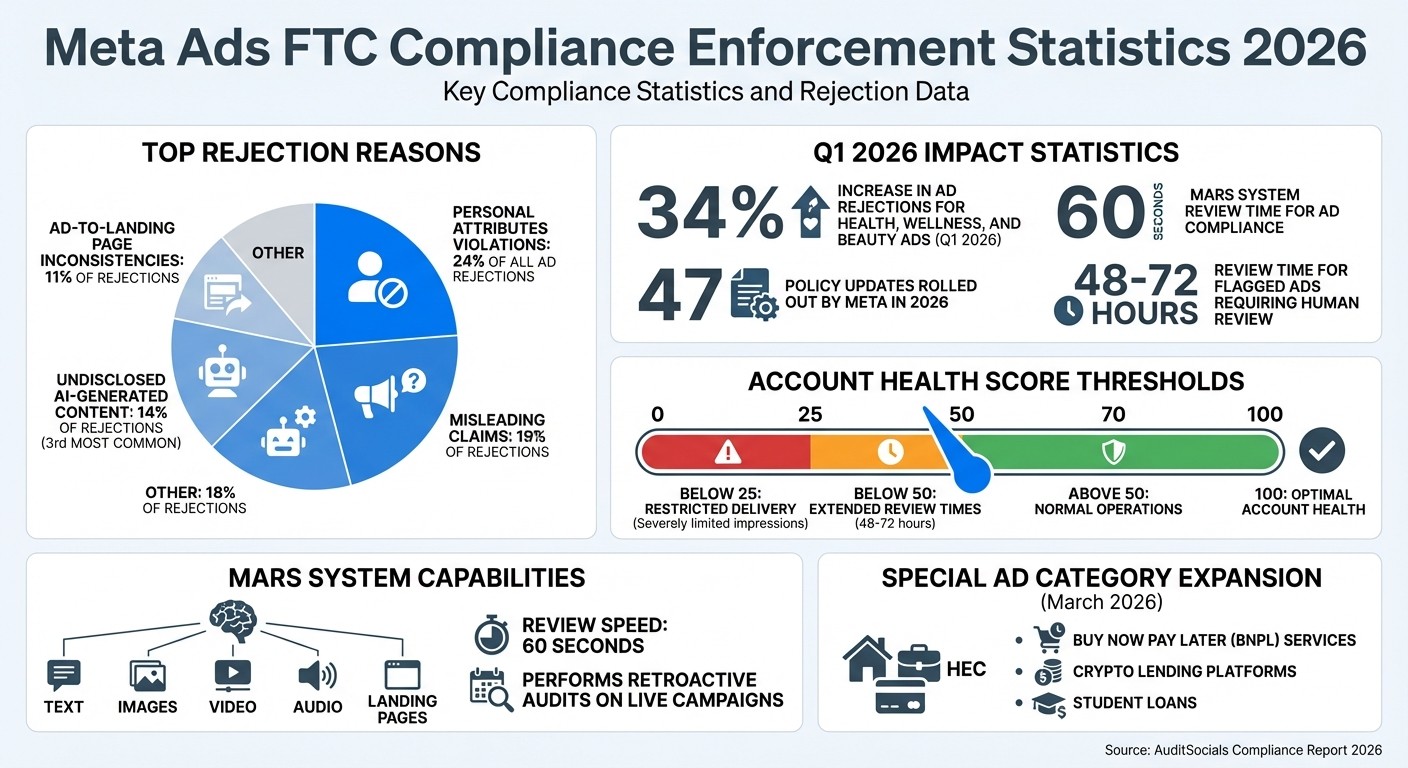
Meta Ads FTC Compliance Statistics and Rejection Rates 2026
Recent FTC Enforcement Cases
March 2026 brought a noticeable shift in digital advertising oversight. Meta rolled out a significant update to its Multimodal Ad Review System (MARS) and retail advertising policies, causing a 34% increase in ad rejections for health, wellness, and beauty ads during Q1 2026. This updated system now evaluates "semantic intent", flagging ads based on implied meanings rather than just explicit rule violations.
This stricter approach affected several areas. Ads featuring undisclosed AI-generated content became a major concern, accounting for 14% of all enforcement actions in 2026. Advertisers using AI to create product renders or synthetic human visuals without proper disclosure faced immediate rejections. Health and wellness campaigns also saw increased scrutiny for "implied transformations." For instance, an ad showing a product next to a fit individual could be flagged for suggesting unverified outcomes. Additionally, the Housing, Employment, and Credit (HEC) category expanded to include Buy Now Pay Later (BNPL) services and crypto lending. These now require special ad categories and stricter targeting rules.
These enforcement measures directly affect advertisers' account health, leading to the penalties outlined below.
Penalties for Non-Compliance
Failing to comply with these regulations now comes with tangible consequences. Meta introduced an Account Health Score, ranging from 0 to 100, which advertisers can view in Ads Manager. Falling below a score of 25 triggers "Restricted Delivery", significantly reducing ad impressions. Scores under 50 result in longer review times, with flagged ads requiring 48–72 hours for human review instead of the usual automated review process.
Advertisers who repeatedly violate policies risk accumulating strikes and "Evasion" flags, especially if they attempt to bypass Special Ad Categories. These flags can quickly escalate, harming account health and increasing the likelihood of stricter scrutiny on future campaigns. Meta’s proactive enforcement approach ensures every ad is scanned by AI before reaching its audience, eliminating the option to test compliance after launch. For advertisers managing multiple campaigns, even a single mistake can have a ripple effect across the entire account, underscoring the importance of rigorous monitoring to stay compliant.
Key Takeaways
FTC compliance isn't just a box to check - it's the backbone of effective and sustainable Meta advertising. With Meta rolling out 47 policy updates in 2026 and adopting proactive, AI-driven enforcement, every ad undergoes close scrutiny before it even reaches an audience. These changes highlight the importance of reviewing every detail of your campaign.
Pay close attention to three key areas: personal attribute accuracy, AI-generated content disclosures, and maintaining a strong Account Health Score. Personal attribute violations top the list of ad rejections, accounting for 24% of cases, while failure to disclose AI-generated content is now the third most common issue at 14%.
Your Account Health Score plays a huge role in ad performance. If your score dips below 50, review times extend beyond the standard 60-second automated check. Drop below 25, and you’ll face "Restricted Delivery", which drastically limits impressions. A single compliance error can snowball, affecting your entire account, so keeping a close eye on this metric is non-negotiable. Every piece of your campaign - from ad creatives to landing pages - needs to align to avoid disruptions.
Meta’s Multimodal Ad Review System (MARS) takes this a step further. It examines text, images, video, audio, and landing pages all at once, flagging inconsistencies that could signal non-compliance or attempts to bypass guidelines. This means your ad creative and landing page must tell the same story, with consistent claims, disclosures, and evidence to back them up.
To stay ahead, regular audits and AI monitoring for compliance are a must. Conduct pre-submission checks, clearly disclose AI-generated content, and respond promptly to Account Health notifications. These steps not only protect your brand reputation but also ensure that your ad performance doesn’t take a hit from penalties that can take weeks to resolve.
FAQs
What evidence do I need to support performance claims in Meta ads?
The FTC demands solid evidence to support performance claims in Meta ads. If you’re making statements like "increased sales" or "higher conversion rates", you need to back them up with current, relevant, and verifiable proof. Any disclosures should be straightforward, steering clear of misleading or exaggerated language. Tools such as AdAmigo.ai can assist in staying compliant by monitoring claims and ensuring they are backed by trustworthy data.
Where should FTC disclosures go in Reels, Stories, and video ads?
FTC disclosures need to be easy to spot and understand, positioned prominently in Reels, Stories, and video ads. Avoid hiding them behind "More" buttons, hashtags, or tucking them away in captions. For video content, make sure disclosures appear within the first few seconds - this can be done verbally, visually, or both - so they’re immediately noticeable. Integrate them smoothly into the content to maintain transparency and ensure viewers aren’t confused.
How can I prevent ad-to-landing-page mismatches that trigger MARS?
To prevent mismatches between your ad and landing page that could activate MARS (Meta's moderation system), make sure your landing page matches the claims, offers, and visuals in your ad. Avoid making misleading or exaggerated promises, and keep your messaging and imagery consistent. Also, double-check that your landing page works properly, stays relevant to the ad, and loads quickly. These practices can minimize MARS triggers and keep your ads compliant with Meta's policies.