
Meta Ads Age Compliance: Rules, Restrictions & Practical FAQ
Meta Ads age compliance: age limits for alcohol, gambling, crypto, CBD & health ads. Covers regional rules, verification, and fixing age-related ad rejections.
Meta Ads age compliance isn't optional — it's the difference between campaigns that run smoothly and ads that get rejected before they ever reach an audience. Meta's 2026 shift to proactive AI enforcement means every ad is scanned before the first impression, and advertisers who misconfigure age targeting for restricted categories — alcohol, gambling, cryptocurrency, CBD, health and wellness, and Special Ad Categories — pay the price immediately.
This guide breaks down every age restriction by category, the regional legal variations that complicate multi-market campaigns, and the practical steps to stay compliant. You'll walk away knowing exactly how to set age targeting, what verification each restricted category requires, and — when things go wrong — how to diagnose and fix age-related ad rejections.
Meta's AI Age Verification and Proactive Enforcement
Key Age Restrictions by Content Category
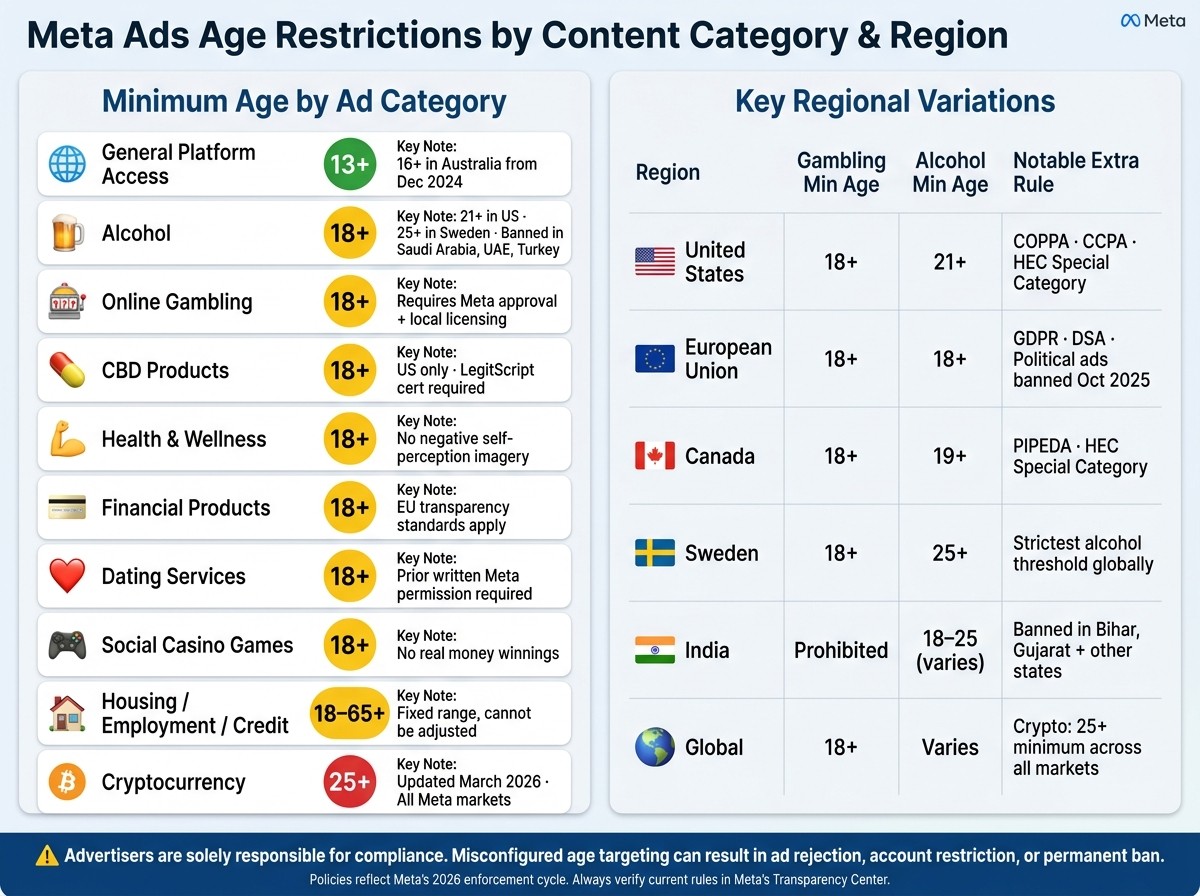
Meta Ads Age Restrictions by Content Category & Region
Meta's policies set clear age restrictions across various content categories, as outlined in the Meta Ads Policy 2025 checklist. Here's a breakdown of these rules.
Platform-Wide Age Rules
Meta enforces a strict minimum age of 13 for all users across its platforms. For sensitive content, the threshold is typically 18+. In Australia, the minimum age for general platform access increased to 16+ in December 2025, which also affects ad targeting for standard categories.
Special Ad Categories — covering housing, employment, and credit ads — are restricted to users aged 18–65+. In early 2025, Meta expanded this category to include products like Buy Now Pay Later (BNPL) services and student loans, applying the same fixed age range.
These overarching policies provide the framework for more specific age restrictions tailored to individual content categories.
Category-Specific Age Restrictions
Beyond the platform-wide rules, Meta applies additional guidelines to certain types of content to align with local laws and product-specific considerations.
Alcohol Ads: Globally, advertisers must target users aged 18+ at a minimum. However, in the United States, the age limit rises to 21+, and in Sweden, it's 25+. Alcohol ads are outright banned in countries like Afghanistan, Egypt, Saudi Arabia, Turkey, and the UAE.
Online Gambling Ads: These require a minimum age of 18, alongside Meta's prior approval and proof of local licensing for each targeted country. See our full breakdown of Meta gambling ad rule changes for the latest requirements.
CBD Product Ads: Restricted to U.S. audiences aged 18+, these ads also require LegitScript certification. Health claims are strictly prohibited.
Cryptocurrency Ads: As of March 2026, cryptocurrency promotions must target users 25 and older, reflecting Meta's cautious approach to high-risk financial products.
Health and Wellness Ads: Ads for weight loss, supplements, and cosmetic procedures are limited to users 18+. Advertisers must avoid language or imagery suggesting unrealistic results or negative self-perception. Meta's AI now automatically flags and enforces these rules, even for implied transformations.
Age Restrictions by Category: Comparison Table
Content Category | Minimum Age | Policy Notes | Regional Variations |
|---|---|---|---|
General Ads | 13+ | Baseline for platform access | 16+ in Australia (from Dec 2025) |
Alcohol | 18+ | Must comply with local drinking laws | 21+ (US), 25+ (Sweden, parts of India) |
Online Gambling | 18+ | Requires Meta approval and local licensing | Restrictions vary by market |
Cryptocurrency | 25+ | Updated March 2026; tiered authorization required | Applies across all Meta markets |
Health & Wellness | 18+ | No "negative self-perception" language or imagery | Stricter scrutiny on before/after transformations |
CBD Products | 18+ | LegitScript certification required; no health claims | U.S. only |
Housing/Employment/Credit | 18–65+ | Fixed age range; cannot be adjusted | Applies in U.S., Canada, and parts of the EU |
Financial Products | 18+ | Must not request PII or imply financial distress | EU-wide transparency standards |
Dating Services | 18+ | Requires prior written permission from Meta | - |
Social Casino Games | 18+ | No real money winnings allowed | Prohibited in select markets (e.g., Singapore, Taiwan) |
These rules reflect Meta’s efforts to align with both global and local regulations, ensuring responsible ad targeting across its platforms. Advertisers can further refine these audiences using AI tools for interest-based targeting to ensure compliance while maintaining performance.
Regional Compliance and Legal Requirements
How Meta's Policies Align with Regional Laws
Meta's approach to regional compliance builds on its global policies by tailoring restrictions to meet specific local laws. While its global standards set a baseline, regional laws often demand stricter measures. For instance, in the U.S., the Children's Online Privacy Protection Act (COPPA) limits data collection from users under 13, and the California Consumer Privacy Act (CCPA) enforces additional privacy protections for California residents. In the European Union, the General Data Protection Regulation (GDPR) and the Digital Services Act (DSA) focus heavily on consent and transparency.
Meta ensures compliance by setting minimum standards, like an 18+ age limit for alcohol-related ads. However, advertisers must adapt campaigns to align with stricter regional laws. To enforce these standards, Meta employs its Multimodal Ad Review System (MARS), which scans ad content — including text, images, videos, and landing pages — for compliance before serving the first impression. This proactive system helps bridge global standards with the more nuanced requirements of individual countries.
"Meta's 2026 policy cycle marks the transition from reactive enforcement (reviewing ads after complaints) to proactive enforcement (scanning every ad through AI classifiers before the first impression is served)." — AuditSocials
Regional enforcement is automated and relentless — Meta's Transparency Center reports thousands of localized content restrictions across global markets in each reporting period. The stakes for non-compliance are high, as shown in April 2025, when the European Commission fined Meta €200 million for breaching the Digital Markets Act (DMA). These examples highlight the tangible risks of failing to meet regional legal standards.
Country-Specific Content Restrictions
Some countries enforce strict ad restrictions that go beyond standard age limits. For example, alcohol ads are entirely banned in Russia, Turkey, and Saudi Arabia. In India, alcohol advertising is prohibited in states like Bihar and Gujarat, while in other states, the legal drinking age varies between 18 and 25.
To navigate these complexities, Meta's Transparency Center serves as a reliable resource. It offers up-to-date information on country-specific rules, helping advertisers stay compliant by adapting to policy changes in new markets. This is especially critical when adapting ads for retail policies that vary by region. Regularly checking this tool before launching campaigns is a smart way to avoid potential pitfalls.
Regional Age Laws: Comparison Table
The table below highlights how key regional laws affect ad age restrictions across different countries.
Region/Country | Key Youth Privacy Law | Gambling Ad Age Minimum | Alcohol Ad Age Minimum | Extra Restrictions |
|---|---|---|---|---|
United States | COPPA / CCPA | 18+ (with authorization) | 21+ | HEC Special Category required for credit/housing |
European Union | GDPR / DSA | 18+ (with authorization) | 18+ (mostly) | Political and social issue ads banned as of Oct 2025 |
Canada | 18+ (with authorization) | 19+ | HEC Special Category required for credit/housing | |
Sweden | GDPR | 18+ (with authorization) | 25+ | Strict local alcohol age threshold |
India | Prohibited | 18–25 (varies by state) | Alcohol ads banned in Bihar, Gujarat, and others | |
Global | N/A | 18+ (with authorization) | Varies by country | 25+ minimum for all cryptocurrency ads |
How Advertisers Can Stay Compliant
Setting Minimum Age Targeting
Advertisers need to actively configure age targeting to align with legal requirements and avoid compliance issues. This is done at the ad set level in Ads Manager, where errors can result in noncompliance.
For restricted categories, it's crucial to manually set the minimum age based on the highest legal requirement in your target market. For example, alcohol ads must target users 21+ in the U.S. and 25+ in Sweden. Starting in March 2026, cryptocurrency ads will require a minimum targeting age of 25, while weight loss and supplement ads cannot target users under 18.
Special Ad Categories — such as Housing, Employment, and Credit — operate differently. Meta automatically sets the age range to 18–65+ for these categories, and advertisers cannot narrow this range. Ensuring your ad targeting and landing page content match these restrictions is critical, as inconsistencies will result in ad rejection.
Advantage+ Audience and Age-Restricted Products
If you're running age-restricted ads, Advantage+ audience behaves differently than you might expect. According to Meta's official documentation, the minimum age you set in Advantage+ is a hard Audience Control — Meta will not serve your ad to anyone below that threshold. However, the age range you specify is only an Audience Suggestion that Meta's delivery system can override if it finds better-performing audiences outside your chosen range.
This has a critical implication: if you're advertising a restricted product (say, alcohol with a 21+ requirement in the U.S.), set the minimum age to 21 and treat the upper end of your range as flexible. Meta will respect the floor but may deliver to users older than your suggested maximum if the algorithm determines they're likely to convert. For advertisers in highly regulated categories, this means you should always double-check that your minimum age setting — not your age range — aligns with the strictest legal requirement in your target market.
For a deeper dive into which categories carry the tightest restrictions, see our complete guide to Meta ads restricted categories.
Verification and Permissions for Restricted Content
Certain ad categories require prior written approval from Meta before they can run. Advertisers can apply for this through the Authorizations and Verifications tab in Meta Business Suite. Below are examples of categories that require additional permissions:
Category | Requirement |
|---|---|
Online Gambling | Written permission + 18+ targeting + compliance with local laws |
Cryptocurrency | Written permission + regulatory licensing or registration |
Addiction Treatment | LegitScript certification + Meta approval |
CBD Products | LegitScript certification + U.S.-only targeting + 18+ + no health claims |
Dating Services | Written permission + specific targeting rules |
Meta's automated review system typically processes approvals within 24 hours, but restricted categories may face ongoing reviews and adjustments. Even after approval, Meta continuously monitors live ads to ensure ongoing compliance.
"Meta's enforcement is increasingly automated, and the bots don't care about your intent. They care about checkboxes." — Alden Morris, Principal Strategist, Intentionally Creative
Ad Rejections for Age Violations: What to Do
Even careful advertisers get age-related rejections. When it happens, the fix is methodical — not a mystery. Here's how to diagnose and resolve age-compliance rejections, step by step.
Common Age-Related Rejection Reasons
Meta's AI flags age-compliance violations for a handful of recurring reasons:
Targeting too young for a restricted category: Your ad set targets users under the required minimum (e.g., 18–65+ for an alcohol ad instead of 21–65+).
Landing page missing an age gate: Your product page doesn't verify the visitor's age before showing restricted content — Meta's reviewers and automated systems will catch this.
Age disclaimer absent from ad creative: Text overlays or captions that imply a product is suitable for all ages will trigger a rejection for restricted categories.
Mismatch between ad copy and targeting: Your ad copy avoids mentioning age restrictions but the landing page sells a restricted product — Meta's MARS system scans both ends of the funnel.
Step-by-Step: Diagnose and Fix an Age Rejection
1. Check the rejection reason in Account Quality. Open Meta Business Suite and navigate to Account Quality → Policy Issues. Each rejected ad includes a specific policy violation reason. Look for references to age targeting, restricted content categories, or landing page requirements — these tell you exactly what to fix.
2. Fix the issue at the source. Most age-related rejections are resolved with one of these actions:
Adjust age targeting at the ad set level: In Ads Manager, open the rejected ad set and set the minimum age to match the highest legal requirement in your target market (e.g., 21+ for U.S. alcohol ads, 25+ for crypto). Save and confirm.
Add an age gate to your landing page: Implement an age-verification prompt (date-of-birth entry or a simple "Are you over 18/21?" confirmation) before restricted content loads. Meta's reviewers check that the gate is functional and not easily bypassed.
Update ad creative: Remove any language or imagery that could be interpreted as targeting minors, and add an age disclaimer where appropriate (e.g., "Must be 21+. Please drink responsibly.").
3. Resubmit the ad for review. After making your changes, go to the rejected ad in Account Quality and click "Request Review" (if available) or duplicate the ad with the corrected settings and submit it fresh. Meta's automated review typically responds within 24 hours.
4. Know when to request a manual review vs. just editing the ad. If you believe the rejection was an error — your targeting, landing page, and creative all comply with Meta's stated policies — request a manual review through Account Quality. But if you genuinely missed a restriction (e.g., you targeted 18+ for alcohol in the U.S.), don't appeal: fix the setting and resubmit. Frivolous appeals can damage your account standing.
If the rejection escalates to an account-level restriction, follow our guide on how to appeal a disabled Meta ad account.
Using Automation Tools for Compliance
Managing compliance across multiple campaigns and markets can be overwhelming without automation. Meta's Account Quality dashboard is a helpful starting point, offering insights into suspended ads, policy violations, and your account's overall health score. This allows advertisers to address issues quickly with policy training and monitoring.
For larger accounts or those operating in multiple markets, tools like AdAmigo.ai provide additional support. The platform's AdAmigo Protect feature monitors account health, flags unusual activity, and identifies delivery anomalies early. Since AdAmigo operates through Meta's official API and adheres to its permissions framework, it complements Meta's enforcement systems, helping advertisers avoid account-level disruptions caused by misconfigured ad sets.
Conclusion and Key Takeaways
Key Points Recap
Meta's age compliance rules require advertisers to stick to strict guidelines. While the platform-wide minimum is 18, certain categories and regions demand higher thresholds — like 21+ for alcohol ads in the U.S. or even 25+ in Sweden. Misconfiguring these settings isn't just a minor mistake. Meta enforces cumulative penalties (which you can avoid by using a Meta ad policy checker), meaning repeated small errors can lead to account-level restrictions.
Responsibility for ensuring compliance lies entirely with advertisers, not Meta. This includes everything from ad creatives to landing pages. A broken link or mismatched content can result in rejection just as easily as a policy violation within the ad itself. And here's the kicker: even if your ad gets approved initially, it's not guaranteed to stay live. Meta's systems periodically re-review active ads, so an ad running smoothly for days can still be flagged and removed. These hurdles make automation tools essential for managing campaigns effectively.
"Meta's 2026 policy cycle marks the transition from reactive enforcement (reviewing ads after complaints) to proactive enforcement (scanning every ad through AI classifiers before the first impression is served). The era of 'launch and see' is over." — AuditSocials
How Automation Simplifies Age Compliance
Age compliance doesn't get easier as you scale. By the end of 2026, Meta aims to verify 90% of its ad revenue sources, with its MARS system scanning every ad before the first impression is served. That system analyzes everything — text, visuals, audio, and landing pages. A single misconfigured age setting across dozens of campaigns in multiple markets is a disaster waiting to happen.
That's where tools like AdAmigo.ai come in. AdAmigo Protect continuously monitors age targeting settings across all your campaigns, flagging misconfigurations — a U.S. alcohol ad set targeting 18+ instead of 21+, a crypto campaign set to 18+ instead of 25+ — before they trigger a rejection. By integrating with Meta's official API, AdAmigo operates within the same compliance framework Meta enforces, catching the age-setting errors that manual oversight inevitably misses.
FAQs
How do I set the right minimum age for ads in multiple countries?
When running ads across different countries, set the minimum age at the ad set level according to the strictest legal requirement among your target markets. For example, if you're targeting both the U.S. (21+ for alcohol) and Sweden (25+ for alcohol), set your minimum age to 25. Meta applies the age floor you set globally to that ad set — it won't automatically adjust per country. For campaigns spanning markets with different legal minimums, create separate ad sets per country or region.
Does Meta verify my age targeting settings automatically?
Yes. Meta's MARS (Multimodal Ad Review System) checks age targeting settings against the content category and regional restrictions before serving the first impression. If your ad set targets 18+ but your ad creative promotes alcohol in the U.S., MARS flags the mismatch immediately. This verification happens automatically — you don't need to request it, and you can't opt out of it.
What happens if my ad runs in a country with a higher age limit than I set?
Your ad will be rejected or, if it slips through initial review, may be flagged and removed retroactively during Meta's periodic re-review of live ads. Meta applies the age floor you set uniformly across all targeted locations — it does not dynamically adjust your minimum age per country. If you're running a single ad set across multiple countries, always set the minimum age to match the highest legal requirement in your target group. For markets with significantly different age thresholds, split them into separate ad sets.
Can I use Advantage+ audience with age-restricted products?
Yes, but you need to understand how Advantage+ handles age settings. According to Meta's official documentation, the minimum age you configure is a hard Audience Control — Meta will not deliver your ad to anyone below that threshold. However, the age range (the upper end) is only an Audience Suggestion that Meta's delivery system may override. For age-restricted products, set your minimum age to the legal requirement (e.g., 21+ for U.S. alcohol) and let Advantage+ optimize the upper range — the floor is what keeps you compliant.
How do I prove my age targeting was compliant if my ad is flagged?
If Meta flags your ad for an age-compliance issue you believe was correctly configured, gather these before requesting a manual review: (1) a screenshot of your ad set's age targeting settings from Ads Manager, showing the minimum age, (2) a screenshot or archived version of your landing page showing the age gate, (3) the rejection reason from Account Quality, and (4) any relevant local regulations that support your age targeting choice. Submit these through Account Quality with a concise explanation of why your settings comply. If the issue escalates, follow our appeal guide for disabled ad accounts.
What can cause an approved ad to be re-reviewed and removed later?
When an ad is initially approved, it doesn't mean it's immune to future scrutiny. Ads can be re-reviewed and potentially removed if they violate updated policies. This can include rules around alcohol promotion, content standards, or regional restrictions. Such changes typically occur when new regulations or compliance requirements come into play, prompting stricter enforcement of Meta's advertising guidelines.
What documents are required for restricted ads like gambling, crypto, or CBD?
To advertise restricted products such as gambling, cryptocurrency, or CBD on Meta platforms, you'll need to get approval through Meta Business Suite. This process requires submitting proof of licensing or legal authorization for your target region. Additionally, you must comply with local laws and adhere to Meta's guidelines, including age restrictions and specific targeting rules. Securing the proper authorization is a critical step to ensure your ads align with Meta's policies for restricted content.