
Meta Ads Policy: Tobacco Ad Guidelines 2025
Can you advertise vapes, nicotine pouches, or tobacco on Facebook and Instagram? Here's what Meta's 2025 ad policy allows, bans, and how to stay compliant.
Meta's 2025 tobacco advertising policy enforces a strict global ban on ads promoting tobacco and nicotine products, including accessories like vape pens, rolling papers, and hookahs. Even nicotine-free alternatives are prohibited. Ads for smoking cessation products are allowed only if approved by the WHO or FDA and must target users aged 18 and older. Violations can result in ad rejection, account restrictions, or permanent bans. Meta uses automated systems and a team of over 15,000 reviewers to enforce these rules, with all ads subject to review before and after going live. Advertisers are responsible for full compliance with Meta's policies and local regulations. Key updates include stricter bans on heated tobacco and nicotine pouches, automated compliance tools and enhanced ad review systems, and transparency measures for synthetic media in ads. Staying compliant is essential to maintaining uninterrupted access to Meta's advertising tools.
Prohibited Tobacco Products and Ads
Meta enforces a strict ban on advertising tobacco and nicotine products, leaving no room for exceptions. The policy is crystal clear:
Ads must not promote the sale or use of tobacco or nicotine products and related paraphernalia.
This unambiguous stance is backed by precise definitions, which are essential to follow if you want to keep your ad account in good standing.
What Meta Considers Tobacco Products
The platform categorizes a wide range of products under this ban. These include traditional items like cigarettes, cigars, chewing tobacco, and pipe tobacco, as well as modern alternatives such as e-cigarettes, vaporizers, vape pens, vape oils, cartridges, nicotine pouches, and heated tobacco products. Accessories like rolling papers, tobacco pipes, hookahs, and filters are also off-limits.
Interestingly, even nicotine-free options like wellness or vitamin-based vapes are banned because they mimic the act of smoking. Meta explicitly states:
Note that promoting vapes is not allowed in any context.
Types of Prohibited Content
The restrictions go beyond just the products themselves. Ads must not show or prominently feature the use of tobacco or related items. For example, visuals of someone smoking or vaping would result in rejection. To avoid these issues, you can use a Meta ad policy checker to scan your creatives before submission.
Meta also forbids promoting tobacco brands, cigar lounges, hookah bars, or events that encourage tobacco use. A direct pitch like "Buy cigarettes and e-cigarettes here today!" would be flagged immediately. Even indirect promotions, such as advertising a cigar bar’s happy hour, violate the rules.
Your landing page is another critical factor. Meta evaluates the destination URL tied to your ad. For instance, if your ad promotes a general retail store but the landing page prominently features tobacco products, it could lead to rejection - or worse, restrictions on your account. If you encounter issues, you may need to fix Meta ad account permission errors to regain access.
Allowed and Restricted Tobacco-Related Ads
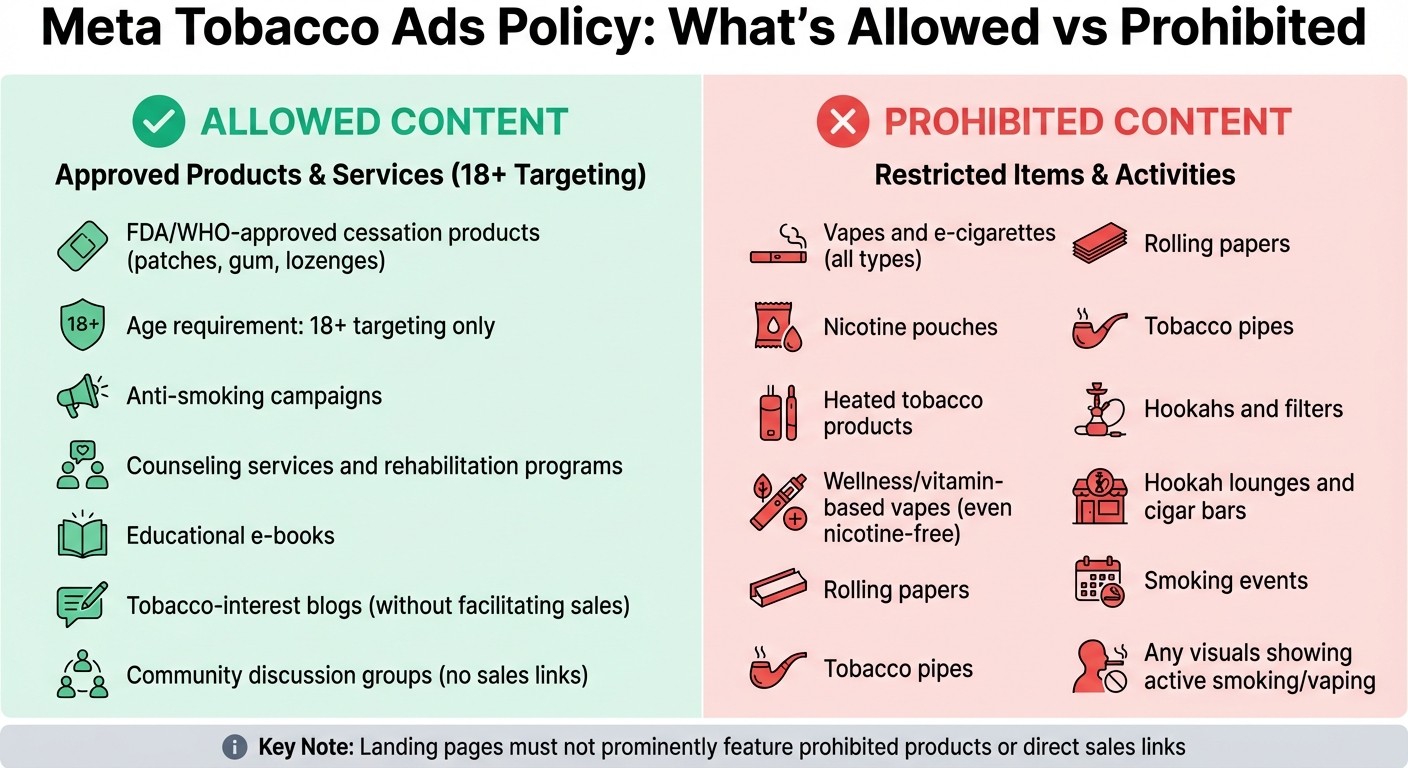
Meta Tobacco Ads Policy: Allowed vs Prohibited Content 2025
Meta imposes strict rules on tobacco-related ads, similar to its political and nonprofit ad policies, but does make exceptions for certain types of cessation and educational content.
Tobacco Cessation and Educational Content
Ads promoting nicotine replacement therapies, like patches, gum, or lozenges, are allowed - but only if these products are approved by the World Health Organization (WHO) or the U.S. Food and Drug Administration (FDA). These ads must also target users aged 18 and older, adhering to teen targeting compliance rules. Using a target audience finder for Meta ads can help ensure these age restrictions are strictly followed. Importantly, this approval requirement excludes products like vapes, which remain completely banned.
"Ads may only promote cessation products approved by either the World Health Organization or the U.S. Food and Drug Administration, and must comply with all applicable local laws, required or established industry codes and guidelines."
Educational campaigns have more flexibility. Anti-smoking advocacy, counseling services, rehabilitation programs, and even informational e-books are all allowed. However, visuals in these ads must align with the anti-smoking message. For example, an ad showing a crushed cigarette with the tagline "Break Free from Nicotine" would be acceptable, but showcasing someone actively smoking would not. Advertisers can also use AI-powered ad strategies to test different creative variations that stay within these visual boundaries.
While Meta permits cessation and educational ads, it continues to enforce strict restrictions on promotions involving tobacco accessories, requiring advertisers to adapt to Meta ads policy changes to maintain compliance.
Accessory and Retail-Specific Promotions
Meta bans ads for tobacco accessories, including rolling papers, pipes, hookahs, and filters. Retailers selling these items cannot promote them, even if they also offer compliant products. Similarly, ads for hookah lounges, cigar bars, or events that encourage tobacco use are prohibited.
However, some forms of tobacco-related content are allowed. For instance, blogs or community groups discussing tobacco interests are acceptable - as long as they don’t facilitate sales. A Facebook Group for cigar enthusiasts debating flavor profiles is fine, but linking directly to an online tobacco shop is not. Meta also reviews destination URLs to ensure they don’t feature prohibited products or direct sales links.
Allowed Content | Prohibited Content |
|---|---|
FDA/WHO-approved cessation products – patches, gum | Vapes, e-cigarettes, nicotine pouches |
Anti-smoking campaigns and counseling services | Hookah lounges, cigar bars, and smoking events |
Tobacco-interest blogs without facilitating sales | Rolling papers, pipes, and filters |
Policy Enforcement and Penalties
Meta uses a combination of automated tools and a team of over 15,000 reviewers to identify ad violations both before and after ads go live.
Automated and Manual Review Processes
Meta's enforcement starts with automated systems that review every ad before it’s approved. These tools analyze the ad’s text, visuals, targeting parameters, and landing pages to ensure they meet Meta’s policies. While most reviews are completed within 24 hours, some cases may take longer.
"Our ad review system relies primarily on automated tools to check ads and business assets against our policies."
Meta
Even after approval, ads remain under scrutiny. Meta uses user reports, alerts from NGOs, and court orders to flag potential issues. The Account Quality tool also helps monitor Business Accounts for repeated violations and performance anomalies. When automated systems can’t make a final decision, Meta’s team of 15,000+ reviewers steps in to manually assess flagged content. If you believe an ad was wrongly disapproved, you can request a manual review through the Account Quality tool in Ads Manager. This layered approach ensures policy enforcement remains consistent and comprehensive.
Penalties for Non-Compliance
Violating Meta’s ad policies results in penalties that escalate based on the severity and frequency of the infractions. The mildest consequence is ad rejection, where a single ad is blocked from running. In such cases, you can edit the ad and resubmit it for review.
For more serious or repeated violations, Meta may impose account restrictions. These can range from limiting access to ad tools to completely disabling ad accounts or Pages. In extreme cases, Meta can permanently ban a user or Business Account. A permanent ban removes all advertising capabilities across Meta’s platforms. However, other team members on the same Business Account may still be able to run ads if their accounts remain in good standing.
Penalty Level | What Happens | Impact |
|---|---|---|
Ad Rejection | Individual ad is disapproved | Requires editing and resubmission |
Account Restriction | Temporary or partial loss of access | Limits campaign launches and feature availability |
Asset Disabling | Page or ad account is shut down | Loss of history and audience reach |
Permanent Ban | Full removal from Meta’s ad system | No access to advertising tools or campaigns |
In 2024, Meta restricted over 33,000 pieces of content in the United Kingdom due to localized enforcement measures. Additionally, in April 2025, the European Commission fined Meta EUR 200 million for breaching the Digital Markets Act, highlighting the serious consequences for advertisers and Meta itself.
2025 Policy Updates and Best Practices for Compliance
Key Updates in Meta's 2025 Tobacco Policy
Meta has introduced several updates to its tobacco advertising policy for 2025, aiming to provide users with more transparency and control. One significant change is the requirement for AI-generated photorealistic human ads to include a "Synthetic" label next to the "Sponsored" tag. This step reflects Meta's commitment to clearly identifying synthetic media.
The updated policy also explicitly bans certain nicotine products that were previously in a gray area. Prohibited items now include heated tobacco products, nicotine pouches, and so-called "wellness" or vitamin-based vapes, even if they are nicotine-free. For cessation products, only those approved by the World Health Organization (WHO) or the U.S. Food and Drug Administration (FDA) can be advertised, and they must target users aged 18 and older.
Meta has also enhanced its automated systems to ensure better compliance. These systems now feature improved geofencing to block restricted content in regions where local laws prohibit such ads. Additionally, live ads are subject to re-review, making ongoing compliance a critical aspect for advertisers.
Best Practices for Creating Compliant Ads
Age-gate your landing pages: Ensure that all landing pages for cessation products include a clear age-verification step. This not only aligns with Meta's policies but also adheres to local regulations. The destination URL must be functional, directly relevant to the ad, and free from prohibited sales or disruptive elements like pop-ups.
Screen ad creatives thoroughly: Use compliance tools to identify and remove banned imagery, such as vape pens, hookah pipes, or rolling papers. Avoid language or visuals that might appeal to minors. If depicting tobacco products, ensure the focus is educational or part of an anti-smoking campaign rather than promoting consumption.
Collaborate responsibly: When working with creators on anti-smoking initiatives, use Meta's branded content tool to properly tag business partners and maintain transparency.
Using AdAmigo.ai for Compliance and Optimization
Keeping up with Meta's evolving guidelines can be challenging, but tools like AdAmigo.ai can simplify the process. This platform scans ad creatives against the latest 2025 standards before submission, helping you avoid rejections and potential account restrictions.
AdAmigo.ai's AI Ads Agent can generate and test compliant creatives while adhering to Meta's policies. Its AI Actions feature provides a daily to-do list, prioritizing adjustments across creatives, audiences, budgets, and bids. This allows agencies to manage up to 4–8× more accounts, freeing up strategists to focus on broader planning.
Another key feature is its ability to detect policy violations before submission. The AI Chat Agent is available to answer compliance questions on demand and can even facilitate bulk campaign launches directly from Google Drive. For $99/month (for accounts spending under $5,000 monthly), AdAmigo.ai offers a cost-effective way to navigate Meta's policies without the need for additional compliance staff or risking penalties.
Conclusion
Meta's 2025 tobacco ad policies set clear boundaries for advertisers. According to Meta:
It is an advertiser's responsibility to understand and comply with our policies outlined in Meta's Advertising Standards, our Terms of Service and any other applicable terms and guidelines, in addition to all local laws, regulations and, where applicable, self-regulatory advertising codes
. Failure to follow these rules can result in account-wide restrictions, including the potential loss of advertising access altogether.
These strict guidelines demand constant attention throughout your campaign's lifecycle.
Meta actively monitors ads with a global team of over 15,000 reviewers. As stated:
Ads remain subject to review and re-review at all times, and may be rejected or restricted for violation of our policies
. Even ads that initially pass review can be flagged later if there are policy changes or if violations are detected during the standard 24-hour review process.
Adhering to Meta ad QA protocols is just one part of the equation. Ethical compliance is equally important for maintaining sustainable advertising practices, often supported by AI compliance tools. Beyond avoiding penalties, compliance reflects a commitment to responsible advertising. Meta’s restrictions on tobacco-related products - including nicotine products, e-cigarettes, and even nicotine-free "wellness" vapes - are designed to shield users from health risks. For cessation products, age restrictions (18+) and approval from organizations like WHO or FDA ensure that messaging aligns with harm-reduction goals.
To keep your campaigns on track, regularly check the Account Quality section in Ads Manager or use AI tools for Meta ad account analysis. Use Meta's Transparency Center to stay informed about policy updates. Additionally, ensure your landing pages are fully functional, relevant, and free from prohibited content, as Meta reviews the entire user experience. Making these practices a habit can help avoid unexpected disruptions.
FAQs
What happens if I violate Meta's tobacco advertising policies?
Meta enforces strict rules when it comes to advertising tobacco and related products. Breaking these rules can lead to serious consequences, even though the exact penalties aren't clearly defined. Possible actions might include having your ads disapproved, facing account restrictions, or, in the worst-case scenario, being permanently banned from the platform.
To steer clear of trouble, make sure your ads fully align with Meta's policies and any applicable local laws or restrictions. Staying up to date on these guidelines is key to protecting your account and ensuring your ads continue to perform effectively.
Can I advertise nicotine-free vaping products on Meta platforms?
Meta's advertising policies strictly prohibit ads that promote the sale or use of vaping products. This rule applies across the board, even to nicotine-free options. Whether or not the product contains nicotine, all vaping-related items fall under this restriction.
How does Meta enforce its tobacco advertising policies?
Meta takes a firm stance on tobacco advertising by enforcing strict rules and a thorough review process. Ads are prohibited from promoting the sale or use of tobacco, nicotine products, or related items like e-cigarettes and vaporizers. The only exception applies to approved smoking cessation products aimed at individuals aged 18 or older, provided they align with local laws.
Before any ad goes live, it undergoes a detailed review to ensure it meets Meta's guidelines. Advertisers must also adhere to the platform’s community standards and advertising policies. If an ad violates these rules, it can be rejected or restricted. However, advertisers have the option to request a review if they believe an ad was mistakenly flagged. This approach helps Meta maintain a responsible and compliant advertising space.