
How Age Laws Change Meta Ad Targeting Rules
Meta now limits teen targeting to age and location only and enforces age minimums for regulated ads. Here's what changed and how to stay compliant.
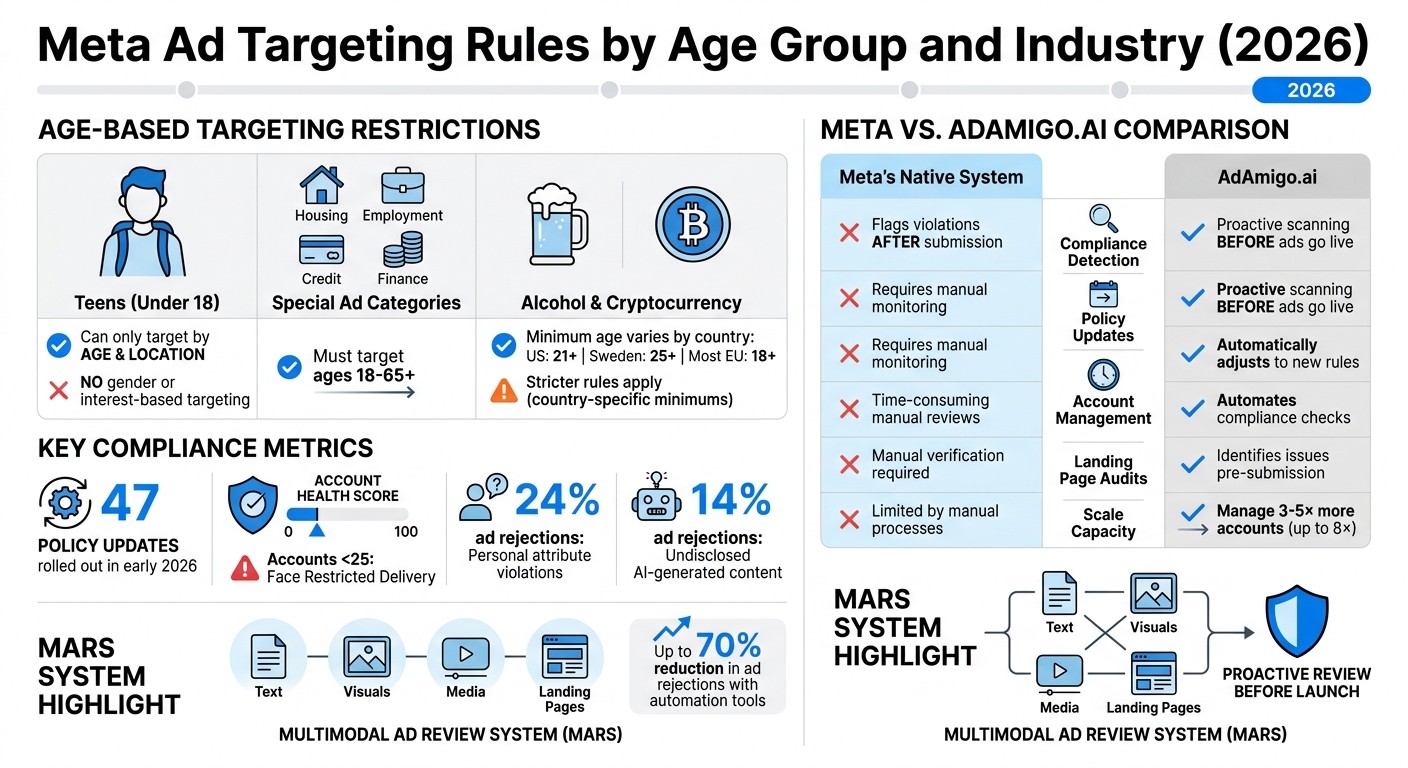
Meta's ad targeting rules have undergone major updates in 2026, especially for age-specific regulations. Here's what you need to know:
Teens (under 18): Ads can only target by age and location - no gender or interest-based targeting.
Special Ad Categories (Housing, Employment, Credit, Finance): Must target users aged 18–65+.
Alcohol and Cryptocurrency Ads: Stricter rules apply - minimum targeting age varies by country (e.g., 21 in the U.S., 25 in Sweden).
New AI System (MARS): Ads are now reviewed proactively before launch, scanning creative assets and landing pages for compliance.
Account Health Score: Accounts scoring below 25 face restricted ad delivery.
Automation Tools: Platforms like AdAmigo.ai help advertisers stay compliant by automating age-gating, monitoring campaigns, and adjusting settings to align with Meta's frequent policy changes.
These updates highlight the growing complexity of ad compliance, making automation tools essential for managing campaigns across regions and avoiding penalties.
Meta Ad Targeting Rules by Age Group and Industry 2026
1. Meta Ad Targeting Rules

Compliance with Regional Age Laws
In 2026, Meta introduced the Multimodal Ad Review System (MARS), a significant upgrade in its ad targeting approach. This system reviews multiple ad elements - such as text, visuals, media, and landing pages - before an ad is served, moving beyond the older, keyword-based methods. For example, MARS can now recognize contextual details, like floor plans in housing ads or office settings in employment-related campaigns.
Meta's age-restricted content changes vary by industry and location. In the United States, alcohol ads must target users aged 21 or older, while the minimum age is 25 in Sweden and 18 in most European countries. Gambling and social casino ads carry their own regional restrictions — operators must comply with Meta's gambling ad compliance rules, which can require minimum ages as high as 25 depending on local regulations. For teens, targeting is limited strictly to age and location, excluding gender and past app activity. Meta explained this decision by stating:
"Teens aren't necessarily as equipped as adults to make decisions about how their online data is used for advertising".
To enforce these age thresholds, Meta uses automated tools that ensure compliance across all campaigns, similar to how the Meta ad review process functions for all advertisers. Advertisers who run teen-facing campaigns should also review best practices for avoiding teen targeting risks, since even unintentional misconfiguration can trigger compliance flags.
Targeting Option | Before 2026 | After 2026 |
|---|---|---|
Interest-based | Partially available | Fully removed |
Behavioral (purchase, device) | Partially available | Fully removed |
Lookalike audiences | Available with limits | Fully removed |
Custom audiences | Available | Fully removed |
Age + Location | Available | Still available |
Gender | Removed 2023, re-added limited 2025 | Limited options |
Contextual placement | Not available | New — available |
This means teen campaigns must now rely almost entirely on creative quality and contextual signals. Since lookalikes and custom audiences are off the table, the ad itself — its visual, copy, and landing page experience — carries the full weight of performance.
Age Verification Framework
Meta enforces its age-based targeting rules through a three-layer age verification system designed to catch misrepresentation before an ad is served to the wrong audience.
Layer 1 — Self-Reported Date of Birth. Every user provides a date of birth at account creation. This is the baseline signal, but Meta treats it as the weakest layer — users can and do misreport their age, particularly in the 13–17 range.
Layer 2 — AI-Based Age Estimation. Meta's machine learning models analyze behavioral signals across the platform — friend graph composition, content engagement patterns, account activity cadence, and linguistic markers — to estimate a user's actual age. When the AI estimate shows a significant discrepancy from the self-reported age, the account is flagged for further verification. According to Meta's own research, 88% of US parents support requiring platforms to verify user age, which has driven investment in this technology.
Layer 3 — Document or Government ID Verification. Flagged accounts must verify their age by submitting a government-issued ID or, in some regions, a video selfie analyzed by age-estimation AI. Until verification is complete, the account's ad visibility is restricted to age-appropriate content only.
Practical takeaway for advertisers: For age-restricted products — alcohol, gambling, and other regulated categories — set your minimum targeting age above the legal threshold. If the law requires 18, target 21. If the law requires 21, target 25. This buffer accounts for AI estimation errors near age boundaries and reduces the risk of your ads reaching underage users through misclassified accounts.
Automation and Adaptability
The pace of policy changes has accelerated, with Meta rolling out 47 updates in the early months of 2026 alone. This rapid evolution makes manual compliance increasingly difficult. To address this, Meta assigns each ad account a Health Score ranging from 0 to 100, which advertisers can monitor your ad accounts to maintain performance. Accounts scoring below 25 face "Restricted Delivery", meaning their ad impressions are significantly limited.
Advertisers promoting regulated products must meet stricter requirements. Age verification now extends beyond the ad itself to include elements like landing pages, lead forms, and Messenger flows. Failing to meet these standards can trigger account-level penalties. Additionally, Meta no longer recommends alcohol-related business pages in algorithmic feeds, a change that has impacted organic visibility — a shift covered in detail in Meta's alcohol ad policy updates. Alden Morris, Founder of Intentionally Creative, highlighted this challenge:
"If you sell alcohol, your page simply won't show up in suggested content feeds anymore - slashing the organic visibility that many store owners depend on".
Since Meta ad rules differ significantly by region, advertisers running multi-country campaigns must verify that their age-gating settings match each target market's legal requirements — not just the most restrictive one.
Impact on Advertiser Strategies
These automated measures force advertisers to rethink their strategies to maintain compliance. The days of trial-and-error campaign adjustments are over. Notably, 14% of ad rejections in 2026 were linked to undisclosed AI-generated content, emphasizing the need for proper disclosure to avoid penalties.
For advertisers managing campaigns across multiple regions, tools like AdAmigo.ai have become essential. These platforms can audit landing pages, verify age-gating measures, and automatically adjust targeting settings, leveraging AI tools for behavioral targeting, helping brands navigate Meta's evolving policies. Solutions like these are becoming critical for staying compliant and maintaining campaign performance in a rapidly changing landscape.
Platform Differences: Instagram vs Facebook vs Threads
Meta's teen ad restrictions aren't applied uniformly across its platforms. Each has its own enforcement layer, and treating them as interchangeable can lead to inconsistent delivery and unexpected rejections.
Instagram applies the strictest controls. Its enhanced creative review can slow ad approval for teen-targeting campaigns, and Sensitive Content Control is locked for users under 16. Teens also can't receive DMs from non-followed accounts, limiting the reach of direct-response ad flows that rely on Messenger-style engagement.
Facebook enforces moderate restrictions. Standard ad review applies, and Marketplace access remains available — though only for age-appropriate listings. Messenger ads are not served to teen users at all, which closes off a retargeting channel many advertisers rely on for older demographics.
Threads is the most restrictive by default. Ads are limited to feed placements only — no boosted posts, no Stories equivalents, and the lowest frequency cap of any Meta surface. For advertisers accustomed to saturating multiple placements, Threads demands a completely different creative and budgeting approach.
The takeaway: Build platform-specific ad sets within your teen campaigns rather than relying on a one-size-fits-all setup. What clears Instagram's enhanced review may underdeliver on Threads, and what works on Facebook may stall in Instagram's approval queue. Segment by platform, adjust creative formats accordingly, and set separate budgets to match each surface's delivery constraints.
2. AdAmigo.ai
AdAmigo.ai takes Meta's improved review protocols a step further by introducing targeted automation to streamline compliance processes.
Compliance with Regional Age Laws
The platform simplifies adherence to regional age requirements for Special Ad Categories (HEC), which mandate targeting individuals aged 18–65+. AdAmigo.ai scans ad content and automatically enforces the correct age restrictions before the ads go live.
Automation and Flexibility
Keeping up with Meta's frequently changing policies can be a daunting task if done manually. AdAmigo.ai eliminates this challenge by automatically aligning its compliance settings with Meta's latest guidelines. It continuously monitors campaigns and uses a pre-submission detection system to catch and fix potential issues to avoid Meta ad rejections before ads even hit Meta's review process. This real-time system ensures smoother operations and saves advertisers from unnecessary delays.
Enhancing Advertiser Strategies
AdAmigo.ai's ability to complete full account scans in less than two minutes revolutionizes account management. By reducing compliance risks across various regions, it allows advertisers to operate at scale. For example, one media buyer using the platform successfully manages up to eight times more accounts compared to traditional manual methods. This efficiency helps agencies expand without needing to proportionally increase their team size.
Pros and Cons
With regional age laws influencing ad targeting strategies, advertisers face a crucial decision between using Meta's in-house system or opting for advanced automation tools. Meta enforces these laws through platform-level restrictions, with minimum age requirements varying by region. Their Multimodal Ad Review System (MARS) reviews text, visuals, audio, and landing pages to catch policy violations before ads are published. Here's a quick comparison of the two approaches.
Meta's system struggles to keep up with the rapid pace of policy changes. In 2026 alone, the platform introduced 47 updates to its advertising policies. Among the most common reasons for ad rejections were personal attribute violations and undisclosed AI-generated content, the latter accounting for 14% of all rejections. The system also requires advertisers to manually verify every ad element, increasing the likelihood of compliance errors.
Automation tools, like AdAmigo.ai, tackle these challenges differently. For instance, AdAmigo.ai scans ad content proactively to ensure it complies with age restrictions. Its automation capabilities significantly boost efficiency, allowing media buyers to manage as much as 3–5 times more accounts compared to manual processes.
Feature | Meta's Native System | AdAmigo.ai |
|---|---|---|
Compliance Detection | Flags violations after submission | Proactively scans ads before they go live |
Policy Updates | Requires manual monitoring | Automatically adjusts to new rules |
Account Management | Time-consuming manual reviews | Automates compliance checks |
Landing Page Audits | Relies on manual verification | Identifies issues pre-submission |
Scale Capacity | Limited by manual processes | Allows one buyer to manage 3–5× more accounts |
The choice boils down to control versus efficiency. Meta's system offers advertisers full manual oversight but requires constant vigilance to keep up with frequent policy changes. On the other hand, AdAmigo.ai automates compliance, giving advertisers the option to operate on autopilot or retain manual control.
Enforcement & Penalties
Violating Meta's age-targeting rules triggers a structured escalation process — and the consequences go beyond a single paused ad.
Violation Escalation Sequence:
1st violation: The offending ad set is paused and the advertiser receives a notification detailing the policy breach. This is a warning, but it's recorded on the account.
2nd violation within 12 months: The entire campaign is disabled, and the advertiser must complete a policy compliance review before relaunching anything in that category.
3rd violation within 12 months: The ad account is suspended. Reactivation requires a formal appeal and proof of corrected processes.
Severe or intentional violations: Meta may issue a permanent ban on the account and associated business entities — no appeal path.
Account Health Score Impact: Age-law violations directly lower your Account Health Score. When that score drops below 25, Meta applies "Restricted Delivery" — your ads still run, but impressions are heavily throttled. Age-law violations directly lower your Account Health Score, and repeated mistakes can compound into Restricted Delivery territory even before account-level penalties kick in.
Regulatory Exposure: Beyond Meta's internal enforcement, advertisers face regulatory risk. Under the EU Digital Services Act, non-compliance can trigger fines of up to 6% of global annual turnover. The UK's Online Safety Act authorizes Ofcom to levy penalties of up to £18 million or 10% of qualifying worldwide revenue — whichever is greater. In the US, COPPA 2.0, reintroduced in the 119th Congress, proposes extending online privacy protections to teens aged 13–16, which would create a new federal compliance framework for any advertiser whose campaigns reach that age group.
Conclusion
Meta's evolving regional age laws have significantly altered how advertisers can target their audiences. For teens, targeting is now restricted to just age and location, as gender and app activity targeting have been eliminated worldwide. Meanwhile, businesses in the alcohol industry face stricter limitations, with their pages removed from Meta's algorithmic recommendations starting in early 2026. This leaves paid advertising as their sole growth avenue. Keeping up with these changes manually has become increasingly difficult.
Meta has shifted from reactive enforcement to a proactive approach, scanning every ad with AI before it goes live. This change is reshaping ad compliance, especially as undisclosed AI-generated content made up 14% of all ad rejections in 2026. The days of launching ads without careful scrutiny are over.
To navigate these challenges, automation has become indispensable for ensuring compliance and maintaining ad performance. Tools like AdAmigo.ai can reduce potential ad rejections by up to 70% through pre-submission audits. These tools streamline processes by automatically applying age-gating, monitoring account health around the clock, and adapting to new policies without requiring manual updates. One media buyer using automation can effectively manage 4–8 times more accounts compared to traditional methods, freeing up time for strategic planning.
For advertisers working in regulated sectors like alcohol, health, and finance, the stakes are higher than ever. Meta's Account Health Score system penalizes accounts with scores below 25, leading to restricted ad delivery. Additionally, landing pages must now include dedicated age verification layers to meet compliance standards. In this environment, automation is the key to avoiding wasted ad spend and ensuring scalable performance.
Start by auditing your landing pages to confirm proper age-gating measures are in place. Then, evaluate whether your current manual workflows can keep up with Meta's rapid policy changes. If not, automation tools that integrate compliance checks with creative, budget, and targeting optimization might be the solution you need to stay ahead.
FAQs
How do I know if my ad is treated as a Special Ad Category?
To determine if your ad is classified as a Special Ad Category, check whether it relates to areas such as housing, employment, credit, or social issues. These categories are governed by stricter Meta guidelines and must adhere to additional regulations.
What age-gating is required on landing pages and lead forms to stay compliant?
To meet Meta's advertising standards, it's essential to implement age gating of 18+ on your landing pages and lead forms. This is particularly important for restricted categories such as alcohol and health-related products. Taking this step ensures your ads align with Meta's rules for promoting sensitive items.
How can I improve a Meta Account Health Score below 25?
If your Meta Account Health Score has dipped below 25, it's time to take action. Start by ensuring that all your ads align with Meta's advertising policies. Violations, such as misleading claims or using restricted content, can hurt your score significantly.
Regularly check the Account Quality section to spot and address any issues early. Also, stay informed about policy updates - especially those related to age restrictions or ad content - as these changes can impact your compliance. By staying vigilant and proactive, you can work toward improving your account's standing.