
5 Best Practices for Meta Ads Attribution Reporting
Restore conversion visibility: match attribution windows, use data-driven models, add Pixel+CAPI, standardize settings, and test incremental lift.
In 2026, Meta Ads attribution reporting has become more challenging due to privacy changes like Apple's App Tracking Transparency and Safari's Link Tracking Protection. These shifts have significantly reduced tracking accuracy, with reported conversions dropping by 15–30% overnight after Meta removed 7-day and 28-day view attribution windows. To navigate these challenges, here are five actionable strategies:
Match Attribution Windows to Your Customer Journey: Align tracking windows with your sales cycle to avoid misinterpreting performance data.
Use Data-Driven Attribution Models: Leverage machine learning and first-party data to improve conversion accuracy.
Check Your Pixel Setup and Use CAPI: Combine Meta Pixel with the Conversions API to boost match rates and recover lost data.
Standardize Campaign Settings: Keep attribution settings consistent across campaigns to avoid data discrepancies.
Experiment with Incremental Attribution: Use advanced methods to measure the true impact of your ads.
These practices help advertisers regain visibility, optimize campaigns, and make better budget decisions in a privacy-first advertising landscape.
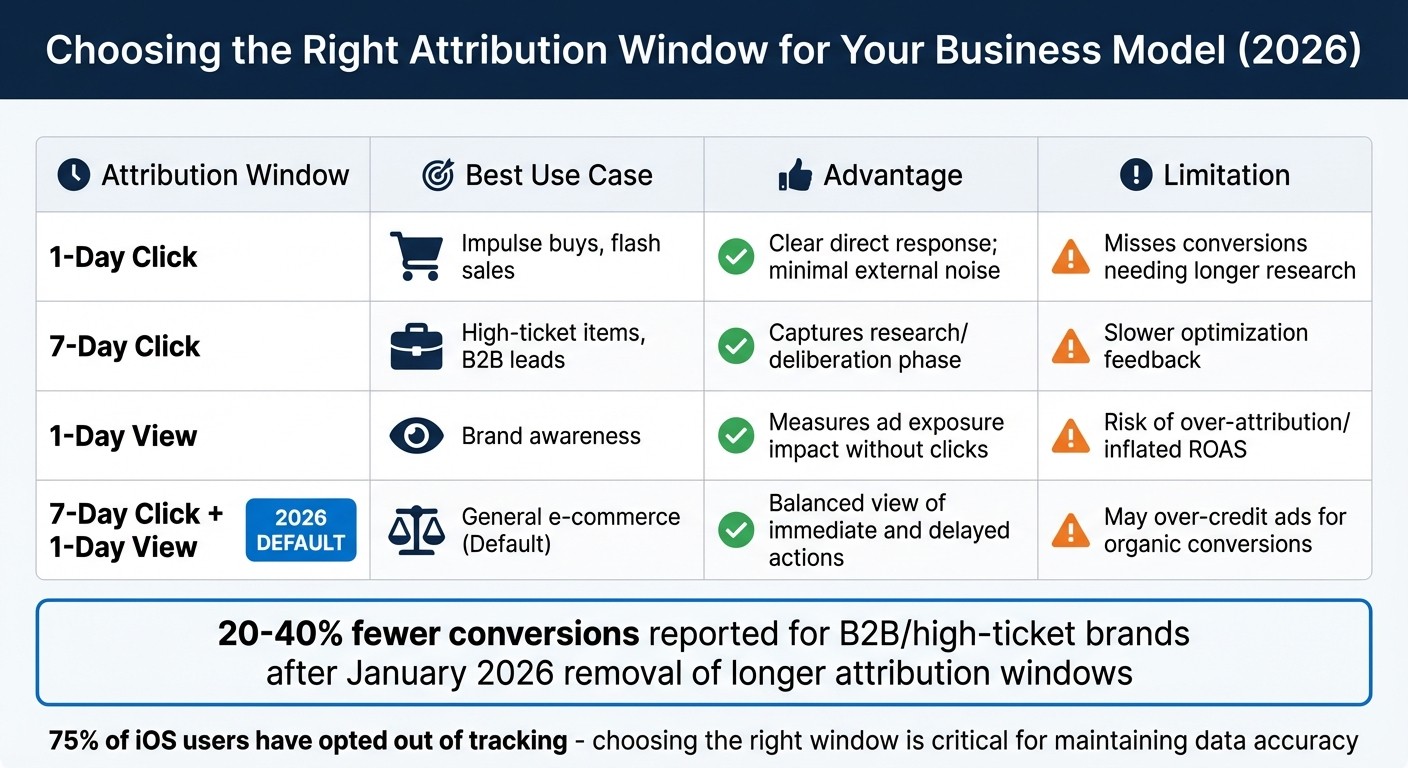
Meta Ads Attribution Windows Comparison Guide 2026
Meta’s New Attribution Model Will Blow Up Your Ad Strategy - Here’s Why
1. Match Attribution Windows to Your Customer Journey
Aligning your attribution window with your actual customer journey is key. Think about it: a $20 flash sale might convert in hours, while a $5,000 software deal could take weeks. Applying the same 7-day click window to both scenarios creates inaccurate data and misattributed conversions.
This alignment ensures your campaigns are backed by data that reflects reality, helping you allocate budgets more effectively.
Impact on Campaign Optimization
Using a window that’s too short for your sales cycle can throw off Meta’s algorithm. For example, if your average customer takes 10 days to decide, but you’re tracking only 7-day clicks, the algorithm assumes your ads aren’t working. As a result, it reallocates your budget away from campaigns that are actually driving sales - you just don’t see them yet. For B2B or high-ticket brands with sales cycles of 2–4 weeks, the January 2026 removal of longer attribution windows caused reports to show 20–40% fewer conversions, even though actual sales remained steady.
Accuracy of Attribution Insights
Here’s a quick look at how different attribution windows suit various business models. For example, 1-day click is great for impulse buys, but it underreports for longer decision-making processes. On the other hand, 7-day click - Meta’s current default - works well for most e-commerce journeys but may not capture longer cycles. The table below breaks it down:
Attribution Window | Best Use Case | Advantage | Limitation |
|---|---|---|---|
1-Day Click | Impulse buys, flash sales | Clear direct response; minimal external noise | Misses conversions needing longer research |
7-Day Click | High-ticket items, B2B leads | Captures research/deliberation phase | Slower optimization feedback |
1-Day View | Brand awareness | Measures ad exposure impact without clicks | Risk of over-attribution/inflated ROAS |
7-Day Click + 1-Day View | General e-commerce (Default) | Balanced view of immediate and delayed actions | May over-credit ads for organic conversions |
Support for Post-iOS Updates Reporting
Privacy changes, like iOS privacy changes have made attribution even trickier. With 75% of iOS users opting out and Safari blocking tracking identifiers, shorter windows only worsen signal loss. Setting the right attribution window is critical for maintaining reliable data, especially when comparing Meta ads attribution vs. third-party tools in this privacy-first era.
To regain visibility, focus on your top 8 conversion events using Aggregated Event Measurement. Make 'Purchase' your Priority 1 event to ensure iOS conversion data is captured. Also, use the Meta Pixel Helper to check for duplicate pixels, as double-firing can inflate ROAS and distort your attribution insights.
2. Use Data-Driven Attribution Models
Data-driven attribution models assign credit to every interaction in a customer's journey, offering a more complete picture of performance. This is especially important now, as Meta ads have seen a 40–60% drop in attribution accuracy due to recent iOS privacy updates. Traditional last-click models just don’t cut it in this new, privacy-focused era.
Accuracy of Attribution Insights
Meta combats the loss of tracking data by using machine learning to estimate the behavior of users who opt out. How? The algorithm studies patterns from users who haven’t opted out and applies those insights to modeled conversions - with an accuracy range of 10–15%. To make these estimates as precise as possible, you need to feed Meta’s algorithm high-quality first-party data.
Impact on Campaign Optimization
Better data means better optimization. For instance, combining the Conversions API (CAPI) with the Meta Pixel can boost match rates to 85–95%. Without CAPI, you risk losing 25–30% of conversion data.
"If you're not running Conversion API in 2026, you're losing 40–60% of conversion visibility." - Luke Costley-White, DOJO AI
These enhanced insights are essential for overcoming the reporting challenges brought on by iOS updates.
Support for Post-iOS Updates Reporting
To adapt your reporting for the post-iOS world, start by improving your Event Match Quality (EMQ) in Meta Events Manager. Aim for a score of 70% or higher by enriching your first-party data. Also, make sure Meta Ads Manager and Google Analytics 4 are aligned on the same time zone. Even a small mismatch can cause 10–15% discrepancies in daily reports.
Finally, consider using server-side tracking tools like Stape or Triple Whale. While these tools typically cost between $50 and $500 per month depending on your event volume, the investment can prevent significant losses in conversion visibility.
3. Check Your Pixel Setup and Aggregated Event Measurement
By 2026, relying solely on pixel tracking captures just 60–70% of conversions. The reasons? Ad blockers and iOS privacy restrictions. That’s a significant gap if the pixel is your only tracking tool.
Ease of Implementation
To build a strong tracking foundation, start by verifying your domain in Meta Business Manager. You can do this via a DNS TXT record or by uploading an HTML file. This process enables Aggregated Event Measurement (AEM), which is critical for tracking iOS users who’ve opted out of data sharing. For a more comprehensive view, you can also map GA4 events to Meta conversions using server-side tracking. Without AEM, these users remain invisible to your campaigns.
Once set up, prioritize your 8 AEM events based on their importance to your business. For example, assign "Purchase" or "Lead" as Priority 1. If a user triggers multiple events, only the highest-priority event will be reported. Regularly check the Events Manager diagnostics tool to catch issues like JavaScript errors or missing code that might stop your pixel from firing properly.
This setup lays the groundwork for better data accuracy, especially when combined with CAPI.
Accuracy of Attribution Insights
Combining your Pixel with CAPI creates a more reliable tracking system, achieving 85–95% match rates compared to the 60–70% you get with pixel-only tracking. Unlike the pixel, CAPI bypasses ad blockers, which affect around 25–30% of web users.
For even better accuracy, enable Automatic Advanced Matching in your pixel settings. This feature uses hashed customer data - like emails or phone numbers - to improve attribution. Aim for an Event Match Quality (EMQ) score of 6.0 or higher by sending additional parameters. Use the "Test Events" tool in Events Manager to ensure events and parameters, such as order value, are working correctly in real time.
Impact on Campaign Optimization
Integrating CAPI can boost your CPA performance by 15–25% within the first month. Why? Meta’s algorithm benefits from higher-quality data, making it easier to identify and target high-value users. To maximize this, use standard events like "Purchase" or "Lead" and include rich parameters such as value, currency, and content_ids.
Tracking Method | Conversion Capture Rate | Ad Blocker Immunity | Match Quality |
|---|---|---|---|
Pixel Only | 60–70% | No | Lower |
Pixel + CAPI | 85–95% | Yes (CAPI portion) | Higher |
A well-structured tracking system is key to accurate attribution and better campaign results.
4. Use the Same Settings Across Campaigns
To make the most of your tracking systems and data models, it's crucial to maintain consistent attribution settings across all campaigns. This ensures your insights remain clear and actionable.
Accuracy of Attribution Insights
Mixing attribution windows - like using a 7-day click window for one campaign and a different window for another - can lead to confusion. Meta and GA4 already show a 20–40% variance due to differing methodologies. Adding inconsistent settings into the mix only makes it harder to figure out whether changes in performance are real or just reporting anomalies.
With privacy updates making things trickier, standardizing settings becomes even more important. To keep things on track, establish a "normal" discrepancy ratio between Meta and your backend data. Then, only investigate when the gap goes beyond 20% of that baseline.
Ease of Implementation
The good news? Standardizing your attribution settings is simple. Stick with the 7-day click window, which is the default for 2026. Benly.ai also recommends using consistent naming conventions for campaigns and ad sets to make cross-account analysis easier: "Standardize naming conventions: Consistent campaign and ad set naming enables accurate cross-account analysis".
Another key step is syncing the time zones between Meta and GA4. A mismatch can cause daily discrepancies of 10–15%, even if your weekly totals match up. Make it a habit to audit these settings monthly to ensure all campaigns align.
Impact on Campaign Optimization
Uniform settings give Meta's algorithm a stable foundation to work with. For example, switching from a 28-day click window to a 7-day click window may reduce reported conversions by 15–30%. Once your settings are standardized, the algorithm can optimize more effectively. As Luke Costley-White from DOJO AI puts it, "The algorithm can't optimize what it can't see". Inconsistent settings, on the other hand, can confuse bidding strategies, making it harder to scale budgets without losing ROAS.
Attribution Setting | Impact on Optimization | Post-iOS 2026 Status |
|---|---|---|
Uniform Settings | High: Enables clear budget scaling and learning. | Recommended: Stable baseline despite changes. |
Mixed Settings | Low: Creates inconsistent data for bidding. | Discouraged: Makes cross-campaign analysis unreliable. |
7-Day Click (Default) | Medium: Covers most standard conversion cycles. | Active: Default standard for 2026 reporting. |
28-Day View | N/A: No longer supports optimization. | Deprecated: Removed as of Jan 12, 2026. |
Take advantage of Meta's "Breakdown by Attribution Setting" feature to analyze different attribution windows without disrupting your optimization data.
5. Apply Advanced Methods Like Incremental Attribution
Understanding Incremental Attribution
With advancements in data analysis, incremental attribution has emerged as a powerful tool for uncovering the real impact of your campaigns. Unlike traditional models that attribute conversions to the last interaction, incremental attribution asks a critical question: Would this conversion have happened without the ad? This method uses probabilistic machine learning to address the gaps left by privacy-focused changes, offering a more accurate picture of causality, especially in today’s advertising landscape.
Implementing Incremental Attribution
Getting started with incremental attribution often involves controlled experiments such as A/B testing conversion rules or leveraging specialized third-party platforms, which can require a considerable investment. Meta is also expanding its "Incremental Attribution" metric, making it more accessible in 2026–2027 as a supplement to last-click reporting. A smart strategy combines incremental attribution with server-side tracking via Meta API configuration best practices, giving you a clearer view of your data. If managing these methods feels overwhelming, platforms like AdAmigo.ai offer automation solutions to simplify the process and provide actionable insights.
Enhancing Campaign Performance
When paired with custom attribution models, incremental attribution delivers a clearer understanding of your campaigns' effectiveness. It identifies which efforts genuinely drive growth, helping you allocate budgets more effectively. By focusing on campaigns that generate real lift instead of just capturing existing conversions, you can avoid over-relying on retargeting and direct resources toward strategies that promote meaningful expansion. This approach ensures a more balanced and effective optimization strategy.
Conclusion
Attribution reporting plays a critical role in identifying which campaigns genuinely drive growth versus those merely capturing conversions that would have happened anyway. With the rise of iOS privacy updates and the phase-out of third-party cookies, traditional multi-channel attribution methods have become outdated. These changes demand marketers rethink their measurement strategies from the ground up.
The five practices highlighted - aligning attribution windows with your customer journey, adopting data-driven models, verifying your Pixel and Conversions API setup, maintaining consistent settings, and leveraging incremental attribution - form a cohesive framework for modern tracking. Relying solely on pixel-based tracking is no longer sufficient. For businesses with physical locations or long sales cycles, implementing an offline conversions API is essential to capture the full customer journey. Even with the Conversions API in place, iOS privacy changes can still result in a 15–25% loss in tracking for iOS traffic. By adopting these strategies, you can adapt to the new landscape of attribution.
The future of attribution is being shaped by AI-driven probabilistic modeling. Instead of depending on outdated "click-to-purchase" tracking, this approach uses AI to interpret user behavior and infer campaign impact. This method fills the gaps created by privacy restrictions and offers a more accurate picture of performance. Combined with the five practices discussed, it ensures conversions are credited more accurately.
As attribution becomes increasingly complex, automation provides a much-needed solution. Managing these strategies manually across multiple campaigns can be overwhelming. Platforms like AdAmigo.ai simplify this process by automatically analyzing performance, reallocating budgets, testing creatives, and scaling successful campaigns using proven creative testing benchmarks - all while adhering to your attribution settings and KPIs. Acting as an always-on AI media buyer, these tools allow agencies to handle 3–5× more clients and help brands improve performance without adding to their teams.
Now is the time to evaluate your current setup. Implementing these practices can lead to smarter budget allocation, better ROAS, and stronger campaign results.
FAQs
What attribution window should I use for my business?
When selecting an attribution window, align it with your sales cycle and the goals of your campaign. For instance, a 1-day click works well for impulse purchases, while a 7-day click is better suited for products or services that require more time for consideration. Meta's default setting - 7-day click + 1-day view - provides a middle ground that suits the needs of many businesses.
How do I know if my Meta Pixel and CAPI are set up correctly?
To make sure your Meta Pixel and Conversions API (CAPI) are working as they should, start by checking that conversions in Meta Ads Manager match the data from your website or CRM. Use the Meta Pixel Helper to confirm that the Pixel is firing correctly. For CAPI, head to Events Manager and review the diagnostics and test events to verify server-to-server events. It's important that both tools consistently track the same events without discrepancies.
How can I measure true incremental lift from Meta ads?
To get a clear picture of incremental lift, it's time to look past outdated last-click or view-through attribution models. These methods have become less dependable with recent privacy updates and stricter tracking restrictions. Instead, consider advanced tools like the Conversions API (CAPI), which can bypass browser limitations and provide more reliable data. Platforms such as AdAmigo.ai take it a step further by analyzing cross-channel behaviors and filtering conversions. This helps you accurately identify the real impact of your Meta ads.