
How Attribution Models Impact Meta Ad Performance
How attribution choices affect Meta ad reporting and AI optimization — use CAPI, backend data, and incrementality testing for accurate results.
Your choice of attribution model can make or break your Meta ad campaigns. It not only determines which ad interaction gets credit for a conversion but also shapes how Meta's AI optimizes your campaigns. Here are the key takeaways:
Attribution Models Matter: Meta's default model (7-day click / 1-day view) often over-credits ads for conversions that might have happened organically.
Data Discrepancies: Expect a 20–40% gap between Meta Ads Manager and tools like Google Analytics due to differing attribution logic.
AI Optimization Relies on Attribution: Meta's AI uses conversion data to decide targeting, so inaccurate signals can lower performance.
Incremental Attribution Is More Accurate: It focuses on conversions directly caused by ads but reports fewer conversions, requiring high volumes to work effectively.
Cross-Platform Challenges: Mismatched attribution across platforms like Meta and GA4 can lead to over-reported conversions and skewed budget decisions.
Better Tracking Solutions: Combining the Meta Pixel with CAPI (Conversions API) improves conversion tracking from 60–70% to 85–95%, enhancing AI performance.
To improve results:
Use backend data as the "source of truth" for revenue tracking.
Validate performance with incrementality testing or geo-holdout studies.
Implement CAPI for cleaner, more accurate conversion data.
Attribution isn't just about assigning credit - it's about understanding what truly drives conversions. By refining your approach, you can make smarter decisions and get better results from your Meta ads.
Meta's NEW Attribution Model Explained What You Need to Know
How Attribution Models Work in Meta Ads
An attribution model is essentially a set of rules that determines which ad interaction deserves credit for a conversion. Meta tracks three main types of engagement: click-through (when someone clicks on your ad), view-through (when someone sees your ad but doesn’t click), and engage-through (when someone interacts with your ad, like leaving a comment, liking it, or watching a video for at least 5 seconds). Each type of engagement is tied to a specific lookback window that decides how long after the interaction a conversion can still be attributed to the ad.
Meta's Default Attribution Logic
Meta relies on a last-touch model, meaning the most recent ad interaction before a conversion gets all the credit. By default, Meta uses a 7-day click / 1-day view attribution window. This means Meta will take credit for a purchase if the buyer clicked your ad within the last 7 days or simply viewed it within the past 24 hours.
Here’s an important nuance: even if a user sees your ad but later interacts with your business organically (like searching for your site on Google and making a purchase), Meta still counts that conversion as its own.
Choosing the right lookback window depends largely on what you’re selling:
Attribution Window | Best For | Key Consideration |
|---|---|---|
1-day click | Impulse buys under $50 | Conservative; may miss longer buying cycles |
7-day click | Standard e-commerce ($50–$200) | Default; suits most businesses |
28-day click | High-ticket or B2B products ($200+) | Accounts for longer decision-making but risks over-attributing |
1-day view | Brand awareness campaigns | Can inflate performance metrics for direct response |
These rules don’t just affect how conversions are tracked - they also guide Meta’s AI in optimizing your campaigns.
Limitations of Meta's Attribution
One major challenge with Meta's attribution system is its walled garden nature. Meta can only track activities within its own platform. It doesn’t know if someone also clicked a Google ad, opened an email, or visited your site multiple times through organic search before converting. This means platforms like Meta and Google can both claim 100% credit for the same sale, and technically, neither would be wrong based on their own systems.
By 2026, pixel-only tracking is expected to capture just 60–70% of conversions, which limits how accurately Meta can track results. Factors like iOS privacy changes, ad blockers, and browser restrictions further disrupt direct tracking. To fill these gaps, Meta uses modeled conversions, which rely on machine learning to estimate what likely happened. While these models are typically accurate within 10–15% of real data, they’re still approximations, not exact figures.
"In 2026, running Meta Ads without CAPI is like driving with one eye closed - you're missing critical information that affects every optimization decision you make." - Gaultier D'Acunto, Co-founder, Benly
When conversion signals are incomplete or skewed, Meta’s AI can struggle to make effective optimization choices. These challenges highlight the need for a closer look at how attribution models compare in the next section.
First-Touch, Last-Touch, and Incremental Attribution Compared
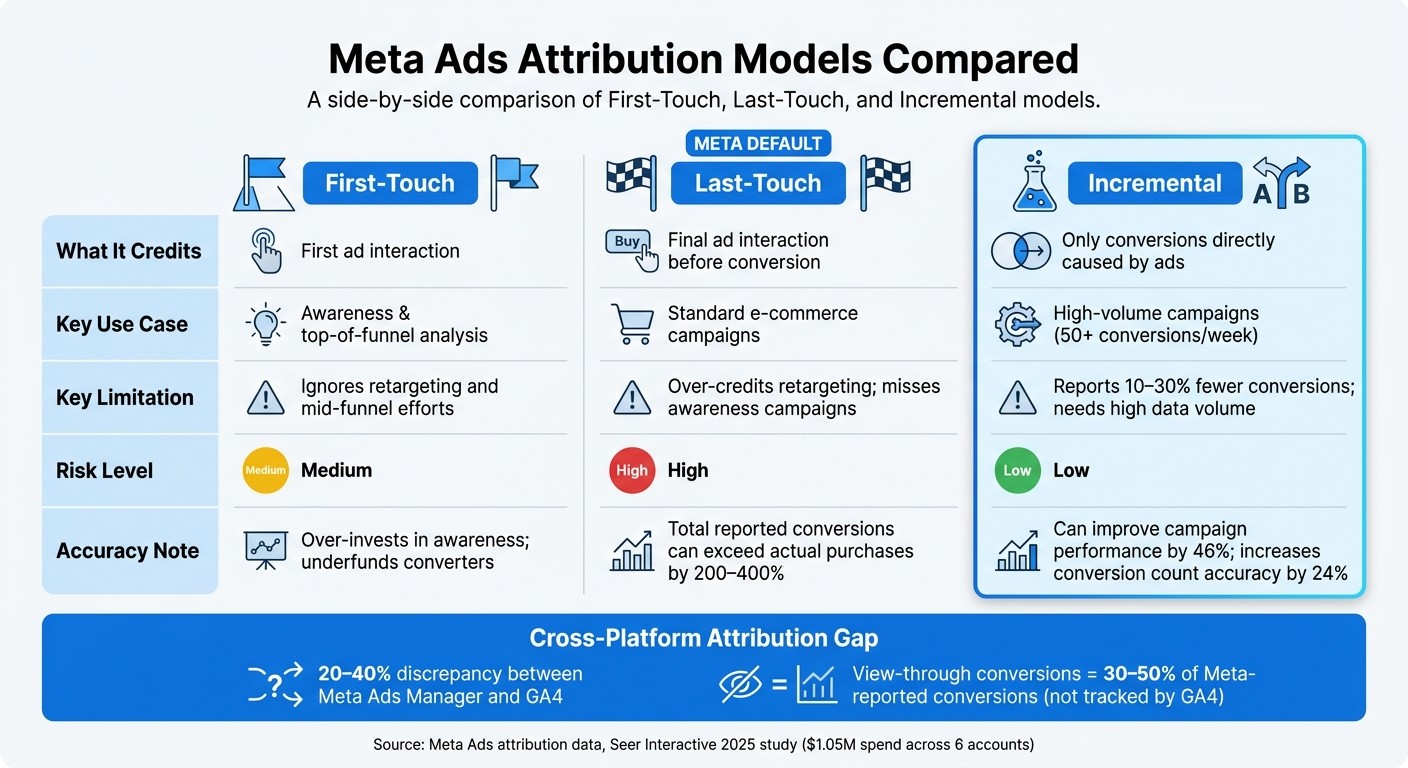
Meta Attribution Models Compared: First-Touch vs Last-Touch vs Incremental
First-Touch Attribution
First-touch attribution gives all credit to the very first ad interaction. This method is handy for understanding which campaigns are most effective at grabbing attention and bringing people into your funnel. However, it overlooks everything that happens afterward - like retargeting ads, email follow-ups, or branded searches that seal the deal. Relying on first-touch attribution often leads to over-investing in awareness campaigns while underfunding those that drive conversions. This often results in missed opportunities for AI-powered retargeting to capture high-intent users.
Now, let’s see how last-touch attribution shifts the focus - and the flaws.
Last-Touch Attribution
Meta’s default attribution model is last-touch, where all credit goes to the final interaction before a conversion. The problem? That final step is often something like a branded search or a direct visit to your site - actions that likely wouldn’t have happened without earlier awareness efforts driven by ads.
This creates a skewed view of performance. Retargeting campaigns, which often occur near the end of the buyer’s journey, tend to look like the heroes. Meanwhile, the prospecting campaigns that sparked initial interest and built intent get sidelined.
"The ROAS number in your Meta dashboard is wrong. Not slightly off - systematically, structurally wrong in ways that get worse as your spend scales." - Larry, Advertising Strategist, AdLibrary
The issue gets even messier in multi-channel setups involving Meta and Google Ads. Platforms like Meta and Google apply their own last-touch logic, meaning both can claim credit for the same conversion. In fact, the total number of conversions reported across platforms can exceed actual purchases by 200–400%.
This confusion highlights why a model focused on true ad impact is essential - enter incremental attribution.
Meta's Incremental Attribution
Incremental attribution flips the script by asking a key question: Would this conversion have happened without the ad? Instead of just tracking clicks, it uses holdout testing. In these tests, some users are shown ads while others aren’t, allowing you to measure the real, causal impact of your campaigns.
Meta’s own data shows that optimizing for incremental results can improve campaign performance by 46%, with updated models increasing conversion counts by 24%. However, incremental attribution tends to report 10–30% fewer conversions because it filters out purchases that would’ve happened organically.
"Incremental attribution changes what gets counted. It filters for causation, not just correlation." - Chris Pollard, Founder, Ads Uploader
In April 2025, Seer Interactive tested this approach using $1.05M in ad spend across six accounts. Meta’s platform reported that 87% of conversions were incremental. But when compared against GA4 data, that number dropped to 67% - a 20-percentage-point gap between Meta’s causation model and path-based attribution. There’s also a practical downside: campaigns with fewer than 50 conversions per week may struggle under this model, as the lower reported conversion volume can disrupt Meta’s algorithm’s ability to optimize.
These challenges underline why choosing the right attribution model is crucial for making the most of your Meta ad spend.
Model | What It Credits | Key Limitation |
|---|---|---|
First-Touch | First ad interaction | Ignores retargeting and mid-funnel efforts |
Last-Touch | Final ad interaction | Over-credits retargeting; misses awareness |
Incremental | Only ad-caused conversions | Reports fewer conversions; needs high volume to work effectively |
How Attribution Models Shape Meta's AI Optimization
How Attribution Affects Conversion Signals and AI Decisions
Meta's AI relies entirely on the conversion signals it receives, and the attribution model you select plays a key role in shaping both the volume and quality of those signals.
For example, a 7-day click window provides the AI with more data than a 1-day click window, offering it a broader dataset to identify patterns and target high-intent users. This timeframe often works well for standard e-commerce campaigns. On the other hand, purchases that require more thought - like B2B software or luxury goods - benefit from a 28-day click window, which captures a longer decision-making process. Choosing the wrong window can distort performance metrics and lead Meta's AI to make less effective targeting decisions.
Data-Driven Attribution (DDA) is another option, distributing credit across multiple touchpoints. However, DDA and Incremental Attribution need a solid amount of historical data before their results stabilize.
One technical factor that shouldn't be overlooked is Event Match Quality (EMQ). If your EMQ score falls below 6.0, Meta struggles to match conversions to users accurately, which limits its ability to find similar audiences. Using the Conversions API to include hashed customer identifiers can boost your EMQ score, helping Meta's AI refine its targeting.
These challenges grow more complex when platforms measure conversions differently.
Cross-Platform Attribution Mismatches
While strong conversion data helps Meta's AI perform better, inconsistencies between platforms can weaken these signals.
For example, Meta and GA4 use different attribution windows, which creates mismatched data. View-through conversions alone can make up 30–50% of Meta's reported conversions. Since GA4 doesn’t track these, a campaign that looks strong in Ads Manager might appear nearly invisible in GA4, leading to a 20–40% discrepancy between the two platforms.
This mismatch can also complicate budgeting. Meta's AI adjusts campaigns in real time based on its own attribution logic, but advertisers often make budget decisions based on GA4 data, creating a disconnect between platform optimizations and advertiser actions.
"Attribution tells you who was standing at the finish line. It doesn't tell you who ran the race." - AdsMAA
Cross-device tracking adds another layer of complexity. Meta can track a user from a mobile ad click to a desktop purchase using login data, but many analytics platforms treat these as separate users. As a result, desktop purchases are often labeled as "direct" traffic instead of being linked to the original ad click.
Where Third-Party Tools Like AdAmigo.ai Fit In
To bridge these data gaps, tools like AdAmigo.ai offer solutions that enhance the quality of data fed into Meta's AI while giving advertisers a clearer picture of performance beyond Meta's platform.
Combining the Meta Pixel with server-side tracking through the Conversions API (CAPI) is now a must. Pixel-only tracking captures just 60–70% of conversions, while a Pixel + CAPI setup can achieve 85–95% match rates. Advertisers who implement CAPI often see a 15–25% improvement in cost per acquisition (CPA) within the first month. This improvement doesn’t come from changes to the ads themselves but from providing Meta's AI with a more complete dataset.
"In 2026, running Meta Ads without CAPI is like driving with one eye closed - you're missing critical information that affects every optimization decision you make." - Gaultier D'Acunto, Co-founder, Benly
AdAmigo.ai takes this a step further. By integrating directly with Meta's API, it analyzes performance data across your account - covering creatives, audiences, budgets, and bids - and optimizes them as a unified system. Its AI Autopilot identifies anomalies, highlights opportunities, and makes adjustments automatically, ensuring campaigns stay effective even when attribution signals are inconsistent. Better attribution and higher-quality data lead to stronger signals for Meta's AI, which in turn drives better campaign results.
How to Get More Accurate Campaign Analysis
Aligning Attribution Across Platforms
To address the attribution mismatches mentioned earlier, it’s crucial to align your metrics for a consistent view of performance. Don’t rely solely on Meta’s dashboard for data - your backend system (like Shopify, your CRM, or an internal database) should serve as the ultimate source of truth for revenue tracking.
Start by standardizing lookback windows across all tools you use. Then, create a platform adjustment factor: calculate the ratio between backend conversions and Meta-reported conversions over a 90-day period. Use this ratio for forecasting to establish a realistic baseline, rather than relying on raw platform data that often lacks comparability. Record conversion metrics separately and calculate a blended efficiency metric by dividing total revenue by total marketing spend across all channels. This approach gives you a clearer picture of overall performance.
Once your attribution is aligned, the next step is validating these results through causal testing.
Using Incrementality Testing to Validate Results
While attribution models tell you which touchpoint gets credit, incrementality testing determines if an ad genuinely caused a sale.
One of the simplest ways to test this within Meta is by running conversion lift studies. These studies compare an exposed group that saw your ads with a holdout group that didn’t. For larger campaigns, geo-holdout tests can provide deeper insights. In this method, ads are paused in specific states for two to three weeks, and the real drop in total sales is measured against what Meta attributed to those regions.
"In a world where every platform claims credit for every sale, the marketer who can prove causation - not just correlation - controls the budget." - AdsMAA
Here’s a real-world example: A $50 million DTC brand conducted a geo-experiment in early 2025 to validate Google Search campaigns claiming a 12x ROAS. By pausing branded search ads in four states for three weeks, the brand saw sales drop by only 8%, revealing a true incremental ROAS of 1.4x. Interestingly, their Meta prospecting campaigns were actually responsible for driving 80% of the demand. Running these tests quarterly helps confirm whether your campaigns are creating new demand or just claiming credit for purchases that would’ve happened anyway.
Once you’ve established causation, the focus should shift to improving the quality of your conversion data.
Improving Conversion Data Quality
Accurate attribution depends on high-quality data within Meta’s system. Incomplete signals can weaken optimization decisions, which impacts campaign results.
To improve conversion tracking, implement CAPI alongside your Meta Pixel. Pixel-only tracking typically captures just 60–70% of conversions, but combining it with CAPI can increase match rates to 85–95%. This is especially important given that around 25–30% of web users use ad blockers, and roughly 75% of iOS users opt out of tracking.
Beyond CAPI, there are two additional steps to further enhance your data quality:
Event Match Quality (EMQ): Send hashed customer identifiers like email, phone number, and external ID through CAPI. Aim for a score of 6.0 or higher to ensure Meta can accurately match conversions to users.
Deduplication: Include a unique
event_idfor each conversion. This ensures that when both Pixel and CAPI fire for the same event, Meta merges them instead of counting them twice.
Conclusion: Attribution Models and Meta Ad Performance
The way you choose an attribution model can have a big impact on how you interpret performance and allocate budgets. For example, the default 7-day click + 1-day view window often gives credit for conversions that might have happened organically. On the other hand, Meta's Incremental Attribution model (introduced on April 1, 2025) tends to report lower - but far more accurate - ROAS figures. In fact, Incremental Attribution improves conversion accuracy by over 20%, which directly affects how budgets are distributed.
Here’s the key idea: Attribution assigns credit, but it doesn’t always reveal what truly drove conversions. As the Adligator Team explains:
"Attribution tells you who clicked; incrementality tells you what actually worked." - Adligator Team
This difference is crucial for refining your Meta ads attribution reporting and optimization. To get this right, you need three key strategies:
Use backend data as your foundation. Treat your backend analytics as the "source of truth" and create an adjustment factor to address the typical 20–40% gap between Meta's metrics and other tools.
Validate with testing. Use methods like Meta's Conversion Lift studies or geo-based experiments to confirm results.
Keep conversion data clean. Pair your Meta Pixel with CAPI (Conversions API) to boost match rates from 60–70% to 85–95%. This step alone can improve CPA by 15–25% within the first month.
Managing these intricacies across multiple campaigns or accounts can be overwhelming. That’s where tools like AdAmigo.ai come into play. Its AI-powered Autopilot continuously monitors performance, spots optimization opportunities, and makes data-driven adjustments aligned with your KPIs. Plus, its AI Chat Agent allows you to ask direct questions like, "Why did ROAS drop yesterday?" and get actionable insights without sifting through endless dashboards. This kind of real-time analysis is invaluable when attribution complexities make it easy to misinterpret what’s actually driving results.
Advertisers who excel at Meta attribution understand that measurement isn’t a one-time task - it’s a continuous process, no matter the size of their budget.
FAQs
Which Meta attribution window should I use for my product?
When selecting an attribution window, align it with your product's typical customer journey. For many campaigns, a 7-day click / 1-day view window strikes a good balance, capturing both direct clicks and view-through conversions effectively. However, for products that require more thought before purchase - like luxury items or B2B services - a 28-day click window may be more suitable, as it reflects the extended decision-making process. To ensure accuracy, compare your campaign results with your analytics platform to identify any discrepancies between attribution models.
Why doesn’t Meta ROAS match GA4 or Shopify sales?
Meta ROAS often shows discrepancies when compared to GA4 or Shopify sales. This happens because of differences in attribution models, view-through tracking, and the impact of privacy changes like iOS updates. Additionally, variations in measurement windows contribute to these differences, leading to a typical variance of around 20–40%.
When should I switch to Meta Incremental Attribution?
Switch to Meta Incremental Attribution if you want to understand the actual incremental impact of your ads. This approach has become especially crucial after the iOS 14.5 update, as last-click attribution is now less dependable due to tracking restrictions and attribution inconsistencies.