
How Last-Click and First-Click Impact Meta Ads
How first-click and last-click skew Meta Ads reporting and budgets, and how AI and Meta updates improve attribution.
Last-click and first-click attribution models can skew your ad performance, budget allocation, and ROI on Meta Ads. Here's a quick breakdown:
Last-click attribution gives all credit to the final ad interaction, favoring retargeting campaigns but undervaluing awareness efforts.
First-click attribution credits the initial interaction, prioritizing awareness campaigns but ignoring middle- and bottom-funnel contributions.
Both single-touch attribution models oversimplify customer journeys, leading to misaligned budgets and performance metrics. Meta's 2026 updates, like the "Engage-through" model, aim to improve attribution accuracy, but gaps remain. AI tools like AdAmigo.ai provide a better solution by analyzing multi-touch data and reallocating budgets dynamically.
Key takeaways:
Use Meta's "Compare Attribution Settings" to test different models and follow attribution reporting best practices.
Tailor attribution windows to your sales cycle (e.g., 1-day for impulse buys, 7-day for high-consideration products).
AI tools can optimize your campaigns by addressing the flaws of single-touch models. This is a core component of full-funnel AI optimization.
Now, let’s dive deeper into how these models work and how you can refine your strategy.
Facebook Ad Attribution Models
Problems with Last-Click and First-Click Models
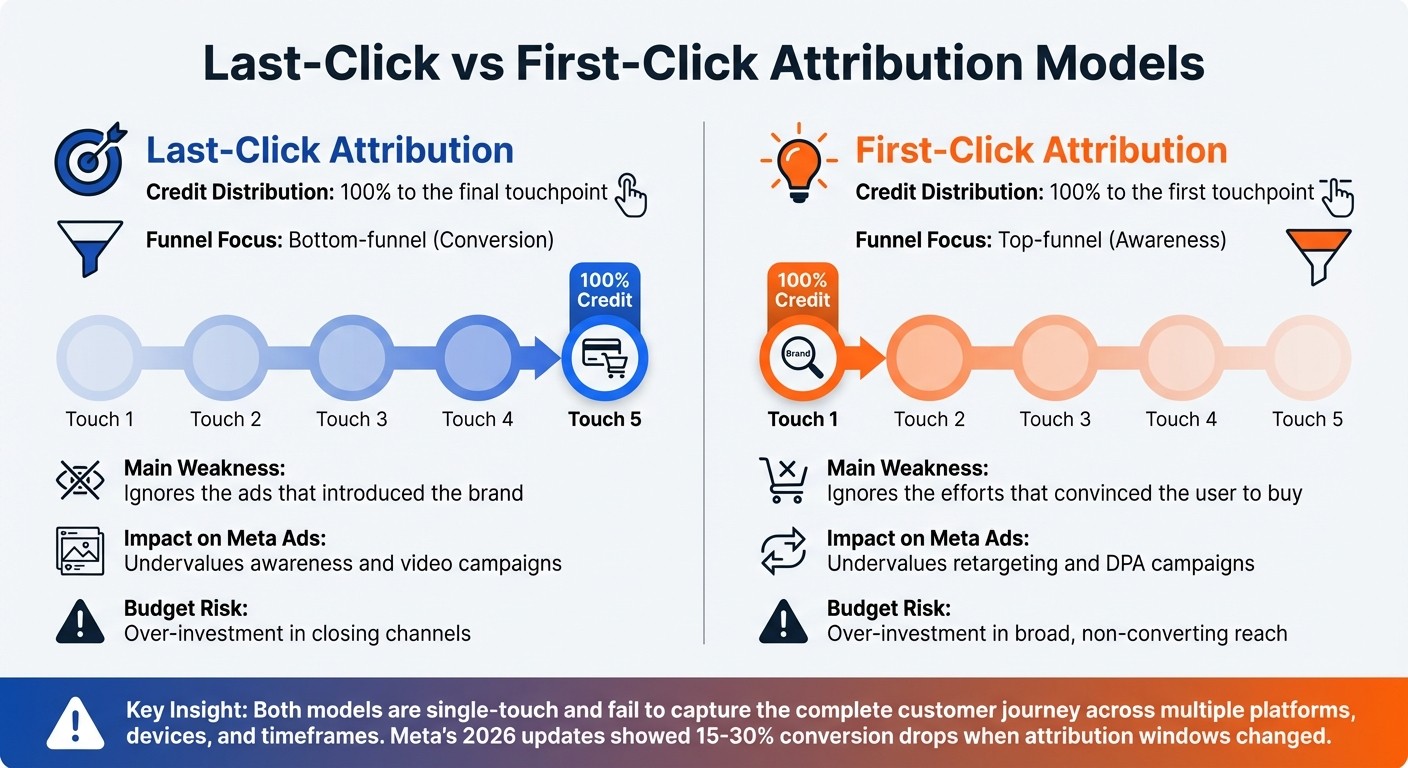
Last-Click vs First-Click Attribution Models Comparison for Meta Ads
Last-Click Gives Too Much Credit to Closing Channels
Last-click attribution puts all the credit on the final ad interaction before a customer converts. While this might seem straightforward, it creates a major blind spot by ignoring earlier touchpoints that helped build awareness. For example, imagine a user sees your Meta video ad multiple times, interacts with a carousel ad, and finally converts after clicking a retargeting ad. With last-click attribution, the retargeting ad gets all the credit, even though earlier ads played a crucial role in guiding the customer to that point.
This leads to a heavy bias toward bottom-funnel strategies like remarketing and dynamic product ads. As a result, budgets are often skewed - channels that introduce your brand get underfunded, while retargeting efforts receive more investment than they deserve. Essentially, you're prioritizing tactics that close deals but neglecting the ones that bring in new customers.
First-Click Ignores the Middle and Bottom of the Funnel
First-click attribution flips the script by giving 100% of the credit to the very first interaction. Picture this: a user clicks on an awareness ad, later engages with a newsletter, watches a product demo, and finally converts through a retargeting ad. In this model, the initial awareness ad gets all the recognition, while the middle and bottom-funnel efforts - like the retargeting ad that sealed the deal - are completely overlooked.
This skewed perspective makes retargeting campaigns appear ineffective, even when they're crucial to driving conversions. It also encourages over-investment in broad awareness campaigns that generate lots of interest but don't necessarily lead to sales. Meanwhile, the channels that actually turn interested prospects into buyers may end up underfunded.
Comparing Last-Click and First-Click Side by Side
Both last-click and first-click attribution models are single-touch, meaning they fail to account for the complex customer journeys that typically span multiple platforms, devices, and timeframes. For instance, after Meta's decision on January 12, 2026, to phase out the 7-day and 28-day view attribution windows, many advertisers saw reported conversions drop by 15–30%. This change further exposed the limitations of single-touch models by forcing marketers to rely on shorter attribution windows, which amplify these biases.
Feature | Last-Click Attribution | First-Click Attribution |
|---|---|---|
Credit Distribution | 100% to the final touchpoint | 100% to the first touchpoint |
Funnel Focus | Bottom-funnel (Conversion) | Top-funnel (Awareness) |
Main Weakness | Ignores the ads that introduced the brand | Ignores the efforts that convinced the user to buy |
Impact on Meta Ads | Undervalues awareness and video campaigns | Undervalues retargeting and DPA campaigns |
Budget Risk | Over-investment in closing channels | Over-investment in broad, non-converting reach |
Neither model captures the full customer journey. To better understand how attribution windows affect your reported return on ad spend (ROAS), try Meta's "Compare attribution settings" tool in Ads Manager. This feature allows you to evaluate performance across different attribution models and spot where your data might be skewed using AI analysis tools.
These single-touch models oversimplify campaign performance, making it harder to allocate budgets effectively - an issue that leads directly to the challenges outlined in the next section.
How Attribution Models Affect Meta Ad Performance
Budget Allocation Problems
Last-click attribution often skews budgets toward the final-click channels, like remarketing and bottom-funnel strategies. This creates a problematic cycle: awareness campaigns, which are crucial for introducing your brand, seem underwhelming in performance metrics. As a result, their budgets are cut, while retargeting ads - closer to the point of conversion - get more funding. Over time, this imbalance leaves the top of the funnel underfunded and the bottom overfunded, eventually depleting your pipeline of new customers. To prevent this, marketers can use AI prompts for budget reallocations to ensure a balanced funnel using CBO best practices.
On the flip side, first-click attribution flips the script. Awareness campaigns receive all the credit, which can lead to overfunding efforts that drive clicks but don’t always lead to sales. Meanwhile, retargeting campaigns - critical for closing deals - may struggle with limited resources.
Both models present challenges, especially when it comes to aligning budgets with actual performance and strategic goals.
ROI Differences and Strategy Misalignment
Switching attribution models can cause major shifts in ROI, sometimes by as much as 40%. For example, about 70% of marketers admit to struggling with proving the ROI of their social media campaigns, and attribution models play a big role in this difficulty. When moving from a last-click model to one that focuses on discovery, platforms like Instagram may suddenly appear responsible for up to 40% of high-value customer journeys - conversions that were previously credited to other channels.
These discrepancies highlight the difficulty in accurately measuring and aligning strategies with performance. To address such challenges, Meta introduced notable updates in 2026.
Meta's 2026 Attribution Updates
In early 2026, Meta introduced updates aimed at improving attribution accuracy. One of the key changes is the "Engage-through" attribution model, which credits conversions that occur within one day of a non-link click interaction. For example, watching at least five seconds of a video ad - or 97% of the video if it’s shorter than five seconds - now counts as a meaningful interaction. This approach provides better insight into how social engagements contribute to conversions, rather than focusing solely on direct clicks.
Meta also adjusted its click-through attribution to align more closely with third-party tools like Google Analytics. Mark Byrne, Director of Paid Media at Brave Bison, explained:
"It should reduce reconciliation debates and make Meta's reporting easier to defend in finance conversations. But it's important to note, this only changes how results are labelled... It does not affect ad delivery".
Shamsul Chowdhury, SVP Paid Media at Zeno Group, added:
"Using the same measuring stick as Google and outperforming them would be a huge win for Meta".
While these updates simplify cross-platform comparisons and improve reporting clarity, they don’t fully address the complexity of multi-step customer journeys. Single-touch models remain limited in capturing the full picture, emphasizing the need for a more comprehensive approach to attribution. These changes lay the groundwork for refining attribution strategies further.
How to Set Up First-Click Attribution and Fix Common Issues
Technical Challenges and Privacy Constraints
Setting up first-click attribution in Meta Ads Manager isn't exactly straightforward. By default, Meta uses a 7-day click and 1-day view attribution model, which gives credit to the most recent ad interaction. To track first-click data, you’ll need to capture and store the FBCLID (Facebook Click Identifier) using real-time conversion tracking via browser-based or server-side methods. However, privacy updates like iOS changes and cookie restrictions can make this tricky. If your sales cycle lasts longer than Meta's 7-day window - say, closer to 15–28 days - you risk losing visibility into the initial touchpoint. To address these gaps, many marketers turn to third-party AI tools or Meta's Incremental Attribution model, which helps separate discovery actions from final conversions.
Step-by-Step First-Click Setup
Although Meta doesn’t have a direct "first-click" option, you can approximate it by using the Incremental Conversions model. Here’s how to set it up:
Start in Meta Ads Manager: Create a new campaign with either a Sales or Leads objective.
Adjust Performance Goals: In the campaign setup, go to the Performance Goal section and click Show More Options.
Select Incremental Conversions: From the dropdown menu, choose Incremental Conversions, complete the campaign setup, and launch it.
Once your campaign is live, incremental performance data will appear in specific columns, showing which ads are driving new customer acquisitions rather than just closing the sale.
Testing with Meta's Attribution Tools
After launching your campaign, use Meta’s attribution tools to confirm that first-click data is being tracked properly. You can also track Meta Ads with Google Analytics to cross-reference attribution data. In Ads Manager, open the Columns dropdown, select Custom, and enable the Compare Attribution Settings option. Under Advanced Options, check the Incremental Attribution box and click Apply. This lets you compare incremental metrics with standard ones, helping you identify which ads are driving initial engagement.
For a deeper dive, create custom columns to analyze conversion paths, time to conversion, and how effective each touchpoint is. Align your attribution window with your sales cycle. For example:
Use 1–7 days for quick, impulse buys.
Use 8–14 days for mid-range purchases.
Use 15–28 days for high-ticket items.
Lastly, keep an eye on your Meta pixel. Regular audits ensure it’s capturing all conversion points. Missing data can lead to gaps in your attribution analysis, making it harder to get the full picture.
Using AI Tools to Balance Attribution Models
AI Solutions for Attribution Problems
Managing attribution analysis manually across Meta campaigns can feel like an uphill battle. AI-powered tools simplify this process by automating multi-touch analysis, blending pixel data with cross-channel signals. This allows for dynamic budget adjustments, which can cut ROI misalignment by as much as 30% in more complex sales funnels. Instead of sticking to outdated attribution models, these platforms evaluate the entire funnel, redistributing spend from over-credited bottom-funnel tactics to awareness campaigns that often go overlooked.
The standout feature of AI tools compared to traditional attribution models lies in how they handle data. Traditional systems rely on rigid, rule-based logic, assigning all credit to a single touchpoint. In contrast, AI tools use machine learning to analyze patterns across anywhere from 20 to 500 touchpoints in a customer’s journey. They account for behaviors across devices and address gaps caused by cookie restrictions. This approach provides a clearer view of which ads are driving new customers versus those simply closing deals already in motion. By addressing the flaws of single-touch models, AI solutions like AdAmigo.ai can continuously refine and optimize the entire funnel.
How AdAmigo.ai Handles Attribution
Platforms like AdAmigo.ai showcase how AI can close attribution gaps through continuous learning. AdAmigo.ai audits Meta ad accounts and adjusts strategies in real time. Instead of relying on fixed attribution rules, it evaluates your brand data, competitor strategies, and past performance to identify which creatives and targeting strategies are effective across the funnel. It adheres to your key performance indicators (KPIs) - such as maintaining at least 3× ROAS while scaling spend by 30% - and automates manual vs AI budget testing and adjustments, eliminating the need for manual tweaks.
Here’s how it works: After linking your Meta ad account (a process that takes about five minutes), you set your goals using the AI Chat Agent. From there, AdAmigo.ai monitors performance and provides a daily AI Actions feed with prioritized suggestions for campaigns, audiences, budgets, and creatives. You can either approve these changes manually or activate autopilot mode, letting the AI implement optimizations automatically. If you have questions like "Why did ROAS drop?", the AI Chat Agent offers real-time insights to explain attribution shifts.
In one example, an agency using AdAmigo.ai discovered that multi-channel attribution issues meant last-click was over-crediting branded search ads with 60% of conversions. These conversions were actually influenced by earlier touchpoints. By reallocating 25% of the budget to first-click video ads targeting cold audiences, the agency saw ROAS jump from 2.5× to 4.2× within two weeks while increasing ad spend by 40%. This kind of connected optimization - where creatives, targeting, bids, and budgets work together seamlessly - is what sets AI-driven tools apart from static rule-based systems.
Benefits for Agencies and In-House Teams
AdAmigo.ai offers clear advantages for both agencies and in-house teams. For agencies, it tackles the challenge of scalability. With AdAmigo.ai, a single media buyer can manage 4–8× more clients by automating tasks like creative generation, targeting, and optimization. This frees up strategists to focus on high-level growth planning while reducing routine workload by 50–70%. The platform’s balanced attribution approach also ensures that client budgets aren’t wasted on over-credited channels.
In-house teams enjoy similar perks without the need to hire costly media buyers. AdAmigo.ai acts as a constant expert, auditing attribution daily and surfacing impactful tweaks through its AI Actions dashboard. Users report consistently achieving at least 3× ROAS while scaling spend by 30%, thanks to the platform’s ability to refresh creatives five times faster than manual methods. It also addresses attribution gaps that single-touch models miss. Features like bulk ad launches via Google Drive make it easy for smaller teams to test hundreds of creative variations quickly, identifying which ones drive results across the entire funnel - not just at the final click. These benefits help correct the imbalances that often plague single-touch models, allowing for smarter, more strategic ad spend allocation.
Conclusion
Main Points About Last-Click and First-Click Models
When it comes to understanding Meta ad performance, both last-click and first-click attribution models fall short. Last-click gives all the credit to the final interaction, often leading to overinvestment in retargeting campaigns while neglecting awareness efforts. On the flip side, first-click models focus solely on the initial interaction, making awareness campaigns seem overly effective but leaving marketers in the dark about what happens further down the funnel. Neither approach reflects the full customer journey, which can result in misdirected budgets and missed opportunities to optimize performance.
Practical Steps for Better Attribution
Meta's "Compare Attribution Settings" tool in Ads Manager is a great starting point for refining your attribution strategy. By comparing models like incremental, 1-day click, and 7-day click, you can identify which channels are over- or under-credited by comparing Meta ad metrics. Tailoring attribution windows to your sales cycle is another key step: shorter windows (like 1-day click) are ideal for quick, impulse buys, while longer windows (such as 7-day click) better suit products that require more consideration. These adjustments can be further enhanced with AI-driven tools for ongoing fine-tuning.
How AI Improves Attribution
AI tools take attribution to the next level by addressing the limitations of single-touch models. Instead of focusing on just one interaction, AI can analyze anywhere from 20 to 500 touchpoints across devices, filling in gaps and providing a more accurate picture of customer behavior. Machine learning enables these tools to dynamically assign credit based on actual performance data, rather than rigidly sticking to one interaction. Platforms like AdAmigo.ai even offer daily recommendations for optimizing creatives, audiences, budgets, and attribution settings, all based on live data. You can choose to approve changes manually or let the system handle them automatically in autopilot mode. This streamlined approach allows agencies to handle 4–8× more clients and helps in-house teams achieve a consistent 3× ROAS while scaling ad spend by 30%, all without needing to expand their team.
FAQs
Which attribution model should I use for my Meta Ads?
When determining the best attribution model, it all comes down to your campaign goals and how your customers behave along their journey.
Take last-click attribution, for example: it gives all the credit to the final interaction before conversion. While this might seem straightforward, it often overlooks the earlier touchpoints that played a role in guiding the customer. On the flip side, first-click attribution focuses entirely on the first interaction, which can unintentionally downplay the importance of later influences that sealed the deal.
For a deeper understanding, AI-driven tools can help map out the entire customer journey. These tools analyze every interaction, offering insights that are much more precise than single-touch models.
That said, multi-touch attribution is often the go-to choice for most campaigns. It provides a more complete picture of how various touchpoints contribute to success. This approach allows marketers to fine-tune budgets and strategies with greater confidence.
How do I pick the right attribution window for my sales cycle?
When selecting an attribution window, think about how long it typically takes your customers to decide to make a purchase. For products that are more of an impulse buy, a shorter window - like a 1-day click or view - is a good fit. On the other hand, items that require more thought and research are better suited to longer windows, such as a 7-day click.
The default option of a 7-day click + 1-day view is a balanced choice, capturing both quick decisions and those that take a little more time. Ultimately, aligning the attribution window with your sales cycle ensures you're getting a clearer picture of how your ads are performing.
How can I measure multi-touch impact on Meta when tracking is limited?
Tracking the full customer journey across Meta ads can be tricky, especially with limited tracking capabilities. Traditional models, such as last-click attribution, often overlook earlier interactions that play a crucial role in conversions. This is where AI steps in to bridge the gaps.
AI tools analyze data from multiple channels and devices, helping to piece together a more complete picture of user behavior. Even when tracking is restricted, these tools can identify patterns and interactions that would otherwise go unnoticed.
Another key factor is selecting the right attribution window, such as a 1-day or 7-day click/view model. These windows help refine your insights, making it easier to evaluate performance and fine-tune campaigns in environments with limited tracking.