
Meta Ad Creative Testing Benchmarks 2025
Creative quality now drives the majority of Meta ad performance—use a three-phase testing framework and automation to cut CPA and boost ROAS in 2025.
In 2025, success with Meta ads hinges on your ability to optimize ad design and messaging. You can even audit your ad creative instantly to identify weak spots. With 56% of campaign outcomes driven by creative quality, nailing the first 3–5 seconds of your ads is more crucial than ever. Costs are rising - CPMs are up 18% year-over-year, and CPA averages $23.10 - so testing is no longer optional if you want to stay competitive.
Key Takeaways:
Click-Through Rates (CTR): Average CTR has doubled to 2.0% compared to 2024. Industry-specific benchmarks range from 0.56% (Finance) to 4.13% (Retail).
Cost Per Acquisition (CPA):CPA varies widely by industry, from $3.16 (Restaurants) to $52.98 (Health & Fitness).
Conversion Rates: Industries like Restaurants (18.25%) and Health & Fitness (14.29%) lead, while Retail and Technology lag behind.
Testing Phases: Structured testing in three phases - initial testing, validation, and scaling - helps refine and scale successful campaigns.
Automation tools like AdAmigo.ai can streamline testing, allowing faster iterations, real-time optimizations, and cost savings. These tools help you manage rising costs and audience fatigue while maintaining performance.
The New Meta Ads Creative Testing Framework for 2026
Key 2025 Meta Ad Creative Testing Benchmarks
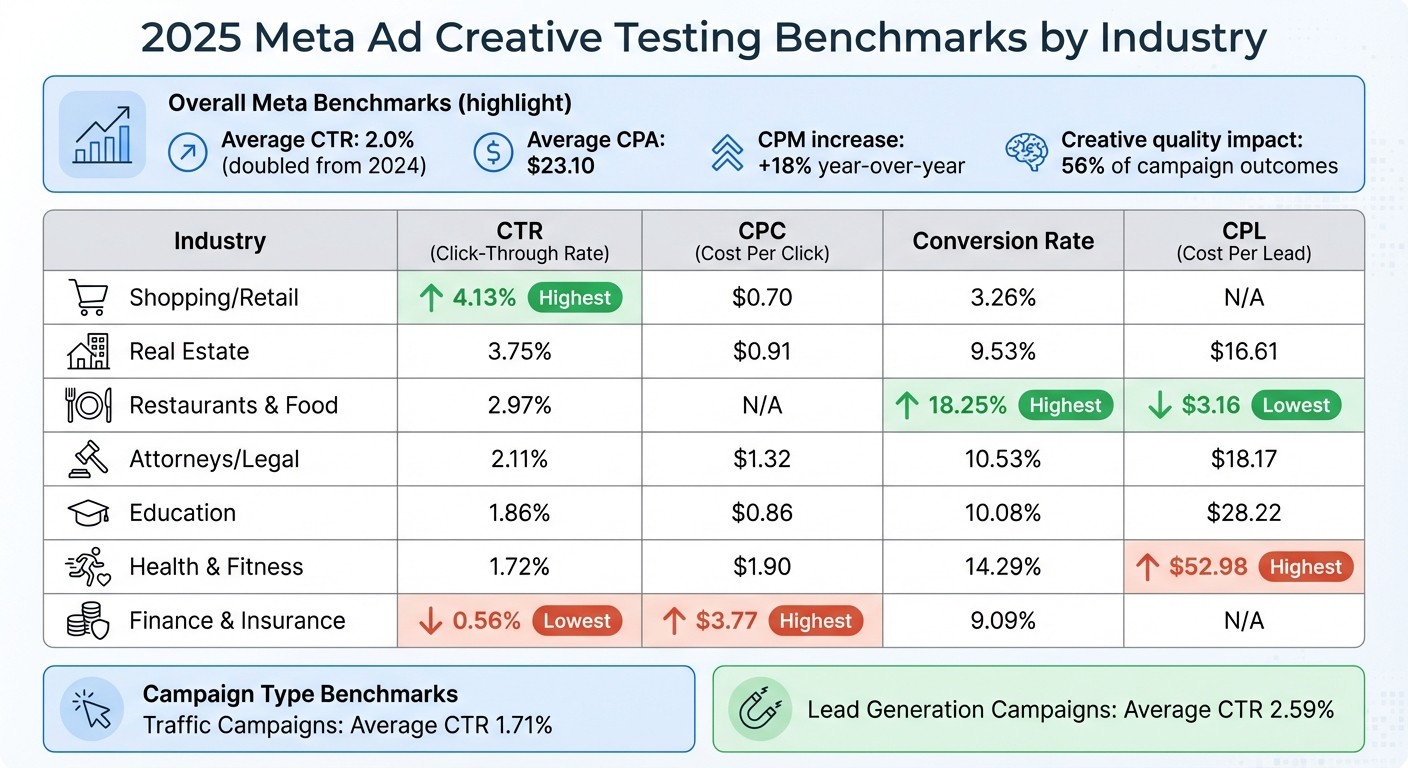
2025 Meta Ad Benchmarks by Industry: CTR, CPC, Conversion Rates & CPL
Here’s a snapshot of the key ad testing metrics shaping 2025.
CTR Benchmarks for Initial Testing and Scaling
Meta's click-through rate (CTR) is expected to jump significantly, doubling from 0.9% in 2024 to 2.0% in 2025. For traffic campaigns, the average CTR is projected to be around 1.71%, while lead generation campaigns typically achieve a higher 2.59% CTR.
Performance varies by industry. For traffic campaigns, shopping and retail dominate with a 4.13% CTR, but finance and insurance trail at just 0.56% CTR. Lead generation campaigns show strong results in real estate with a 3.75% CTR, followed closely by restaurants and food at 2.97% CTR. If your campaign’s CTR falls below these benchmarks, it’s likely time to refine your creative hooks or messaging before scaling.
CPM and CPA Benchmarks for Optimized Campaigns
Cost-per-thousand impressions (CPMs) have risen sharply - up by over 18% in early 2025 - especially in competitive sectors like fashion and beauty. For example, in the UK, expect to allocate £300–£500 per creative test to reach statistically significant results.
Meta’s average cost per acquisition (CPA) now sits at $23.10. However, the numbers vary significantly by industry. Restaurants and food enjoy a low $3.16 cost per lead (CPL), while health and fitness face a much higher $52.98 CPL. Other sectors like real estate average around $16.61 CPL, and attorneys and legal are close at $18.17 CPL. These benchmarks are critical for understanding where your campaign costs stand compared to the industry standard and how to reduce them. For a broader perspective, you can also compare these figures against Meta ads benchmarks by industry and country.
Conversion Rate and ROAS Expectations
Conversion rates also show wide variation across industries. Restaurants and food lead the pack with an impressive 18.25% conversion rate, followed by health and fitness at 14.29% and education at 13.58%. Meanwhile, retail and technology lag behind at 3.26% and 2.31%, respectively. If your retail campaign hits a 4% conversion rate, it’s outperforming the market average.
When scaling campaigns, aim for at least a 3× return on ad spend (ROAS). For instance, a Birmingham-based health supplement brand managed to lower its CPA from £58 to £34, scale revenue by 2.3×, and achieve a 3.4 ROAS by testing 12 hooks and 8 creative iterations. Keep in mind that rising CPMs combined with falling CTRs may indicate audience fatigue, signaling a need for fresh creative.
Industry | CTR | CPC | Conversion Rate | CPL |
|---|---|---|---|---|
Shopping/Retail | 4.13% | $0.70 | 3.26% | N/A |
Real Estate | 3.75% | $0.91 | 9.53% | $16.61 |
Health & Fitness | 1.72% | $1.90 | 14.29% | $52.98 |
Attorneys/Legal | 2.11% | $1.32 | 10.53% | $18.17 |
Restaurants & Food | 2.97% | N/A | 18.25% | $3.16 |
Education | 1.86% | $0.86 | 10.08% | $28.22 |
Finance & Insurance | 0.56% | $3.77 | 9.09% | N/A |
Phases of Meta Ad Creative Testing
A structured approach to creative testing - covering discovery, validation, and scaling - helps ensure budgets are spent wisely and metrics are accurately measured. Here’s how the process unfolds across three key phases.
Phase 1: Initial Testing Benchmarks
The first phase focuses on discovering attention-grabbing "scroll-stoppers." These are the hooks that capture interest in the first 3–5 seconds. Since creative elements influence 56% of campaign outcomes, allocate 10–15% of your daily budget to lower creative testing costs during this stage.
Start small. Test three to five variations of a single video, each with a different opening line. Let the tests run for at least 48 hours and aim to collect 50 conversion-tracked events before making any decisions.
For example, in 2025, a health supplement company in Birmingham tested 12 hook variations on Reels. They found that a "before-and-after testimonial" was their top performer, resulting in a 41% improvement in click-through rate (CTR). This insight allowed them to scale effectively without losing ROAS.
Once you’ve identified a creative that works, move on to the next phase: validation.
Phase 2: Validation Benchmarks
With promising creatives in hand, the focus shifts to conversion metrics. The goal here is to confirm that your scroll-stoppers not only grab attention but also drive meaningful results. If a new creative variant outperforms your baseline by at least 20%, it’s ready to be included in scaling campaigns. Keep a pipeline of validated assets to maintain momentum.
Returning to the Birmingham supplement brand, they built on their winning hook by collaborating with eight different creators. Using the same framework, they validated their approach and reduced their cost per acquisition (CPA) from approximately $73 to $43 over six weeks, all while continuing to generate high-quality leads.
Phase 3: Scaling and Fatigue Management
Scaling involves promoting validated creatives while carefully managing audience fatigue. Use "Highest Volume" bidding to optimize campaign-wide budgets. Watch for signs of oversaturation, such as rising CPMs paired with declining CTRs.
To maintain performance, diversify your creative formats and messaging. Implementing dynamic creative optimization can further streamline this process. Studies show that combining different approaches - like 9:16 video, audio, storytelling, and human presence - can lower CPA by 16% and boost conversion rates by 29%. Additionally, using varied formats has been linked to a 32% improvement in CPA and a 9% increase in incremental reach.
Rotating creatives every 3–4 weeks helps combat banner blindness. Focus on refreshing hooks and value propositions instead of making only minor visual changes. By consistently introducing fresh content from creators, the Birmingham brand scaled its revenue by 2.3× and achieved a 3.4 return on ad spend (ROAS).
Using AI Tools for Benchmark-Driven Optimization
Hitting Meta ad benchmarks for 2025 - like a 0.90% CTR and $1.72 CPC - requires more than just effort; it demands speed and precision that manual workflows can’t match. AI-driven platforms excel in this space by generating creatives, adjusting bids in real time, and optimizing campaigns before they lose steam. One standout in this realm is AdAmigo.ai.
How AdAmigo.ai Enhances Creative Testing
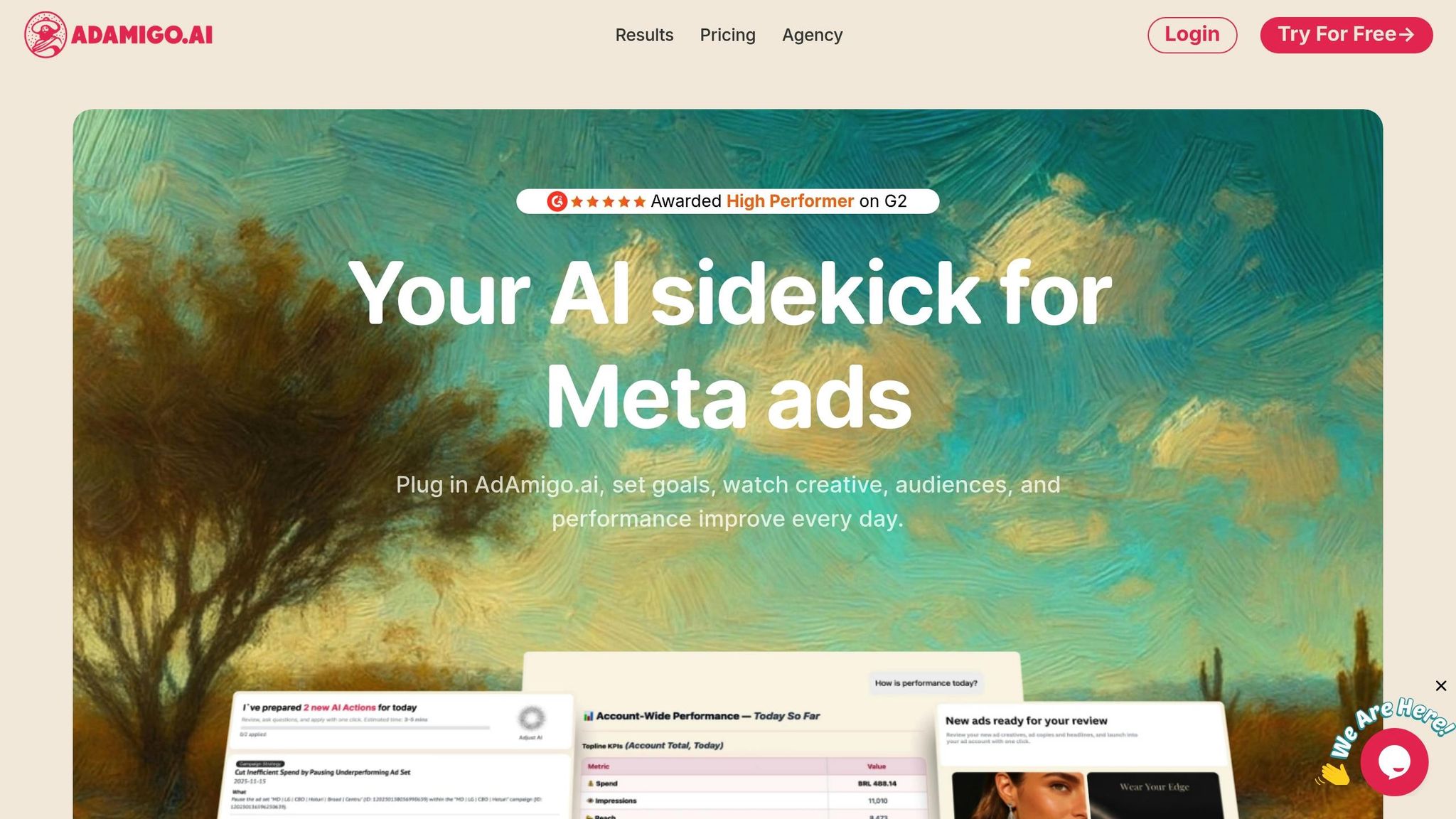
AdAmigo.ai is a prime example of automation tailored for achieving benchmarks. Acting as an autonomous media buyer, it uses your brand data and insights from competitor ads to refine your campaigns. Its AI Ads Agent analyzes your brand identity alongside top-performing competitor ads, creating on-brand image and video creatives. These creatives are ready to launch with optimized targeting and copy - all with a single click.
The platform’s AI Actions feature simplifies campaign management by offering a daily, prioritized list of tweaks across creatives, audiences, budgets, and bids. Instead of manually comparing metrics like CTRs or CPMs against historical data, AdAmigo.ai pinpoints adjustments that can move the needle. For deeper insights, the AI Chat Agent answers detailed questions, conducts ad account audits, and even allows bulk campaign launches through a chat interface.
What sets AdAmigo apart is its ability to continuously refine strategies based on live results, rather than sticking to rigid rules or traditional automation. Agencies report that a single media buyer can handle 4–8× more clients, while in-house teams benefit from a system that reduces the need for additional hires and builds expertise over time.
AdAmigo.ai vs. Manual Creative Testing
Here’s a closer look at how automation stacks up against traditional methods:
Feature | Manual Creative Testing | AdAmigo.ai Automation |
|---|---|---|
Time Investment | Requires daily monitoring and setup | Weekly check-ins with continuous optimization |
Testing Capacity | Limited to 3–5 variations due to bandwidth | Instantly launches hundreds of variations using bulk automation |
Optimization Speed | Reactive, slower adjustments | Proactive, real-time bid and budget shifts |
Creative Production | Lengthy brainstorming and design cycles | Weekly AI-generated image/video creatives |
Data Analysis | Manual comparisons against static benchmarks | Automated audits using historical and competitor data |
While manual testing can work for smaller budgets or niche experiments, scaling up to meet industry benchmarks - especially in competitive sectors like Finance & Insurance (0.56% CTR, $3.77 CPC) - requires automation.
Getting Started with AdAmigo.ai
To begin, link your Meta ad account, set your KPIs (e.g., "Increase spend by 30% while maintaining ≥3× ROAS"), and provide a brief for AdAmigo.ai. From there, you can either review daily AI-recommended campaigns and optimizations or let the system take over entirely. Over time, the platform learns which creatives hit your goals and which need updates, freeing you to focus on big-picture strategy.
Conclusion and Key Takeaways
In 2025, running successful Meta ad campaigns requires sharp attention to detail and ad optimization strategies. Metrics like a $1.92 CPC for leads and the 3-second rule for user engagement are essential for identifying where your funnel might be losing potential customers. For instance, a high click-through rate (CTR) paired with low conversions often points to landing page issues rather than problems with the ad creative itself. Additionally, with lead costs climbing roughly 21% year-over-year, refining targeting and quickly iterating on creative assets through a bulk launch workflow are more important than ever to maintain profitability.
To navigate these challenges, a structured approach to creative testing is key. Following a three-phase framework - initial testing, validation, and scaling - can keep your campaigns focused and effective. Start by testing 3–5 creative variations to identify top performers, validate those winners, and then scale up. Allocate the majority of your budget to proven ads but leave room for experimenting with new ideas. This is especially critical as creative fatigue can reduce engagement by 20–30% in just one week, making regular updates to your ads a necessity.
Traditional manual processes can’t keep up with the pace of advertising in 2025. Automated tools like AdAmigo.ai are game-changers, enabling faster campaign optimization by generating weekly ad creatives, launching hundreds of variations instantly, and managing bids around the clock. This automation not only speeds up testing cycles and improves ROAS but also allows agencies to handle 4–8× more clients per media buyer while helping in-house teams save on hiring costs. The result? More efficient workflows, better performance, and more time to focus on strategic growth.
FAQs
What is a good CTR for my industry in 2025?
In 2025, a solid click-through rate (CTR) usually ranges from 1.61% to 2.64%, though this can shift depending on the industry. Sectors such as arts, entertainment, and real estate often see averages above 2.6%, making them standout performers. It's important to measure your CTR against benchmarks specific to your industry to accurately assess how you're doing.
How much budget should I set aside for creative testing?
To effectively test creative concepts, allocate a sufficient budget to experiment with 3–6 focused ideas every two weeks. A good rule of thumb is to budget 2–3 times your target CPA. Additionally, aim for each ad to achieve 5,000–10,000 impressions. This approach provides enough data to evaluate performance and make decisions grounded in clear insights.
How can I tell if performance drops are due to creative fatigue or my landing page?
Creative fatigue can manifest as a drop in CTR and conversion rates, even if your landing page remains unchanged. However, if your CTR holds steady while conversions decline, the problem might stem from the landing page itself. To figure out what's causing the issue, test one variable at a time - either change the creatives or adjust the landing page, but not both simultaneously. Tools like AdAmigo.ai are helpful for tracking metrics in real time, making it easier to pinpoint where performance is slipping.