
10 Benefits of AI Trend Forecasting
How AI trend forecasting saves time, boosts accuracy, personalizes creatives, cuts ad waste, and spots trends 3–5 days before competitors.
AI trend forecasting is transforming how brands approach advertising by predicting outcomes and spotting challenges early with predictive analytics. Instead of relying on reports that show past performance, this technology uses advanced models to forecast trends 3–5 days ahead, giving marketers a clear edge. Here’s what you need to know:
Save Time: Automates trend analysis, saving 15–20 hours weekly.
Boost Accuracy: Forecasting accuracy reaches up to 91% in 90 days, compared to 45–55% with manual methods.
Scale Campaigns: Manage thousands of ads effortlessly across markets.
Optimize Ads in Real-Time: Detect creative fatigue and adjust instantly.
Personalize Ads: Tailor ads to user behavior for better engagement.
Cut Costs: Spot performance drops early, reducing wasted ad spend by up to 50%.
Stay Ahead of Competitors: Identify trends 3–5 days before they catch on.
Data-Driven Decisions: Rely on insights, not guesswork, for better outcomes, especially when planning budgets for seasonal trends.
Lower Risks: Early detection of issues prevents budget waste.
Improve Over Time: Models continuously learn, refining predictions and performance.
AI tools like AdAmigo.ai simplify this process with features like automated recommendations, trend-based actions, and real-time ad optimizations. Whether managing a small business or a large agency, AI trend forecasting helps you stay ahead, save money, and improve campaign results.
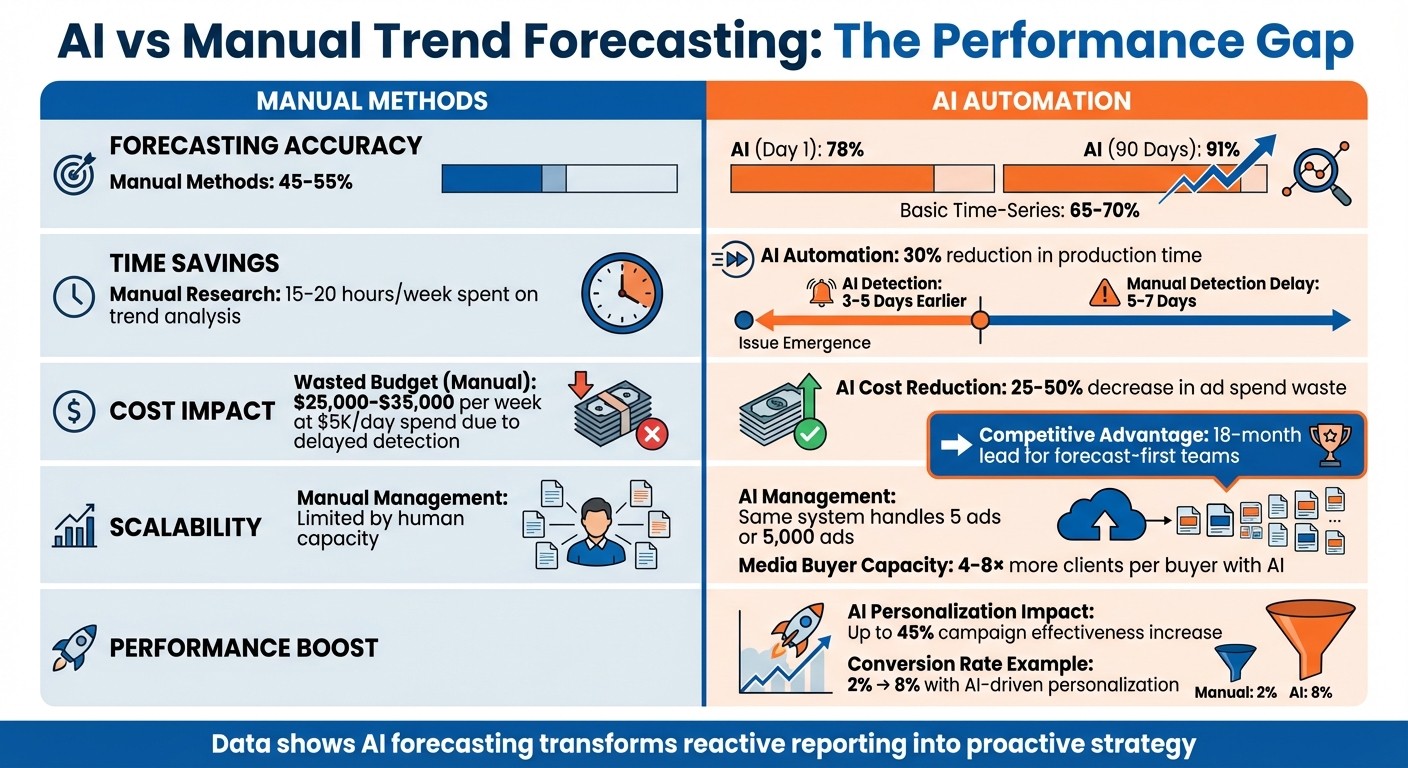
AI vs Manual Trend Forecasting: Performance Comparison
From Reactive to Predictive Marketing - Use AI to Forecast Campaign Performance
1. Saves Time on Trend Research
Digging through data manually to identify trends eats up valuable hours. Marketing teams spend 15–20 hours per week analyzing past performance. The problem? By the time they notice issues like rising cost per acquisition or creative fatigue, it’s often too late. On average, these delays in detection take 5–7 days.
AI changes the game. Instead of waiting for dashboards to reveal what’s already happened, AI forecasting flags shifts 3–5 days earlier. It automates tasks like tracking competitor creatives, breaking down hook and messaging patterns frame by frame, and pinpointing what’s currently effective in your industry. This automation eliminates the need for tedious manual research. Marketers can further streamline this by using AI prompts for Meta ads reporting to extract insights instantly. By catching potential problems early, teams can act faster and avoid costly delays.
The time saved is substantial. AI-powered creative production reduces production time by about 30%. Teams can shift their focus from repetitive tasks to higher-level strategy. For example, a single media buyer can now handle 4–8× more clients without compromising quality. This is possible because the AI takes over time-consuming trend analysis and data crunching by using the best AI tools for optimizing paid ads. At an ad spend of $5,000 per day, a delay in spotting issues could waste $25,000–$35,000 in budget.
AI processes vast amounts of data - CTR trends, conversion rates, competitor activity - within minutes, allowing for real-time strategy adjustments. This shift from reactive reporting to proactive forecasting gives marketers a significant edge.
2. Delivers More Accurate Predictions
When relying on manual forecasting - often based on intuition or limited data - you’re looking at an accuracy range of just 45–55%. Even basic time-series models only push that up to 65–70% accuracy, which is barely better than guessing.
AI forecasting completely changes the game. Models trained on cross-brand patterns start with 78% accuracy on day one and can reach 91% within just 90 days. How? Through a continuous learning process that refines predictions by comparing forecasts to actual outcomes and integrating your brand’s specific data. AI pulls insights from three key data sources: cross-brand patterns from over 100 similar businesses, your historical data, and real-time signals. This multi-layered approach uncovers trends that manual vs. AI forecasting methods simply overlook. The result? Sharper predictions and the ability to adjust campaigns more quickly and effectively. This is critical when scaling Meta ad campaigns to maintain profitability.
These improved predictions also mean teams can detect problems much earlier. Traditional methods rely on dashboards that show what’s already happened, but AI identifies subtle shifts - like a 3% daily increase in CPA - before they escalate into major issues. It even analyzes competitor creative strategies, messaging saturation, and auction dynamics —often by using tools to audit your ad creative for weaknesses— at a scale that’s impossible for human teams to manage alone. This allows for faster, more proactive decision-making.
"The difference isn't incremental - it's structural. Forecast-first teams make decisions 5-7 days earlier than report-first teams, and that timing gap compounds into an 18-month competitive advantage." - Cresva Team
AI also helps teams manage risk better. By leveraging AI-generated confidence intervals, they can use AI-driven resource prioritization to allocate budgets based on the lower end of the 95% range, minimizing risks while still capturing potential gains.
3. Scales Across Multiple Campaigns
Scalability takes the benefits of time savings and predictive accuracy to the next level, allowing you to manage vast ad portfolios with ease.
Handling numerous campaigns manually can be overwhelming for media buyers. There's only so much data one person can analyze, so many dashboards they can monitor, and so many adjustments they can make before quality begins to drop. AI trend forecasting completely removes those limits.
The beauty of AI lies in its ability to scale effortlessly. The same system that manages five ads can handle 5,000 across multiple countries without breaking a sweat. It tracks performance signals, identifies trends, and adjusts strategies across your entire portfolio - all automatically. This isn’t just about automation; it’s about using a unified intelligence to uncover patterns that would be impossible to spot when looking at campaigns individually.
For agencies, this changes the game entirely. With AI taking care of execution, one media buyer can oversee 4–8 times more clients, freeing senior strategists to concentrate on high-level planning and competitive positioning. Instead of spending hours testing bids and budgets, teams can focus on setting goals, reviewing AI insights, and making decisions that drive real results.
AI scalability also boosts performance across the board. It reallocates resources and optimizes campaigns across various markets seamlessly. Plus, it identifies trends and anomalies 3–5 days earlier than standard dashboards. This early detection allows teams to act quickly - shifting budgets, pausing underperformers, and scaling up winning campaigns before issues arise.
"AI scalability makes size irrelevant. Same system handling 5 ads can manage 5,000 ads across multiple countries." – Daniel Rozin, CMO and Co-founder, AdGPT.com
This level of scalability not only enhances efficiency but also lays the groundwork for real-time creative optimizations in future strategies.
4. Optimizes Creatives in Real-Time
Real-time creative optimization tackles the challenge of creative fatigue head-on by responding as soon as performance issues arise. AI monitors key performance indicators like day-over-day CPA changes, drops in CTR, and scroll velocity to detect when creative elements need a refresh - completely removing the need for constant manual intervention by choosing the right AI ad platform. Instead of relying on weekly reports that take 5–7 days to surface problems, AI acts almost immediately.
This process relies on Dynamic Creative Optimization (DCO). By breaking down ads into modular components - headlines, visuals, calls-to-action, and social proof - AI assembles the most effective combination for each user. This isn’t guesswork; it’s data-driven personalization designed to maximize conversions. Marketers can also use a creative idea converter to transform raw concepts into these high-performing assets. Reports show that AI-powered personalization can boost campaign effectiveness by as much as 45%.
AI doesn’t stop at just assembling ad components. It also creates tailored variations by adjusting headlines, text, images, videos, and carousels. Aspect ratios are automatically optimized for different platforms, such as 9:16 for Stories and Reels or 1:1 for Feed. Moreover, AI fine-tunes tone, emotional appeal, and value propositions based on factors like the user’s device, location, and even the time of day.
5. Personalizes Ads at Scale
Traditional ad segmentation often relies on broad categories like age or location. AI takes this a step further by creating dynamic clusters based on real-time user behavior. Instead of sticking to static demographics, machine learning analyzes patterns like browsing habits, transaction activity, device preferences, and intent signals. This allows AI to group users by what they're actively doing, not just who they are. The result? Ads that feel more relevant because they're tailored to current user intent.
AI personalization works on an impression-by-impression basis. Every time someone scrolls past your ad, the system evaluates factors like scroll speed, location, time of day, and the surrounding context. Based on this data, AI determines which version of your ad will resonate most in that exact moment. It doesn’t stop at a few variations - AI can generate countless unique ad versions for individual impressions.
Feature | Manual Segmentation | AI-Driven Personalization |
|---|---|---|
Data Basis | Static demographics (age, location) | Dynamic behavioral clusters and real-time intent |
Granularity | Broad audience groups | Individual impression-level (1:1) |
Speed | Periodic updates | Real-time, always-on adjustments |
This level of granularity allows AI to make real-time adjustments, improving ad relevance throughout the day. For example, one company saw its conversion rate jump from 2% to 8% after implementing AI-driven personalization. The system excels at identifying micro-trends within niche segments, often before they become widely apparent, giving marketers a competitive edge.
"AI has transformed personalization from basic audience segmentation into adaptive, real-time creative orchestration." – Vibemyad
The shift from audience-level targeting to impression-level optimization ensures your ads stay relevant as user behavior evolves. AI not only personalizes but also adapts instantly, refreshing your messaging across thousands of micro-segments without requiring constant manual updates. This makes campaigns more effective and far less labor-intensive.
6. Reduces Advertising Costs
When it comes to advertising, the real problem isn’t just how much you spend - it’s how much of that money goes to waste. AI trend forecasting tackles this issue head-on by identifying potential performance drops before they happen, rather than after your budget has already taken a hit. For instance, traditional manual monitoring typically takes 5–7 days to detect issues like rising CPAs (cost per acquisition) or creative fatigue. If you’re spending $5,000 a day, that delay could mean wasting tens of thousands of dollars.
AI flips this timeline by predicting CPA spikes and conversion declines 3–5 days in advance. This gives you a crucial window to act - whether that means pausing underperforming ads, refreshing your creatives, or reallocating your budget for maximum efficiency. Predictive models don’t just guess; they adapt over time to align with your brand’s specific patterns, ensuring accuracy improves as you use them.
But it doesn’t stop at early detection. AI also strengthens your creative strategy by spotting market-wide saturation trends. For example, if competitors are using similar visuals or messaging, your ads can get lost in the noise, driving up Meta Ads CPMs and reducing your impact. By analyzing these patterns, AI helps you pivot toward less crowded “creative whitespace,” where ads stand out and costs per result often decrease.
Feature | AI-Driven Tools | Manual Management |
|---|---|---|
Alert Timing | Predicts issues 3–5 days in advance | Detects issues 5–7 days after they occur |
Creative Strategy | Identifies saturation trends | Relies on delayed, reactive monitoring |
Cost Savings | Potentially cuts ad spend by 25–50% | Adjusts only after performance drops |
This proactive approach can cut advertising costs by as much as 25–50%. Plus, every forecast is refined based on actual outcomes, creating a feedback loop that continuously improves efficiency. The result? You’re not just saving money - you’re reallocating it toward strategies that work, often staying ahead of your competitors in the process.
7. Spots Trends Before Competitors
Getting ahead of a trend can make your ads stand out, and AI gives you that edge by spotting emerging trends 3–5 days before standard dashboards catch on. Traditional methods, on the other hand, often trail by 5–7 days.
What makes AI so fast? It processes real-time data from sources like social media, search queries, e-commerce stats, and news sentiment - unlike traditional approaches that rely on periodic reports or limited focus groups. Machine learning picks up on subtle shifts in consumer behavior, like behavioral targeting signals or changes in intent, that might go unnoticed by humans. Meanwhile, Natural Language Processing (NLP) groups these signals into themes, helping you spot what’s gaining traction before it hits the mainstream. This early detection sharpens your strategy and gives you a lead over competitors.
By acting 5–7 days sooner, AI not only saves you from costly delays - estimated at $25,000–$35,000 for a 5–7 day lapse with a $5,000 daily ad spend - but also provides up to an 18-month competitive edge. On top of that, early trend detection helps uncover "creative whitespace", those untapped areas where competitors haven’t yet introduced specific messaging or visuals.
"The brands that win aren't the ones with the best dashboards – they're the ones that see problems before they materialize and opportunities before competitors notice them." - Cresva Team
8. Bases Decisions on Data, Not Guesses
AI takes strategic decision-making to a new level by relying on hard data instead of gut feelings. While human intuition can hover around a 45–55% accuracy rate, AI's probabilistic forecasting starts at 78% and can reach up to 91% within just 90 days. That’s a significant leap in confidence and precision.
For example, instead of debating whether a headline is catchy enough, AI dives deep into hook analysis and landing page messaging breakdowns. It identifies which elements actually drive conversions, often uncovering surprising interactions - like how visuals and auction dynamics play off each other - things that manual analysis might miss. This shift from “what looks good” to “what works” can boost campaign performance by as much as 45%.
Speed is another game-changer. Where manual reviews of dashboards might take 5–7 days to catch issues like rising costs or creative fatigue, AI works in real-time. With its 24/7 monitoring, it flags problems immediately, allowing you to adjust budgets or swap out underperforming creatives before overspending becomes an issue.
Feature | Human Intuition | AI Data-Backed Insights |
|---|---|---|
Forecast Accuracy | 45–55% | 78–91% (after 90 days) |
Reaction Speed | 5–7 day delay | Real-time adjustments |
Decision Basis | Subjective experience | Predictive modeling & patterns |
Monitoring | Periodic manual checks | 24/7 automated oversight |
Over time, AI doesn’t just maintain its edge - it gets sharper. By analyzing seasonal trends, competitor strategies, and winning creative patterns, it refines its predictions. This allows for proactive adjustments, often outpacing competitors who are still reacting to changes. The result? Lower risks and consistently better campaign outcomes.
9. Lowers Campaign Risk
AI forecasting transforms the way campaigns are managed, shifting the focus from reacting to problems to anticipating them. Instead of realizing your ad creative has stopped performing only after wasting thousands of dollars, AI can detect warning signs 5–7 days earlier than top AI ad management tools. That extra time can make all the difference in protecting your budget.
By catching performance drops early, AI helps reduce unnecessary spending. It spots issues like creative fatigue or declining performance before they hurt your campaign. This early detection gives you the chance to tweak your strategy while it still matters, rather than scrambling to recover after the damage is done.
"The average detection delay with dashboard-based monitoring is 5-7 days. At $5K/day in ad spend, that's $25-35K in avoidable waste." - Cresva Team
AI also keeps an eye on creative saturation across your competitors. If multiple brands start using similar messaging, visuals, or hooks, your ads risk blending into the background noise. AI flags these trends early, giving you the opportunity to adjust your approach before your creative loses its impact. This insight doesn’t just protect your ad’s effectiveness - it also helps you avoid unnecessary financial losses.
And here’s the kicker: AI forecasting gets better over time. Each prediction adds to the system’s knowledge, creating a feedback loop where AI learns from performance data to continually sharpen its ability to reduce risk. With every campaign adjustment, the system learns more about your brand’s patterns, making future risk management even more precise and effective.
10. Improves Performance Over Time
AI forecasting doesn’t just deliver short-term benefits - it gets better the longer you use it. By continuously learning from outcomes, it refines its predictions over time. Unlike static tools, AI adapts by comparing each prediction to actual results, using any discrepancies to fine-tune its model. This ongoing process steadily increases accuracy and strengthens its forecasting ability and improves Meta ad ROI.
At the start, AI models draw insights from patterns observed across hundreds of brands, tackling the "cold start" problem head-on. Over the first 30–90 days, they adjust to your business's unique characteristics - like seasonal trends, audience behaviors, and creative performance cycles. During this period, accuracy improves significantly, climbing from an initial 78% to as high as 91% within three months.
Learning Phase | Data Source | Accuracy Level |
|---|---|---|
Day 1 (Baseline) | Cross-brand patterns (100+ brands) | ~78% |
Month 1–2 | Historical data & seasonal adjustments | 85–88% |
Month 3+ | Real-time inputs & continuous learning | 91% |
This structured learning allows AI to uncover patterns that might escape human analysis. For example, it can identify shifts in cost-per-acquisition (CPA) at specific budget levels, lower creative testing costs, spot early signs of creative fatigue, or detect subtle seasonal trends. After six months, these insights become even more precise, helping to fine-tune campaigns with full-funnel AI optimization.
With this evolving intelligence, your approach shifts from reacting to problems to anticipating them. AI enables you to predict challenges 3–5 days in advance, giving you the upper hand and compounding benefits over time.
How AdAmigo.ai Uses AI Trend Forecasting
AdAmigo.ai showcases how AI trend forecasting can be applied effectively, offering tools that simplify ad creation and optimization. Here's how their core systems work:
The AI Ads Agent keeps a constant watch on your brand identity, tracks competitor ads, and evaluates high-performing creatives. Using this data, it generates new ad designs that align with your brand while incorporating trending visual elements and messaging. This process not only ensures relevance but also cuts production time by about 30%. With daily insights at your fingertips, staying ahead of trends becomes much more manageable.
AI Actions delivers a daily list of auto-prioritized recommendations for optimizing creatives, audiences, budgets, and bids. Instead of manually analyzing data to spot trends, you receive actionable suggestions based on real-time performance. The Entry Plan provides up to 2 AI Actions daily, while the Gringo Plan offers unlimited actions, making it perfect for agencies or brands running multiple campaigns and tests.
The AI Chat Agent acts as your personal analyst, answering questions like, “Why did my ROAS drop this week?” (a common question when optimizing ROAS) It uses trend data to provide actionable insights and can even launch campaigns directly through a conversational interface. This feature simplifies decision-making by making trend-based actions quick and intuitive.
AdAmigo also identifies which creative "hooks" remain effective for 30+ days within your industry. By focusing on these durable strategies, you can stand out in a landscape where many brands rely on similar AI tools. This differentiation is key to maintaining a competitive edge.
Pricing and Plans
AdAmigo offers two plans designed to meet different needs:
Plan | Monthly Price | Annual Price | Best For | AI Actions |
|---|---|---|---|---|
Entry Plan | $99 | $79/month | Small businesses spending <$5K/month | Up to 2 per day |
Gringo Plan | $299 | $179/month | Growing brands and agencies | Unlimited |
Both plans include full access to the AI Chat Agent and performance dashboards. The Gringo Plan adds features like bulk ad launching, Slack/WhatsApp integration, and a one-on-one onboarding session with a Meta ads expert. These tools are tailored to help businesses streamline their ad strategies and achieve better results.
Conclusion
AI trend forecasting is changing the game for advertising by shifting brands from reactive strategies to proactive decision-making. Imagine being able to predict CPA spikes or creative fatigue 3–5 days in advance - this kind of foresight can help avoid wasting valuable budget and keep campaigns running smoothly.
What sets AI apart is its ability to learn and adapt over time. While traditional methods plateau, AI models can boost forecasting accuracy from about 78% to an impressive 91% within just 90 days. This continuous improvement creates an edge that manual management simply can’t match.
Think about the time your team spends on reporting and planning - 15 to 20 hours a week, gone in an instant. With AI taking over these tasks, your focus can shift entirely to creative strategy and execution.
Adopting AI tools today isn’t just about keeping up - it’s about pulling ahead. Whether you’re a small in-house team or managing multiple client accounts, AI-powered platforms level the playing field, offering smaller teams the tools to compete with much larger operations. It’s a chance to unlock the next stage of campaign success.
If staying ahead matters to you, platforms like AdAmigo.ai can help. These tools provide real-time, autonomous optimization, empowering brands to spot challenges before they arise and seize opportunities before competitors catch on.
"The brands that win aren't the ones with the best dashboards - they're the ones that see problems before they materialize and opportunities before competitors notice them."
FAQs
What data does AI use to forecast ad trends?
AI analyzes past campaign data and monitors real-time user behavior to predict upcoming advertising trends. By spotting patterns and fine-tuning targeting strategies, it helps forecast trends with improved precision.
How quickly does AI forecasting improve for my account?
AI forecasting can help improve your account's performance in as little as 5–7 days. By predicting trends, it allows you to make proactive adjustments to your campaigns. For instance, if your CPA starts climbing or your ROAS begins to drop, AI can spot these changes early - before they become bigger problems. This kind of early detection gives you the chance to manage campaigns more effectively and achieve stronger results over time.
Can AI safely run my Meta ads on autopilot?
AI can handle your Meta ads with ease using tools like AdAmigo.ai. These platforms dig into past performance data, keep an eye on real-time trends, and automatically tweak your creatives, targeting, budgets, and bids. They stick to your set rules - like budget limits, pacing, geographic preferences, and placement guidelines - and can run in either fully automated or semi-automated modes. To get the best results, it's smart to regularly review the AI's recommendations. This helps you stay aligned with your goals and avoid pitfalls like ad fatigue or missed targeting.