
Dynamic Creative Selection with AI: How It Works
AI shrinks ad-testing cycles and cuts wasted spend by selecting and optimizing creative elements in real time.
Dynamic creative selection uses AI to automatically test and optimize ad combinations by mixing elements like images, text, and calls-to-action. Instead of comparing manual vs. AI testing methods, AI evaluates performance in real time, reallocates budgets, and tailors ads to individual users based on behavior and preferences. This approach improves efficiency, speeds up decision-making, and reduces wasted ad spend.
Key points:
AI tests hundreds of ad variations simultaneously.
Adjustments are made instantly, unlike slower manual methods.
Performance signals like click-through rates and user engagement guide decisions.
Meta's 2026 Andromeda update accelerated ad fatigue, making AI optimization essential.
Tools like AdAmigo.ai automate ad management, reducing manual effort.
AI-driven systems outperform manual methods by acting faster, analyzing deeper, and continuously learning to keep ads effective.
Core Components of AI-Powered Dynamic Creative Systems
Data Inputs and Signals
AI-powered systems thrive on data, constantly analyzing it to determine the best ad, audience, and timing. These inputs are grouped into three main types:
Audience signals: These include details like age, gender, location, interests, and even custom audiences (e.g., website visitors).
Behavioral signals: Metrics such as click-through rates (CTR), cost-per-click (CPC), viewability, and time spent engaging with an ad fall under this category.
Conversion signals: These focus on outcomes, like return on ad spend (ROAS), cost per lead (CPL), conversion rates, and lifetime value.
More advanced systems take it a step further by incorporating contextual signals. For instance, they monitor ad frequency to ensure users aren’t overwhelmed, aiming for around 3 to 4 impressions per person each week. They also track whether a user is visiting for the first time or is a returning customer. Using creative tagging, these systems analyze specific ad elements - like opening hooks, character appearances, color schemes, and audio styles - to understand how each factor impacts performance. This continuous data analysis allows AI to make dynamic decisions that optimize ad creative performance.
Creative Asset Libraries and Templates
At the heart of any dynamic creative system is its asset library. Platforms like Meta's Dynamic Creative allow advertisers to upload up to 10 images or videos, 5 headlines, 5 primary texts, 5 descriptions, and 5 calls-to-action (CTAs) per ad. The AI then combines these elements to identify the most effective configurations for different audiences.
"Meta AI automatically mixes and matches these assets and delivers the combinations most likely to drive installs, purchases, or subscriptions." - Angad Singh, Marketing and Growth, Segwise
A key to unlocking the system’s potential lies in structured metadata. By tagging assets based on factors like hook type, emotional appeal, offer claim, and format, the AI can learn not just what works but why it works. A well-organized asset library also ensures replacements are ready when top-performing ads start to lose effectiveness. This is crucial because research shows that creative elements contribute to 56% of a campaign's ROI - outperforming bid strategies, audience targeting, and timing combined. Clearly, the quality and organization of your asset library play a huge role in campaign success.
Once your library is set, the next step involves using advanced decision-making logic to optimize how these assets are deployed.
Rule-Based vs. AI-Driven Decision Logic
The real optimization power lies in the decision logic that drives ad performance. Traditional dynamic creative optimization (DCO) systems rely on fixed rules and known audience data to assemble pre-built components. While effective to some extent, these systems are slow and limited in flexibility. AI-driven systems, on the other hand, rely on reinforcement learning algorithms, like multi-armed bandits, to dynamically balance testing new creatives with scaling proven ones.
The difference in speed is stark. Rule-based systems require statistical significance before making changes, often wasting budget on underperforming variants for days. AI-driven systems, however, act on early performance signals, allowing for quicker adjustments. Another major shift is in content creation. While rule-based systems can only rearrange existing assets, AI-driven systems can use generative AI to create entirely new assets from prompts and test them in real time.
"The distinction matters because genAI removes the production bottleneck that limited DCO's scale." - EMARKETER Editors
Here’s a breakdown of how the two systems compare:
Feature | Rule-Based (Traditional DCO) | AI-Driven Decision Logic |
|---|---|---|
Logic Source | Predefined, static rules | Real-time learning & reinforcement algorithms |
Asset Handling | Assembles pre-built components | Generates new assets using GenAI |
Speed | Waits for statistical significance | Reacts to early signals |
Creative Analysis | Surface-level (e.g., which ad performed best?) | Element-level (e.g., which hook or color worked?) |
Workflow | Manual strategy and activation | AI manages end-to-end workflows |
One important tip: keep your funnel stages separate. Ads designed for prospecting and those for retargeting serve different purposes and rely on different metrics. Testing them together can muddle your results.
How AI Selects and Optimizes Ad Creatives
Data Collection and Analysis
AI thrives on a strong, unified data foundation. It gathers information from multiple sources - like pixel events, product feeds, CAPI signals, and live metrics - and compares these against historical benchmarks to assign dynamic scores to each asset. This process is crucial because incomplete or poorly attributed data (often called "dirty" data) can disrupt the feedback loop, leading to the promotion of ineffective ads.
Another key factor in this process is understanding where users are in their customer journey. For instance, a first-time website visitor and a returning customer are unlikely to respond to the same ad. AI tailors creative elements like tone, messaging, and offers to match the user's stage - whether they're in the awareness, consideration, purchase, or loyalty phase. These refined insights feed directly into the system's real-time decision-making.
Real-Time Creative Selection
Once the data is processed, AI employs a two-stage system to pick the best ad creative through bulk ad testing. First, it simulates interactions between creative elements to rank potential combinations. Then, it selects and serves the top-performing ad in real time.
This decision-making happens at the impression level, meaning the system evaluates user signals and context for every single ad impression. Some platforms go a step further by using predictive modeling. These models, trained on actual campaign outcomes, can estimate ad performance before any budget is spent - a powerful way to optimize campaigns upfront.
To maintain focus, AI limits the number of variations for each creative element to 3–5. This approach prevents the algorithm from becoming overwhelmed, ensures faster learning, and helps achieve statistical significance for each combination.
"Structured metadata is what separates a selector that learns from one that just reacts." - Murat Bock, Founder, AdLibrary
Continuous Learning and Feedback Loops
AI doesn’t just stop at selecting ads; it continuously improves through adaptive feedback loops. By analyzing early signals like thumbstop rates, hook rates, and swipe-ups within the first 200–400 impressions, the system can quickly identify underperforming creatives. For example, a hook rate below 25% on cold traffic prompts immediate deprioritization.
At its core, this process relies on a multi-armed bandit algorithm. This algorithm strikes a balance between testing new creative variations and doubling down on those already performing well. A well-tuned system can cut the budget wasted on ineffective ads from 30–40% to under 15%.
AI also addresses creative fatigue by monitoring audience saturation and adjusting for frequency-driven drops in click-through rates. When a creative hits its fatigue point, it’s automatically replaced. This ability has become even more critical since Meta's Andromeda update (January 2026) sped up delivery cycles, making creatives burn out in days rather than weeks.
Tools like AdAmigo.ai are designed to thrive in this fast-paced environment. With features like its Ad Factory, AdAmigo.ai continuously analyzes top-performing ads, refines winning strategies, and generates fresh creatives to keep campaigns running at peak performance.
How to Set Up AI-Driven Dynamic Creative Selection
Preparing Creative Assets and Feeds
The backbone of an AI-driven dynamic creative system lies in how you organize your assets. Start by building creatives in a modular format - break them into separate layers like background, product visuals, and text. This setup allows the AI to mix and match elements without requiring you to manually create every possible combination. Think of it as working with LEGO pieces instead of creating a single, fixed design.
Take a close look at your top-performing ads to uncover patterns. For example, do problem-focused hooks perform better than benefit-driven ones? Does opening with social proof improve engagement? These insights should guide the types of creative variations you develop. Following Meta’s DCO-ready asset guidelines can also streamline this process.
Here’s a practical approach: start with a "creative seed" - a proven headline or image - and use it as a foundation to create structurally distinct variations. For example, test a curiosity-gap hook against a direct-benefit hook while keeping all other elements the same. Meta ad experiments show that headline changes alone can account for 60–80% of click-through rate (CTR) differences, making this a high-impact area to focus your testing efforts.
Once your creative assets are structured for flexibility, the next step is setting up your campaign parameters to maximize the AI’s potential.
Configuring AI-Driven Campaigns
With your assets ready, the way you structure your campaign and set boundaries can significantly impact how well the AI performs. Using CBO vs ABO strategies allows you to balance control and automation; CBO (Campaign Budget Optimization) lets the algorithm allocate spending automatically, while ABO (Ad Set Budget Optimization) offers more control during the early testing phase. A common strategy is to start with ABO to gather initial performance data and then transition to CBO once you’ve identified the winning creatives.
Set clear performance benchmarks before scaling. For instance, establish a minimum hook rate or a maximum CPC (cost per click) threshold. Automated rules for pausing ad sets can also help—specifically those that trigger when an ad set exceeds 2–3 times your target CPA (cost per acquisition) without delivering conversions. This prevents overspending on underperforming ads during the initial learning phase.
To keep your campaign fresh, allocate 15–20% of your total ad budget specifically for testing. This ensures the AI has a steady stream of new creative variations to evaluate.
Platforms like AdAmigo.ai simplify this process. You can set KPIs, budget limits, audience preferences, and scaling rules directly within the tool. AdAmigo’s AI Autopilot can handle tasks like launching tests, adjusting budgets, and pausing underperforming ads - either automatically or with your approval.
Once your campaign is running, consistent monitoring and updates are key to maintaining performance.
Monitoring Performance and Updating Creatives
After setting up your structured assets and campaign rules, focus on maintaining performance by regularly reviewing metrics and refreshing creatives. Allow the algorithm 5–7 days of consistent delivery to complete its learning phase before making any changes. Adjusting too soon can reset the learning process and lead to unreliable results.
Once the learning phase is complete, shift your attention to metrics like CPA, ROAS (return on ad spend), and conversion rates, rather than just CTR or impressions. Standard dashboards often lack creative-level insights, so use AI-powered tagging to pinpoint which hooks, visuals, or headlines are driving results.
Following Meta’s Andromeda update in January 2026, creative fatigue now sets in faster - sometimes within just a few days. To stay ahead, monitor performance frequently and have replacement creatives ready before the current ones lose their effectiveness.
"Creative fatigue happens faster under Andromeda. What used to perform well for weeks might now exhaust in days." - Extuitive
Tools like AdAmigo Protect can add an extra layer of security by automatically monitoring account health, flagging unusual spending patterns, and identifying delivery issues early. This helps you catch potential problems before they escalate into costly mistakes.
How To Setup Dynamic Creative Facebook Ads - BEST FEATURE EVER?
Once your ads are live, you'll need to analyze dynamic creative ad results to identify which combinations are driving the most conversions.
Measuring the Performance of AI Dynamic Creative Selection
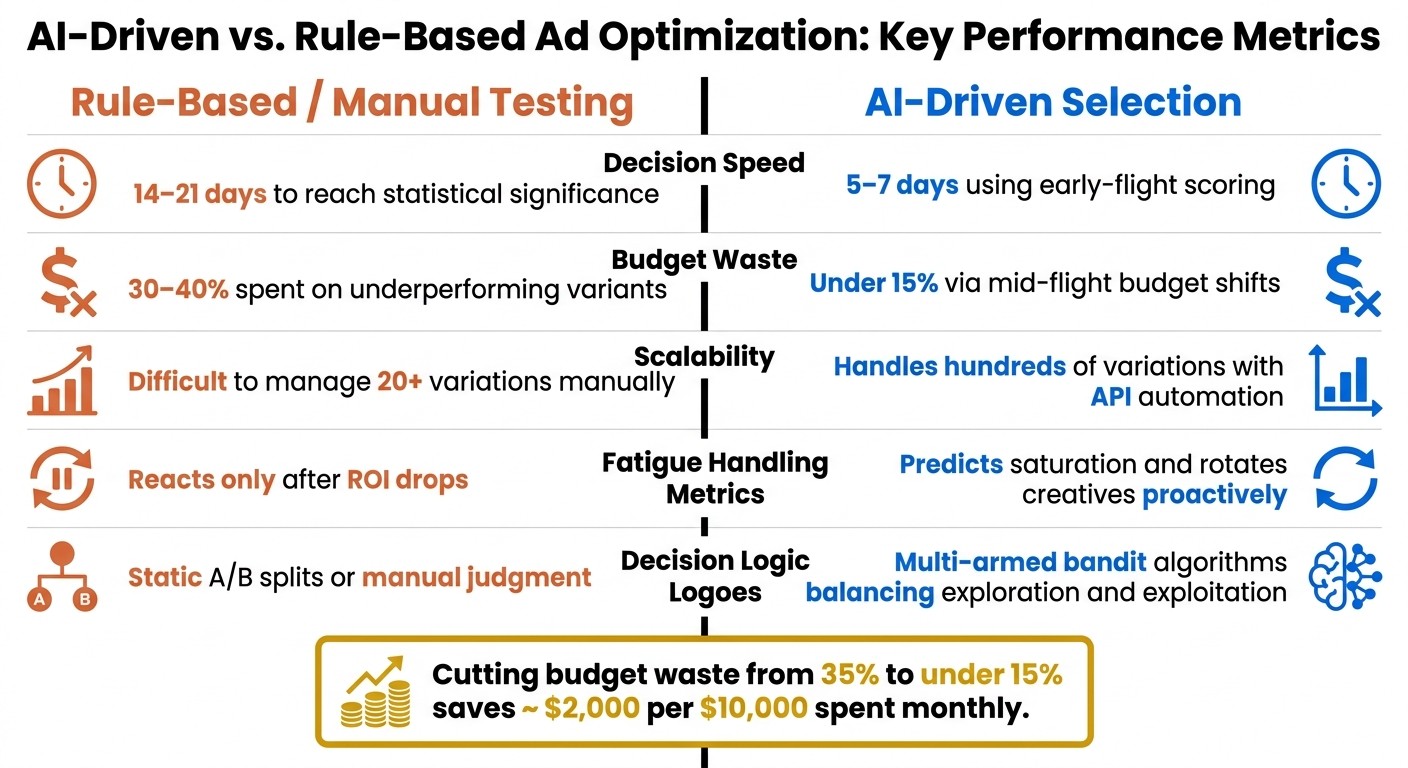
AI-Driven vs. Rule-Based Ad Optimization: Key Performance Metrics
Once your campaign is live, it’s time to dive deeper into performance metrics. Don’t stop at surface-level stats - AI performance deserves a closer look.
AI-Driven vs. Rule-Based Optimization: A Side-by-Side Comparison
The best way to grasp the impact of AI-driven selection is by stacking it up against traditional rule-based or manual testing methods. Here's how they compare:
Feature | Rule-Based / Manual Testing | AI-Driven Selection |
|---|---|---|
Decision Speed | 14–21 days to reach statistical significance | 5–7 days using early-flight scoring |
Budget Waste | 30–40% spent on underperforming variants | Under 15% via mid-flight budget shifts |
Scalability | Difficult to manage 20+ variations manually | Handles hundreds of variations with API automation |
Fatigue Handling | Reacts only after ROI drops | Predicts saturation and rotates creatives proactively |
Decision Logic | Static A/B splits or manual judgment | Multi-armed bandit algorithms balancing exploration and exploitation |
This table highlights the efficiency boost from AI-driven methods. For example, cutting budget waste from 35% to under 15% could save you around $2,000 for every $10,000 spent monthly.
Breaking Down Performance by Creative Element
While overall ad performance shows which creatives are succeeding, it doesn’t explain why. AI-driven systems dig deeper, analyzing individual creative elements - hooks, visuals, CTAs, color schemes, and offer angles - to pinpoint what’s driving returns.
"An intelligent ad creative selector uses AI to rank and route creatives based on performance signals - hook rate, thumbstop, conversion attribution, and frequency - rather than human guesswork." - Murat Bock, Founder, Adlibrary
Key metrics to monitor at the element level include:
Hook rate: The percentage of 3-second video views compared to impressions (aim for over 25% for cold traffic).
Thumbstop ratio: How often viewers pause or linger on the ad.
Frequency-adjusted CTR: Click-through rate adjusted for how many times the audience has already seen the ad.
The last metric is especially useful for distinguishing between creative fatigue and simple overexposure. These issues might look the same at first glance but require entirely different solutions.
However, tagging your assets is crucial for this level of insight. Without labels for formats, hook types, and offer angles, the AI can’t identify patterns that drive results.
Measuring the Impact on ROI
Once you’ve broken down performance metrics, it’s time to measure the AI’s direct impact on ROI. Compare results against your previous manual methods by testing within a controlled budget - typically 2,000–5,000 impressions per creative. This allows the AI to gather enough data without risking your primary budget.
Two key benchmarks to track:
Winner retention rate: The percentage of creatives that remain profitable four weeks after scaling. A good AI system should achieve 60–70%.
Budget waste ratio: The share of your total spend going to underperforming creatives. Effective AI should keep this below 15%.
Platforms like AdAmigo.ai simplify this process. Their AI Autopilot continuously monitors creative, audience, and budget performance, giving you clear insights into what’s driving ROAS improvements and what needs to be paused or replaced. Instead of juggling multiple reports, you get a unified view of how creative decisions are shaping your campaign’s success.
Conclusion and Key Takeaways
AI-driven dynamic creative selection is revolutionizing how Meta ad campaigns are managed. Instead of waiting weeks for statistical significance, AI now uses early-flight signals like hook rate and thumbstop ratio to shrink decision cycles from weeks to just days.
This shift isn't just faster - it’s more cost-effective, too. Budget waste drops dramatically, from 30–40% with manual methods to under 15% when AI-powered selectors are in play. Businesses implementing these systems correctly can expect a 10–20% increase in ROAS within the first 90 days. And here’s a staggering insight: headline changes alone account for 60–80% of CTR variance in most Meta experiments. This highlights the importance of analyzing individual creative elements rather than relying solely on ad-level reporting.
As discussed earlier, structured metadata and controlled variation are the backbone of effective creative testing. Before launching, make sure to tag your creative inventory by hook type, format, and emotional tone. Without this structured metadata, the AI won’t be able to pinpoint what’s driving performance. Also, keep variation counts manageable - stick to 3–5 variations per element to ensure the algorithm has enough focus during its learning phase. And don’t overlook frequency monitoring, especially after Meta’s January 2026 Andromeda update, which has significantly sped up creative exhaustion rates.
Platforms like AdAmigo.ai simplify this process by automating creative rotation, budget adjustments, and performance tracking. They show how AI tools can streamline optimization, combining automation with human oversight. The most successful brands leverage AI to test ideas faster while using human judgment to steer the broader strategy. By blending AI insights with strategic decision-making, brands can maintain high-performing campaigns over the long term.
FAQs
What data is needed for AI dynamic creative to work effectively?
To get the most out of AI-driven dynamic creative, start by supplying high-quality data about your creative assets and their performance. This means providing a mix of images, videos, headlines, descriptions, and CTAs. The more variations you include, the better.
Performance signals like engagement metrics, click-through rates (CTR), and conversions are critical. These help the AI pinpoint which combinations resonate most with your audience. On top of that, combining historical data with real-time engagement insights allows the AI to refine its approach on the fly, ensuring your creative assets are continuously optimized for improved outcomes.
How many creative variations should I test at once?
Testing numerous creative variations at the same time is a smart way to improve performance while avoiding creative fatigue. Experts often recommend trying out dozens - or even hundreds - of variations to pinpoint the ads that deliver the best results.
How can I tell if performance dropped due to fatigue or targeting?
To figure out whether performance declines are due to ad fatigue or targeting issues, take a closer look at key metrics like click-through rates (CTR), conversions, and frequency. If you notice engagement dropping while frequency keeps climbing, it's likely a case of ad fatigue. On the other hand, if performance dips but frequency remains steady, the problem might lie with your targeting.
Platforms like AdAmigo.ai can help track these indicators, giving you the insights needed to make adjustments. Whether it’s refreshing your ad creatives, tweaking your targeting, or refining audience segments, these tools can guide you in tackling performance issues head-on.